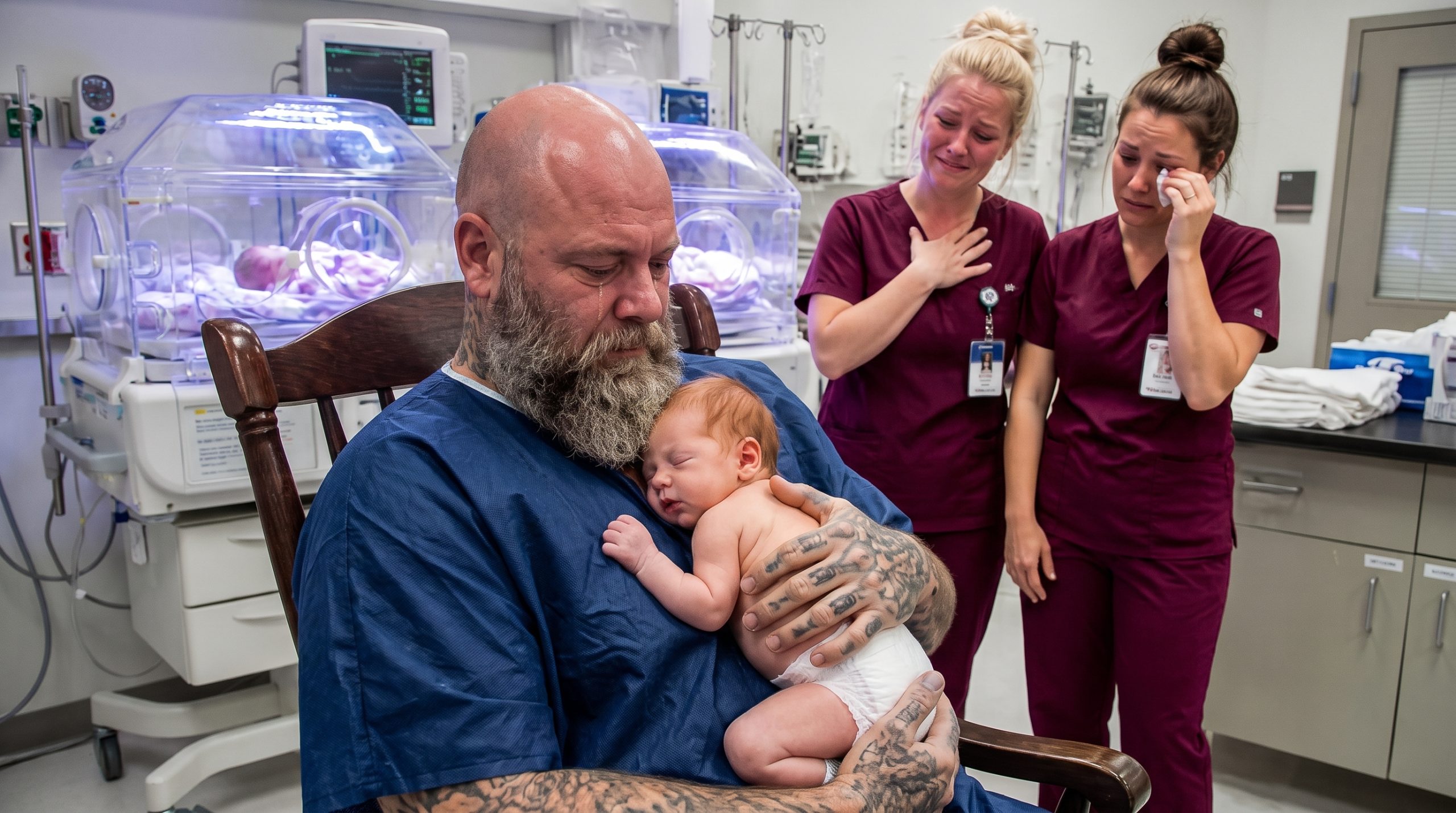
The sterile air of the NICU felt charged with a heavy, breathless tension as the young woman walked slowly toward bed nine. Her eyes were red and swollen, her hair messy, and her hands trembled uncontrollably as she looked down at the tiny baby sleeping peacefully against Wade’s massive chest. She stopped three feet away from the wooden rocking chair, staring at the giant, tattooed man holding her infant son with such fierce, unyielding tenderness.
“Are… are you holding my baby?” she choked out, her voice barely carrying across the soft hum of the heart monitors.
“I came back…” she sobbed, burying her face in her trembling hands.
“I tried to leave, but I couldn’t stop thinking about him.”
Wade didn’t move suddenly, nor did he look at her with an ounce of judgment or anger.
“He’s a strong little guy,” Wade said softly, his deep, resonant voice filling the room with an incredible, calming warmth.
“He was just waiting for his mama to come back.”
The social worker, Sarah Vance, stepped forward, placing a gentle hand on the young woman’s shoulder as she looked at me. “This is Maya Miller,” Sarah explained to our nursing team. “She suffered severe postpartum panic and exhaustion, but she checked herself into the family crisis center three blocks away to get help. She wants to be a mother to her boy.”
Maya collapsed into the vinyl chair beside Wade, her body shaking with deep, agonizing sobs of pure exhaustion and guilt. “I don’t have anything…” she wept, looking up at the giant biker. “I don’t have a crib, I don’t have a nursery, and my family told me I would fail the moment he was born early. I was so scared he would die like my little sister did.”
Wade slowly shifted his position in the rocking chair, adjusting his arms so that Maya could see her son’s sweet, tranquil face clearly under the soft light. “Fear makes people run away from the things they love most, Maya,” Wade said, his eyes filled with a profound, knowing empathy. “I ran away from this hospital for twenty years after I lost my little girl, Hannah. I thought if I stayed away, the pain wouldn’t follow me.”
Maya looked up into Wade’s weathered face, her eyes locking onto the faded hospital band on his wrist beside his daughter’s tiny footprint tattoo.
“You lost a baby here?” Maya asked softly, wiping her tears with her sleeve.
“Twenty-four years ago,” Wade nodded gently, his silver beard brushing against the top of the blue gown. “She was born at twenty-six weeks, right in that corner bed over there. I spent twenty years believing I was weak because I couldn’t save her. But coming back here taught me that love isn’t about avoiding the pain—it’s about showing up when someone needs you.”
I stepped forward, sliding a rolling stool over so that Maya could sit right beside Wade’s chair. “Your baby boy didn’t stop crying all morning, Maya,” I told her warmly, offering her a fresh box of tissues. “We tried everything, but the moment Wade held him, he settled right down. He knew he was safe.”
Wade carefully shifted the baby’s weight, guiding the tiny bundle out of his arms and gently laying him directly onto Maya’s bare chest for kangaroo care. “Now it’s your turn, Mama,” Wade whispered, a broad, radiant smile spreading across his bearded face as the baby let out a soft, happy sigh against his mother’s warm skin.
Maya held her son tightly, tears of pure, unadulterated relief spilling down her cheeks as the baby’s heart rate monitor clicked into a perfect, rhythmic beat. “Thank you…” she sobbed, looking up at Wade. “Thank you for holding him when I couldn’t.”
“That’s what family does,” Wade replied, standing up slowly from the rocking chair, his knees making a soft popping sound as he stretched his massive six-foot-seven frame.
“And around here, nobody fights alone,” he added firmly.
Two hours later, the quiet afternoon in the NICU was interrupted by the loud, rumbling roar of twenty heavy motorcycle engines pulling into the hospital’s front parking lot.
I walked over to the corner window, pulling the blinds aside to see a stunning, unbelievable sight unfolding on the concrete below.
Over two dozen members of the Iron Guardians Motorcycle Club—men and women wearing heavy leather vests, boots, and silver chains—were unloading three pickup trucks filled to the brim with baby supplies.
They carried boxes of diapers, formula tins, handmade wooden cribs, baby clothes, strollers, and gift cards straight through the hospital’s sliding glass doors.
Wade stood at the center of the lobby, his leather vest back on his shoulders, guiding his club members as they set up a massive donation table in the family waiting room.
“This is all for Maya and Baby Boy Miller,” Wade announced to the astonished hospital staff, his deep voice booming off the high marble ceilings. “The Iron Guardians are officially sponsoring this young mother and her boy.”
Maya stood in the doorway of the waiting room, holding her swaddled son against her shoulder, tears streaming down her face as she looked at the mountains of supplies and the sea of rough, tattooed bikers offering her warm smiles and congratulations.
“We’re going to make sure you have everything you need to bring your boy home, Maya,” one of the female bikers said, handing her a handmade baby blanket embroidered with tiny yellow bears. “Grizzly told us about you, and around here, Grizzly’s family is our family.”
Over the next four weeks, Baby Boy Miller—whom Maya officially named Noah Wade Miller in honor of the giant who had held him—grew stronger every single day.
Maya attended every parenting class, moved into a cozy new apartment secured through the hospital’s assistance fund, and learned how to care for her son with unwavering confidence and devotion.
Wade came to the NICU every single morning, sitting beside Maya and little Noah, teaching her how to hold him, feed him, and soothe him through the difficult nights.
The giant biker who had walked into our unit carrying twenty-four years of silent, suffocating grief had transformed our entire ward into a sanctuary of hope, healing, and absolute love.
On a bright, sunlit Friday afternoon, Noah was officially discharged from the hospital, weighing a healthy six pounds and breathing completely on his own.
The entire NICU nursing staff gathered in the main hallway, clapping and cheering as Maya walked toward the exit doors holding Noah in a brand new car seat.
Standing right by the glass doors was Wade, wearing his leather vest, holding a small silver box in his large, scarred hands.
He stepped forward, setting the box gently in Maya’s lap.
“What is this, Wade?” Maya asked, her eyes shining with tears as she opened the lid.
Inside rested a beautiful, custom silver locket containing a photograph of little Noah on his very first day, alongside an engraved inscription that read: Protected by Hannah’s Guardian Angels.
“My little girl couldn’t stay,” Wade said, his voice soft, steady, and filled with a deep, peaceful joy that warmed everyone in the room. “But she gave me enough love to last three lifetimes. You take good care of that boy, Maya.”
Maya stood up, throwing her free arm around Wade’s massive waist, burying her face against his leather vest as she held him tight. “He will always know who you are, Wade,” she promised through her tears. “He will grow up knowing that his godfather is the toughest, gentlest man in the world.”
I stood beside the nursing station, wiping tears from my eyes as I watched Wade walk out the glass doors alongside Maya, guiding her safely toward her new life under the bright afternoon sun.
I looked down at the volunteer log on my desk, touching the entry where Wade “Grizzly” Turner had signed his name four weeks earlier under the infant comfort program.
I realized then that true strength isn’t found in physical size, heavy leather, or tough exteriors, but in the courage to take a broken, grieving heart and open it wide enough to heal another human soul.
And as the roar of motorcycle engines echoed softly across the hospital parking lot, taking our little boy safely home, I knew that the legend of the biker who held the baby would live in our NICU forever.