For the first time since the crash, the pieces began fitting together. The accident had happened three weeks earlier on a rural road outside town, and Caleb had told everyone I simply lost control after a tire failure.
But the road-camera footage showed another vehicle following me closely before the collision. Investigators later determined that the vehicle was Caleb’s truck.
I stared at the image.
“He followed me.”
The detective nodded. “We believe he did.”
While detectives worked, my medical team treated the injuries Caleb had caused. I went into surgery that afternoon and spent another night under observation.
When I woke, my daughter was sitting beside me with her grandmother. Emma had been told only that I was hurt again, and she held my hand carefully.
“Mommy, you don’t have to go home yet, right?”
I looked at her. “No, sweetheart.”
She sighed with relief. That was the moment I made a decision.
I was never going back to that house. The hospital assigned a victim advocate to help me with emergency housing and financial protection, and she helped freeze the accounts Caleb controlled.
For years, he had convinced me that surviving without him was impossible. Within forty-eight hours, I learned how wrong he was.
The detective returned with photographs from the crash. The driver’s side of my car showed damage that didn’t match the tire-blowout story Caleb had given investigators.
A second vehicle had made contact with my rear quarter panel moments before I lost control. The paint transfer was the same dark blue as Caleb’s truck.
My hands began shaking.
“He hit me.”
The detective nodded. “We believe he did.”
Then the financial records arrived. Caleb had opened two credit accounts in my name without my knowledge and had also increased the life insurance policy attached to our marriage several months before the accident.
The beneficiary was him.
I stared at the document. “Why would he increase it?”
The detective answered quietly.
“We think he expected you not to survive.”
I couldn’t speak. For eleven years, I had believed the worst thing Caleb did was make me feel small.
I had been wrong.
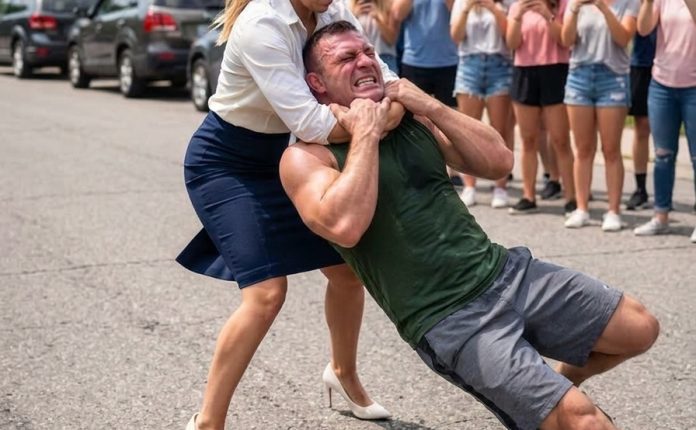
He had been building a plan around my disappearance. And when the crash failed to kill me, he came to the hospital believing he could finish what the road had started.
Investigators searched Caleb’s office and the family home after obtaining the proper warrants. They found copies of the insurance paperwork, messages discussing my medical condition, and a folder containing information about my accounts.
Inside that folder was a handwritten note.
“Once she’s gone, everything becomes simple.”
I never wanted to see it. But the prosecutor needed to know it existed.
Caleb’s attorney later argued that the note had been misunderstood and that the insurance increase was ordinary financial planning. The evidence said otherwise.
There were messages to a financial adviser asking how quickly life insurance could be paid after a death. There were searches about debt protection, texts complaining that I had become “too expensive to keep around,” and the hospital incident had been witnessed by nurses and captured on security footage.
There was no longer a story Caleb could tell that erased all of it. He was charged with aggravated assault and additional offenses related to the investigation into the crash and financial misconduct.
The next several months were difficult. I moved into a small furnished apartment with Emma.
The first night, I slept with the television on because silence felt too large. Emma placed her stuffed rabbit beside my bed.
“You can have him tonight,” she said. “He makes people feel better.”
I smiled. “Thank you.”
My recovery continued slowly. Physical therapy hurt, walking with casts was frustrating, and learning to trust my own body again was even harder.
But each week, I became stronger. I also started therapy and finally said out loud everything I had spent eleven years minimizing.
The controlling money. The threats. The constant criticism. The fear of disagreeing.
My therapist looked at me one afternoon.
“You were not keeping your marriage peaceful. You were keeping yourself safe.”
That sentence stayed with me. It changed the way I remembered my entire life with Caleb.
The legal case moved forward. Caleb eventually accepted a plea agreement on the hospital assault after the video and medical evidence became impossible to dispute.
He received a prison sentence and was ordered to have no contact with me or Emma. The investigation into the crash resulted in additional charges after the vehicle evidence and financial records were connected.
The court ordered restitution for the financial losses caused by the fraud and required Caleb to forfeit control of the accounts he had opened in my name.
The life insurance claim was denied after investigators established the fraudulent circumstances surrounding the policy changes.
I kept the house only until my attorney helped me confirm that Caleb had no legitimate right to force a sale while the proceedings were pending. Eventually, I sold it anyway.
I couldn’t imagine raising Emma in the same place where I had spent years measuring every word before speaking. Six months after the hospital attack, I signed the final paperwork.
The money recovered from the financial accounts helped cover my medical expenses and moving costs. There was no giant settlement that made me rich.
There was something better.
Control of my own life.
Emma started sleeping through the night again. I began walking without a cane.
The first time I climbed three stairs by myself, I stopped halfway and laughed. Emma was behind me.
“You did it!” she shouted.
I turned around. “I did.”
She hugged me carefully. Six months later, I returned to work part time as an accountant.
I had forgotten how much I loved numbers. Numbers did not lie, did not tell me I was imagining things, and did not make me doubt what I could see.
One afternoon, I received an email from the detective saying the final report had been completed. Caleb had admitted that he had been tracking my financial situation for months because he believed divorce would leave him responsible for debts he had accumulated secretly.
He had increased the insurance because he wanted an easier way out. The crash, according to the evidence, had begun with him intentionally striking my car.
I read the report twice. Then I closed my laptop.
I expected anger. Instead, I felt tired.
So tired of giving that man pieces of my life. I didn’t want to give him another emotion.
The court finalized a long-term protective order for me and Emma. Our finances were separated completely, Caleb’s access to my accounts was permanently removed, my credit was repaired, and the fraudulent accounts were closed.
The house was sold. The insurance claim was denied. The restitution order was entered, and the medical bills were paid.
Six months had passed.
I had survived the crash. I had survived the hospital. And I had survived the man who had spent years convincing me I could not survive without him.
One year later, Emma and I lived in a small house with a sunny kitchen and a garden outside the back door. I planted tomatoes because I wanted to watch something grow where I had once spent years feeling trapped.
Emma kept a yellow chair beside the window and did her homework there. Sometimes she still asked about her father, and I never lied to her.
I simply told her that some adults make choices that are wrong and that children are never responsible for those choices.
One Saturday morning, she came into the kitchen wearing mismatched socks.
“Mom?”
“Yes?”
“Are you happy now?”
I looked around the room.
The sunlight.
The tomatoes.
Her backpack by the door.
My coffee cooling beside the sink.
“Yes,” I said.
Then she smiled.
“Good.”
She grabbed a strawberry from the counter and ran outside. I stood there for a moment.
There was no monitor beeping. No hospital door.
No voice telling me I was a burden.
No man deciding what my life was worth.
Just my daughter laughing in the garden.
One year later, I understood what really changed that day in the hospital. It wasn’t the police.
It wasn’t the evidence.
It wasn’t even the arrest.
It was the moment I said no.
A small word from a woman who had spent eleven years believing she had to stay quiet to keep her family together.
“No.”
That was where my old life ended.
Everything after that was mine.
My body.
My money.
My home.
My choices.
My future.
I still have scars from the crash. Some mornings my ribs ache when the weather changes.
Sometimes a hospital smell can take me back to that room in an instant. But the memory no longer owns me.
I own what came after it.
And every morning when Emma walks into the kitchen, steals a piece of bacon from my plate, and says, “Morning, Mommy,” I remember something I once forgot.
A life does not become valuable because somebody else finally decides to value it. It was valuable all along.
I just had to survive long enough to believe it.