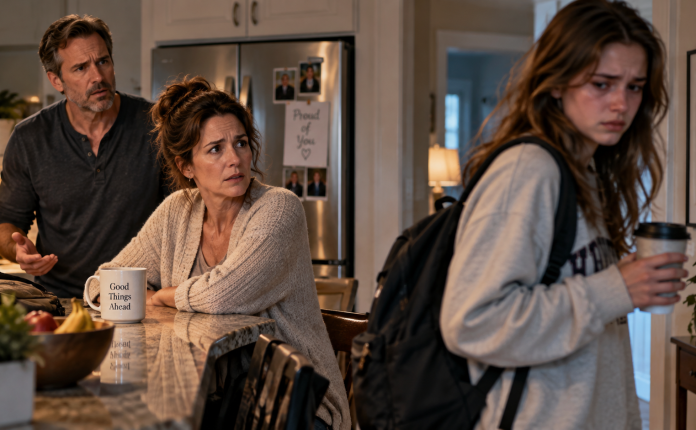
Mark remained silent for several seconds. I had spent twenty-two years knowing every little expression on his face, and I knew immediately that he was trying to decide whether another lie could still save him.
“Clare, I can explain.”
“I know.” I kept my voice calm. “You don’t need to explain the emails. They’re your words.”
He sat down slowly. “I thought your father would eventually leave you enough that we wouldn’t have to worry anymore.”
“We?”
“Yes.”
“You quit your job before Dad was even buried.”
“I thought it was time.”
“You promised your mother a house.”
“I wanted to help her.”
“You promised Melissa two hundred thousand dollars.”
“She needed it.”
“And you never once asked me what I wanted.”
Mark lowered his eyes. “I assumed you’d want us to help them.”
That was the sentence that finally broke something inside me. Not the money, not the spreadsheet, and not even the emails.
The assumption.
For years, Mark had mistaken my silence for agreement. He had mistaken my generosity for permission.
And now he had mistaken my inheritance for his retirement.
I took a breath. “My father knew.”
Mark looked up. “What?”
“Dad knew exactly what you were doing.”
His face went pale.
I told him about the trust, the emails Samuel had preserved, the spreadsheet, and the video. Mark rubbed both hands over his face.
“Why would he do that?”
“Because he watched how you handled money.”
He said nothing.
Then I told him what Dad had written.
“He said people show their character when they think nobody is watching.”
Mark stared at the floor. “I didn’t think I was doing anything wrong.”
“I know.”
That answer hurt him more than anger would have.
The estate was finalized over the next several months. The family trust remained intact, and the house and investments were managed according to Dad’s instructions.
No money was handed directly to Mark, Diane, or Melissa simply because they expected it. Melissa threatened legal action briefly, but her attorney explained that she had no claim to assets that were protected inside the trust.
Diane stopped speaking to me for several months. Mark’s former employer refused to rehire him after he asked for his old position back.
He had quit voluntarily, so there was no severance package and no inheritance rescue.
Six months after Dad’s death, Mark and I met with separate attorneys. Our finances were completely separated, and he returned the money he had moved from our joint account.
He also signed a postnuptial agreement recognizing that my inherited assets belonged to me. For once, he didn’t argue.
That surprised me.
When we got into the car afterward, he looked at me. “I know what you think of me.”
“I don’t think you’re evil.”
He looked at me.
“But I don’t trust you.”
He nodded slowly. “I understand.”
It was the first honest thing he had said in months.
We tried counseling, not because I owed him another chance, but because twenty-two years deserved an honest conversation about what had gone wrong. Mark admitted that he had always associated money with security.
His own father had lost everything when he was young, and Mark had spent his life believing financial power meant nobody could ever take his future away.
Somewhere along the way, protecting himself had become more important than respecting me. Understanding that did not excuse him.
But it helped me understand why he had become so obsessed with my father’s money.
One year later, my father’s trust had grown quietly. I had stopped checking its value every morning because the money no longer felt like something waiting to be spent.
It felt like a responsibility.
I used a portion to create a scholarship in Dad’s name through a local trade school. Another portion helped restore the old Hail Mechanical community workshop Dad had supported for years.
I kept the house.
Not because it was worth millions, but because every room still contained pieces of him. The kitchen where he taught me to make pancakes, the garage where he fixed my first bicycle, and the office where he taught me that character was what people did when nobody was watching.
I finally understood what he meant.
Mark and I did not magically become the couple we were twenty-two years earlier. Trust had to be rebuilt slowly, and some things could never be forgotten.
But I no longer stayed quiet to keep the peace.
When I disagreed, I said so.
When I didn’t want to lend money, I said no.
When Diane asked for something, I decided for myself instead of automatically agreeing.
And when Mark respected a boundary, I noticed.
That mattered.
Melissa eventually apologized. She admitted she had believed Mark when he told her the inheritance was basically guaranteed.
“I should have asked you,” she said.
“Yes,” I replied.
She looked embarrassed. “I didn’t.”
“No.”
Diane called months later. She cried and admitted that she had been wrong about me.
I listened.
Then I told her something Dad had taught me.
“Being family doesn’t mean you’re entitled to what someone else owns.”
She was quiet for a long time.
“I understand,” she finally said.
I believed she was beginning to.
One year after Dad’s funeral, I sat alone on the back porch and played his old voicemail.
“Call me when you get this, sweetheart.”
I smiled through tears.
I hadn’t deleted it. I don’t think I ever will.
Mark came outside and sat beside me. He didn’t ask about the trust or the house.
He simply sat there.
After a few minutes, he said, “I miss him too.”
I looked at him.
“You barely knew what he was like when it came to money.”
He nodded. “I know.”
Then he said something I never expected.
“He taught me something anyway.”
“What?”
“That loving someone doesn’t give you ownership of what they have.”
I was quiet.
Then I nodded.
That sentence didn’t fix everything.
But it was a beginning.
I looked toward the old maple tree Dad had planted when I was a little girl. Its branches moved softly in the evening wind.
I thought about the morning Mark quit his job.
The promises he made.
The imaginary houses.
The imaginary checks.
The imaginary future he had built with money that wasn’t his.
And I thought about Dad’s final warning.
Let him show you who he is.
He had.
So had I.
And somewhere between those two truths, I had finally become the woman my father always believed I could be.
Not a daughter guarding an inheritance.
Not a wife afraid to say no.
Just Clare.
Standing on my own feet.
Choosing my own future.
One year later, the inheritance had not changed who I was.
It had revealed who everyone else was.
And perhaps that was the greatest gift my father left me.