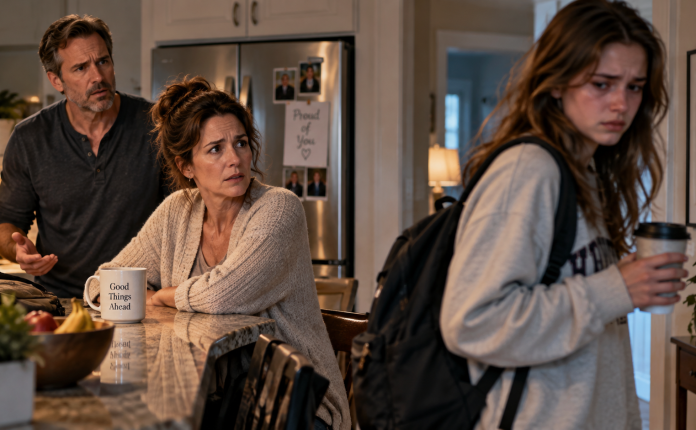
“Six thousand four hundred dollars,” Daniel said. I put my suitcase down, but I kept my hand around the handle. Renata turned toward him so quickly that her chair scraped the floor. “You told me you were using the emergency money,” she said. He looked between us. “That is the emergency money.” “No,” I said. “It is my money, in an account you can access if I have an emergency.” After Harold died, I had added Daniel as a joint owner because grief made every ordinary task feel impossible. I had told him exactly what the money was for, and he had promised not to touch it without asking. I could still remember him saying, “Of course, Mom. You can trust me.”
He brought his phone to the table and opened the statements. Twelve hundred dollars had gone to Sunrise Pines, and another fifty-two hundred had gone toward his credit cards over three months. “Groceries went on those cards,” he said. “Car repairs. Things for this family.” I asked, “Then why didn’t you tell this family?”
His mouth opened, but nothing came out. Renata sat down again. “I knew about the deposit,” she said. “You told me Dolores had money put aside for things like this. You never told me you were paying the cards.” I looked at her and asked, “Did either of you hear me say yes?”
I called my lawyer, Miriam, from the hall. Her answering service reached her, and she called back while Daniel stood beside the kitchen doorway, holding the phone he had finally let me examine. I told her what I knew, without calling it theft or demanding an arrest. “We need the account agreement and the statements,” she said. “Being allowed to withdraw money at the bank and being entitled to keep it are different questions.”
“But those were my deposits, and he promised,” I said. Miriam didn’t rush to reassure me. “Then we document both, but a joint account complicates the claim,” she said. “Save everything. We can ask for repayment, but I won’t promise you what a court would decide.” It was not the answer I wanted, but it sounded like solid ground.
I photographed the residence paperwork and downloaded the statements. “The bank is closed,” I told Miriam. “I don’t want to leave the rest there.” She walked me through protecting my remaining funds without treating Daniel’s money as mine. I transferred my remaining balance to an existing account in my name alone, then wrote myself a reminder to speak to the bank when it reopened.
When I returned, Daniel was looking at the landlord’s letter. “Are you throwing us out?” he asked. I pointed to the paragraph Miriam had insisted on including. “Your lease, rent, and security deposit stay as they are. The new instructions tell you who manages the property and where notices go.” “Your tenancy is not how we settle this.”
“You made it sound like everything was changing,” Renata said. “For me, it is,” I answered. “For you, the lease still ends in September.” The manager would handle repairs, collect rent, and discuss any renewal through the ordinary process. They would receive the same required notices and protections as any other tenants.
Daniel rubbed both hands over his face. “You have eleven million dollars, and you want six thousand back.” I told him the prize was not eleven million dollars of spending money after taxes and planning, but that was not the point. “If I had eleven dollars, you needed permission. If I had eleven billion, you still needed permission.”
“I was going to replace it when I got another job,” he said. “Then you could have asked for a loan.” He looked toward the stairs, where the children were listening. I lowered my voice. “I would rather have heard that you were frightened than found out you were comfortable frightening me.”
My granddaughter came down in her socks. “Grandma, are you leaving because we laughed?” she asked. I set my bag aside and took her hands. “You hurt my feelings that day, but you are not responsible for the decisions the adults made afterward.” Her brother stayed on the bottom step until I held out a hand for him, too.
“I should’ve said it wasn’t funny,” he muttered. “Next time someone gets made into the joke, you can,” I said. I gave them my new address and promised that their calls would always be welcome. Then I told Daniel and Renata that visits would have to be arranged with me, not announced to me. Nobody argued with that distinction.
Outside, the cabdriver had turned off his engine and was reading a newspaper. I apologized for the wait and paid for the extra time. Daniel followed me down the path, carrying nothing. “Can we talk when you get there?” he asked. “Not tonight,” I said. “Send me the rest of the statements first.”
My sister met me in Savannah with a thermos of coffee and an argument about which road had less traffic. She did not ask to see the landlord’s letter. At my yellow house, she put two mugs on the counter and asked, “Do you want company tonight, or would you like me to go home?” I cried because both answers were allowed.
The next business day, I spoke directly with Sunrise Pines. “Your son is listed as the family contact,” the administrator said. “We don’t have a signed admission agreement from you.” I asked her to check for a power of attorney and any arrangements involving my pension; there were none. “I am not moving in,” I said. “Please confirm in writing that the application is canceled and I have no ongoing payment obligation.”
“The reservation terms allow a nine-hundred-dollar refund,” the administrator explained. “Three hundred is retained as the cancellation fee.” I asked Miriam to review the paperwork before accepting that loss. “I wish I could make every dollar come back,” she said, “but this fee is in the terms Daniel accepted.” The refund returned to the original account and was transferred to my sole account with the bank’s help, leaving fifty-five hundred dollars to address.
Miriam sent a repayment demand with the statements attached. “Get your own legal advice before you sign anything,” I told Daniel. After several weeks, he called with a proposal his lawyer had helped him make. “Two hundred fifty a month. I can manage that without promising you money I don’t have.” We signed an agreement acknowledging the fifty-five-hundred-dollar obligation, with no interest if he kept the schedule and the possibility of a civil claim if he did not.
I also asked them both for a written account of what had happened. “Why write it down?” Renata asked. “Because I’m tired of leaving a conversation and finding out later that we remember different promises.” Her acknowledgment was not a court order or an invented punishment. It began, “I treated a decision about your life as a problem I could solve without you.”
“I got the job,” Daniel told me in February. “Less money, longer drive, but it’s steady.” They tightened their budget, canceled the room arrangement with Renata’s brother rather than ignoring the lease requirements, and kept paying rent. In March, the property manager called about a leaking kitchen tap. “Please arrange the repair,” I said; owning the house meant paying its bills, too.
By summer, Daniel had made another decision. “We can’t comfortably afford the house anymore,” he said. “We’ve found a smaller apartment in the children’s school district.” I did not forgive the rent or raise it to punish them; the manager coordinated an ordinary September move-out. “Return their deposit under the usual rules, and keep it separate from what he owes me,” I told her. They received it back apart from an agreed, itemized cleaning charge.
None of those consequences looked impressive from the outside. There were bank forms, smaller rooms, extra commuting, and a payment that arrived every month. When Daniel complained once about the cramped apartment, I said, “I know it’s an adjustment.” He waited, perhaps for an offer, and then answered, “It is. We’re figuring it out.” Nobody could dismiss what had happened as one bad joke anymore.
My own adjustment was less graceful than I expected. For weeks I woke early, certain someone needed breakfast, and then stood in a kitchen where only one cup was waiting. I missed the children so fiercely that I nearly offered to pay for a visit before anyone had asked. My sister caught me looking at flights and said, “You can miss them without hiring them to come.”
At the library reading group, a woman moved her bag off the chair beside her. “You don’t have to talk,” she said. “Sometimes it’s just nice to listen.” I spent three meetings doing exactly that, hired someone to fix the porch railing, and slowly stopped treating help as proof I was useless. In March, my sister asked what I wanted for my seventy-fourth birthday. “Dinner I don’t cook,” I said, and we went somewhere that served enormous slices of pie.
Daniel called every Sunday at a time we agreed on. At first, he described his commute and the weather as if we were strangers standing at a bus stop. Eventually he said, “I heard her call you a burden. I let you think I hadn’t.” I sat with that for a moment before answering, “Yes, you did.”
“I thought if I stayed quiet, I wasn’t taking a side,” he said. “You were leaving me alone on mine.” He did not ask me to soften that sentence. Later, he told me he had begun counseling through his new employer’s assistance program, but I did not treat attendance as proof that everything was repaired. What mattered was whether he could hear no without turning cruel or helpless.
Renata called separately in May. “I kept a list in my head of everything you cost,” she said. “I didn’t count what you did; I wanted your room, and I made that sound like concern for you.” When she started to explain how stressed she had been, she stopped herself. “That explains why I was tired. It doesn’t explain away being mean.”
I told her I appreciated the apology, but I was not ready to stay under the same roof again. “All right,” she said, and for once there was no second argument hidden behind the first answer. Over the following months, she sent photographs of the children without attaching requests for money or childcare. Trust returned in pieces small enough that I sometimes noticed them only afterward.
I had something to admit, too. In August, Daniel asked why I had waited so long to tell them. “At first, I needed time to make decisions you couldn’t take over,” I said. “Later, I liked imagining your face when you found out. I wanted you to feel as small as I had.”
“Did it help?” he asked. I looked out at the rose bushes, which had needed far more attention than the listing photographs suggested. “For about a minute,” I said. “Leaving helped longer.” I did not apologize for protecting the money or arranging my move, but I stopped pretending my silence had contained nothing except wisdom.
One year later, Daniel called about visiting Savannah for New Year’s. “We’ve booked a hotel,” he said. “Would lunch on the first work for you?” I checked my calendar before saying yes. He was still making his repayment installments, and we did not celebrate him for keeping an agreement. But when he handed me the next payment, I thanked him without reopening the entire argument.
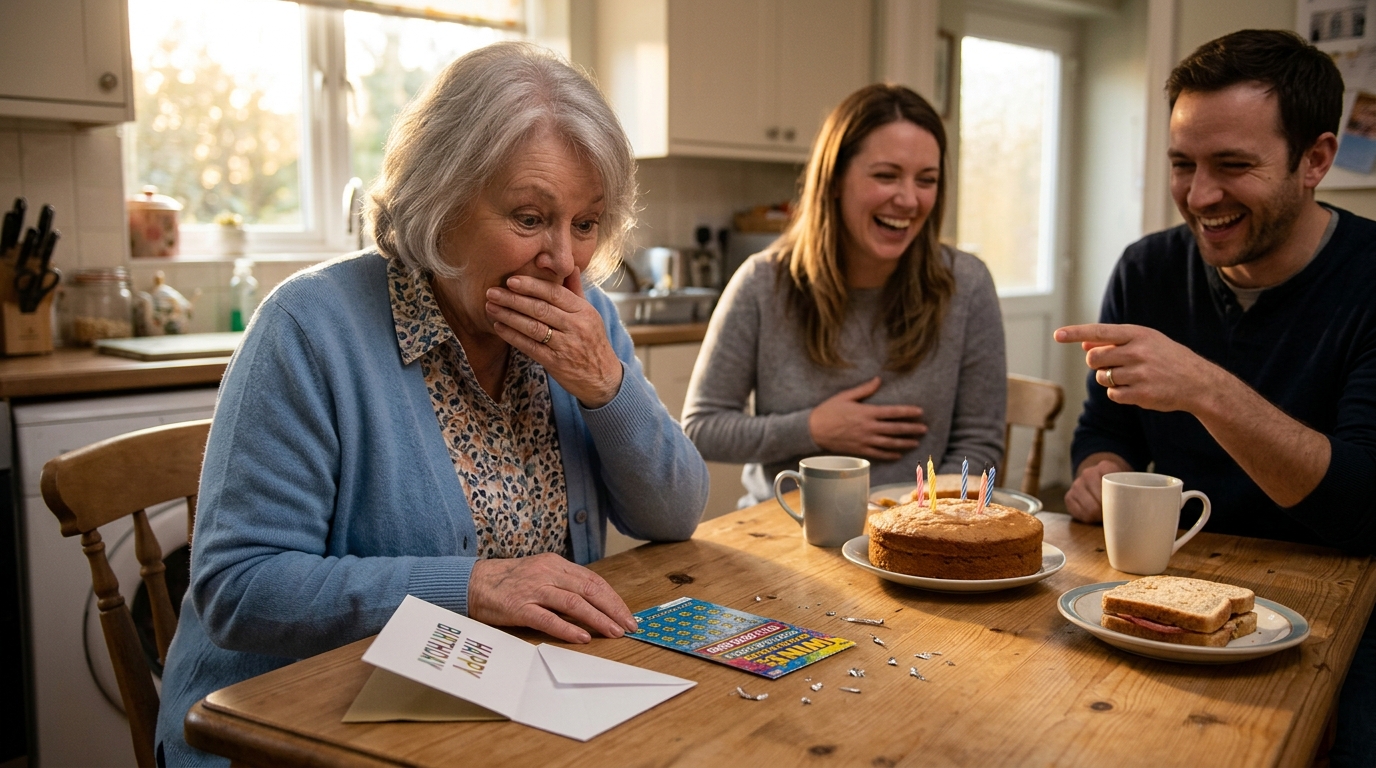
My granddaughter brought a card she had made, with a crooked drawing of my yellow house. “No scratch ticket,” she said, and then looked worried. I smiled. “A card is a perfectly good gift, sweetheart.” I put it on the mantel where I could see it from my chair.
After lunch, I started gathering the plates out of habit. Daniel stood and said, “Leave those, Mom. We’ve got them.” I almost thanked him as though he had offered something extraordinary, but instead I went out to the porch with my sister. Through the open window, I heard ordinary conversation and running water, and nobody calling for me.
When they left that evening, the children asked when they could return. “We’ll look at the calendar,” I told them. I hugged my son, closed my own front door, and stood for a moment in the quiet. The next morning belonged to me, and I no longer needed anyone to be sorry before I could enjoy it.