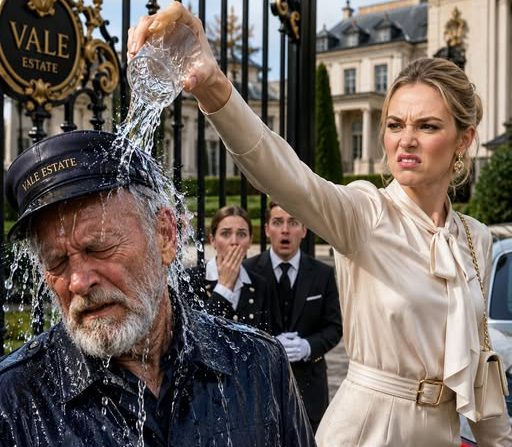
The first glass of water hit my face before my son’s fiancée even asked my name.
By the time it finished running down my gray beard and into the collar of the borrowed gatekeeper’s coat, I already knew Adrian was about to marry a stranger.
For thirty-eight years, I had built Vale Global from one rented warehouse into an empire of hotels, logistics firms, banks, and technology companies. Men in tailored suits now waited in outer offices to hear my opinion on numbers they would never have seen if I had not once unloaded crates with my own hands at three in the morning. Yet that morning, I wore cracked boots, a faded cap, and the navy coat of a gatekeeper named Walter Reed.
Only three people knew the truth.
My lawyer.
My head of security.
And my son, Adrian, who believed I was overseas and would not be back until after the engagement dinner.
My wife had died when Adrian was nineteen, leaving me one promise: never let wealth choose his heart for him. I had kept that promise for years. I stayed silent about girlfriends. Silent about charm. Silent about the women who looked at the family name a beat longer than they looked at my son’s face. But Celeste Marrow’s sudden curiosity about confidential projects, vendor structures, and “what happens after marriage” had made silence feel less like wisdom and more like cowardice.
So I took the gate for one day.
Celeste arrived in a white sports car, stopped inches from my booth, and leaned on the horn.
“Open it,” she snapped.
“Good morning, ma’am,” I said. “May I see your invitation?”
She lowered her sunglasses and looked me over with the kind of disgust moneyless people know instantly and wealthy people often pretend does not exist.
“Do you know who I am?”
“I’m afraid rules apply to everyone.”
She stepped out in cream silk and looked me up and down like I was something damp dragged in by weather.
“You people always cling to tiny scraps of authority.”
“I’m only doing my job.”
That was when she took the crystal bottle from her car, poured water into a glass, and tipped it over my head.
“Let me wash the filth off you.”
Two housemaids froze near the front path. I heard one gasp.
I wiped my eyes slowly.
“That was unnecessary.”
“What’s unnecessary,” she said, “is paying old men who smell like basements.”
Then she tossed the empty glass at my feet.
“Tell Mr. Vale I want this gatekeeper fired before dinner.”
And with that, she used Adrian’s private code and drove through the gates as if the world had already been signed over to her.
I touched the tiny camera sewn into my collar.
Every word had been captured.
Every expression too.
But humiliation was not the worst discovery.
Ten minutes later, Celeste’s father arrived.
He did not recognize me either, of course. Why would he? Men like Richard Marrow only see uniforms when they want something moved faster. He walked up to the booth, glanced once at my soaked coat, then handed me a sealed envelope.
“Give this to the kitchen manager,” he said. “Cash only. No records.”
Inside was a list of vendor substitutions for Vale-certified contracts. Catering, cleaning, floral supply, private transport. Every legitimate vendor carefully replaced with Marrow-owned shell companies after the wedding date, each marked with percentages and silent kickback instructions.
I smiled beneath the wet cap.
They were not entering my family.
They were entering my balance sheet.
By noon, I was dry again, changed into a second gate coat, and sitting in the security room with Elias Grant, my head of estate operations, while we reviewed footage from every angle. Celeste humiliating staff. Richard Marrow bribing what he thought was a servant. Three separate audio files. A clear image of the envelope. A clean shot of the company names.
Elias folded his arms and said what I was already thinking.
“They aren’t nervous.”
“No,” I said. “They’re practiced.”
That was the ugliest part. Not the cruelty. Not even the greed. The ease. Celeste had not lashed out because of stress or embarrassment. She had done it with the comfort of a woman who had been moving through the world that way for years and had never once paid a price for it.
I asked Elias to pull staff records.
By one o’clock, we had a pattern.
Two resigned housekeepers within six months.
A driver who quit without notice.
A florist who asked never to be assigned to estate functions again.
Three private complaints made quietly to management about Celeste’s treatment of employees, each withdrawn before formal review after Adrian personally asked that everyone “be patient, she’s under pressure.”
Pressure.
That word has protected more bad people than loyalty ever has.
At three, I called my attorney, Margaret Lin.
She came to the estate without touching a single curb on the long drive, which is how women like Margaret communicate urgency. I laid out the envelope, the recordings, the vendor lists, and the employment complaints. She read everything once, then again more slowly.
“Do you want family counsel,” she asked, “or corporate counsel?”
That was an important question.
Family counsel protects feelings.
Corporate counsel protects territory.
“Both,” I said.
She nodded once. “Then by dinner, the Marrows need to know two things. First, the engagement is over if Adrian has any judgment left. Second, every Marrow-connected entity touching Vale infrastructure will be frozen pending review.”
“Can we do it that fast?”
Margaret looked at me with something close to insult.
“Of course we can.”
The board was alerted quietly. Internal compliance was activated. Vendor substitutions were halted before a single signature could finalize. Three Marrow subsidiary accounts tied to pending partnership arrangements were flagged. By five-thirty, I knew more about Richard Marrow’s financial habits than his own wife probably did. Debts disguised as expansion. Inventory padding. Inflated invoices. Borrowed prestige stitched together with borrowed money.
So when the sun began to set and guests arrived for what they thought would be an elegant engagement dinner, I was ready.
I did not reappear dramatically.
That would have been for them.
Instead, I entered the library through the east corridor just after Adrian raised his glass to thank everyone for coming. The room was all candlelight and polished silver, soft piano from the next room, gardenias floating in bowls near the windows. Celeste stood at Adrian’s side in ivory satin, one hand resting possessively on his sleeve, smiling the smile of a woman who believed the evening had only one direction left to go.
Then she saw me.
Not as Walter Reed.
As myself.
The cap was gone.
The false beard removed.
My own black suit back where it belonged.
For one full second, her face emptied.
Adrian lowered his glass slowly. “Dad?”
The room quieted.
Richard Marrow turned, saw me, and went still enough to make his cufflinks look nervous.
I walked to the center of the room without hurry.
No one spoke.
Then I looked directly at Celeste and said, “I’m glad you could make it. You wanted the gatekeeper fired before dinner.”
The silence that followed was exquisite.
She went white first.
Then red.
Then tried for laughter.
“I… I don’t understand.”
“No,” I said. “But you will.”
I turned to Adrian.
My son looked stricken, confused, already halfway to understanding and resisting it at the same time.
“Before you say anything,” I told him, “you’re going to watch.”
Margaret stepped forward then, slim folder in hand, and handed the remote to Elias. The screen at the far end of the library came to life.
First clip:
Celeste at the gate, sunglasses low, asking if I knew who she was.
Second clip:
The glass of water tipping over my head.
Third:
“Let me wash the filth off you.”
Nobody moved.
Then came Richard Marrow’s visit to the gate booth. The envelope. The words cash only. No records. The vendor list projected clearly enough that three executives from Vale procurement began murmuring before the clip even ended.
Celeste tried to speak.
Richard tried next.
Margaret cut through both of them with the calm precision of a surgeon.
“We have preserved video, audio, written instructions, and financial ties linking the Marrow family to attempted procurement corruption inside Vale Global operations. We also have supporting internal complaints regarding staff mistreatment and retaliatory conduct. Effective immediately, all Marrow-affiliated onboarding, contracting, and partnership reviews are suspended.”
Richard’s face changed.
Not shame.
Panic.
Celeste turned toward Adrian and reached for his arm.
“Baby, this is ridiculous. Your father is humiliating me because he never liked me.”
Adrian stepped back.
Just one step.
But it was enough.
Because suddenly the room could see the distance.
He looked at me, then at the screen, then at Celeste in a way I had never seen him look at anyone before. Not with love. Not even with anger. With recalculation. He was finally matching the woman from the dinners to the woman at the gate. The charitable smile to the contempt. The perfect manners to the water running down an old man’s face.
“I asked you once,” he said quietly, “how you treat people when no one important is watching.”
Celeste opened her mouth.
He did not let her answer.
“You lied.”
She began crying then. Beautifully, I admit. Enough to move a weaker room. But not this one. Not after the footage. Not after the envelope. Not after the servants at the back wall had all gone perfectly still in that unmistakable way staff do when justice finally enters through the front door.
Richard tried bluster.
“This is a misunderstanding. A joke taken out of proportion.”
Margaret handed him a second folder.
“No,” she said. “This is a forensic summary.”
He read the first page and sat down without meaning to.
That was when I knew it was over.
Not because the board members looked disgusted, though they did.
Not because Celeste had begun to unravel, though she had.
Because Adrian stopped trying to save her.
He looked at her for a long moment.
Then he took the ring box from his pocket.
Every guest in the library forgot how to breathe.
Celeste saw it and straightened, probably thinking — stupidly, impossibly — that he might still go through with it out of pride or pressure or the old human weakness for saving face in public.
Instead, Adrian closed the box and set it on the mantel.
“I won’t marry you,” he said.
She actually laughed, a short broken sound. “Because of a stupid stunt with some old servant?”
That sentence finished her more thoroughly than anything I could have said.
Adrian’s expression hardened in a way that made him look more like his mother than he ever had before.
“No,” he said. “Because it was my father. And because if you can do that to someone powerless in your mind, you would eventually do it to anyone.”
He turned then to Richard Marrow.
“And you,” he said, “don’t ever bring cash and corruption onto my family’s property again.”
Celeste stared at him as if betrayal had just happened to her.
That, too, told me all I needed to know.
Security moved in quietly after that. Not rough. Just final. The Marrows were escorted from the estate with more dignity than they had shown anyone who worked there. Celeste cried all the way to the front steps. Richard tried one last threat about lawyers and press and scandal.
Margaret smiled at him with open pity.
“Please do call someone,” she said. “We’d enjoy discovery.”
After they were gone, the house stayed silent for several seconds.
Then Adrian turned to me.
He looked twenty years younger and ten years older at once. Hurt. Ashamed. Awake.
“You should have told me,” he said.
I considered that.
Then shook my head.
“No,” I said. “You needed to see it.”
He looked down.
That hurt him.
Good.
Because love without discernment becomes entitlement very quickly when money is involved. His mother had made me promise not to let wealth choose his heart for him. Tonight, for the first time, I felt I had honored that promise completely.
Later, long after the guests left and the staff had cleared the untouched dessert course, Adrian came to my study. He stood in the doorway with his jacket over one arm and said, very quietly, “I’m sorry.”
Not for the broken engagement.
For not seeing.
That mattered more.
I nodded toward the chair across from my desk. He sat. For a while, neither of us spoke. At last he asked, “When did you know?”
“The water wasn’t when I knew,” I said. “It was when she enjoyed it.”
He looked away then.
And because he is my son, and because he deserved truth after all of this, I gave him the full one.
“A cruel person under pressure is unfortunate,” I said. “A cruel person at ease is character.”
He sat with that a long time.
Then he asked about the Marrow companies, the debt, the shell substitutions. I told him enough. Not all. He is still learning how deeply greed will dress itself up before entering a room.
By dawn, the Marrow family was out of every live Vale negotiation. Their company audit was underway. Three board seats they had been privately promised through future marriage alignment no longer existed. And Adrian, who had almost married beauty wrapped around contempt, spent the morning walking the estate grounds with a cup of coffee and a face full of the kind of quiet pain that only comes when illusion dies cleanly.
I joined him by the lower gates just after sunrise.
The same gates where Celeste had leaned on the horn and demanded entry.
The same gates where she decided a gatekeeper’s dignity cost less than her irritation.
Adrian looked at the booth for a long time.
Then he said, “Walter Reed was a good man.”
I smiled.
“Yes,” I said. “He was.”
Some fathers test their sons by denying them.
I never believed in that.
But sometimes you must test the people who want to stand beside them for life. Not with riddles. Not with games. With reality. With power removed. With a uniform that invites contempt instead of advantage.
Because money can buy excellent manners.
Only character can survive anonymity.
That night my son did not lose a fiancée.
He escaped one.
And the woman who poured water on an old man to prove her place in the world learned, too late, that she had done it in front of the one man who could erase her family’s future with a phone call and a board vote.
I didn’t enjoy that part as much as I probably should have.
But I won’t pretend I disliked it either.