The last picture I have of my daughter was taken on our front porch at 5:12 p.m., almost a year ago.
She was wearing a pale blue dress, one hand looped through her twin brother’s arm. Both of them were laughing at something their father had just said. I remember reaching over to fix one loose curl beside her face before stepping back with my phone.
“Stay together tonight,” I told them.
“We always do,” my son said.
“Mom, we’re not little kids anymore,” my daughter replied, smiling.
That was the last time I heard her voice.
At 11:47 that night, the school principal called me. His voice was shaking.
“Your daughter is missing. Please come to the school immediately.”
She never came home.
The police searched the gym, the parking lot, the football field, the woods behind the school, and the river less than half a mile away. They questioned classmates, teachers, janitors, chaperones, parents, anyone who had seen anything. Some people thought she had been taken. Others whispered she might have wandered off upset and fallen near the water.
Again and again, they asked my son the same question.
“Where did she go?”
And every time, he gave them the same answer.
“I don’t know. She just stepped outside for air. I thought she’d come right back.”
After that night, my son became someone I barely recognized.
He stopped laughing.
Stopped sitting at the table with us.
Stopped opening his curtains.
He locked his bedroom door every time he went inside. If I knocked, he answered through the wood.
“Please, Mom. Just don’t come in.”
I thought it was grief.
I thought he was drowning in the same horror the rest of us were drowning in, only in his own private way. So I respected it. His silence. His anger. His need to be alone.
For eleven months.
Until the afternoon I smelled smoke under his bedroom door.
He was away at college by then, only three hours upstate, and had come home the weekend before to grab books and some laundry. I thought maybe he had left a candle burning, or a charger plugged in under a blanket, or some stupid dorm-life habit had followed him back into the house.
I didn’t think.
I shoved the door open.
There was no fire.
The room was still.
Then I saw the prom picture on his desk.
My daughter smiling in blue.
My son beside her.
The last ordinary moment of my life framed in cheap silver.
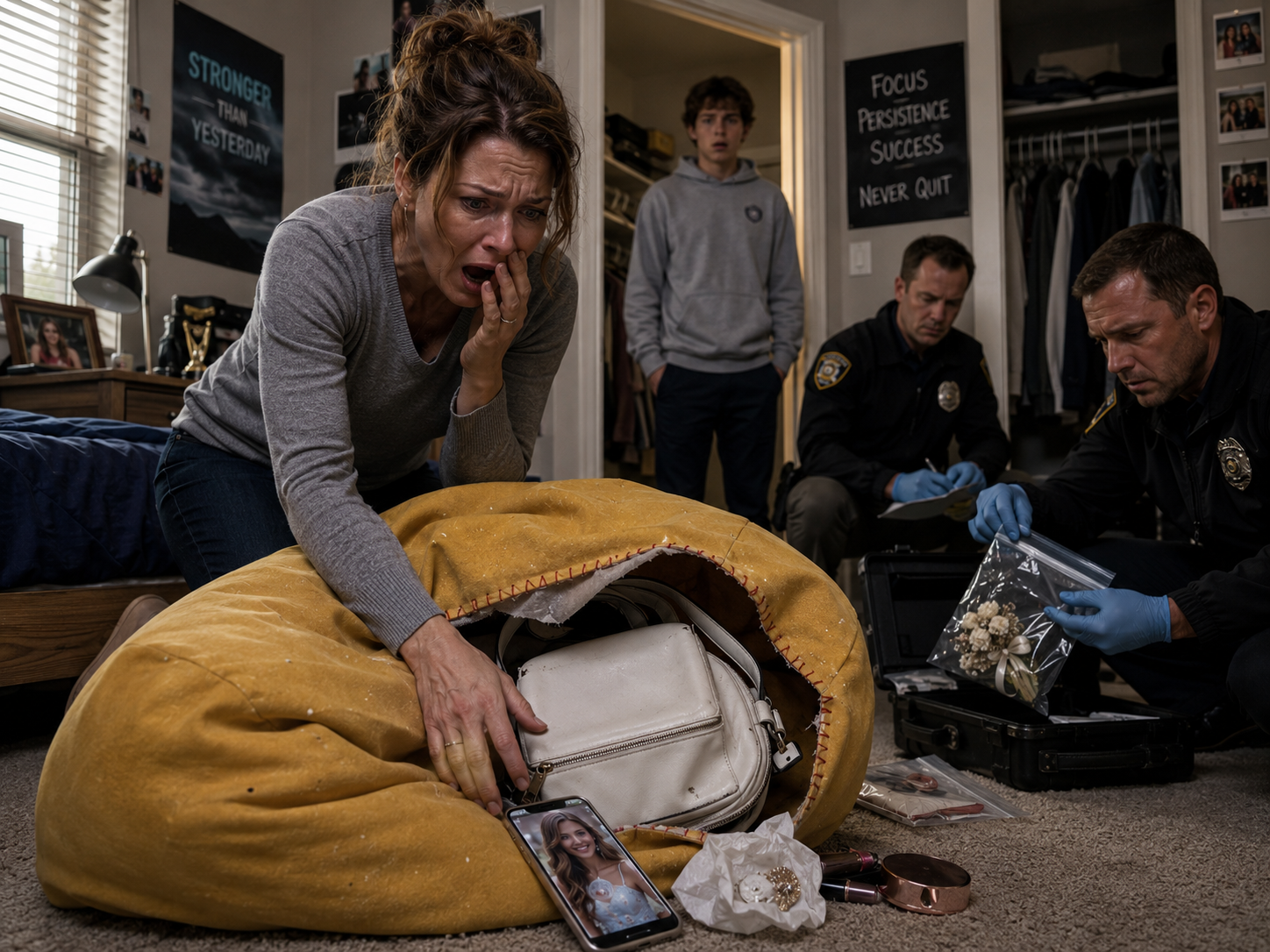
My knees gave out, and I dropped onto the yellow beanbag chair we had given him for his twelfth birthday.
And immediately, I felt it.
Something was wrong.
The chair was uneven.
Soft in one place.
Hard in another.
Not lumpy with old foam.
Wrong.
I stood up, flipped it over, and saw a seam I had never noticed before. A long line of hand stitching ran across the bottom in bright red thread, nothing like the factory seams on the rest of the chair.
My hands started shaking.
I pulled at the thread.
The fabric split.
And what spilled out onto the floor made me scream.
It wasn’t stuffing.
It was a backpack.
My daughter’s backpack.
The small white one with the silver zipper she took to prom because it matched her shoes. I knew it before I even touched it. I knew it the way mothers know their own children’s handwriting in a pile of papers, the way we know the sound of one particular voice in a crowded room.
The zipper was stuck halfway shut.
Inside were her lipstick.
Her compact.
Her phone.
And wrapped in a crumpled napkin at the very bottom, one of her earrings.
I couldn’t breathe.
I dropped the bag and stumbled backward until I hit the wall. My whole body had gone cold, but my face felt burning hot. For eleven months, police had searched. Volunteers had searched. Divers had searched the river while I stood on the bank convincing myself hope was not the same thing as denial.
And all that time, my daughter’s bag had been hidden inside my son’s room.
Inside a beanbag chair.
Inside my house.
I called 911 so fast I nearly dropped my phone.
“This is evidence,” I remember saying. “From my missing daughter. It was hidden in my son’s room. Please send someone now. Please.”
They came quickly.
Two officers first.
Then detectives.
Then crime scene people in gloves who moved with careful hands and flat voices.
They photographed everything before touching it. The chair. The red thread. The backpack. The room. The photo on the desk. The half-burned candle on the windowsill that had made me open the door in the first place.
Then Detective Morrow, who had been on my daughter’s case from the beginning, asked me the question I had been trying not to hear since the moment that bag hit the carpet.
“Did anyone besides your son have access to this room?”
I shook my head.
“No.”
That word seemed to stay in the air between us.
By evening, they had a warrant for my son’s dorm room.
By morning, they had him in an interview room.
My husband wanted to go to him immediately. Wanted to believe there had to be some explanation, some awful misunderstanding, some reason our son had hidden his sister’s bag without being involved in whatever happened to her.
I wanted that too.
God, I wanted that.
But wanting a thing doesn’t make it strong enough to stand.
At noon, Detective Morrow came back to our house and sat down at my kitchen table.
He looked ten years older than he had the day he first stood in my driveway after prom.
“We recovered more items from your son’s dorm,” he said.
He set a clear evidence photo on the table between us.
My daughter’s corsage.
Dried brown around the edges now, but still recognizable. Then another photo. Her phone case. Cracked. Then another.
A pair of shoes.
My daughter’s prom shoes.
My husband made a sound I had never heard from a grown man before.
Not crying.
Something beneath it.
I stared at the photographs until the edges blurred.
“Say it,” I whispered.
Morrow hesitated.
Then he said, “We believe your son knows what happened to her.”
I closed my eyes.
Not because I was surprised anymore.
Because the sentence, once spoken aloud, made the world divide into before and after.
They questioned him for hours. At first, he denied everything. Said he panicked when he found the backpack outside behind the school. Said he hid it because he was afraid police would think he had something to do with it. Said he kept hiding pieces because once the first lie was told, he didn’t know how to stop.
But lies don’t hold when they are made to stand beside facts.
His fingerprints were inside the bag.
His texts to my daughter ended later than he originally claimed.
And most damning of all, deleted messages were recovered from his old cloud backup.
Messages between him and a senior boy named Travis.
Prom night.
By the river.
An argument.
A panic.
By the next day, they brought Travis in too.
And then the truth came out.
Not all at once.
In pieces.
Ugly, pathetic pieces.
My daughter had wanted to leave early. Travis had been drinking. He got handsy near the river path behind the school after-party. My son tried to pull him off her. There was shouting. Pushing. My daughter shoved Travis back. He slipped on the muddy bank and grabbed at her to steady himself. My son grabbed too.
She fell.
Hit her head on a rock on the way down.
For a moment, according to both of them, she was still moving.
Still trying.
Then she wasn’t.
They didn’t call for help.
That is the part I will never survive.
Not the fall.
Not even the death.
The choice after.
My son said he panicked. Travis said they’d both be blamed. They dragged her farther down the bank where the reeds were thick. They hid her bag. Then they went back separately and told everyone she had stepped outside for air.
My son came home with her ghost and locked his bedroom door for eleven months.
The police found her body two days later.
Not far from where the first search teams had looked, but far enough that spring flooding and thick reeds had concealed what cowardice left behind. I was told she had likely died quickly. People said that like it was mercy.
It wasn’t.
Mercy would have been calling for help.
Mercy would have been bringing her home.
When they arrested my son, I watched from behind the living room curtain because I could not bear to stand on the porch and I could not bear not to see it either. He looked smaller than I remembered. Not like a monster. That would have been easier. He looked like my child.
That was the horror of it.
He turned once before getting into the car, as if maybe I would come outside, maybe I would stop this, maybe motherhood would rise up and erase consequence.
I didn’t move.
My husband did.
He ran out to the driveway and shouted his name, crying openly, begging him to tell them it wasn’t true.
Our son just lowered his head.
By then, truth had finally become heavier than silence.
The trial took months.
There were hearings.
Statements.
Experts.
Words like obstruction and abuse of a corpse and failure to report.
Travis’s family blamed my son.
My son’s defender blamed panic.
The prosecution blamed both of them exactly as they should have.
And me?
I sat in hard courtroom benches and listened to my daughter’s final minutes translated into timelines and legal language until I thought I might lose my mind.
People looked at us strangely after that.
Not with sympathy.
Not exactly.
With that terrible mixture of pity and fascination reserved for families whose pain becomes public enough to be discussed in grocery store lines.
Some said my son was a good boy who made one terrible mistake.
I never answered those people.
Because no.
A mistake is spilling juice on a dress.
Missing a turn.
Forgetting a birthday.
What they did after she fell was not a mistake.
It was a choice.
Several choices.
My son was convicted.
So was Travis.
Different charges. Different sentences. Same ruin.
The day the verdict was read, I felt no triumph. No relief. Only exhaustion so deep it seemed to come from my bones. My husband sat beside me hollowed out and gray, as if grief had finally found new organs to feed on.
Afterward, in the parking lot, he asked me if I hated our son.
I stood there with my purse hanging open, courthouse papers bent in my hand, and thought about that question for a long time.
“No,” I said at last. “I hate what he did.”
That was the most honest thing I had.
Because love does not always leave when horror arrives.
Sometimes it stays.
And that is its own punishment.
I sold the yellow beanbag chair.
Not because I needed the money. Because I could not look at it one more day. I kept the prom picture, though. I nearly threw it out a hundred times, but in the end I couldn’t. It is still the last photo of both my children standing side by side in a world that had not yet cracked open.
Sometimes I stare at it and try to find the exact second when innocence ended.
I never can.
Maybe that is because it ended after the photo.
Maybe that is because innocence does not vanish in one moment, but in the choice not to tell the truth afterward.
On the anniversary of my daughter’s disappearance, I go to the river now. I bring pale blue flowers. I sit there until the light changes and the air cools and I can almost remember her laugh without hearing the principal’s voice after it.
The hardest part is not that I lost a daughter.
It is that I lost both of my children on the same night.
One died by the river.
The other died the moment he decided to hide her and come home pretending not to know where she was.
And all because I opened a bedroom door I had spent eleven months being too afraid, too respectful, or too heartbroken to force.
People say a mother always knows.
That isn’t true.
Sometimes a mother only knows when the seam finally splits open and the truth comes spilling out onto the floor.