The morning of Jack Hayes’s Trident ceremony in Coronado smelled like salt water, brass polish, and coffee cooling in paper cups under the California sun. The wind kept snapping the little American flags along the seating area, sharp little cracks of sound between the band’s warm-up notes.
I sat three chairs away from my father.
Close enough to see the shine on his retired Navy captain’s buttons.
Far enough to know he had placed me there on purpose.
In my family, love had always worn a uniform.
My father’s house was practically a museum of naval service. Shadow boxes lined the hallway. Ship photographs hung over the fireplace. Challenge coins sat inside a glass case he dusted before every holiday like dust itself might dishonor the years he had given to the sea.
Jack fit that world perfectly.
My younger brother had always been the easy answer. He liked discipline, direct orders, early mornings, and praise you could measure in patches, billets, and handshakes from men my father respected.
I had once been the daughter everyone pointed to.
At eighteen, I got into the Naval Academy. My father left the admission packet on his desk for three weeks, pretending he had forgotten it there just so visitors would notice. My mother framed my Induction Day photo before I had even finished saying goodbye.
Then, according to the story my family was given, I left Annapolis without graduating.
That was the version they kept.
No satisfying explanation.
No dramatic confession.
No illness they could soften into sympathy.
Just a quiet change of direction, a sealed file, and my mother’s careful little smile whenever anyone asked.
“Samantha chose a different path.”
She always made it sound polite.
Polite can be crueler than shouting when everyone knows what it means.
The real paperwork never sat on my father’s desk. It moved through sealed orders, restricted briefings, redacted reports, and rooms where nobody used full names unless they absolutely had to. There were signatures I could never explain, dates I could never defend, and years of service that would never appear in any family album.
So I let them keep the easy version.
My father never punished me loudly. He didn’t throw things. He didn’t call me weak. He just stopped looking at me whenever the subject turned to duty, sacrifice, or honor. At Thanksgiving, he asked Jack about training and asked me to pass the rolls. At birthdays, he shook my brother’s hand and hugged me like a neighbor from church.
A family does not always erase you with anger.
Sometimes they do it with careful manners.
That morning, I wore a navy blazer, gray slacks, and low heels that would not draw attention. Years of training had taught me how to disappear in plain sight. I counted exits without moving my head. I noticed the plainclothes security near the bleachers, the sight lines around the field, the clipped conversations at the command tent.
My mother noticed none of it.
Her eyes were fixed on Jack.
He stood with the other graduates, shoulders square, face sunburned and proud. I was proud of him too. Whatever else my family had gotten wrong, Jack had earned that morning. The freezing water, the sleep deprivation, the brutal weeks that stripped a person down to bone and will — I knew more about that kind of cost than any of them guessed.
Then my mother leaned close, perfume slicing through the salt air, and whispered, “Watch your brother carefully, Samantha. Maybe you’ll learn something today.”
She said it gently.
That made it worse.
I felt my jaw tighten once, then forced it loose. I didn’t answer. Explaining myself was impossible, and defending myself would have violated more than just family peace. So I folded my hands in my lap and watched the ceremony continue while my father stared straight ahead, chin high, pretending the daughter beside him had never carried anything heavier than disappointment.
At 10:16 a.m., the rear admiral stepped to the microphone.
The speech began exactly as expected. Brotherhood. Honor. Discipline. The weight of the Trident. Families sat straighter. Phones lifted. Mothers dabbed their eyes. Fathers looked proud in that stiff, contained way military fathers do when emotion has to pass through rank first.
Then the admiral stopped.
Not paused.
Stopped.
The band quieted at the edges. Someone near the command tent shifted a clipboard. An officer beside the podium turned his head, confused.
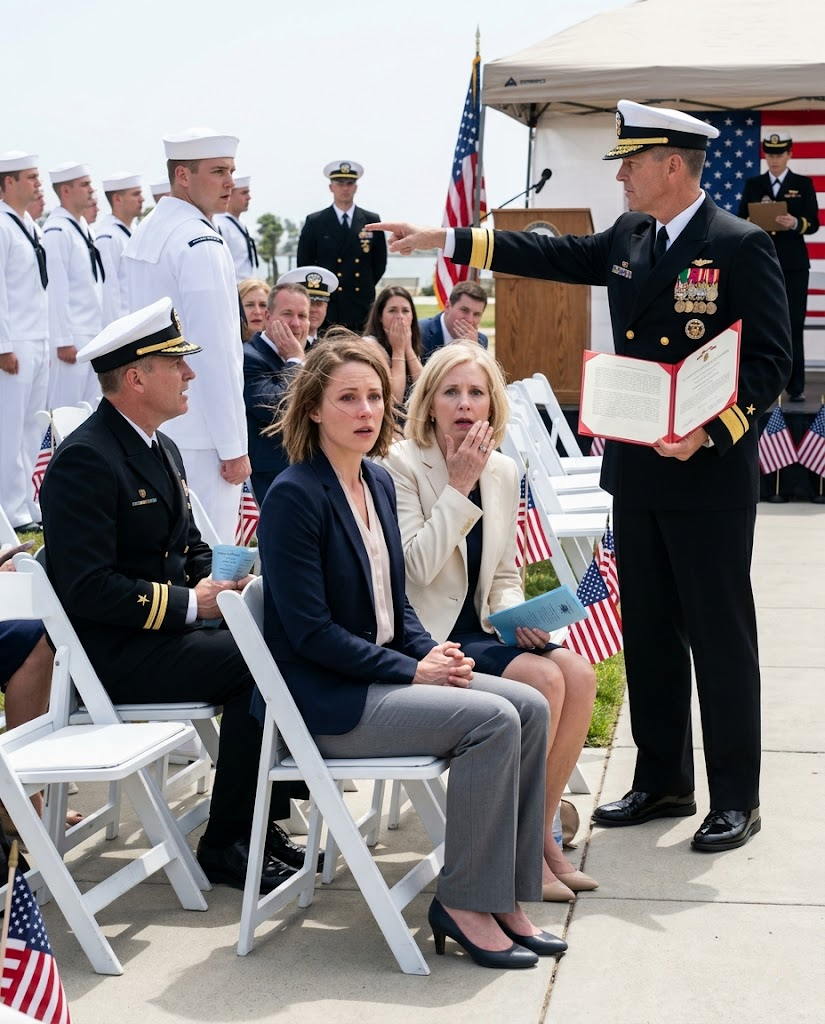
The admiral’s gaze moved past the graduates, past Jack, past my father in his retired captain’s uniform, until it landed directly on me.
My mother’s hand froze on her program.
My father finally turned.
And when the rear admiral stepped away from the microphone, lifted his hand toward the audience, and said, “Before we continue, I need to acknowledge one officer present today—” the words cut across the field so cleanly even the wind seemed to stop.
My mother looked from the admiral to me as if there had to be another officer seated somewhere behind my shoulder. My father’s face did not change at first. He had trained his expression for decades into something polished and unreadable, but I saw his right hand close around the folded ceremony program until the paper bent.
Jack turned in formation.
For the first time that morning, he did not look like the family hero.
He looked like a younger brother realizing he had only been given half the story.
The admiral was not smiling.
Beside him, a staff officer opened a dark folder with a red-bordered cover sheet. I knew that cover sheet. I knew the classification mark. I knew exactly the kind of trouble that began when one of those folders appeared in public, even in sanitized form.
Then the next blow landed.
The officer removed a commendation packet I had signed six years earlier under an operational title no one in my family had ever heard. Jack’s training commander recognized the signature before anyone else did.
His face drained first.
Not my mother’s.
Not my father’s.
His.
He looked at me with a kind of respect too immediate to fake, then stepped back half a pace as if the ground under his own boots had changed rank without warning.
My mother whispered, “Samantha?”
My father said nothing.
The admiral lifted the folder slightly, returned to the microphone, and began the sentence my family had never been ready to hear.
“Commander Samantha Hayes, United States Navy, is present with us today.”
The field went completely silent.
Not quiet.
Stunned.
My mother made a small sound I had never heard from her before, something between confusion and fear. My father stayed frozen, except for the pulse in his neck. Jack stared at me like I had just stepped out of a wall.
The admiral continued.
“Many of you know Commander Hayes only through what cannot be said. That is by design. But there are moments when silence does a disservice to service itself. This is one of them.”
I should have stood immediately.
Training said stand.
Protocol said stand.
Instead, for one strange second, I couldn’t move.
Because all at once I was not on that field in Coronado. I was twenty years old again, being separated from the visible track and handed to something with no graduation photos and no family weekends. I was twenty-four in a briefing room with no windows. Twenty-eight signing documents under names that were mine and not mine. Thirty-two standing in a foreign airfield watching dawn arrive after a week no one at home would ever know existed.
Then the admiral said, “Commander, on your feet.”
So I stood.
Every head in the audience turned.
My father looked up at me slowly, the way men look at monuments they somehow failed to notice while driving past for years. My mother’s mouth was slightly open. Jack’s expression shifted from shock to something deeper and more painful.
Recognition.
Not of facts.
Of pattern.
All those years I dodged questions.
All those holidays I disappeared early.
All those bland answers and vague assignments and calm refusals to correct the story.
The admiral opened the commendation.
“For distinguished service in operations directly impacting the protection of U.S. personnel and allied assets across multiple theaters,” he read, voice measured, “and for leadership under conditions of extraordinary operational risk—”
He didn’t finish the full citation.
He couldn’t.
Not publicly.
But he didn’t need to.
The words already hit hard enough.
Then he looked directly at my father.
“Captain Hayes,” he said, and the use of my father’s old title in that moment felt surgical, “with respect, your daughter did not leave service. She entered a level of it few ever see and fewer survive.”
You could have heard fabric moving in the audience.
My father stood then.
Slowly.
Automatically.
Like his body knew something his mind had not caught up to yet.
He did not salute.
Retired officers don’t do that casually, not in moments like this.
But the effort not to was visible in every line of him.
My mother was crying now, though I could not tell whether it came from pride, shame, or the simple violence of finding out she had built an entire emotional structure around a lie that had always belonged more to her than to me.
Jack broke formation without permission.
That part nearly made me smile.
He took two steps forward before his commander’s look stopped him. But by then it didn’t matter. The whole ceremony had already shifted. What was supposed to be a moment about one son becoming legible to the family had suddenly become a reckoning with the daughter they had spent years politely minimizing.
The admiral wasn’t done.
He closed the folder and said, “Today is about these graduates. It should remain so. But no family present should leave this field confused about what service looks like simply because some forms of it come home in silence.”
Then, before returning to the script, he added, “Commander Hayes, thank you.”
I nodded once.
That was all.
Anything more would have broken me.
The ceremony resumed after that, but nobody around us was really watching the same way anymore. My mother kept dabbing her eyes and glancing sideways at me as if a full explanation might materialize if she stared hard enough. My father sat rigid, gaze forward, face carved out of old damage. Jack completed the ceremony like the professional he was, but every time applause rose, his eyes found me first.
When it ended, families rushed the field.
There were hugs.
Photos.
Crying.
Flags.
Phones everywhere.
I stayed where I was until the crowd broke enough to make movement sensible. Jack got to me first.
He still had his Trident pinned on.
Still smelled like sun and starch and ceremony.
For one second he just stood there, looking at me like he didn’t know which part of me to address first.
Then he said, “You let me think I was the only one.”
That hurt because it was true in the emotional sense, even if not the factual one.
“I let you have your day,” I said quietly.
He laughed once, but there was no humor in it.
“This was supposed to be my day.”
“It still is.”
He stared at me a second longer.
Then, to my surprise, he pulled me into a hug so hard it almost knocked the breath out of me. He had been bigger than me since he was sixteen, but something in that embrace felt younger than that. Like the brother who used to trail after me barefoot in summer and demand I let him tag along.
“You should have told me,” he said into my hair.
“I couldn’t.”
“I would have believed you.”
“That’s not the problem.”
He understood that. I felt it in the way his arms tightened once before he let go.
My mother came next.
Of course she did, because mothers cannot tolerate standing outside a story once they realize they are central to its damage. She touched my sleeve like she was checking whether I was physically real.
“Commander?” she whispered, as if saying the word too loudly might collapse the whole thing.
“Yes.”
Her eyes filled again.
“All these years…”
I looked at her.
There were a hundred possible endings to that sentence.
All these years we were proud of the wrong child.
All these years I thought you quit.
All these years I made you smaller so I could understand you.
She never finished it.
Good.
Some things deserve to stay unfinished.
My father came last.
He stood in front of me in his old captain’s bearing, shoulders square, hands behind his back like he was still deciding which version of himself was permitted to enter this moment. For the first time in a long time, he did not look like a father to me.
He looked like an officer facing a report he had badly misread.
“You outrank me now,” he said.
It was not a joke.
It was also not the point.
But it was the only bridge he knew how to build in that moment, so I took it for what it was.
“This isn’t about that.”
“No,” he said. “It’s about the fact that I let myself believe my daughter walked away from duty because that was easier than admitting I no longer understood the shape of it.”
That was the closest thing to an apology I had ever heard from him.
And because I knew him, I knew how much it cost.
He swallowed once, then added, “I was wrong.”
That nearly undid me more than anything the admiral said.
Because my father was not a cruel man, not in the obvious ways. He was simply a man built inside an older model of service, one that taught him to honor what could be displayed and mistrust what could not be named. My silence had looked like absence to him. My restraint had looked like failure. And once he chose that interpretation, pride did the rest.
“I know,” I said.
His face moved then. Not much. But enough to show pain.
“At Thanksgiving,” he said quietly, “I asked you to pass the rolls.”
I actually smiled.
“Yes.”
He looked down.
“I remember.”
“So do I.”
For a second we just stood there in the middle of the field, among sailors and families and cameras and late morning sun, holding that ugly little memory between us like evidence.
Then my father did something I had not expected and may never forget.
He came to attention.
Not for the ceremony.
Not for the admiral.
For me.
Then he saluted.
A full, formal salute. Perfect. Sharp. Public.
People nearby saw it and went quiet again. My mother put her hand over her mouth. Jack exhaled like he’d been kicked.
I returned it.
Because there are some things that are not about family first or pain first or even love first.
Sometimes they are about recognition.
Sometimes they are about finally seeing what has been standing in front of you all along.
When he dropped his hand, his eyes were wet.
He did not apologize again.
He did not explain himself.
He just said, “Welcome home, Commander.”
That was the best he could do.
For that day, it was enough.
Later, after the field cleared and the families drifted toward restaurants and rented halls and celebratory drinks, I stood alone for a minute near the edge of the parade ground looking out at the water. Jack was taking photos with his class. My mother was telling someone on the phone through tears that no, she hadn’t known, no, none of them had. My father stood a little apart, quiet for once, as though he was still recalibrating the internal map of his own family.
Jack came up beside me eventually.
“Were you ever going to tell us?” he asked.
“Probably not.”
He nodded.
“Yeah. That sounds like you.”
There was no accusation in it this time.
Just understanding.
Then he grinned, a little crooked.
“So. Commander.”
“Don’t start.”
He laughed.
“Absolutely not. I’m using that forever.”
That laugh saved something in me.
Because for the first time that morning, it felt like we might still become siblings again instead of symbols arranged by our parents’ expectations.
Before we left, Jack touched the Trident on his uniform and looked at me seriously.
“Were you proud of me before all this?”
I turned toward him.
“Jack,” I said, “I was proud of you before any of them knew who I was.”
He nodded once, eyes bright now, and looked away fast.
That evening, my father asked if I would come to dinner with the family.
He asked.
Not instructed.
Not assumed.
Not arranged through my mother.
That mattered.
At the restaurant, he introduced me by my rank only once, then caught himself and simply said, “my daughter.” Somehow, after everything, that meant more.
People talk about public revelations as if they are victories.
They are not.
They are ruptures.
Some heal cleanly. Some do not.
What happened at that Trident ceremony did not erase the years my family let the easy story stand. It did not return the birthdays, the holidays, the careful exclusions, or the thousand small ways polite disappointment can hollow out a relationship. But it did something else.
It stopped the lie from running the room.
And sometimes that is where repair begins.
My mother told me that morning I should learn from my brother’s example.
In the end, all of them did learn something that day.
Just not what she meant.