The hospital room smelled like antiseptic, stale coffee, and the plastic sleeve from a fresh roll of bandages. The monitor beside my bed kept beeping with that calm little rhythm that felt almost insulting, while the fluorescent light above me buzzed like a trapped insect.
Both of my legs were locked in plaster casts from thigh to foot. They felt heavy as wet concrete, and every tiny shift dragged the blanket across the bruises along my ribs. Three weeks earlier, a speeding car had turned an ordinary afternoon into broken glass, ambulance lights, and a hospital intake form stamped 6:42 p.m.
For twenty-one days, I waited for Caleb to walk into that room like my husband.
He walked in like a man collecting a debt.
“Enough with this drama, Rebecca,” he snapped from the foot of my bed. His shirt was pressed. His shoes were polished. His face was so hard it made the room feel colder. “Get up. We’re leaving.”
I stared at him through the medication haze.
“Caleb, I can’t.”
His jaw tightened.
“Don’t start.”
“My legs are broken.”
“I heard the doctors.” He leaned over the rail, close enough that I could smell mint gum under his cologne. “I also heard the billing desk ask about payment again. I’m done wasting money on this performance.”
That word landed harder than the crash.
Performance.
I had not performed the cracked ribs.
I had not performed the stitches hidden under my hairline.
I had not performed the hospital bracelet cutting into my swollen wrist.
But Caleb had always been good at turning my pain into his inconvenience.
We had been married eleven years. I left my accounting job when Emma was little because Caleb said our daughter needed one parent steady at home. I packed lunches, handled school calls, sat alone through parent-teacher meetings, paid bills from the kitchen table, and learned which silences kept the house peaceful.
A woman can mistake peacekeeping for love for a very long time.
Then one day she stops moving, and everyone notices she was the furniture.
“I gave up everything for this family,” I said, barely louder than the monitor. “You’re my husband. You’re supposed to help me.”
His eyes didn’t soften.
They narrowed.
“Help you?” he said. “You’re a burden.”
The room went still except for the beeping.
Not injured.
Not his wife.
Not the mother of his child.
A burden.
He grabbed the blanket first, jerking it down like he could strip away the last of my dignity in one movement. Then his hand clamped around my upper arm. I tried to brace against the mattress, but my fingers shook so badly my wedding ring clicked against the metal rail.
“Caleb, stop,” I whispered.
He pulled harder.
Pain shot through my ribs and up into my throat. My casts dragged against the sheet, and the monitor changed rhythm, fast now, sharp alarms stacking over each other.
“Get out of that bed,” he hissed. “I’m not paying for a wife who can’t even be useful.”
Something hot rose in me then.
I didn’t slap him.
I didn’t scream every sentence I had swallowed for eleven years.
I didn’t tell him what kind of man counts hospital bills while his wife lies there unable to stand.
I only gripped the rail with both hands and said, “No.”
For one second, Caleb looked stunned, as if the bed itself had spoken.
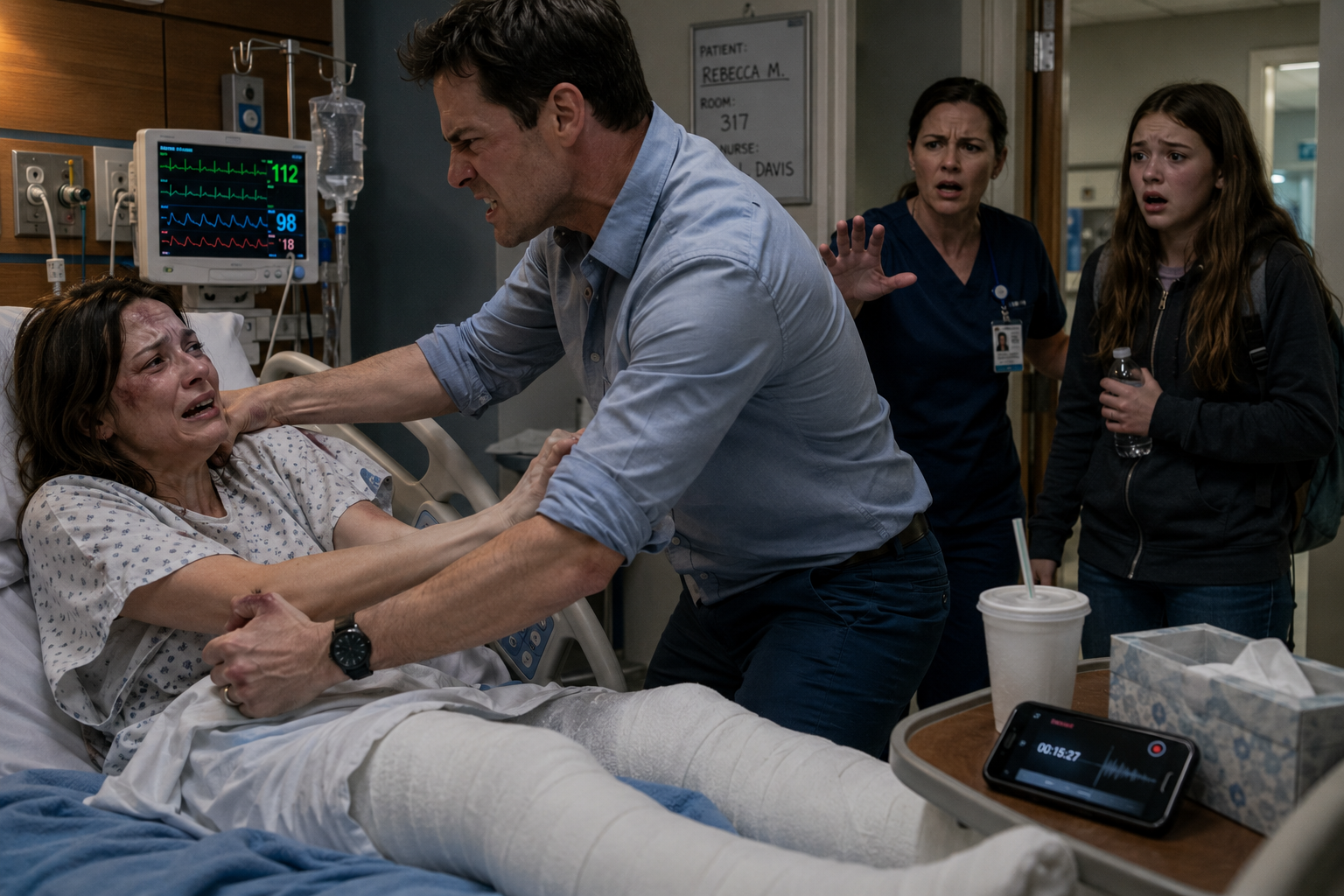
Then he slammed both fists into my stomach.
The pain went white.
My breath vanished. My body folded as much as the casts would allow, and the sound that came out of me didn’t feel human. It sounded like somebody trapped two rooms away.
The monitor broke into a frantic shriek.
Caleb leaned over me, red-faced, one hand twisted in the blanket, the other already lifting again.
“You don’t get to talk back to me,” he said. “Do you understand?”
I looked past him toward the hospital door. The hallway beyond it was bright, clean, painfully normal. Somewhere outside, a cart wheel squeaked. Somewhere near the nurses’ station, someone laughed softly. Somewhere, my daughter Emma probably still believed her father had come to check on me.
But inside that room, Caleb’s shadow covered the bed.
The visitor log outside the door had his name on it. The hospital chart had mine. The monitor was screaming for both of us.
And just as Caleb drew his fist back again, the silver handle on the door began to turn.
A nurse stepped in first, and the look on her face changed so fast it was like watching a light switch flip. Her expression went from routine to alarm, from alarm to something colder. Caleb froze over me with his fist still half-raised, the blanket twisted in his other hand, and my gown bunched under his knuckles.
“Sir,” she said, voice low and sharp, “step away from the bed.”
Caleb straightened fast, tugging at his shirt like he had only leaned in to fix my pillow.
“She’s confused,” he said. “She’s medicated.”
But the monitor was still screaming, my hand was locked around the rail, and my casted legs had shifted sideways where he had tried to drag me.
Then the nurse looked down at the tray beside me.
That was the one thing Caleb had not noticed.
My phone was there, propped faceup beside the paper cup of melting ice chips.
Recording.
The red timer was still moving.
It had caught everything.
Burden.
Performance.
Not useful.
The sound of his fists hitting me.
The sound I made after.
Behind the nurse, another face appeared in the doorway.
Emma.
She was fifteen, still wearing her school hoodie, holding a vending-machine water bottle with both hands. The bottle slipped from her fingers and hit the floor with a hollow crack.
“Dad?” she whispered.
Caleb’s face emptied.
Not guilt.
Not shame.
Calculation.
The nurse hit the call button on the wall without taking her eyes off him.
“Security is coming,” she said.
Then Emma looked at me through the gap beside the nurse, tears already running down her face, and asked the question that finally made Caleb step back.
“Mom… is this why you always told me to keep my bedroom door locked when he was angry?”
The whole room went silent.
Caleb turned toward her too quickly.
“Emma, stop. You don’t know what you’re seeing.”
But she did.
That was the problem.
She knew too much.
I saw it happen in her face right there. Not confusion. Recognition. Like a hundred small moments had suddenly lined up into one unbearable answer.
The broken plate he once threw past my head and called an accident.
The nights he pounded on my door after arguments.
The way I always changed the subject when she asked if we were okay.
The way I used to smile too brightly after bruises and say I bumped into things.
Children collect truth long before adults are brave enough to name it.
Emma took one shaking step into the room.
“You said she fell because she was clumsy,” she whispered. “You said the car accident made her emotional.”
Caleb looked at the nurse, at the phone, at me, at the hall behind him where footsteps were already coming fast.
“This is a misunderstanding.”
“No,” I said.
My voice sounded thin, but steady.
“This is the first time you got caught.”
That landed.
Because it was true.
Security arrived first. Then another nurse. Then a doctor I had seen only twice in three weeks but who took one look at my vitals, the blanket on the floor, Caleb’s position by the bed, and the phone screen, and knew enough.
They moved him out fast.
Not violently.
Professionally.
Which somehow made it worse for him.
He kept talking as they pulled him toward the hall.
“She’s lying.”
“She’s unstable.”
“She’s on medication.”
“She gets dramatic when she’s scared.”
Emma flinched at every sentence, but she didn’t leave.
She came to my bed instead.
By then I was shaking so hard the rails rattled.
The nurse turned off the alarm, checked my abdomen, called for imaging, and asked quietly, “Did he hit you more than once?”
I looked at Emma.
Then at the nurse.
“Yes.”
That was the first time I had ever said it out loud to another adult.
Yes.
Not maybe.
Not he gets upset.
Not it’s complicated.
Not you don’t understand him like I do.
Yes.
The police came before midnight.
A female officer took my statement while a second officer spoke to Emma outside the room with a child advocate present. The hospital copied the video from my phone before it could be lost or corrupted. Photos were taken of my arm, my stomach, the displaced casts, the marks already beginning where his fingers had dug into me.
The doctor ordered another scan.
That was when the next blow came.
Because while everyone was moving around my room with clipboards and soft voices and the kind of urgency no one can fake, the obstetric resident came in with my chart in her hand and asked, “You said you had one prior miscarriage at ten weeks?”
I nodded automatically.
Then stopped.
Because I had never told Caleb that.
Only my doctors knew.
The resident blinked, glanced at the door where he had just been taken out, then at me.
My whole body went cold for the second time that night.
He had chosen that exact place to hit.
Not my face.
Not my shoulder.
My stomach.
The place he knew had once already broken me.
And suddenly I understood something worse than rage.
This hadn’t been random.
It had been deliberate.
The doctor must have seen that understanding happen in my face because she put a hand on my blanket and said, very gently, “We’re checking everything now.”
I closed my eyes.
Emma was still holding my hand.
“What prior miscarriage?” she asked quietly.
I opened my eyes again.
I had spent years trying to protect her from the ugliest parts of my marriage by feeding her softer lies. But the room was already past lies now.
“Before you,” I said, “I was pregnant once.”
Her fingers tightened around mine.
“Did he do that too?”
I couldn’t answer.
I didn’t have to.
My face did it for me.
Emma made a sound that was half sob, half fury, and turned away so fast her ponytail whipped across her shoulder. For a second I thought she was going to run.
Instead she walked straight to the officer in the hall and said, in the clearest voice I had ever heard from her, “I want to make a statement too.”
That was the moment I realized my daughter was done being a child in this story.
By morning, Caleb had been charged.
Assault.
Domestic battery.
Interference with medical care.
The hospital social worker found me a victim advocate before sunrise. By eight o’clock, there was already an emergency protective order in motion. By ten, his sister was texting that I was ruining his life. By noon, his mother left a voicemail saying marriage is hard and public scandal helps no one.
I saved every message.
Then I blocked them.
The scan came back clear enough that afternoon.
No internal bleeding. No fresh organ damage. My ribs hurt. My abdomen felt bruised from the inside. The doctors said I was lucky.
Lucky.
I lay there staring at the ceiling thinking about that word.
Lucky that a nurse walked in.
Lucky that I had set my phone down recording because some small buried part of me knew Caleb never entered rooms empty-handed.
Lucky that Emma came back with a water bottle at the exact wrong and right moment.
Lucky, maybe.
But also finished.
That was the real thing.
Finished with explaining.
Finished with minimizing.
Finished with confusing survival for marriage.
Emma stayed with me that night on the pull-out chair by the window. Around two in the morning I woke up to see her sitting upright in the dark, knees pulled to her chest, staring at nothing.
“Come here,” I whispered.
She climbed carefully onto the edge of the bed beside my cast and laid her head against my shoulder.
“I should have known,” she said.
“No.”
“I heard things.”
“You were a child.”
“I’m not now.”
That hurt because it was true.
I kissed the top of her head.
“No,” I said. “You’re not.”
Three days later, after I was stable enough to be discharged to a rehab wing instead of home, my advocate brought me a folder.
Temporary sole use of the house.
Temporary financial freeze.
Temporary custody protections.
Emergency family court date.
All because of one video, one nurse, one daughter, and one man arrogant enough to think hospital walls would protect him from consequence the way our house always had.
Caleb tried to call me from county holding that evening.
I let it ring.
Then I deleted the voicemail without listening.
I didn’t need to hear which version of him had shown up this time.
The angry one.
The crying one.
The apologizing one.
The one who said stress made him do it.
The one who asked whether I really wanted Emma to grow up without a father.
Too late for that.
She already had.
What she had instead was a man in the same body, wearing the right title, paying the right bills, and turning our home into a place where silence did the parenting.
A week later, when the first hearing came, I appeared by video from a rehab room with both legs still elevated and my hospital bracelet still on. Caleb appeared in county orange.
He would not look at me.
That, more than anything, made me understand the case was real.
Men like Caleb survive on being watched with fear. Remove that, replace it with a camera and legal language, and suddenly they cannot hold their own shape.
The judge granted everything we asked for.
Protection order.
No contact.
Temporary custody.
Exclusive use of the home.
Mandatory evidence preservation.
When the clerk read it all into the record, Emma sat beside my bed gripping the chair arms so tightly her knuckles were white.
Afterward she looked at me and said, “So he can’t come near us?”
“No,” I said.
She let out one long breath.
Then she cried.
Not because she wanted him back.
Because her body had been bracing for impact for years and finally got told it could stop.
Recovery took months.
The casts came off.
Physical therapy started.
The bruises yellowed and faded.
The house was repainted.
The bedroom door I had once locked from the inside was replaced entirely.
And in the middle of all that ordinary rebuilding, the strangest thing happened.
Peace stopped feeling suspicious.
Emma laughed more.
I slept better.
No one slammed cabinets.
No one made the walls feel smaller.
One Saturday, while I was practicing with a cane in the kitchen, Emma found the old visitor sticker from the hospital tucked inside my purse and held it up.
“Do you want me to throw this away?”
I looked at it for a long time.
Then I shook my head.
“No,” I said. “Keep it.”
She frowned.
“Why?”
Because that was the night everything ended.
Because that was the night everything began.
Because a nurse opened a door before a second blow landed and my daughter asked one question that stripped the lie down to bone.
But what I said out loud was simpler.
“Because sometimes the worst night of your life is also the first honest one.”
Emma nodded like she understood.
And maybe she did.
After a terrible car accident, my husband came into my hospital room furious that I was still costing him money. He called me a burden. Tried to drag me from the bed. Hit me where he knew I was weakest.
What happened next was beyond anything I imagined.
Not because the world suddenly became kind.
But because the truth finally had witnesses.