After my father died, my brother said there was nothing left to discuss. The house was sold. The money was divided. The old desk in the hallway was the only thing nobody wanted, so I took it home. Three weeks later, one of the drawers jammed. When I pulled it loose, a yellow envelope fell from behind the wood. My name was written on the front in my father’s shaky handwriting. Inside was a letter, a key, and a photograph of my mother holding a baby I had never seen before. At the bottom, my father had written one sentence that made me sit on the floor and cry. “Tell Anna the truth before her brother sells what belongs to her.”
The air in my apartment turned thin. I sat on the hardwood, the photograph vibrating in my hand. The infant’s face, captured in the hazy sepia of an old print, was mine—or rather, it was a mirror of me. But my birth records had always been clear. I was an only child.
My phone buzzed against the floorboards, shattering the silence. A message from Elias: “Are you going to toss that desk? The movers said you kept it. It’s trash, Anna. Clear it out.”
The possessive urgency in his words hit me like a physical blow. It wasn’t about the desk. It was about the cavity behind the drawer.
A sharp rap at my door sent my pulse into a frantic sprint. I shoved the envelope into my coat pocket and stood, my knees trembling. When I swung the door open, Elias was standing there, his coat collar turned up against the evening chill. He didn’t wait for an invitation; he stepped inside, his eyes darting immediately to the broken desk in the spare room.
“You’re a hard person to reach, Anna,” Elias said, his voice clipped. He walked past me, his gaze lingering on the splintered wood of the desk drawer. “I told you to clear the house completely. You’re holding onto ghosts.”
“Why were you so desperate to sell the house, Elias?” I asked, my voice echoing in the small hallway. “The money didn’t matter to you. I saw your bank statements. You were already wealthy.”
Elias turned, his expression hardening into a mask of cold indifference. “Don’t play detective. It’s a bad look on you.”
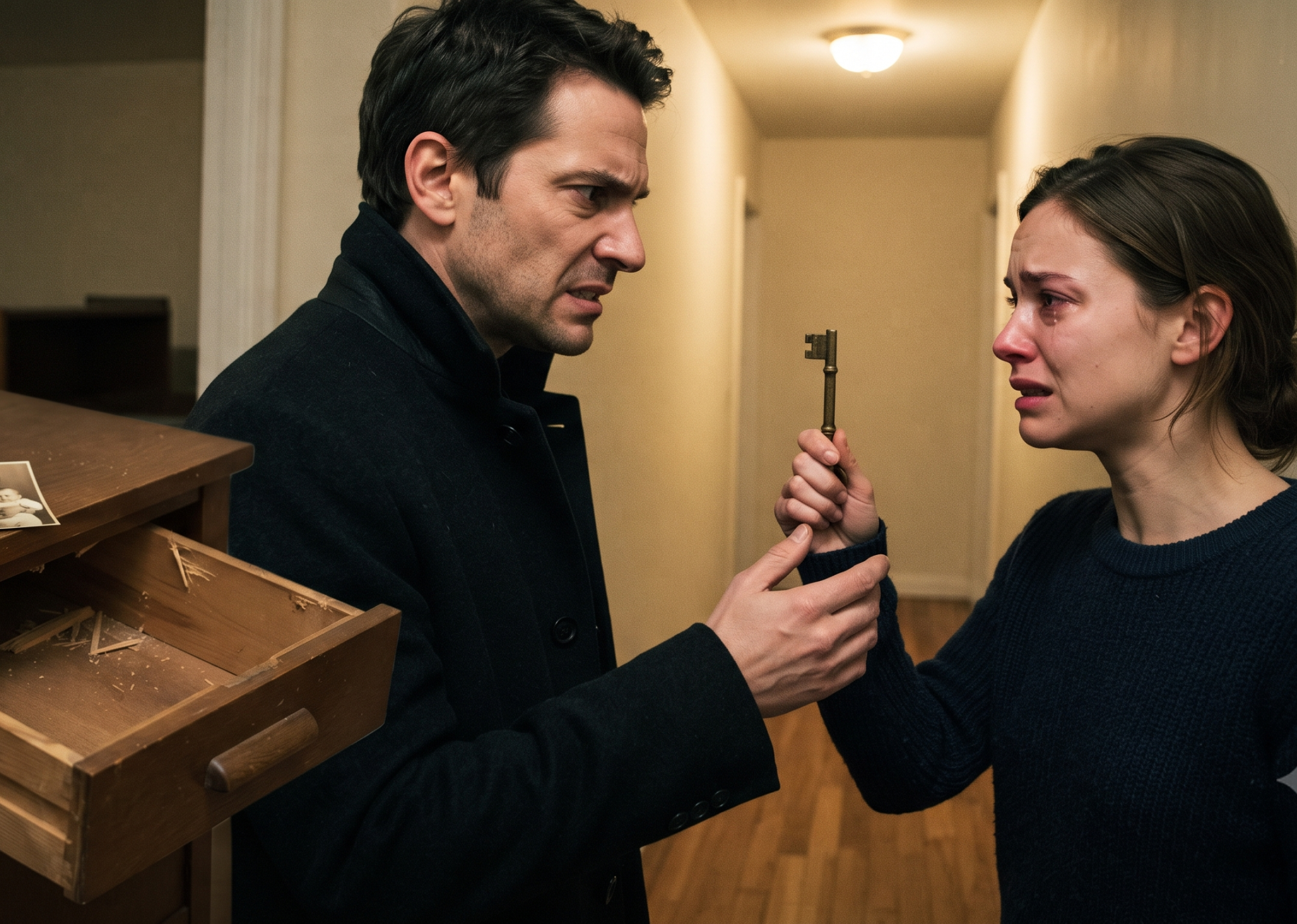
I pulled the brass key from my pocket. It glinted under the hallway light, heavy and defiant. “Then explain this. And explain the baby.”
Elias stopped. The silence stretched between us, so thick it felt like drowning. His eyes narrowed as he looked at the key, and for the first time, I saw it—not anger, but a raw, jagged fear.
“You shouldn’t have opened that,” he whispered, his posture dropping the facade of the composed businessman. “Father didn’t want you to see it until he was gone, but he didn’t realize the danger he was putting you in. You think he left you a treasure? He left you a debt.”
“A debt?” I moved toward him, my heart hammering. “That’s my mother in that photo. That’s a child. Is that my sibling? Or is that me?”
Elias stepped into my space, his voice dropping to a gravelly, urgent hum. “Anna, listen to me very carefully. That key doesn’t unlock a savings account. It unlocks a truth about our family that people have been killed to keep quiet. If you take that key to the location on the tag, you aren’t just revealing a secret—you’re putting a target on your back.”
“I’m already in danger, aren’t I?” I said, looking him straight in the eyes. “That’s why you pushed the sale. You were trying to lock the doors before I could find the key.”
Elias looked away, his jaw tightening. “I was trying to keep you alive. But now that you know… there’s no going back.”
He reached out, his hand hovering toward the key. “Give it to me, Anna. Let me handle it. I can make this go away.”
I pulled the key back, my grip firm. The image of the baby—the secret that had been hidden in the darkness of the desk for twenty years—suddenly felt more real than the brother standing before me.
“You’ve been handling things for long enough, Elias,” I said, stepping toward the door. “It’s my turn to know what belongs to me.”
I didn’t wait for his reply. I sidestepped him, my heart slamming against my ribs like a trapped bird. As I reached the door, Elias caught my arm, his grip bruising.
“If you go to the Northside Storage complex,” he hissed, his composure completely fractured, “you won’t find money. You won’t find a will. You’ll find the reason why our mother was never really allowed to be our mother. She didn’t leave because she wanted to, Anna. She left because she was protecting the very thing you’re holding in your hand.”
I yanked my arm away, the shock of his words rippling through me. “Then I guess I’m finally going to understand why she never came home.”
“Anna, wait!” he shouted as I threw the door open.
I didn’t look back. I ran down the stairs, the cool night air biting at my cheeks. I knew he would follow me, and I knew that if I wanted to survive this, I couldn’t go to the facility by car—he’d track the plate. I ducked into the shadows of the alleyway, my breathing ragged. I had the key, I had the photo, and for the first time in my life, I had a purpose that was entirely, terrifyingly my own.
I navigated the labyrinth of the city’s backstreets, my mind replaying the photograph. The baby in the picture didn’t just look like me; there was a small, distinct birthmark on the infant’s left wrist—the same mark I had spent my childhood hiding under watch straps and bracelets. A chill crawled up my spine. Was it possible that I was not who I thought I was? Was I not the daughter of this house, but the secret that had torn it apart?
I reached the industrial outskirts of the city, where the shadows stretched long and thin between abandoned warehouses. The Northside Storage complex stood like a tomb in the moonlight, a sprawling, grey metal monolith surrounded by high fences topped with razor wire. My heart sank. This wasn’t a place for heirlooms. It was a fortress.
I slipped through a gap in the fence I had spotted years ago on a childhood bike ride, my clothes snagging on the metal. Every sound—a distant siren, the rustle of a plastic bag—sounded like a gunshot. I found the row of lockers, the numbers fading into the rusted steel.
304.
I approached the locker with the brass key trembling in my hand. It was the only unit in the row that didn’t have a modern digital padlock; it held an old-fashioned, heavy-duty deadbolt. As I inserted the key, the metallic click sounded like a thunderclap in the unnatural silence.
The door groaned as I pulled it upward. I braced myself for weapons, for gold, for documents—anything. But as the interior light of my phone illuminated the space, I saw nothing but a single, pristine wooden cradle, a small trunk, and a stack of letters addressed to a name I had never heard: Elena.
My name wasn’t Anna.
I dropped to my knees, the air leaving my lungs. The letters, the cradle, the existence of this place… it was a graveyard for a life that had been erased. I opened the trunk, and inside lay a passport. My mother’s photo, but a different name, a different life, and a stamp from a country that didn’t exist anymore.
Then, I heard the crunch of gravel behind me.
“I told you not to come,” a voice said. It wasn’t Elias. It was a man I recognized from the funeral—my father’s lawyer, the one who had disappeared the day after the burial. He held a suppressed pistol, his expression etched with a cold, professional pity. “Your brother tried to protect you, Anna. But curiosity has a way of being fatal.”
I stood up, the passport clutched in my hand, staring at the man who represented the final piece of the lie. The truth wasn’t just my inheritance; it was my death warrant. And as he stepped into the light of the locker, I realized that the mystery of my mother’s disappearance wasn’t just a sad story—it was an ongoing, lethal operation.
Do you think Anna should attempt to fight back with the information she found, or is there a way to bargain with the lawyer using the documents in the trunk?