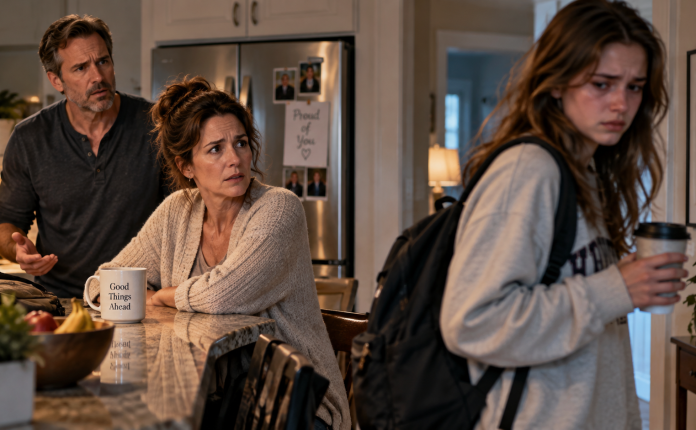
My oldest son looked me in the eye across my own dining room table and said, “We can’t rearrange our whole lives around a woman who may not even be here next year.”
Then my daughter picked up her designer purse, pushed back her chair hard enough to scrape the hardwood, and added, “Call us when you’ve handled the paperwork, Mom.”
My youngest son said nothing. That silence hurt worse than both sentences combined.
They walked out of my house four days after I told them I had been diagnosed with advanced cancer.
Twenty minutes later, my doctor called.
And what she told me made me slide down the kitchen cabinets onto the cold tile floor and laugh until my ribs ached. Not because anything was funny. Nothing about that night was funny. The roasted chicken had gone cold on the table. The candles were still burning beside three abandoned wine glasses. My hands still smelled faintly of rosemary and lemon from a dinner I had cooked because I was foolish enough to want one normal evening with my children.
I laughed because in the span of twenty minutes, I learned two truths that split my life in half.
The first was that I was not dying the way I had been told.
The second was that my children had already treated me like I was dead.
My name is Maribel Wren. I am sixty-three years old, and I live in a faded blue house on a quiet street in Savannah, Georgia, where the oak trees hang over the sidewalks like old women whispering secrets. My husband, August, and I bought this house thirty-two years ago when the porch sagged, the upstairs bathroom leaked, and the kitchen smelled permanently of old coffee no matter how many times I scrubbed it.
August said it had good bones.
I used to think people did, too.
We raised three children in that house. Sterling, my oldest, now thirty-seven, always believed the world owed him the best seat at the table. Coralie, my middle child, thirty-four, could turn guilt into perfume and spray it around a room until everyone else apologized. Beckett, my youngest, thirty-one, was the quiet one, the careful one, the boy who used to sleep with a flashlight under his pillow and grew into a man who spoke mostly in numbers.
And then there was Juniper.
Juniper was Coralie’s daughter, seventeen years old, with chipped blue nail polish, thrift-store cardigans, and a habit of calling me every Thursday just to ask what I had for dinner. Not because she needed money. Not because she wanted a ride. Just because she liked the sound of my voice, or at least she said she did.
For years, I clung to Juniper like proof that something decent still grew from the family August and I had planted.
Four days before the phone call, I sat in an exam room at St. Catherine’s Medical Center while Dr. Elena Voss turned her computer screen toward me. The fluorescent lights made everything look washed out, including her face.
“Maribel,” she said gently, “the imaging is concerning.”
Doctors use words like concerning when the truth is too sharp to hand over all at once.
There was a mass. There were test results. There were shadows that had not been there before, or maybe they had been there and no one had noticed. She spoke carefully, but I had spent thirty-eight years as a bookkeeper. I knew what bad numbers sounded like even when someone wrapped them in soft paper.
“How serious?” I asked.
She folded her hands. “Serious enough that I don’t want you facing this alone.”
That was the sentence that followed me home.
Not the word cancer. Not the treatment options. Not even the word advanced, which she said once and then seemed to regret.
I don’t want you facing this alone.
I drove home with the windows down even though the October air had a bite to it. Spanish moss blurred past the windshield. Somewhere downtown, church bells rang the hour, and I remember being offended that time had the nerve to keep moving.
I parked in my driveway and sat there for a long while with both hands on the steering wheel. The front porch still had the pumpkin Juniper had painted for me two weeks earlier, crooked grin, purple hat, one googly eye missing. August would have laughed at it. He had been gone seven years by then, taken in his sleep by a heart that had worked faithfully until the one night it didn’t.
I wanted him so badly in that driveway that I said his name out loud.
Then I called my children.
Sterling answered first. “Mom? I’m walking into a meeting.”
“I need you,” I said.
That stopped him.
The silence on the other end lasted just long enough for me to hear the muffled hum of his office. “Is it the house? The roof again?”
“No,” I said, my voice steadying in a way that surprised me. “It’s my health. I have cancer, Sterling. And I need you and your siblings to come over for dinner on Thursday.”
He didn’t ask how I was. He didn’t ask if I was scared. He asked, “Thursday? I have a client dinner. Can we do Friday?”
“Thursday,” I insisted, and I heard the iron in my tone—the same iron I used to keep the books in the black when business was lean.
When they arrived, the air in my dining room was heavy with the scent of rosemary and expectation. I had prepared the roasted chicken—August’s favorite—and poured the good wine. I wanted to see if the table was big enough to hold the truth, or if it would shatter under the weight of it.
It shattered before I even poured the second glass.
They didn’t hear my news with tears or questions. They heard it with calendars and long, appraising looks at my furniture. Sterling calculated the cost of my care against his upcoming vacation. Coralie, sitting across from me, had already begun talking about the “logistics of the property” as if I were a line item in an audit.
And then, they left. The sound of their car doors slamming in the driveway was the final punctuation mark on a chapter I realized I had been writing for decades, one where I was the supporting character in my own life.
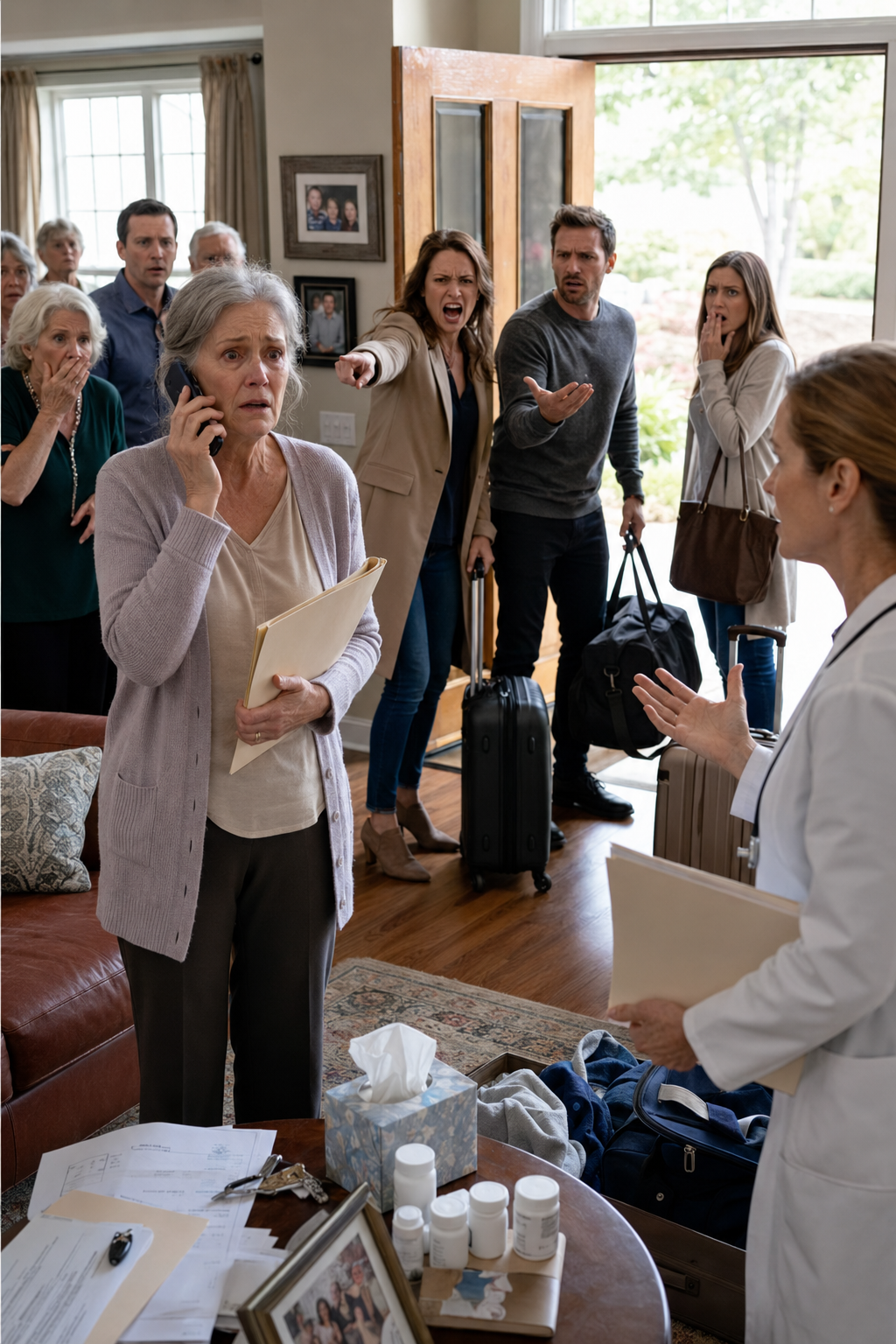
Twenty minutes later, the phone rang. It was Dr. Voss.
“Maribel?” she said, her voice sounding different, urgent, but not in the way I expected. “I need you to come back to the office first thing tomorrow morning. I’ve been looking over the lab work again—the cross-reference with the biopsy from the lab in Atlanta. There’s been a clerical error. A catastrophic one.”
My breath hitched. “What are you saying, Elena?”
“I’m saying the biopsy samples were switched, Maribel. That mass? It’s benign. A localized fibroid. It’s not cancer. You are healthy. You are absolutely, perfectly healthy.”
The room tilted. My legs turned to water, and I slid down the kitchen cabinets. I laughed. I laughed until my chest heaved, a jagged, wild sound that echoed off the high ceilings. I wasn’t dying. I was free. But I was also entirely alone in a house that suddenly felt very large and very, very quiet.
I sat on that tile floor for a long time. I thought about the way Sterling had looked at my dining room chairs as if he were measuring them for his own house. I thought about Coralie’s designer purse and her “paperwork.”
I stood up, walked over to the table, and picked up my wine glass. I looked at the three empty chairs. Then, I walked to the kitchen drawer, pulled out my old address book, and dialed a number I hadn’t called in months.
“Juniper?” I whispered when she picked up.
“Grandma?” Her voice was sleepy, sweet, and immediate. “Is everything okay? It’s past nine.”
“Everything is about to be very different, darling,” I said, a cold, clear clarity settling over me. “I have a lot to tell you, and I need a partner. Are you hungry?”
“Always,” she said.
“Good,” I replied. “Come over tomorrow. And bring that crooked-grinned pumpkin in from the porch. We’re going to do some redecorating.”
I went to my desk, opened the drawer where I kept the deeds, the trust documents, and the old accounts, and I began to write. I didn’t write a will; I wrote a redistribution. If they wanted to treat me like a fading memory, I would ensure that was exactly what I became to them. I would become a stranger, a phantom, and a woman who finally, for the first time in thirty-eight years, spent her money on herself.
The next morning, the sun rose over Savannah, and for the first time since August died, I didn’t check the weather to see if it would ruin the garden. I went to the bank. I called my lawyer. I made calls that would unravel the inheritance my children were so eager to carve up like that cold, dry chicken.
By the time Sterling called that afternoon to ask about the “paperwork,” I wasn’t the woman who begged for company. I was the woman who finally understood that blood is a suggestion, but character is a choice.
“Mom, about the house,” Sterling began, his voice practiced and smooth.
“The house is no longer a concern of yours, Sterling,” I said, watching the oak trees sway through the window. “And frankly, neither am I.”
I hung up, turned off the ringer, and went to the porch to wait for Juniper. The garden was wild, the house was old, and for the first time in my life, I was finally, beautifully, at home.