For forty years, I believed my wife had vanished with our children because she hated me enough to erase me from their lives. Then, three days after my seventy-fourth birthday, a hospice nurse called and told me that a woman using a false name had died with my photograph beneath her pillow. She was my daughter. By the time I reached her lonely apartment, every chance to ask why she had never come home was gone. But when I helped remove her mattress, I heard metal scraping against the bed frame. Sewn deep inside the fabric was a locked box containing two baby teeth, a scorched photograph, and a cassette labeled in my daughter’s handwriting:
Dad, play this only after Uncle Martin is dead.
Part 1: The Last Saturday
The call came at 8:17 on a Monday morning.
I remember the exact time because I had just placed two slices of bread in the toaster and was watching the red coils brighten when my telephone rang.
These days, nobody called my landline except salespeople and the medical clinic reminding me about appointments. I almost let it ring.
“Mr. Daniel Mercer?” a woman asked when I answered.
“Yes.”
“My name is Helen Warren. I’m a social worker with St. Catherine’s Hospice in Fairmont. I’m calling regarding a patient named Mara Vale.”
“I’m sorry,” I said. “I don’t know anyone by that name.”
There was a pause.
“Did you have a daughter named Emily?”
The toaster sprang up behind me.
For several seconds I could hear nothing except the dry ticking of the kitchen clock.
My knees weakened, and I reached for the edge of the counter.
“My daughter disappeared in 1986.”
“How old was she?”
“Eight.”
“Did she have a small crescent-shaped birthmark behind her left ear?”
The room seemed to tilt.
“Yes.”
Helen inhaled slowly.
“Mr. Mercer, Mara was forty-eight years old. During her final week, she asked us to contact you after her death.”
I tightened my grip on the receiver.
“After?”
“She died early this morning.”
The silence that followed was so complete that I could hear the refrigerator motor click off.
For forty years, I had imagined finding Emily in a hundred different ways. I imagined her walking toward me at an airport. I imagined seeing her name on a marriage announcement. I imagined a knock at the door, followed by the face of the eight-year-old girl I had lost transformed into a woman I would somehow still recognize.
Never once had I imagined arriving too late.
“Did she say anything about my son?” I asked.
“I’m afraid she left only a few instructions and a key to her apartment.”
“Where is she?”
“Fairmont.”
Fairmont was less than two hours away.
For forty years, my daughter had lived within driving distance.
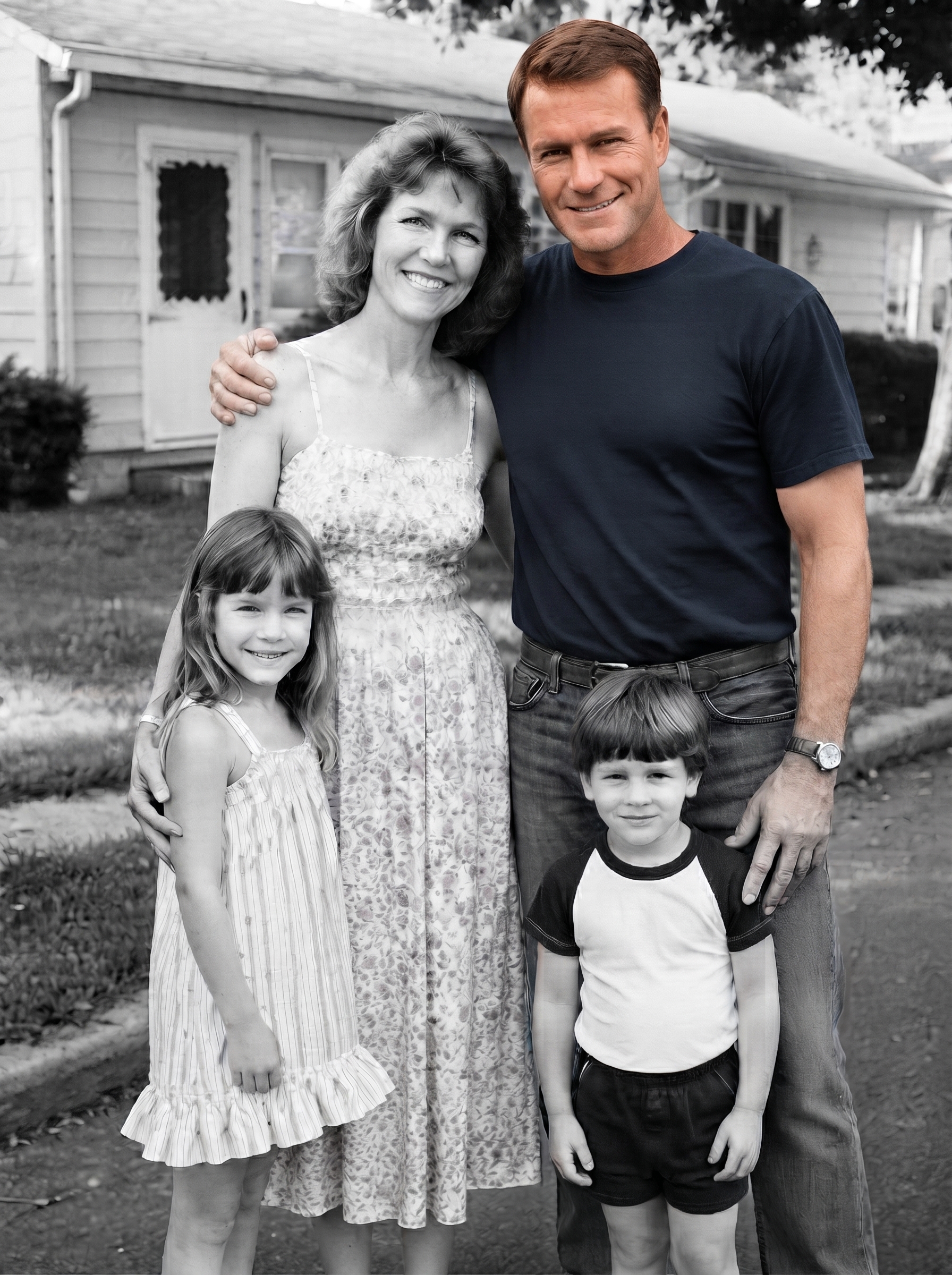
I left the toast untouched and packed nothing except my wallet, medication, and the old photograph I carried in my coat pocket. It showed Emily sitting on my shoulders while five-year-old Noah clung to my leg, laughing. Laura stood beside us, one hand raised against the sun.
It had been taken six weeks before they disappeared.
On Saturday, June 14, 1986, Laura announced she was taking the children to visit her cousin Grace near Lake Bellamy.
“I thought Grace moved to Blackwater,” I said.
“She’s staying at the lake for the summer.”
Laura avoided my eyes as she folded Noah’s blue sweatshirt into a canvas bag.
I was thirty-four then, running a construction supply company with my older brother, Martin. We had spent the previous week arguing over missing invoices and a contract Martin wanted me to sign. I was exhausted and distracted.
That became one of the many things I spent forty years punishing myself for.
Emily stood in the hallway with her stuffed rabbit under one arm.
“Are you coming, Daddy?”
“Not this time, Em.”
Her face fell.
I crouched in front of her.
“I have to meet Uncle Martin at the office. But I’ll take you to Miller’s Pond next weekend. Just you, me and Noah.”
“Promise?”
“I promise.”
She held out her little finger.
I hooked mine around it.
Noah ran into the hallway carrying a plastic dinosaur and wearing only one shoe.
“I’m ready!”
“You’re missing something,” I said.
He looked down.
“My other dinosaur?”
“Your shoe.”
He giggled as I lifted him.
Laura watched us from beside the door. Her expression was strange—tender, frightened and distant at the same time.
“What?” I asked.
“Nothing.”
She stepped forward and kissed me.
It was not a casual goodbye kiss. Her hands pressed against my face, and for one fleeting second I felt her trembling.
“Laura?”
She released me quickly.
“We’ll be home Sunday evening.”
Those were the final words my wife ever spoke to me.
At seven on Sunday night, I called Grace.
She had not seen Laura in eight months.
At eight, I called the police.
At eleven, they found our station wagon at the Westhaven bus terminal, locked and empty. Laura’s handbag was gone. Two suitcases were missing. Noah’s emergency asthma inhaler lay beneath the passenger seat.
Detective Samuel Price asked whether Laura and I had been fighting.
“Every married couple fights,” I told him.
“About what?”
“Money. My hours. My brother.”
“Did she ever threaten to leave?”
“No.”
That was almost true.
Six months earlier, during an argument, Laura had shouted, “One day you’ll come home and we’ll be gone.”
She apologized later and said she had not meant it.
When I admitted this, Detective Price wrote it down.
By Tuesday, newspapers were calling it a domestic disappearance. By Friday, reporters were parked outside my house.
Then the police found the note.
It had been mailed from Westhaven the morning Laura disappeared.
Daniel,
Do not search for us. The children are safe. I cannot live in fear anymore. You know what you did, and someday the world will know too.
Laura
I read it until the handwriting blurred.
“That’s hers,” I whispered.
Detective Price studied my face.
“What did she mean?”
“I don’t know.”
He asked whether I had ever struck my wife.
“No.”
Threatened her?
“No.”
Struck the children?
“Never.”
Then he mentioned Peter Hale.
Peter was the accountant at Mercer Brothers Supply. He had died in a single-car accident nine days before Laura vanished.
“Mrs. Mercer called him three times the night before his death,” Price said.
“I didn’t know that.”
“Your brother says Peter discovered irregularities in the company accounts.”
“Martin told you that?”
“He also said you and Peter had a confrontation.”
I felt cold.
Martin and I had argued with Peter about missing funds, but Martin had insisted we keep the matter inside the company.
“Where is my brother?” I asked.
“Being interviewed.”
Martin arrived at my house after midnight. He walked through the kitchen door without knocking, as he had since we were boys.
He was six years older than me, taller, broader and far more comfortable telling lies. He hugged me hard enough to appear loving.
“We’ll find them,” he said.
“Did you tell the police I threatened Peter?”
Martin stepped back.
“I told them you argued.”
“You said he discovered irregularities.”
“He did.”
“You told me it was an accounting mistake.”
“I was trying to protect the company.”
“From what?”
He stared at me for a moment before lowering his voice.
“Daniel, you need to stop behaving like everyone is against you. Laura was afraid. We both know that.”
“Afraid of what?”
His expression changed so quickly I almost missed it.
Satisfaction.
Then sorrow returned to his face.
“I don’t know.”
For the next two years, I traveled wherever a possible sighting led. I slept in cheap motels, searched school records and mailed photographs to police departments across the country.
Most leads were cruel accidents of resemblance.
Some were deliberate scams.
A woman in Oregon claimed she knew where Emily was and asked for five thousand dollars. A man in Arizona said Noah had been adopted by a doctor. A caller whispered that Laura was dead, then laughed.
Detective Price was the only person who never treated me like a guilty husband or a delusional father.
In October 1987, he visited me carrying an enlarged surveillance photograph taken at a Westhaven motel on the day before the disappearance.
Laura stood beside the vending machines.
Emily and Noah were behind her.
A man was holding the motel-room door open.
His face was partially turned, but I recognized the heavy watch on his wrist and the scar above his thumb.
It was Martin.
“He says he was helping her leave you,” Detective Price told me. “He claims she called him because she was frightened.”
“He never told me.”
“I know.”
“Arrest him.”
“Helping an adult leave her husband isn’t kidnapping. We need evidence that the children were endangered or taken across state lines under false identities.”
“He lied for sixteen months!”
Price placed a hand on my shoulder.
“I’m going back through everything.”
He died eleven days later when his car slid off a rain-soaked road.
The case passed to another detective, then another.
Martin denied knowing where Laura went. He said he gave her five hundred dollars, drove her to the motel and left.
Our partnership ended.
He bought my share of the company for less than half its value because I needed money to keep searching. Over the next thirty years, Mercer Brothers became one of the largest building suppliers in the region.
Martin became rich.
I became the man who kept two children’s bedrooms unchanged.
Forty years after the disappearance, I stood inside my daughter’s apartment in Fairmont.
Helen from the hospice met me there. She was a kind woman in her fifties with tired eyes.
“Mara—Emily—had ovarian cancer,” she explained. “She refused most visitors. Near the end, she gave me your name and childhood address.”
“Did she talk about me?”
“She said you used to make pancakes shaped like animals.”
I covered my mouth.
Every Sunday, I had made Emily rabbits and Noah dinosaurs.
Helen touched my arm.
“She said she was sorry.”
The apartment was painfully neat. Books lined the walls. A sewing basket rested beside the window. On the bedside table stood a photograph of Noah and Emily from 1986—the same photograph I had distributed during the search.
The frame faced the bed.
“She looked at it often,” Helen said.
“Why didn’t she call me?”
“I don’t know.”
After Helen left, I sat on the edge of the mattress where my daughter had spent her final nights.
The bed creaked beneath me.
I whispered the words I had rehearsed for forty years.
“I never stopped looking.”
When I rose, my shoe caught the fabric beneath the mattress. I bent to free it and saw a section of upholstery stitched with thick red thread.
Emily had been a professional seamstress.
I found scissors in her sewing basket and cut through the stitches.
My fingers touched cold metal.
The box was no larger than a hardcover book. Its lock had already been broken.
Inside were two baby teeth wrapped in tissue, a key, several ledger pages, a photograph blackened around the edges, and an old cassette tape.
The photograph showed Laura standing outside a wooden cottage.
Martin’s arm was around her waist.
Laura was pregnant.
On the back, someone had written:
Blackwater, August 1984. Noah belongs to him.
My hands began shaking.
Beneath the photograph lay a note in Emily’s handwriting.
Dad, if you found this, I failed to tell you myself. Uncle Martin did not help Mom escape from you. He helped her escape with him. And when she tried to bring us home, he killed her.
Part 2: My Daughter’s Voice
For several minutes, I could not move.
The apartment seemed to recede around me, as though I were standing at the end of a long tunnel.
I read the sentence again.
He killed her.
I had imagined Laura alive for decades. I had imagined her raising the children beneath another name, perhaps regretting what she had done but too ashamed to return.
I had also imagined her dead.
But I had never imagined Martin’s hands involved.
A cassette player sat on a shelf beneath the window. It looked older than the other electronics, deliberately preserved.
I inserted the tape.
There was a click, several seconds of static, and then a woman inhaled.
“Dad, it’s Emily.”
Her voice was low and uncertain.
I closed my eyes.
“I have recorded this six times,” she continued. “Every time, I erase it because I don’t know how to tell you what happened without admitting what I did. I knew where you were. I found you when I was twenty-three. I saw you sitting alone in a diner. I followed you home. But Uncle Martin told me that if I spoke to you, Noah would die.”
I pressed one hand against my chest.
Emily’s voice trembled through the speaker.
“Mom lied when she took us away. But she didn’t understand the whole lie yet.”
The tape stopped abruptly.
I turned it over.
On the second side, Emily began with a date: March 11, 2025.
She explained that Laura had known Martin before she met me. They had dated briefly when Laura was nineteen, but Martin left her for another woman.
Years later, after Laura and I were married, their relationship resumed.
The affair began during the winter of 1983.
Noah was born in January 1985.
My son had my mother’s eyes, or so I had always believed.
The photograph from Blackwater had been taken five months before his birth.
“Mom told me the trip was a game,” Emily said. “She said we would surprise you after a few days. At the motel, Uncle Martin told her you had killed Mr. Hale because he discovered stolen money. He showed her photographs of Mr. Hale’s car and a bloody shirt he said belonged to you. Mom was already afraid because she had helped Uncle Martin hide invoices from the company.”
I remembered the missing invoices.
The unexplained withdrawals.
The contract Martin had pressured me to sign.
“Mom believed you would go to prison,” Emily continued. “Uncle Martin told her the police would take us away and that you might hurt her before you were arrested. She agreed to disappear until he could arrange new identities.”
My grief changed shape.
Laura had not simply left me for Martin.
She had helped him steal from us.
Then she had believed his evidence against me because accepting his story protected her from admitting what they had done together.
The tape continued.
Martin drove them from Westhaven to a cottage near Blackwater, nearly three hundred miles north. Laura and the children lived there under the name Reed.
Martin visited every few weeks.
To Emily, he became Uncle Mark.
Noah was told he was too young to remember his real father.
Laura grew increasingly frightened. She found newspaper articles showing that Peter Hale’s death had been ruled an accident, not murder. She also discovered that the bloody shirt Martin showed her had been taken from a hunting accident years earlier.
In December 1986, Laura found papers in Martin’s briefcase proving that he had transferred company funds into accounts controlled by Grace, her cousin.
“She started writing letters to you,” Emily said. “She never mailed them because Uncle Martin checked the mailbox. She told me we would leave after Christmas. She said you might hate her, but she would tell the truth.”
My breath caught.
Laura had intended to come home.
On January 3, 1987, Martin arrived at the cottage.
Emily had been upstairs with Noah.
She heard Martin and Laura arguing below.
“You promised Daniel would be arrested,” Laura shouted.
“I promised you’d be safe.”
“You lied about Peter.”
“Keep your voice down.”
“You killed him, didn’t you?”
A long silence followed.
Then Martin said, “Peter made a choice.”
Laura threatened to go to the police.
Martin reminded her that she had forged invoices and kidnapped two children.
“You’ll go to prison,” he told her. “Daniel will take the children, and Noah will learn who his real father is.”
Emily heard a chair overturn.
Laura screamed for her to take Noah and run.
The children escaped through an upstairs window onto the porch roof. Emily jumped first. Noah slipped and injured his ankle.
They hid in the trees.
From there, Emily saw smoke rise from the kitchen.
She saw Martin walk out of the cottage alone.
Then she saw him go back inside.
When he emerged, he carried Noah.
“I wanted to run after him,” Emily said on the tape. “But Mom had told me to stay hidden. I stayed there all night. I thought Noah was dead.”
A volunteer firefighter found Emily the next morning. She was hypothermic, confused and terrified.
Martin arrived before the police could question her.
He claimed to be her uncle and legal guardian. He told authorities her mother, “Lauren Reed,” had died in the fire and her younger brother had also perished.
The cottage was so badly burned that only one adult body was recovered.
No child’s body was found, but Martin said Noah had been cremated in the hottest part of the fire.
The local sheriff accepted the explanation.
This was 1987, before digital records connected every missing child to every hospital and school. Laura’s false identification listed Martin as her brother.
Grace confirmed his story.
Emily was taken to a private psychiatric facility under the name Mara Reed.
“Uncle Martin told me you started the fire,” she said. “He said Mom called you and begged you to forgive her, but you came to Blackwater in a rage. I remembered seeing a man outside, and he kept telling me it was you. After enough medicine and enough questions, I believed him.”
I gripped the edge of the table.
“I hated you,” she whispered. “That is the ugliest truth I have to give you.”
The facility closed in 1994 after accusations of abuse. By then, Emily was sixteen and had been placed with Grace under a new surname: Vale.
Grace kept her isolated, telling her Martin was paying for her protection.
At eighteen, Emily left.
She became a seamstress, moved often and searched quietly for Noah.
She also searched for me.
“When I found you at the diner, I sat three booths behind you,” she said. “You had our missing-person flyer folded beside your coffee. It had been seventeen years, and you were still carrying it.”
I remembered that diner.
I had gone there after following a false lead about a woman named Emily Mercer attending a nearby college.
“I wanted to walk over,” my daughter said. “But Martin found me first.”
He had followed her.
He showed Emily a recent photograph of a young man leaving a high school graduation ceremony.
Noah.
Alive.
Martin said he knew where Noah lived. If Emily contacted me or the police, Martin would arrange an accident.
“I believed him because I had seen what happened to Mom.”
The tape ended with Emily saying there was more evidence in a storage locker. The key was in the box.
A note beside it listed the location: Blackwater Central Station, Locker 214.
I drove north the following morning.
The station had been renovated, but the old storage area remained in the basement. The manager allowed me to open the locker after I showed him Emily’s death certificate and the key.
Inside was a cloth bag containing Laura’s diary, old letters addressed to me, and a yellow envelope labeled Noah.
The first letter was dated December 19, 1986.
Dear Daniel,
I have committed sins against you that I cannot explain away. I loved your brother before I understood what love was, and I let that old weakness enter our marriage. Noah may be his child, but you are the only father he has ever known.
Martin told me you killed Peter. I believed him because believing him allowed me to pretend that leaving was necessary instead of selfish.
Now I know the truth.
Peter found the false invoices. Martin cut the brake line in his car. I have the original ledgers.
I am bringing the children home.
Please protect them, even if you can never forgive me.
Laura
I lowered the letter.
The yellow envelope contained a school photograph of Noah at seventeen. On the back was a different name.
Samuel Reed. Class of 1997.
There was also a recent address.
He lived in Briar County, less than ninety miles from my house.
My son was alive.
I had begun to cry when something slipped from the envelope and landed on the floor.
It was a newspaper clipping from only six months earlier.
The headline read:
LOCAL VETERINARIAN SURVIVES DELIBERATE HIT-AND-RUN
The veterinarian’s name was Dr. Samuel Reed.
At the bottom, Emily had written:
Martin knows Noah is searching too. Dad, find him before Martin finishes what he started.
Part 3: The Man Who Had My Son’s Face
I called the Briar County sheriff from the station.
The deputy who answered would not discuss an active investigation, but he confirmed that Dr. Samuel Reed had survived the hit-and-run and returned to work.
“Has anyone been arrested?” I asked.
“No.”
“Does he have police protection?”
“Sir, who are you?”
I looked at Noah’s school photograph.
“I’m his father.”
The words felt both natural and impossible.
Samuel’s veterinary clinic stood between a feed store and a pharmacy in the small town of Alder Creek. A painted wooden sign showed a dog, cat and horse beneath the words Reed Animal Care.
I remained in my car for twenty minutes.
People entered carrying pet carriers or leading dogs. A little girl came out holding a jar of treats.
At last, a tall man stepped onto the sidewalk.
He had gray beginning at his temples. His sleeves were rolled to his elbows, and a stethoscope hung around his neck.
He turned toward a barking dog.
The angle of his smile stopped my heart.
Noah had smiled that way when he was five—one corner rising before the other.
I got out of the car.
“Samuel?”
He looked at me.
“Yes?”
“My name is Daniel Mercer.”
Recognition erased the smile.
He glanced toward the clinic door, then at the street.
“You shouldn’t be here.”
“You know who I am?”
“I know who you claim to be.”
“I have proof.”
“You need to leave.”
“Noah—”
His face hardened.
“That is not my name.”
“It was the name your mother gave you.”
“My mother died because of you.”
The words struck with physical force.
People on the sidewalk looked toward us.
“Martin told you that.”
“My uncle saved my life.”
“He took you from a burning house.”
“He took me away from the man who set it on fire.”
“I wasn’t there.”
Samuel stepped closer.
“You expect me to believe you spent forty years looking for us, yet you never found the fire report?”
“The names were false. The records were buried in another county.”
“Convenient.”
“Emily found me.”
His anger faltered.
“What did you say?”
“Your sister died two days ago.”
The color left his face.
“No.”
“She had cancer.”
“You’re lying.”
I held out the recent photograph from Emily’s bedside.
Samuel stared at it but did not take it.
“She found you,” I said. “She knew you survived. She spent years trying to protect you.”
He backed toward the clinic wall.
“I spoke to Mara three weeks ago.”
“Mara was Emily.”
“No. Mara was my cousin.”
“That is what Martin told you.”
Samuel pressed both hands against his head.
“Stop.”
I placed Laura’s letter on the hood of my car.
“Read this.”
“I don’t want anything from you.”
“It’s your mother’s handwriting.”
He looked down.
For a long time, neither of us moved.
Then he took the letter.
His eyes traveled across the first page. His jaw tightened. By the time he reached the final lines, his hands were trembling.
“This could be forged.”
“There are dozens more.”
“Martin said she was frightened of you.”
“Martin was sleeping with her.”
Samuel struck me.
The blow came fast and hard. I fell against the car door, tasting blood.
He immediately stepped back.
“I’m sorry,” he said, though his expression remained furious.
“You have every right to be angry.”
“Don’t tell me what I have a right to feel.”
“You’re correct.”
A woman in blue scrubs opened the clinic door.
“Dr. Reed?”
“I’m fine, Annie.”
She looked at me suspiciously before going inside.
Samuel lowered his voice.
“I remember the fire. I remember smoke. I remember someone carrying me.”
“Martin.”
“I remember a man shouting that my father wanted us dead.”
“You were five years old, injured and terrified.”
“I remember my mother screaming.”
“So does Emily.”
He flinched at the name.
I told him about the recording.
I told him Emily had watched Martin leave the burning cottage.
I told him one adult body had been found.
“She said you were alive,” I finished. “Martin took you somewhere else and told her you were dead.”
Samuel leaned against the wall.
“I woke up in a hospital. Uncle Martin said my mother and sister had died. He said you caused the fire and disappeared before the police arrived.”
“Where did you live?”
“With a family named Reed in Minnesota. Martin said they were relatives.”
“They adopted you?”
“Guardianship first. Adoption later.”
“Did Martin visit?”
“Twice a year.”
“Did he pay them?”
“I don’t know.”
I studied the grown man before me.
“I brought your dinosaur to every search interview for ten years.”
His eyes lifted.
“What?”
“A green plastic tyrannosaurus. You carried it the morning you left.”
Samuel’s lips parted.
“I remember a dinosaur.”
“You named it Captain Bite.”
He stared at me.
No one else could have known that. Laura found the name ridiculous, and Emily was too young to remember every detail.
Samuel looked away quickly.
“The hit-and-run,” I said. “What happened?”
“I had been asking questions about my adoption. The driver came onto the sidewalk. Police found the truck abandoned.”
“Did Martin know you were investigating?”
Samuel did not answer.
That was answer enough.
We agreed to meet after the clinic closed.
He chose a diner in the center of town and sat across from me with both arms folded. I brought photographs, newspaper clippings, police reports and copies of Laura’s letters.
Samuel examined them without speaking.
When he reached a photograph of himself sitting on my shoulders, his composure broke.
“I’ve seen this,” he whispered.
“Where?”
“In a dream.”
“It happened at the county fair.”
“There were balloons.”
“Yes.”
“And a woman spilled lemonade.”
I laughed through my tears.
“You cried because it landed on your dinosaur.”
Samuel covered his face.
For several minutes, I watched my son weep for a childhood stolen so completely that even his memories had been presented to him as nightmares.
We arranged a DNA test.
“I need facts,” he said. “Not stories.”
“So do I.”
The sheriff agreed to reopen the hit-and-run investigation after hearing Emily’s recording. Blackwater authorities also reopened the cottage fire.
Martin’s attorney issued a statement calling my accusations the delusions of a grieving man.
Two days later, someone broke into Samuel’s clinic.
Nothing valuable was taken.
But every file related to his adoption disappeared.
That night, Samuel called me.
“I found something.”
I drove to his house, a modest farmhouse at the edge of town.
He led me into the basement and opened a metal trunk.
Inside were childhood clothes, school certificates and a half-burned wooden box Martin had given him when he turned eighteen.
“He said these were recovered from the cottage.”
Samuel removed a silver locket. One side was blackened. Inside was a photograph of Laura holding Emily as a baby.
Behind the photograph was a folded strip of paper neither of us had noticed before.
Samuel unfolded it carefully.
The message was written in Laura’s handwriting.
Emily, take your brother to the old well. Your father Daniel is innocent. Trust no one except Detective Price.
Below the sentence, Laura had written a series of numbers.
Samuel looked at me.
“What are these?”
I recognized the first six digits.
“They’re dates.”
The rest resembled account numbers.
Peter Hale’s missing evidence.
Before we could examine them further, headlights swept across the basement window.
A vehicle stopped outside.
Samuel moved toward the stairs, but I grabbed his arm.
The front door burst inward.
A man’s voice echoed through the house.
“Give us the locket, Dr. Reed, and neither of you has to die tonight.”
Part 4: The Old Well
Samuel switched off the basement light.
Footsteps crossed the floor above us.
I could hear at least two people.
Samuel opened a cabinet and removed a veterinary tranquilizer gun.
“You keep that in your house?” I whispered.
“I treat horses.”
The basement had a rear door leading beneath the porch. We moved toward it, but one of the intruders began descending the stairs.
Samuel raised the tranquilizer gun.
A flashlight beam struck the wall.
“Dr. Reed,” the intruder called. “Your uncle wants to settle this peacefully.”
“Breaking into my house is peaceful?”
“Give us the locket.”
The man reached the bottom step.
Samuel fired.
The dart struck his thigh. He shouted and fell against the railing.
The second intruder ran downstairs with a handgun.
I swung the metal trunk into his knees.
The gun discharged into the ceiling.
Samuel tackled him before he could recover.
The struggle lasted less than a minute, though it felt much longer. The first intruder tried to stand, staggered twice and collapsed as the tranquilizer took effect.
Police arrived soon afterward.
The men were private security contractors employed by a company connected to Mercer Holdings.
Martin denied sending them.
One carried a burner phone containing a single text:
Recover Hale evidence. No police.
The sender’s number had been deleted, but the message established that the numbers in Laura’s locket mattered.
The next morning, Samuel and I drove to Blackwater.
The cottage site had become part of a state conservation area. Only the stone foundation remained beneath thick weeds and young trees.
According to Laura’s note, Emily was supposed to take Noah to an old well.
We found it fifty yards behind the cottage, covered by rotting boards.
A police evidence team removed the boards and lowered a camera.
At the bottom lay a rusted metal container.
Inside were financial ledgers wrapped in oilcloth, photographs of forged checks and a microcassette recorder.
The tape had been damaged by moisture but remained partly playable.
Peter Hale’s voice emerged through static.
He described Martin diverting company funds through false suppliers controlled by Grace. Peter had confronted him and planned to contact the authorities.
“If anything happens to me,” Peter said, “Daniel has no knowledge of these accounts. Martin told me he could solve the problem permanently. I believe he means to kill me.”
The recording ended.
Martin’s motive for killing Peter was clear.
His motive for manipulating Laura was just as strong.
Laura had processed several fraudulent invoices after Martin told her they were part of a tax strategy. If Peter’s evidence surfaced, she could connect Martin to the accounts.
So Martin convinced her that Daniel had killed Peter, persuaded her to flee and placed her under his control.
But there was another item in the container.
A letter addressed to Detective Price.
Laura had written that Martin planned to move money from the company after Daniel was arrested. She also described their affair and admitted Noah might be Martin’s biological child.
The final paragraph was dated January 3, 1987—the day of the fire.
Martin is here. Emily heard us arguing. I told the children to go to the well, but Noah is hurt. If they do not reach it, please find them. Martin says I belong to him because I chose him once. I finally understand that he has never loved anyone. He only keeps what he believes he owns.
Samuel read the letter twice.
“Why didn’t Emily reach the well?”
“She said you injured your ankle. She hid closer to the house.”
“And Martin found me.”
“Yes.”
Samuel stood among the remains of the cottage, staring at the ground.
“My whole life, he told me he rescued me.”
“He rescued you from a fire he started.”
Blackwater detectives searched old hospital records. They found an admission for a five-year-old unidentified boy on January 4, 1987, brought in by a man claiming to be his uncle.
The boy suffered smoke inhalation, an ankle fracture and temporary memory loss.
Martin removed him against medical advice after one day.
The fire investigation became a homicide case.
The medical examiner reviewed preserved evidence from the recovered body. Modern testing confirmed it was Laura.
She had suffered a skull fracture before the fire.
Martin had struck her, then set the cottage ablaze.
The district attorney warned us that evidence linking him directly to the blow remained limited. The ledgers and recordings proved fraud and provided motive, but Martin’s lawyers would argue someone else killed Laura.
Grace was still alive.
She lived in a gated retirement community on the coast.
Detectives interviewed her twice. She claimed memory loss.
Samuel and I visited without warning.
Grace answered the door wearing white linen and gold earrings. She was eighty-one but appeared carefully preserved, as though age were another truth she had attempted to conceal.
When she saw me, the color drained from her face.
“Daniel.”
“You remember me.”
“I heard about Emily. I’m very sorry.”
“You raised her under a false name.”
“I protected her.”
“From me?”
“From the scandal.”
Samuel stepped forward.
“What scandal?”
Grace looked at him and began to cry.
“Oh, Noah.”
“My name is Samuel.”
“You look like Martin.”
Samuel’s jaw tightened.
I placed a copy of Laura’s final letter on the table.
“She knew Martin killed Peter,” I said. “She planned to expose him.”
Grace lowered herself into a chair.
“I told him to let her go.”
“You helped him steal my children.”
“I helped Laura leave. That was different.”
“You forged identification.”
“She begged me.”
“And after the fire?”
Grace pressed a hand against her mouth.
“Martin said Daniel had found them. He said Daniel attacked Laura.”
“You knew that was a lie.”
“I suspected.”
“You took Emily anyway.”
Grace looked at the floor.
“Martin had photographs of me signing the false accounts. He said we would all go to prison.”
“So you drugged a traumatized child and taught her to hate her father.”
“I was afraid.”
I leaned toward her.
“My daughter died afraid.”
Grace began sobbing.
Samuel did not move.
“Where did Martin take me?” he asked.
“To the Reeds.”
“Who were they?”
“Friends of his wife.”
“Did they know I had been kidnapped?”
“No. He told them your parents were dead.”
“Why did he separate us?”
Grace looked at him with genuine pity.
“Because Emily saw too much.”
“And me?”
“Because Martin believed you were his son.”
Samuel’s face became unreadable.
Grace agreed to provide a sworn statement in exchange for consideration from prosecutors. She described seeing Martin return from Blackwater with blood on his coat and Noah unconscious in his car.
She also admitted intercepting letters Emily attempted to send me.
“How many?” I asked.
“Eleven.”
“Where are they?”
“Martin kept them.”
Martin was arrested for fraud, conspiracy, kidnapping and obstruction. The murder charge remained pending.
For the first time in forty years, I watched my brother enter a courthouse in handcuffs.
He smiled when he saw me.
“You always were dramatic, Danny.”
I had not heard that childhood name in decades.
Samuel stood beside me.
Martin looked at him for a long moment.
“My boy,” he said.
“I’m not yours,” Samuel replied.
Martin’s smile widened.
The DNA results arrived that afternoon.
The testing laboratory confirmed with absolute certainty that Emily had been my biological daughter.
The report regarding Samuel used different words.
Daniel Mercer is excluded as the biological father.
At the bottom was an additional comparison requested by investigators after Martin’s arrest.
Martin Mercer cannot be excluded. Probability of paternity: 99.997 percent.
Samuel lowered the report.
For the first time since finding him, he looked at me not with anger or suspicion, but with fear.
From across the courthouse corridor, Martin called out:
“You can pretend all you want, Noah. But the blood in your veins is mine.”
Part 5: What Makes a Father
Samuel disappeared for three days.
He did not answer my calls. The clinic staff said he had taken emergency leave. His truck was gone from his house.
I understood why he ran.
His entire identity had been destroyed twice—first at five and again at forty-five.
I returned home and sat in Noah’s childhood bedroom.
The dinosaur wallpaper had faded to pale green shadows. Captain Bite remained on the shelf, one plastic leg scratched from years of play.
I considered removing it and taking it to Samuel.
Instead, I waited.
On the fourth evening, a truck stopped outside.
Samuel entered without knocking.
He stood in the hallway looking at the family photographs I had refused to remove.
“You kept everything,” he said.
“I didn’t know what else to do.”
He entered his old bedroom and picked up the dinosaur.
“Captain Bite,” he whispered.
“You remember?”
“Not exactly. But the name feels familiar.”
We sat on the floor like two people trying to rebuild a house from broken pieces.
“Martin is my biological father,” he said.
“Yes.”
“You knew it was possible.”
“After I saw the photograph.”
“But before?”
“No.”
“Would it have changed anything?”
I answered immediately.
“No.”
“You don’t have to say that.”
“I changed your diapers. I walked the hallway with you during asthma attacks. I taught you to throw a ball, and you nearly broke Mrs. Dalton’s window. You called me Daddy before you knew what the word meant.”
Samuel looked at the dinosaur.
“I struck you.”
“You were angry.”
“I accused you of killing my mother.”
“You believed the man who raised you from a distance.”
“He didn’t raise me. The Reeds did.”
“Were they kind?”
“Yes. They thought Martin was my guardian. They died believing my parents were dead.”
“I’m glad someone loved you.”
Samuel’s eyes filled with tears.
“That makes it worse.”
“Why?”
“Because I had good people. Emily had Grace.”
We visited Emily’s apartment together.
Samuel walked through every room slowly. In the closet, we found dresses Emily had sewn but never worn. Her desk contained folders documenting Martin’s companies, Grace’s properties and old Blackwater records.
She had been building the case alone.
Inside a drawer was a stack of unsent letters.
One was addressed to Samuel.
Dear Noah,
I found you when you were twenty-two. You were standing outside a veterinary college with a woman in a red coat. I wanted to tell you who I was, but Martin had already warned me. I watched you laugh and decided that knowing me might destroy the life you had built.
That was cowardice disguised as sacrifice.
I am sorry.
Samuel pressed the letter to his chest.
Another letter was addressed to me.
Dad,
I do not expect forgiveness for staying away. Martin threatened Noah, but fear was not the only reason. I was ashamed that I believed you killed Mom. I was ashamed that I spent years hating the person who never stopped loving me.
I visited your street every Christmas for twelve years.
Once, I saw you placing two gifts beneath the tree.
You still wrote our names on them.
I wanted to knock.
I never became brave enough.
I looked toward my living room window.
Every Christmas Eve, I placed two wrapped gifts beneath the tree. On Christmas morning, I stored them unopened in the attic.
Forty years of gifts waited upstairs.
“She saw them,” I whispered.
Samuel placed his arm around my shoulders.
It was the first time he touched me with affection.
The prosecutors searched Martin’s properties. In a safe hidden beneath the floor of his country house, they found Emily’s intercepted letters, Laura’s forged identification and the original shirt Martin had used to frighten her.
They also found photographs of Peter Hale’s damaged brake line.
Martin had documented his own crime, perhaps as insurance against Grace or perhaps because he enjoyed preserving proof of his power.
Still, the murder weapon used against Laura had never been found.
Grace claimed Martin struck Laura with a fireplace poker, but without physical evidence, his lawyers attacked her credibility.
Then Samuel remembered the burned box.
The locket had been hidden behind a false panel. We examined the box again and found a second compartment containing a small brass key.
It matched a deposit box at a bank in Blackwater.
The box had been opened only twice since 1987—once by Martin in 1998 and once by Emily in 2024.
Inside was a bloodstained scarf, several photographs and a sealed microcassette.
The photographs showed Martin burning documents outside the cottage shortly before the fire.
The scarf belonged to Laura.
But the cassette was the most important evidence.
Emily had recorded the argument from upstairs.
Her child’s voice could be heard whispering to Noah to remain quiet.
Below them, Laura confronted Martin.
“You cut Peter’s brakes.”
“He was going to ruin everything.”
“You told me Daniel did it.”
“I told you what you needed to hear.”
“I am taking the children home.”
“You are not taking my son to him.”
“Daniel is his father.”
“Daniel is nothing.”
A crash followed.
Laura cried out.
Then came the sound of metal striking something solid.
Martin’s voice grew calm.
“You always mistake guilt for love, Laura.”
The tape captured him pouring fuel.
It captured Emily climbing through the window with Noah.
It captured Laura, still conscious, whispering a final sentence.
“Daniel will find them.”
Martin’s attorneys could no longer argue that someone else had killed her.
He was charged with first-degree murder.
Before the trial, Martin requested a meeting with Samuel.
Samuel initially refused.
Then he changed his mind.
“I need to see what he is without the stories,” he told me.
We met Martin in a secure interview room at the county jail. A thick sheet of glass separated us.
Martin looked smaller without his tailored suits. Yet his eyes remained sharp.
He ignored me.
“You became a veterinarian,” he said to Samuel. “I paid for your schooling.”
“The Reeds paid for my schooling.”
“I reimbursed them.”
“You mean you bought silence.”
“They didn’t know anything.”
“You let me believe my mother and sister died together.”
“It was kinder.”
“Kinder than what?”
“Knowing your mother chose Daniel over us.”
Samuel’s voice tightened.
“She chose to tell the truth.”
“She panicked.”
“She tried to save her children.”
Martin leaned toward the glass.
“She betrayed me. Just as Daniel always did.”
I laughed bitterly.
“I was eleven when you decided I had stolen Dad’s love from you. Is that what this was about?”
Martin finally looked at me.
“You inherited everything that should have been mine.”
“We inherited the company equally.”
“Dad trusted you. Laura married you. Even my son called you Daddy.”
Samuel stood.
“You are not my father.”
Martin’s composure cracked.
“I created you.”
“No. You created a lie around me.”
Martin slammed his palm against the glass.
“I saved you from the fire!”
“You started it.”
“I carried you out!”
“After murdering my mother.”
“I gave you a life.”
“You stole the one I already had.”
Samuel turned to leave.
Martin shouted after him.
“Ask Daniel why Detective Price died!”
I froze.
Samuel looked back.
Martin smiled again.
“The brakes failed in the rain, didn’t they?”
My skin turned cold.
Detective Price’s death had been ruled an accident.
Martin leaned close to the glass.
“Peter wasn’t the only man who should have checked beneath his car.”
Part 6: The Price of the Truth
Detective Price’s body had been buried for thirty-nine years.
His car had been destroyed after the investigation, but photographs from the accident remained in county archives. A modern forensic engineer reviewed them and found evidence that the rear brake line had been cut.
The pattern matched the damage to Peter Hale’s car.
Martin had killed the only detective who believed me.
Prosecutors added another murder charge.
When the news became public, people who had avoided me for decades began calling.
Former neighbors apologized.
Retired officers admitted the original investigation had focused too heavily on me.
Newspapers printed photographs of Laura, Emily and Noah beneath headlines about “the Mercer family conspiracy.”
I hated those headlines.
To the public, our tragedy was a mystery finally solved.
To me, it was forty Christmas mornings, two empty bedrooms and a daughter whose voice I could hear only through a cassette.
Emily’s funeral was held beneath a clear September sky.
Samuel stood beside me at the grave.
Only twelve people attended: hospice workers, two women from Emily’s sewing circle, Samuel’s clinic staff and a few people who had known her as Mara Vale.
I spoke last.
“My daughter was eight years old when she was taught that love was dangerous,” I said. “She spent the rest of her life protecting people from threats that lived mostly in the voice of one man. Some will ask why she did not come home sooner. I will not ask that question. A frightened child does not become unafraid simply because her body grows older.”
Samuel lowered his head.
“I lost forty years with Emily. But I will not let those missing years become the only truth about her. She was talented. She was loyal. She was brave long before she believed it.”
After the service, Helen gave me a final envelope.
“Emily asked me to give you this only after she was buried.”
Inside was a handwritten letter.
Dad,
When you read this, I hope Noah is beside you.
The box in my mattress contains the ugliest parts of our family, but I do not want ugliness to be my last gift.
There is another box beneath the loose floorboard under my sewing table.
That one is for both of you.
We returned to the apartment and lifted the floorboard.
The second box contained dozens of small objects: ticket stubs, drawings, birthday cards she had made but never sent, and photographs taken from a distance.
There was one of me leaving church.
One of Samuel outside his clinic.
One of the old house at Christmas, glowing with lights.
At the bottom were two quilts.
One was covered in fabric dinosaurs.
The other was made from pieces of Laura’s old dresses.
A note was pinned to them.
For the father who waited and the brother who survived.
Samuel held the dinosaur quilt against his face.
For the first time, he called me Dad.
It was a whisper.
But I heard forty lost years inside it.
Martin’s trial began in February.
Grace testified for three days. She admitted everything: the forged records, Laura’s disappearance, Emily’s confinement and the intercepted letters.
Martin’s lawyers portrayed her as an accomplice seeking mercy.
Then Emily’s recordings were played.
The courtroom heard an eight-year-old child begging her brother not to cry while their mother confronted a murderer downstairs.
We heard Laura say my name.
We heard the strike.
We heard the fuel.
Martin stared straight ahead.
He was convicted of murdering Laura, Peter Hale and Detective Price. He was also convicted of kidnapping, fraud, conspiracy and attempted murder connected to Samuel’s hit-and-run.
Because of his age, every sentence was effectively a life sentence.
Before sentencing, the judge allowed victims’ statements.
I stood across from my brother.
“For forty years, I thought the worst thing you took from me was time,” I said. “But time was only the container. You took my children’s trust in their own memories. You turned love into evidence of danger. You made a frightened woman believe that confession was impossible and a frightened child believe that silence could keep her brother alive.”
Martin watched without blinking.
“I used to wonder whether I could forgive you. I no longer ask. Forgiveness is not a door you are entitled to have opened.”
Samuel spoke after me.
He described growing up believing his father was a murderer and his mother had died calling another man’s name.
Then he placed the DNA report on the table.
“You told me blood made me yours,” he said. “But blood did not sit beside my bed when I could not breathe. Blood did not search for me. Blood did not keep my room waiting for forty years.”
He looked toward me.
“My father is Daniel Mercer.”
Martin’s face changed.
For the first time, he looked defeated.
Six months after the trial, the state granted Grace a reduced sentence because of her testimony and age. She moved into a secure medical facility.
I visited her once.
“Did Laura love me?” I asked.
Grace closed her eyes.
“Yes.”
“That isn’t the same as being faithful.”
“No.”
“Or honest.”
“No.”
“Why did she choose Martin?”
“She was afraid of being ordinary,” Grace said. “Martin made secrecy feel like importance. By the time she understood the difference, people were dead.”
I appreciated the answer because it did not excuse Laura.
She had betrayed me.
She forged invoices, continued an affair and took our children away.
Martin manipulated her, but he did not invent every weakness he used.
I could mourn her murder without pretending she had been innocent.
Before I left, Grace took my hand.
“Laura wrote something on the night before the fire. Martin thought he destroyed it, but I kept a copy.”
She gave me a single folded page.
Daniel,
I do not ask you to forgive me. I ask you to believe that when I finally understood what I had done, I chose to come home.
If I fail, tell Emily that fear is not the same thing as truth.
Tell Noah that fatherhood is not decided by blood.
And tell them both that the safest place they ever knew was real.
It was you.
I read the letter in my car.
At the bottom, written in a different ink, Grace had added a sentence in 1987.
Martin saw me copy this. If I speak, he says Noah will disappear forever.
That evening, I called Samuel.
“I found another letter from your mother.”
“I’ll come over.”
“There’s something else.”
“What?”
I stared through the windshield.
For forty years, I had believed the conspiracy ended with my brother and Grace.
But Grace’s notation raised another question.
Martin had been in police custody for the hit-and-run when Emily’s apartment was searched.
Yet the hospice nurse had told me that someone entered Emily’s room the night before her death—a man claiming to be her attorney.
The visitor log listed no name.
Inside Laura’s copied letter, Grace had written one final line beneath the fold.
Martin did not act alone at the cottage. The man who carried the fuel was the same officer who closed your children’s case.
Part 7: The Last Name in the Box
The officer who officially closed the disappearance investigation in 1992 was Lieutenant Raymond Cole.
He had replaced Detective Price after the crash.
Cole told me there was no evidence of foul play. He advised me to “accept that Laura chose a new life.”
He retired in 2004 with full honors.
At eighty-six, he lived in a private nursing residence twenty minutes from Emily’s apartment.
Investigators reviewed Martin’s financial records and found payments to Cole stretching from 1987 to 2005. The transfers were disguised as consulting fees through a security company.
Cole had altered the cottage fire report, removed Emily and Noah’s names from regional missing-child notices, and ensured that no connection was made between Laura Mercer and the dead woman identified as Lauren Reed.
He had also provided Martin with updates whenever I found a promising lead.
That was how Martin always reached witnesses before I did.
That was how he knew Emily had found me at the diner.
Cole had followed her from a records office after she requested the original missing-person file.
When detectives confronted him, he claimed dementia.
Medical evaluations showed mild cognitive decline, but not enough to prevent questioning.
Samuel and I watched through a one-way window as Cole was interviewed.
At first, he denied knowing Martin.
Then investigators showed him the bank transfers.
Cole sighed.
“You don’t understand what things were like then.”
“What were they like?” the detective asked.
“Messy. The wife left willingly. The husband looked guilty. The brother had influence.”
“You helped conceal a murder.”
“I never saw anyone killed.”
“Were you at the Blackwater cottage?”
Cole stared at the table.
“Martin called me after Laura threatened him. He said she was hysterical and had attacked him.”
“What did you see when you arrived?”
“Smoke.”
“And Laura?”
“On the floor.”
“Alive?”
Cole swallowed.
“Yes.”
My fingers curled against the window frame.
“What did Martin ask you to do?”
“Bring fuel from the shed.”
“Why?”
“He said the cottage needed to burn completely or Daniel would destroy all of us.”
“Did you pour it?”
“No.”
“Who did?”
“Martin.”
“What did you do?”
Cole’s voice dropped.
“I carried the container inside.”
“And the children?”
“I saw the girl on the porch roof. Martin told me he would handle her.”
“Did you see Noah?”
“Martin brought him to the car.”
“Why didn’t you save Laura?”
Cole closed his eyes.
“She looked at me.”
The room became silent.
“She was conscious,” he continued. “She said Daniel’s name. Martin told me that if she lived, my payments and the Hale investigation would come out. I walked outside.”
“You left her to burn.”
“Yes.”
Cole was charged as an accessory to murder, conspiracy and obstruction.
He also admitted visiting Emily at the hospice.
Martin had instructed him years earlier to monitor her. When news of her illness reached him, Cole went to discover what evidence she possessed.
“Did you harm her?” investigators asked.
“No. She was already dying. She looked at me and said, ‘My father is coming.’”
“Did you find the box?”
“I searched the drawers. Not the mattress.”
“What did she say before you left?”
Cole looked toward the observation window, almost as though he knew I was there.
“She said we had mistaken her silence for surrender.”
Emily had waited until she knew death was near before giving the hospice my name. She understood Martin might watch me if she contacted me earlier.
She hid the evidence inside the mattress because Cole had searched her apartment before.
The box that made my blood run cold had also protected the truth long enough for me to find it.
Cole pleaded guilty.
No trial could return Laura, Emily, Peter Hale or Detective Price, but the guilty plea filled the last deliberate gap in the story.
For the first time in four decades, there was no unknown figure waiting behind the next lie.
Samuel began visiting every Sunday.
At first, our conversations were cautious. We discussed safe subjects—his clinic, the weather, repairs needed around the house.
Then memories began returning.
He remembered the red wagon I pulled through the neighborhood.
He remembered hiding crackers beneath his pillow.
He remembered Emily singing to him when thunderstorms shook the windows.
One afternoon, we opened the attic.
Forty wrapped Christmas presents sat inside plastic storage containers. The paper had yellowed. The ribbons had flattened.
Samuel picked up the first box bearing his name.
“You bought these every year?”
“Yes.”
“What did you think would happen?”
“I thought you might come home.”
He opened the box.
Inside was a child’s train set.
We laughed and cried at the absurdity of a forty-five-year-old veterinarian holding a toy intended for a six-year-old.
We opened every present.
Some were childish. Later gifts included books, watches, college dictionaries, kitchen appliances and blank photo albums.
The final present, purchased the previous Christmas, contained two house keys.
Samuel held them up.
“What are these?”
“One for you. One for Emily.”
He closed his hand around both.
“We’ll keep hers.”
We transformed Emily’s bedroom into a sewing room but left several of her childhood belongings in place. Samuel took the dinosaur quilt home.
I kept Laura’s quilt folded in a cedar chest.
I did not display photographs of Laura as though nothing had happened. Neither did I destroy them.
She had been my wife.
She had betrayed me.
She had tried to return.
She had died protecting our children.
All those truths were allowed to exist together.
Samuel and I established the Emily Mercer Foundation for adults who had been abducted or separated from family as children. It funded DNA testing, counseling and record searches.
On the first anniversary of Emily’s death, we held a small gathering at the foundation’s office.
A photograph of her hung near the entrance. Not the childhood photograph from the missing-person posters, but one Helen had found on Emily’s hospice identification card.
She was smiling slightly.
She looked tired but unafraid.
After the guests left, Samuel and I drove to Miller’s Pond.
I had promised to take Emily and Noah there the weekend after their trip.
Forty-one years late, I carried a picnic basket to the water.
Samuel placed Emily’s baby tooth beneath a maple tree. I placed one of her handmade birthday cards beside it.
We sat on the shore until sunset.
“Do you think she knew we would find each other?” Samuel asked.
“Yes.”
“How can you be sure?”
“Because she put both our names on the second box.”
Samuel skipped a stone across the pond.
“I spent my whole life thinking the wrong man was my father.”
“You were a child. Then you were protecting the life you understood.”
“I wish I had believed you sooner.”
“I wish I had noticed Laura was frightened that last morning.”
“We could do this forever.”
“Do what?”
“Choose a moment and imagine we could have changed everything.”
He was right.
Regret had kept me alive during the search, but it could not teach us how to live after being found.
Samuel reached into his pocket and handed me a small object.
Captain Bite.
“You should keep him,” I said.
“No. He waited here with you.”
I turned the scratched dinosaur over in my hands.
“What about your house?”
Samuel smiled.
“I bought another one.”
We sat there as the final sunlight spread across the water, warm and bright.
For forty years, I had thought finding my children would restore the family I lost.
It did not.
Emily was gone. Laura was gone. Noah was now Samuel, a man with his own history, grief and loyalties.
We could not return to the morning before the trip.
We could not become untouched by betrayal.
What we could do was tell the truth without letting it become another prison.
As darkness approached, Samuel stood and offered me his hand.
“Ready to go home, Dad?”
I looked once more at the water.
Then I took my son’s hand.
“Yes,” I said. “Let’s go home.”