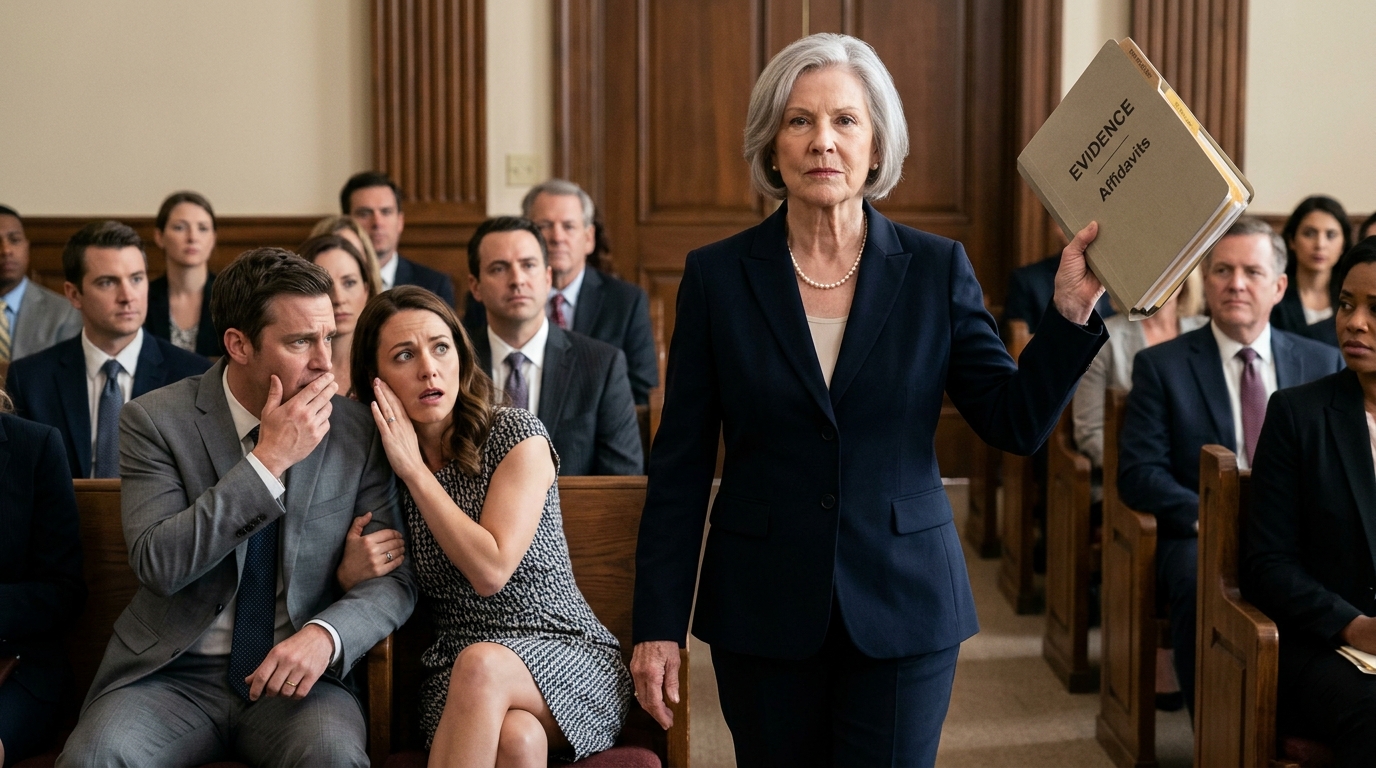
Judge Mercer called a fifteen-minute recess, and when the court reconvened, his tone had shifted entirely. He addressed Curtis Hale directly. “Counselor, I would strongly advise you to consider whether continuing to represent the petitioners in this matter exposes you to sanctions, given what the court has just heard.”
Curtis requested a brief conference with his clients, and when they returned, he informed the court that the petition for guardianship was being withdrawn. Judge Mercer nodded slowly. “Withdrawal noted. However, given the evidence presented today, this court has an independent obligation to refer this matter to Adult Protective Services and to the district attorney’s office for review of potential criminal charges.”
Daniel’s composure finally cracked. “Your Honor, this was a misunderstanding. My mother has always been difficult to help, and we were only trying to protect her interests.”
“Mr. Vance,” Judge Mercer said evenly, “I have thirty years on this bench, and I have never once heard a recording of someone shouting at their elderly mother about property ownership described as an attempt to ‘help.’ This hearing is adjourned.”
Outside the courtroom, my attorney, whom I had quietly retained the week they changed my locks without either of them knowing, met me with a folder of additional documentation. Her name was Priscilla Okafor, and she had spent the three weeks before the hearing building a financial trail that went far beyond what I’d played for the judge that morning.
“There’s more than just the assault and the attempted account transfers,” Priscilla told me as we sat in her office later that afternoon. “Daniel forged your signature on two documents attempting to add himself to the deed of the house. We caught it because the notary stamp used doesn’t match any registered notary in the county.”
I felt something harden in my chest that had nothing to do with grief anymore. “Forgery,” I said. “That’s not a family dispute. That’s a felony.”
Priscilla filed a formal complaint with the district attorney’s office within the week, and detectives opened an investigation into both the assault allegations and the forged deed documents. Daniel was charged with attempted fraud and forgery, along with a misdemeanor assault charge tied to the recorded confrontation in the hallway. Vanessa faced a separate assault charge related to the wrist injury, along with a charge for filing a false police report, since she had once called the police herself, months earlier, claiming I had threatened her during an argument that recordings later proved never happened the way she described.
The criminal case moved faster than I expected. Faced with clear audio evidence, forensic documentation matching the forged notary stamp to Daniel’s own printer, and testimony from my longtime locksmith and family friend, both Daniel and Vanessa’s attorneys began negotiating plea agreements rather than risk trial. Daniel pleaded guilty to attempted forgery and misdemeanor assault, receiving eighteen months of probation, mandatory anger management counseling, and a restraining order barring him from my property. Vanessa pleaded guilty to assault and filing a false report, receiving a similar probationary sentence along with community service.
Neither of them served jail time, a fact that initially frustrated me until Priscilla reminded me that the far more meaningful victory had already happened: the guardianship petition was dead, my accounts and my home remained entirely mine, and there was now a permanent legal record establishing exactly what kind of people they had chosen to become.
I changed my own locks again, this time with a security system Priscilla insisted on, and I updated my will and power of attorney documents to remove Daniel entirely, naming my niece, Rosalind, as my designated agent instead, a decision that felt less like punishment and more like simple, overdue self-preservation.
The following months were quieter than I expected them to be. I returned, part-time, to consulting work with my old firm, training a new generation of forensic accountants on exactly the kind of guardianship fraud patterns I had just survived myself. There was a strange, sharp satisfaction in teaching a room full of twenty-somethings how to spot the very tactics my own son had tried to use against me.
Daniel reached out twice during his probation, both times through brief, guarded emails asking to “talk things through eventually.” I didn’t respond to either one. Priscilla told me that was entirely my right, and Dr. Fenwick, the therapist I began seeing that spring to work through the grief of losing a relationship with my only child in this particular, ugly way, agreed that healing didn’t require reconciliation on anyone else’s timeline but my own.
“You’re allowed to grieve the son you thought you raised,” Dr. Fenwick told me during one session, “even while holding the man he actually became fully accountable for what he did.”
That distinction helped more than I expected it to. I mourned the boy who used to help me balance my checkbook at the kitchen table as a teenager, genuinely curious about how numbers told stories. I did not mourn the man who shoved me against a wall over a house deed.
One year after that courtroom hearing, I hosted a small dinner at my house, the same house Daniel had once tried to steal out from under me, filled with people who had actually shown up during the hardest parts of that year: Rosalind, Priscilla, two old colleagues from my Bellweather days, and my longtime locksmith, who had become an unlikely but genuine friend through the whole ordeal.
“To Eleanor,” Rosalind said, raising her glass, “who apparently cannot be underestimated by anyone, ever, for any reason.”
I laughed, really laughed, in a way that had felt harder to access in the months right after the hearing. I thought about Daniel’s whispered confidence walking into that courtroom, so certain that a cane and silver hair meant helplessness. He had spent his whole life watching me solve other people’s financial mysteries at the kitchen table, and somehow never learned the one lesson that should have mattered most: I always found the truth eventually, and I never stopped once I started looking for it.