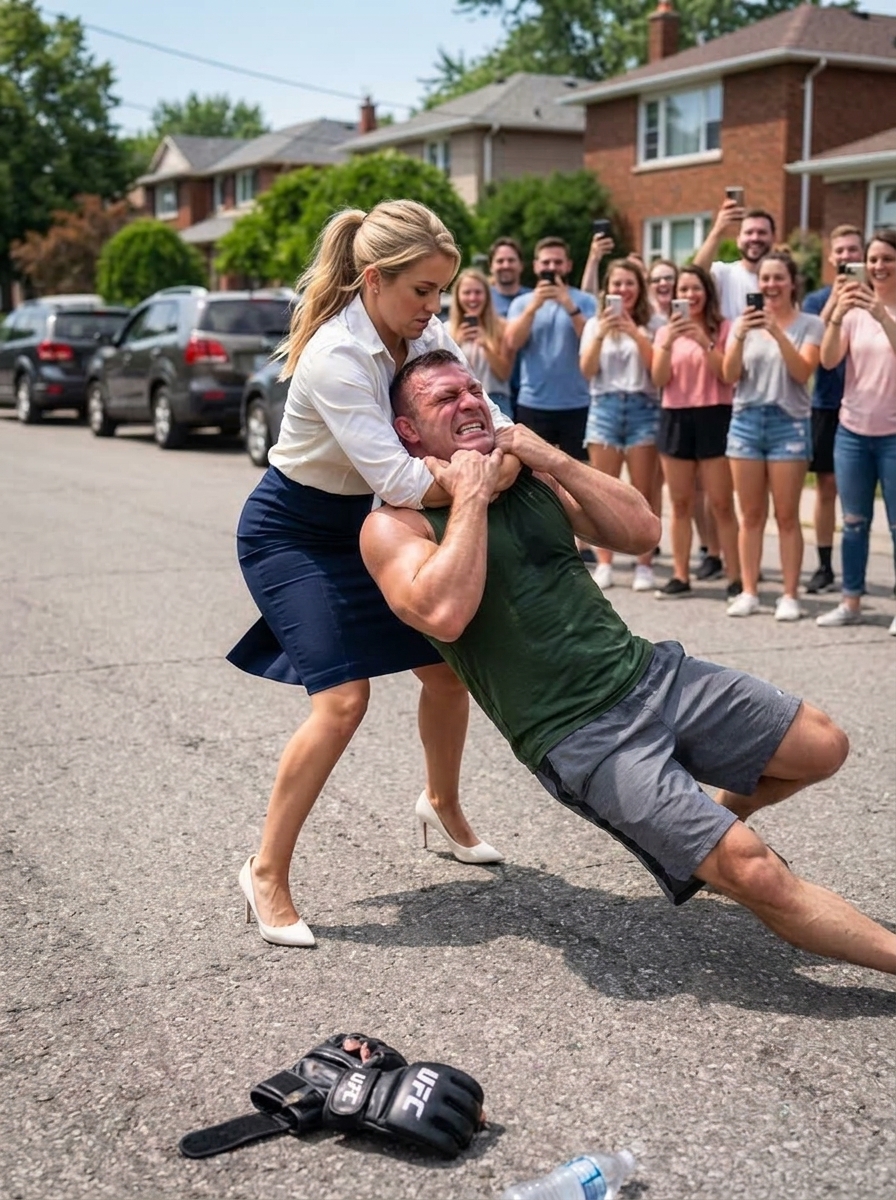
The detective’s name was Ramona Vasquez, and she had watched the footage four times before she ever knocked on my door. “Ma’am, I want to be straightforward with you,” she said, standing on my porch with her notebook closed. “Based on what I’ve seen, this is a fairly clean assault case. He advanced on you after you verbally declined, twice, and you never struck him. If you want to press charges, I don’t anticipate a difficult case.”
I asked her for a day to think about it, which surprised her. I think she expected me to say yes immediately. But I had two things to consider that she didn’t, and one of them was sitting at my kitchen table pretending not to listen.
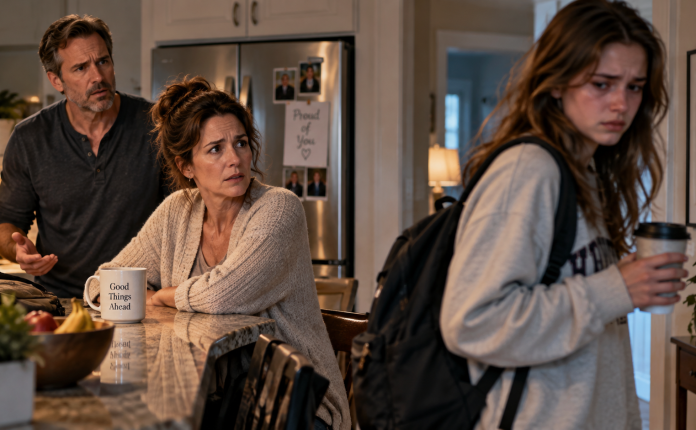
Noah had seen the video before I got home. Half his high school had. He was fifteen and furious in the particular way fifteen-year-olds get when someone hurts their parent, and the first thing he said to me when I came in was, “Mom, you should have put him in the hospital.”
“No,” I said. “I shouldn’t have. And I want you to understand exactly why, because this matters more than the fight does.”
We sat at that table for a long time. I told him something I’d told young officers for twenty years: that the entire point of knowing how to do violence is knowing when not to. That restraint under provocation isn’t weakness, it’s the whole discipline. That if I had hurt Logan Whitmore on that street, in front of those cameras, I would have handed him the story he wanted and lost everything I’d spent my career building, regardless of who started it.
“He’d have been the victim,” Noah said slowly.
“He’d have been the victim,” I agreed. “And I’d have been a colonel who beat up a neighbor. Nobody would have watched the first ninety seconds of that video. They’d only have watched the last fifteen.”
The other consideration was the Army. My commanding officer, Brigadier General Alton Whitfield, had been careful on the phone that first night, and more careful in person two days later. There was no formal investigation, he explained, because there was nothing to investigate: the footage showed a service member declining a fight, being attacked, and using minimal force to disengage without injuring her assailant. If anything, the JAG officer who reviewed it described it as a textbook example of proportionality.
“That said,” General Whitfield told me, “you’re going to be visible now whether you want to be or not. Decide how you want to handle that, because it’s going to be handled either way.”
I filed the charges. Not out of anger, and I want to be clear about that, because a lot of people afterward assumed it was personal. I filed because Logan had been escalating on that street for months, because a delivery driver had been shoved and said nothing, because every neighbor on Juniper Hollow had spent a year complaining behind closed doors and hoping someone else would deal with it. I was the first person he’d picked who had the standing and the documentation to actually make it stop.
Logan was charged with misdemeanor assault. His father hired an expensive attorney from Denver who tried, initially, to argue that a “mutual combat” situation had occurred between two consenting trained fighters. That argument survived approximately as long as it took the prosecutor to play the audio in which I twice stated I would not fight him.
The attorney’s second approach was more interesting and, I’ll admit, briefly effective. He argued that my training made me the greater danger, and that Logan, a young man with an amateur record, could not reasonably have been expected to know he was challenging a career Army officer with combatives instruction going back two decades. The judge, a dry woman named Priscilla Ahn, responded to this with one of the more memorable lines I’ve heard in a courtroom.
“Counselor,” she said, “your client threw gloves at a woman’s feet in her own street and demanded she fight him. The fact that she turned out to be more capable than he assumed is not a mitigating factor. It’s the entire risk of the thing he chose to do.”
Logan pleaded guilty. He received twelve months of probation, forty hours of community service, an anger management program, and a no-contact order. He was also, separately and more consequentially for him, suspended indefinitely by the state athletic commission, which had received the footage and took a dim view of a licensed amateur fighter initiating a street altercation with an untrained civilian. His fighting career, such as it was, effectively ended in that parking-lot-sized stretch of asphalt.
Grant Whitmore’s outcome was messier and slower. The video he’d recorded, and then posted, before realizing what it actually showed, circulated widely enough that a local news station picked it up. He deleted it within hours. Denise Okafor’s version had already been shared several hundred times by then.
The professional consequences for him arrived over the following months and had nothing to do with me directly. Two commercial clients quietly declined to renew contracts with his development firm. A city council contract he’d been pursuing went to a competitor. Nobody said publicly that it was because of the video, and I genuinely don’t know that it was, but Silver Creek is a small town and reputations there are load-bearing.
What I remember most from that period wasn’t the legal process. It was the neighbors.
Denise came by a week after the incident with a casserole and an apology I hadn’t asked for. “I’ve lived across from that boy for a year,” she said. “I watched him shove that delivery guy. I didn’t do anything. I’ve been thinking about that a lot.”
“You did something,” I told her. “You kept the footage when his father told you to delete it. That’s not nothing.”
Other people came too, slowly, over that spring. The delivery driver, a young man named Emeka, stopped his cart in front of my house one afternoon and said simply, “I saw the video. Thank you.” A woman three houses down told me she’d finally reported Logan’s pre-dawn motorcycle noise to the city, something she’d been meaning to do for eight months.
That’s the part I didn’t expect. One person declining to be intimidated in public turned out to be unexpectedly contagious on a street where everyone had privately agreed to be intimidated in silence.
I did have to decide about the visibility General Whitfield had warned me about. I turned down two national interview requests and a podcast. I said yes to exactly one thing: a talk at Noah’s high school, at his principal’s request, about restraint, de-escalation, and what it actually means to be trained.
I told those kids the thing I’d told Noah at the kitchen table. That the most dangerous person in any room should be the hardest one to provoke. That every hour I’d spent learning to fight had been matched by hours learning when the answer was to walk, to talk, to document, to let the other person make the choice that would define what happened next. That Logan lost that day not because I was better trained, but because he threw the first punch on camera after I’d said no twice.
A girl in the back row asked what would have happened if there’d been no cameras. It was a sharp question and I gave her an honest answer: it would have been harder, and it might have come down to my word against his, which is exactly the situation that keeps bullies employed. Witnesses matter. Documentation matters. Being the person who says the quiet part out loud, on the record, matters.
Noah changed that year in ways I’m still grateful for. The anger burned off by summer and turned into something steadier. He joined the wrestling team in the fall, and his coach told me at a meet that Noah was the only kid on the roster who consistently checked on opponents after a match. “Somebody taught him that,” the coach said.
“Somebody tried,” I said.
Logan and I never had a reconciliation, and I want to be honest that I didn’t seek one. He completed his probation. The no-contact order meant we didn’t speak, which suited us both. About eight months in, Grant sold the house and the two of them moved out of Silver Creek entirely. I heard secondhand that Logan had taken a job at a gym two counties over, coaching youth classes, and I hope that’s true. He’s twenty-two. There’s a lot of time to become someone else.
One year after the gloves hit the asphalt, I sat on my front steps with coffee before sunrise, which is what I’d moved to that street to be able to do in the first place. No motorcycle. No music from the garage next door. Denise waved from her driveway on her way to work. Emeka’s delivery cart came through around seven, and he raised a hand as he passed.
The peace I’d wanted turned out to be real, but it hadn’t been available through avoidance. I’d spent weeks staying out of Logan’s way, telling myself that was the mature choice, and the entire street had been doing some version of the same thing for a year. What actually ended it was standing still on a piece of asphalt with my hands down, saying no clearly enough for eleven people to hear, and letting a young man who’d never been told no make his own decision in front of every camera on Juniper Hollow Drive.
I kept the gloves, actually. They’re in a box in the garage. Not as a trophy, because there’s nothing in that day worth commemorating. I keep them because occasionally I need the reminder that the loudest man in any room is almost never the most dangerous one, and that the quietest choice available to you is frequently the strongest one you’ll ever make.