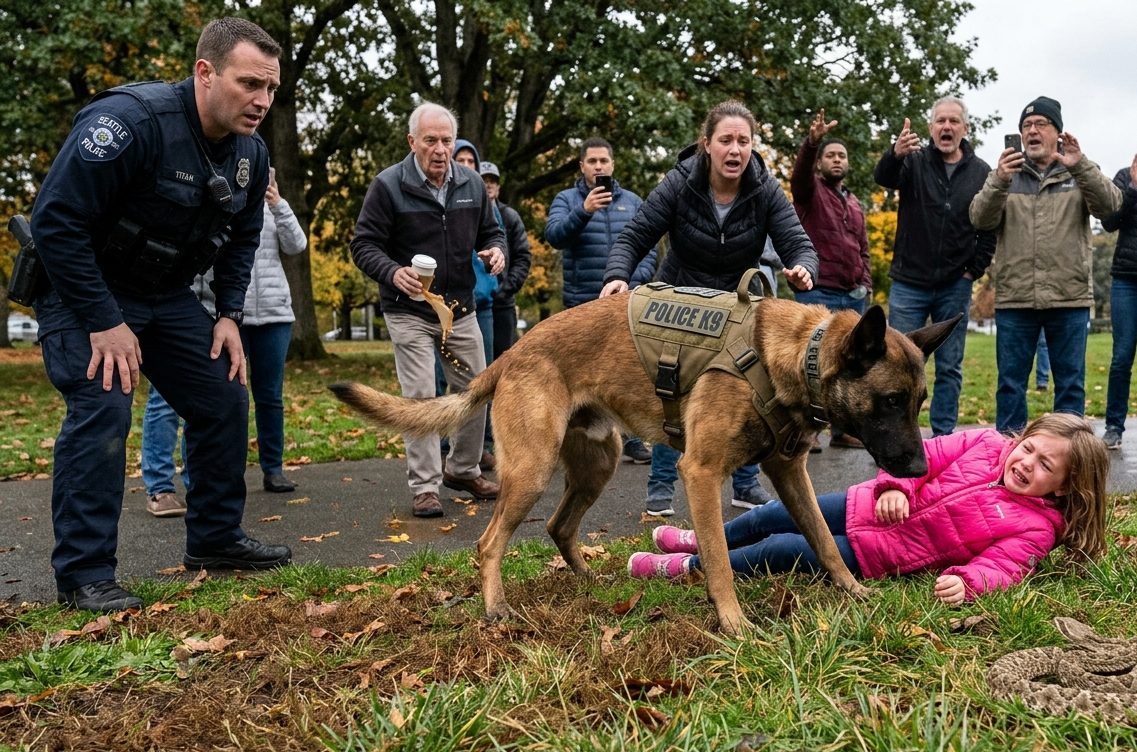
The park stayed closed for the rest of that day and most of the next, cordoned off with yellow tape while Wallace’s team and the FBI’s joint terrorism task force processed the scene inch by inch. I spent that first evening in a debrief that ran nearly four hours, walking investigators through every second of Titan’s behavior, the direction he’d been facing, the timing of his lunge, anything that might help them understand not just what had happened but why.
The device itself, once rendered safe and transported for analysis, turned out to be more sophisticated than Wallace’s initial read suggested. It contained a pressure-sensitive trigger designed to detonate under roughly forty pounds of weight, calibrated, investigators believed, specifically to be set off by a child rather than an adult. That detail landed in the room like a physical blow when the lead FBI analyst, a methodical woman named Priscilla Renner, read it aloud during our second debrief.
“Whoever built this wanted a child to trigger it,” she said. “The park was chosen deliberately too. Centennial hosts a children’s charity fun run every year on the third Sunday of the month. Today was the third Sunday.”
The fun run itself had been rescheduled at the last minute due to a permit issue, something only a handful of people would have known in advance, which narrowed the investigation considerably. Detective Marcus Whitfield, assigned to lead the criminal side of the case, began working backward through everyone who’d had access to that scheduling information: the parks department, the charity’s small staff, and a handful of vendors.
It took nine days to identify him. Ronald Kettering, a forty-six-year-old former maintenance worker for the city parks department, had been terminated eight months earlier following a workplace harassment complaint filed by two female coworkers. Detective Whitfield’s investigation uncovered a trail of increasingly unstable social media posts in the months since his firing, culminating in a private message thread, recovered through a warrant, describing his intention to “make the city remember him.”
Kettering had worked at Centennial Park for eleven years before his termination and had detailed knowledge of the fun run schedule, the park’s foot traffic patterns, and, critically, the exact patch of grass where children typically gathered to wait near the starting line. The permit delay that had accidentally saved dozens of children that day had come as news to him too late to relocate the device before officers began their outreach patrol.
He was arrested at his apartment in Tacoma, where investigators recovered bomb-making materials matching the device recovered at the park, along with handwritten notes referencing at least two other locations he had been considering. He was charged with attempted use of a weapon of mass destruction, attempted murder, and multiple counts related to endangering minors, charges that carried the possibility of a life sentence given the deliberate targeting of children.
“If Titan hadn’t reacted when he did,” Priscilla told me during a follow-up meeting weeks later, “our timeline suggests the fun run would have started within the hour. We’re talking about potentially dozens of children clustered in that exact area.”
I sat with that number for a long time. Dozens.
The girl Titan had knocked to the ground, whose name I learned was Maisie, came to visit us at the precinct three weeks later with her mother, Genevieve, both of them still visibly shaken but wanting, as Genevieve put it, “to actually meet the dog who saved my daughter’s life instead of just seeing him in a news clip.” Maisie approached Titan cautiously at first, understandably wary of the animal who had physically tackled her weeks earlier, but within minutes she was scratching behind his ears while he leaned his full ninety pounds against her legs, tail sweeping the floor.
“I was mad at him for a whole week,” Maisie admitted, looking up at me. “I thought he was mean.”
“He was the opposite of mean,” I told her. “He knew something dangerous was there before any of us did, and the only way he had to protect you was to move fast. He probably saved your life by scaring you.”
Genevieve had brought a letter she’d written, one she insisted on reading aloud rather than simply handing over, her voice breaking twice as she described watching Titan’s lunge from thirty feet away and believing, in that first terrible second, that her daughter was being attacked by a police dog for no reason at all. “I was ready to hate that animal,” she said. “I was already thinking about a lawsuit before I even understood what I was looking at. I think about how close I came to being angry at the exact thing that saved her.”
The department, once the investigation concluded and the full story became public, awarded Titan a formal commendation, an honor typically reserved for exceptional acts of service, presented at a ceremony that Maisie and Genevieve both attended alongside dozens of officers and Sergeant Wallace Okafor’s entire EOD team. Titan, characteristically unbothered by the pageantry of it all, spent most of the ceremony trying to steal a piece of ribbon off his own medal.
I struggled more than I expected to in the weeks following the incident, oddly enough not because of the danger itself but because of how close I had come to doubting my partner in the moment that mattered most. I kept replaying those first few seconds, the blind panic, the certainty that Titan had simply broken down after eight years of flawless service, and I had to sit with the uncomfortable truth that my first instinct had been to assume the worst about the one partner who had never once given me a reason to.
I talked about it with our department’s K9 unit psychologist, a thoughtful man named Dr. Halloway who specialized in handler-dog bonded trauma, something I hadn’t known was an entire specialty until I needed it. “You reacted the way any handler would in an unprecedented situation,” he told me. “Titan had never disobeyed you before. Your brain didn’t have a framework for ‘my dog is right and I don’t understand why’ in under three seconds. That’s not a failure of trust. That’s just how quickly a human mind processes genuine novelty.”
That reframing helped, slowly, over the following months. I started deliberately building in more scenario training with Titan afterward, not because I doubted him again, but because I wanted my own reactions to catch up to his instincts faster next time, whatever next time might look like.
Maisie’s family started a small tradition that spring, visiting the precinct every few months with a bag of treats specifically for Titan, and Maisie herself, now eight, had taken to telling anyone who would listen that she wanted to be a K9 handler herself one day. “I want a dog exactly like Titan,” she told me during one visit. “One who notices things nobody else can see.”
Kettering’s trial took place nearly fourteen months after the incident. Faced with the recovered materials, the digital evidence establishing his intent and target selection, and testimony from Detective Whitfield’s investigation, his attorney pursued an insanity defense that ultimately failed once forensic psychiatrists testified to the calculated, methodical nature of his planning over several months. He was convicted on all counts and sentenced to life in federal prison without the possibility of parole, a sentence the judge described as necessary given the deliberate targeting of a public space specifically chosen for its concentration of children.
I didn’t attend the sentencing. I’d given my testimony during the trial itself, detailing Titan’s behavior in exacting technical detail for the jury, and I felt no need to witness the final chapter in person. What I needed instead was standing beside me most days anyway, ears up, tail wagging, utterly indifferent to the magnitude of what he’d prevented, mostly interested in whether I’d remembered to pack his favorite treats for our shift.
One year after that Sunday afternoon, Centennial Park hosted its rescheduled children’s charity fun run, the same event whose permit delay had inadvertently saved so many lives the year before. The department asked Titan and me to lead the opening lap, an honor I accepted mostly because Maisie had specifically requested we be there, now sporting a small K9-themed t-shirt she’d insisted her mother buy for the occasion.
Standing at the starting line with Titan sitting calmly beside me, surrounded by dozens of children stretching and laughing in the cool morning air, I thought about how differently that exact patch of grass could have looked exactly one year earlier. I thought about the three commands Titan had ignored, the only three in eight years of perfect service, and how each act of disobedience had been, in its own way, the most obedient thing he’d ever done, faithful not to my voice in that moment but to something more essential underneath it: the entire purpose he’d been trained, and had chosen, to serve.
Maisie ran the first lap holding my hand, Titan trotting easily on my other side, and when she crossed the small finish line minutes later, breathless and grinning, she turned back and shouted something that made the whole gathered crowd of families laugh and cheer.
“Titan gets a medal too!”
He did, eventually, receive a small ribbon that afternoon, which he immediately tried to eat, utterly unbothered by his own significance, exactly the way the best partners usually are.