Dad… my back hurts so bad I can’t sleep. Mom told me not to tell you.
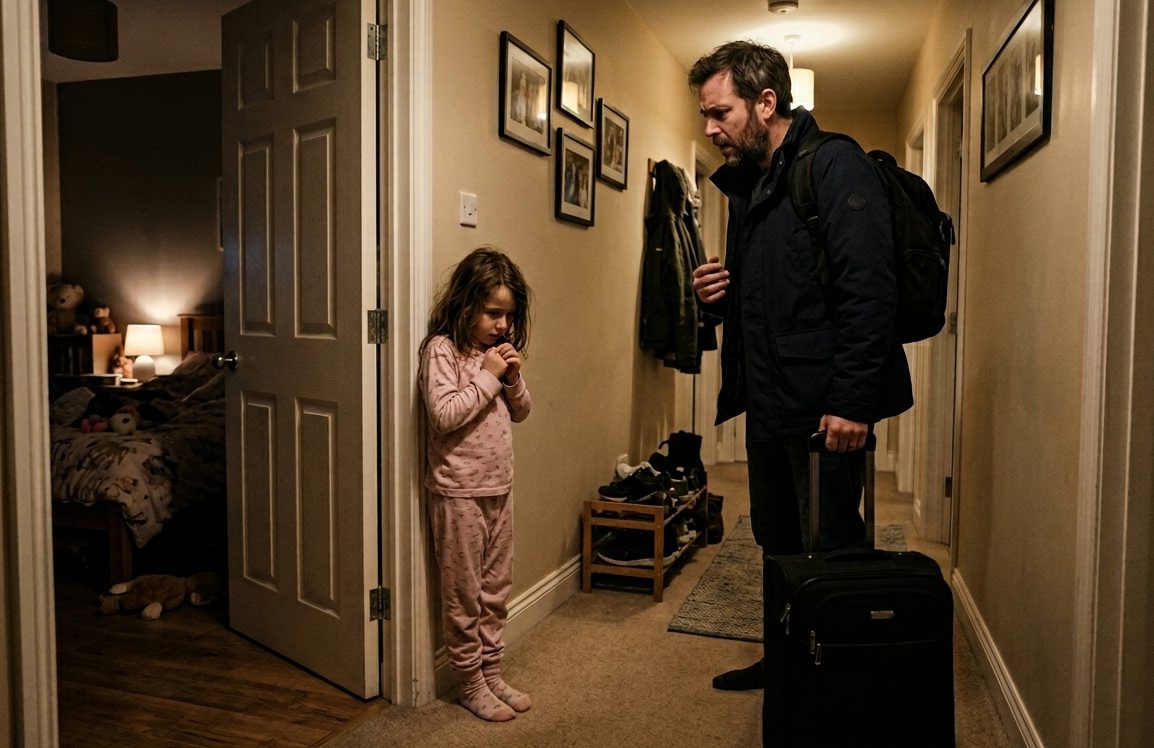
I had barely been home fifteen minutes when my eight-year-old daughter quietly handed me the kind of sentence that splits a life in half. My suitcase was still by the front door. My jacket was still thrown over the couch. I had just come back from a work trip, and something already felt wrong the second I stepped inside. No little footsteps racing to greet me. No laugh. No hug. Just a silence that didn’t belong in a house with a child in it.
Then I heard her from the bedroom.
Soft. Fragile. Barely louder than a breath.
“Dad… please don’t be mad,” she whispered. “Mom said if I told you, things would get worse. But my back hurts… and I can’t sleep.”
I froze in the hallway, one hand still gripping the handle of my suitcase so hard my knuckles burned. This wasn’t whining. This wasn’t a child trying to avoid bedtime. This was fear. Real fear. The kind that changes the air in a room before you even see the face it’s coming from.
I turned toward the bedroom and saw Sophie standing half-hidden behind the door, like she expected someone to snatch her back the second she said too much. Her shoulders were tense. Her eyes were fixed on the floor. She looked smaller than any child should.
I crouched down slowly. “Sweetheart,” I said, fighting to keep my voice steady, “look at me.”
She did, but only for a second.
Her eyes were wet.
“I’m not mad at you,” I said. “I need you to tell me what happened.”
She hesitated. Then she lifted the back of her pajama shirt with trembling fingers.
I stopped breathing.
There was a deep purple bruise running across the left side of her lower back, spreading upward in ugly yellowed edges like it had been there for days. Not a scrape. Not a bump. Not the kind of mark you get from playing too hard on a schoolyard. It looked like something had hit her. Hard.
My whole body went cold.
“Who did this?” I asked, too quickly.
She flinched.
That broke me even more than the bruise.
I reached out, slower this time, and put my hand on the bed beside her instead of touching her. “Sophie,” I said quietly, “you are not in trouble. I need the truth.”
Her bottom lip shook. “Mom said I fell.”
The words came out like something memorized.
I swallowed hard. “Did you?”
She didn’t answer.
Instead she whispered, “Please don’t make her mad.”
That was all I needed to hear.
My ex-wife, Claire, and I had been divorced for three years. Shared custody. Week on, week off. It had been messy, but not like this. Never like this. Claire could be sharp, cold, controlling in quiet ways that left no fingerprints. But I had spent years convincing myself that difficult didn’t mean dangerous. That our daughter was safe because I needed her to be.
Now I was staring at a bruise on my child’s back and hearing fear in her voice that no eight-year-old should carry.
“Where’s your mom?” I asked.
“At work,” she whispered. “She said to go to bed early and not bother you when you got home.”
Of course she did.
I sat beside Sophie and asked if I could look closer. She nodded. The bruise was warm to the touch. She sucked in air the moment my fingers got near it. I felt nausea rise straight into my throat. Then I noticed something else. There were smaller marks too. Fainter ones near her side. Not as dark. Older, maybe. Like this wasn’t the first time pain had landed there.
“How long has your back been hurting?”
She looked down at her hands. “Since Tuesday.”
Tuesday.
It was Friday night.
Three days.
Three days my daughter had been hurting, sleeping badly, walking around with that kind of pain, and nobody had taken her to a doctor. Nobody had called me. Nobody had done anything except tell her to stay quiet.
I stood up so fast the chair by her desk tipped sideways.
She startled. “Dad?”
I turned back immediately, forcing myself to kneel again, forcing my face back under control because she didn’t need my rage. She needed me steady.
“We’re going to the doctor,” I said.
Her eyes widened. “Mom said not to.”
“I know what Mom said.”
For the first time since I’d walked in, Sophie looked directly at me.
Then, in a voice so small it nearly undid me, she asked, “Will you still love me if I told?”
I felt something tear clean through my chest.
I pulled her into my arms as gently as I could. “Baby,” I said, “I will love you for telling me for the rest of my life.”
She started crying then. Quietly at first. Then harder. The kind of crying that sounds less like sadness and more like relief finally finding somewhere to go. I held her until she could breathe again. Then I packed an overnight bag with shaking hands, took pictures of the bruises, grabbed my keys, and carried her to the car.
Halfway to the emergency room, my phone lit up.
Claire.
I stared at the screen for one long second.
Then I answered.
“You’re home early,” she said.
I looked at Sophie in the rearview mirror. She was curled in the back seat with her stuffed rabbit clutched to her chest, one cheek wet with tears.
And that was the moment I knew whatever came next would change everything.
“You’re home early,” Claire said again, her voice calm in that way that only made me angrier.
I kept my eyes on the road. “Why does Sophie have a bruise across her back?”
Silence.
Not confusion. Not shock. Silence.
Then she exhaled sharply. “Oh my God. She told you?”
The way she said it almost made me pull the car over.
“She’s been in pain for three days,” I said. “What happened?”
“She fell off the kitchen stool. I already told her that.”
My hands tightened around the steering wheel. “You told her that? Or that’s what happened?”
“Don’t start this.”
Start this.
I looked in the mirror again. Sophie had gone still, listening.
“I’m taking her to the ER,” I said.
Claire’s voice changed instantly. “Are you insane? Do you want people asking questions? Do you want this turned into something it isn’t?”
That sentence told me more than anything else could have.
I hung up.
At the hospital, Sophie was quiet with the nurses at first, polite in that heartbreaking way scared children often are. But once the doctor asked Claire’s name and whether anyone had told her not to say anything, my daughter’s eyes filled and she whispered, “Mom said if I told Dad, things would get worse.” The room changed after that. Not loudly. Just completely.
They took X-rays.
Then more imaging.
Then a social worker came in.
The bruise on her back was bad enough. What I wasn’t prepared for was the doctor telling me she had a hairline fracture near one of her lower ribs. Not major. Not surgical. But not a simple fall either. The doctor’s face was careful when he asked me whether there was any chance Sophie had been struck.
I didn’t answer right away because my body had stopped feeling like mine.
Sophie did.
She looked down at the blanket on her lap and whispered, “Mom pushed me into the counter because I spilled juice.”
I closed my eyes.
For one second, just one, I thought I might pass out.
The social worker moved fast after that. So did the nurses. Claire showed up twenty minutes later, furious, still in heels, still carrying her purse like this was an inconvenience she’d come to manage. But the moment she realized there was already a hospital report, photographs, and a child protective services worker in the room, I watched her whole expression change.
Not guilt.
Calculation.
She tried anger first. Said I was poisoning Sophie against her. Said our daughter was emotional, dramatic, clumsy. Then she tried tears. Said she’d been overwhelmed, overworked, alone. Said she never meant to hurt her. Said it was one push, one bad moment, one accident twisted into something ugly because I wanted custody.
But then Sophie saw her.
And she physically recoiled.
That was it.
That was the moment nobody in that room ever forgot.
My daughter did not run to her mother. She did not cry for her. She pulled herself tighter into my side and started shaking so hard the nurse stepped in front of the bed without even thinking about it. Whatever story Claire wanted to tell after that, her own child had already told the truth with her body.
CPS placed an emergency hold that night. Sophie came home with me.
The court hearing happened five days later. I barely slept the whole week. Neither did Claire, judging by the gray under her eyes and the way she kept rewriting herself in front of the judge. Stressed mother. Misunderstood discipline. Bitter ex-husband. But the medical records didn’t bend. The hospital photos didn’t bend. And Sophie, when the child specialist asked where she felt safest, didn’t hesitate.
“With Dad,” she said.
Temporary full custody was granted that morning.
Claire cried outside the courtroom.
I felt nothing.
Not because I wanted revenge. Because by then I understood something I should have understood the first second my daughter whispered in that bedroom. Protection is not cruelty, even when someone dangerous calls it that.
The first month after Sophie moved in with me full-time was harder than I expected. Not logistically. Emotionally. She startled at loud sounds. Apologized when she dropped spoons. Asked permission to use the bathroom in her own home. Once, when I accidentally closed a cabinet too hard, she covered her head with both arms before she even realized what she was doing. I had to go into the garage and cry where she couldn’t hear me.
But slowly, she changed.
Or maybe she stopped shrinking.
She started sleeping through the night first. Then laughing more. Then singing to herself while drawing. The first time she spilled orange juice at my kitchen table and froze, I just grabbed a towel and said, “Looks like the table needed a drink too.” She stared at me for two full seconds before bursting into tears. Then she laughed through the tears so hard she got hiccups.
That was the day I knew she was beginning to believe me.
That home could be safe.
That mistakes were survivable.
That love didn’t arrive with conditions attached.
Months later, her back had healed. The bruise was gone. The fracture was just a line on an old chart. But some things take longer. Trust. Rest. The ability to speak without checking the room first. We got her therapy. We got a routine. We got bedtime stories back. We got pieces of her childhood returned one careful night at a time.
And sometimes, usually when the house was very quiet, I still heard that first sentence in my head.
Dad… my back hurts so bad I can’t sleep. Mom told me not to tell you.
I think I’ll hear it for the rest of my life.
Not because it haunts me.
Because it reminds me.
Children do not always scream when something is wrong. Sometimes they whisper. Sometimes they wait until the suitcase is still by the door and the house is finally quiet enough to risk the truth. Sometimes they lead with an apology for surviving badly.
And if I have learned anything from that night, it is this:
When a child says, “Please don’t be mad,” what they usually mean is, “Please be safe enough for me to tell.”