My name is Barbara. I am sixty-four years old. I have lived in my house for twenty-eight years. My husband died four years ago — a heart attack, sudden, the kind where you’re grateful they didn’t suffer and furious that you didn’t get to say goodbye. It’s just me now. Me, and my garden, and twenty-eight years of memories pressed into the walls like flowers in a book.
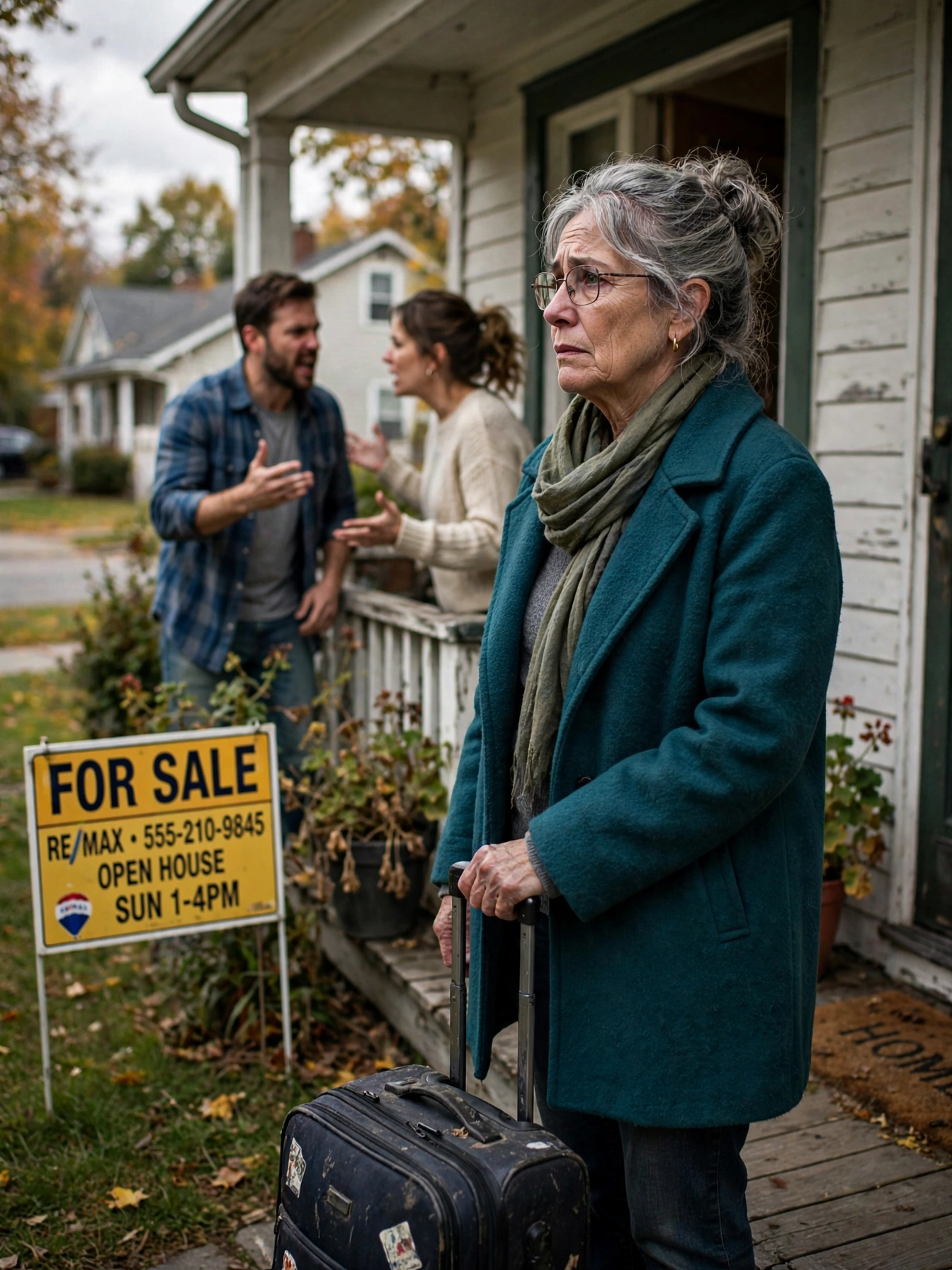
Last Thursday, I pulled into my driveway with groceries — milk, bread, the good tomatoes — and there was a sign on my lawn. A real estate sign. “FOR SALE — Call Johnson Realty.” Red, white, and blue, stuck into the grass I’d been mowing myself since my husband died.
I thought it was a mistake. Wrong house. These things happen. I called the number on the sign, standing in my own driveway with the car still running.
“Hi, I’m calling about the listing at 412 Maple Street—”
“Beautiful property!” the agent chirped. She sounded young. “Four bedrooms, just listed yesterday. Original woodwork, big yard. Are you interested in a viewing?”
“I LIVE there,” I said. “I never listed my house.”
Silence. Then, carefully: “Ma’am… the listing was submitted by the homeowner. A Mr. Kevin Walsh. He provided the deed.”
Kevin Walsh. My son. My baby, the boy I rocked to sleep singing off-key, the teenager who ate me out of house and home, the man who held my hand at his father’s funeral.
My son had listed my house for sale without telling me.
I drove to his house with the groceries still in the back seat, the milk going warm. I was shaking so hard I could barely turn the key in the ignition. He opened the door, saw my face, and said:
“Mom. Come in. We need to talk about what’s best for you.”
What’s best for me. He had decided. Without me. He said it the way you’d talk to a child who doesn’t understand why she can’t have candy.
“Kevin,” I said, standing in his entryway, “there’s a for-sale sign in my yard.”
“I know. Sit down, let me explain.”
He sat me down at his kitchen table — his kitchen, in his house, the one he bought with the down payment I helped him with — and he slid a paper across the table. “Mom, look. It’s for your own good. The house is too big. The stairs — remember when you fell last winter?”
“I tripped on ice, Kevin. I’m sixty-four, not ninety-four. I tripped, I got up, I was fine.”
“The market is incredible right now. We could get five hundred thousand. You could move into Sunny Acres — it’s lovely, they have bingo, there’s a dining room—”
“I don’t want bingo! I want my house! My garden! My —” I stopped, because my voice was breaking, and I didn’t want to give him that.
He sighed. It was the sigh of a man dealing with a difficult parent, and I had seen that sigh before — on the faces of other people’s children, in restaurants, and I had always thought: my Kevin would never. “Mom, I already have a buyer. They’re offering cash. We close next month.”
“A buyer? Kevin, you can’t sell my house!”
“I can.” He tapped the paper with his index finger. “Because three years ago, when Dad died, you signed a quitclaim deed adding me to the title. Remember? ‘For convenience,’ the lawyer said. ‘In case anything happens.'”
I did remember. Vaguely. The lawyer’s office, that terrible week after the funeral, papers everywhere, Kevin beside me saying “just sign here, Mom, it’s routine, it’s what everyone does.” I had been grieving. I had trusted my son.
“That was supposed to be for emergencies,” I whispered.
“This is an emergency,” Kevin said. “You’re getting older. The house is a liability. The roof, the furnace — what happens when something big goes?”
I stared at my son — my baby, my boy — and I saw a stranger calculating my worth in square footage. It was the loneliest moment of my life, lonelier than the funeral, because at the funeral I had still believed my son was on my side.
“Get out of my way,” I said quietly. “I’m going home.”
“Mom—”
“MY home. Until a court says otherwise.”
I drove home, walked past that for-sale sign like it was a stranger’s dog, and called the one person I knew would help: my late husband’s best friend, a retired judge named Bill Harris. He’d known me for thirty years. He’d carried my husband’s casket.
Bill listened to the whole story over coffee at my kitchen table. He didn’t interrupt. When I finished, he said: “Barbara, that quitclaim deed — do you have a copy?”
I didn’t. Kevin had “handled” everything after my husband died. I had let him, because grief makes you hand things to the nearest strong hands.
“Then we start there,” Bill said. “Because if you were misled about what you were signing, that’s fraud. And Barbara — I think you were.”
He connected me with a real estate attorney named Susan. She pulled the deed records. What she found made her whistle low, the way people do when they see something they didn’t expect.
“Barbara,” she said, “this quitclaim didn’t just add Kevin to the title. It transferred one hundred percent ownership to him. You signed away your entire house. You don’t own any of it.”
The room spun. I gripped the edge of her desk. “But the lawyer said—”
“The lawyer was Kevin’s college roommate,” Susan said grimly. “Did you have independent counsel? Did anyone explain to you, separately, what you were signing?”
I hadn’t. I’d trusted my son. Those four words sat in the room like a stone.
“Here’s the good news,” Susan said. “In this state, a deed obtained through misrepresentation can be voided. Especially with an elderly parent, especially with a fiduciary relationship. We can fight this. And we will.”
We fought. It took five months. Five months of depositions, of filings, of sitting in offices with fluorescent lights while lawyers talked about me as if I weren’t there. Kevin hired a lawyer — with what money, I never learned, though I have my suspicions about where it came from. In his deposition, under oath, Kevin admitted: “The lawyer was my college roommate. I told Mom it was routine.”
The judge voided the deed. The listing was cancelled. The for-sale sign came down — I watched them pull it out of my lawn, and I stood at my window with my arms crossed, and I did not wave.
But the real battle wasn’t legal. It was personal. Kevin didn’t speak to me for months. The silence was worse than the lawsuit. I would see his car drive past my street — not stopping, just passing — and I would stand at the window until the taillights disappeared.
When he finally called, he was crying. “Mom, I’m drowning in debt. The credit cards, the car payments, I borrowed against everything. I saw the house as my way out. I’m sorry. I’m so sorry.”
“Kevin,” I said, and my voice was steadier than I felt, “you could have asked me for help. Instead you tried to steal my home while I was grieving your father.”
“I know. I’m… I’m getting help. Financial counseling. Therapy. I’m trying.”
We’re rebuilding. Slowly, carefully, the way you rebuild anything that was broken badly. He comes for Sunday dinner now. He fixed my gutters last month — unasked, on a Saturday morning, the way his father used to. We don’t talk about the lawsuit. We talk about the garden.
But I did three things after the case was over, and I tell every woman I know to do the same. I put the house in a trust — with Susan as trustee, not Kevin. I got my own lawyer for everything, and I mean everything. And I took down that for-sale sign myself — the one they’d left by the curb — and I burned it in the fire pit in the backyard, and I watched it burn.
Last week, Kevin asked: “Mom, are we okay?”
“We’re getting there,” I said. “But Kevin — my house is not your safety net. It’s my home. There’s a difference. I need you to understand the difference.”
He nodded. He understood. Finally.
Never sign anything “routine” without your own lawyer. Not even — especially — for family. Love and paperwork don’t mix without a witness. I learned that at sixty-four, standing in my own driveway, staring at a sign in my own yard.
My house is mine. The sign is gone. And I check my yard every morning — just in case.