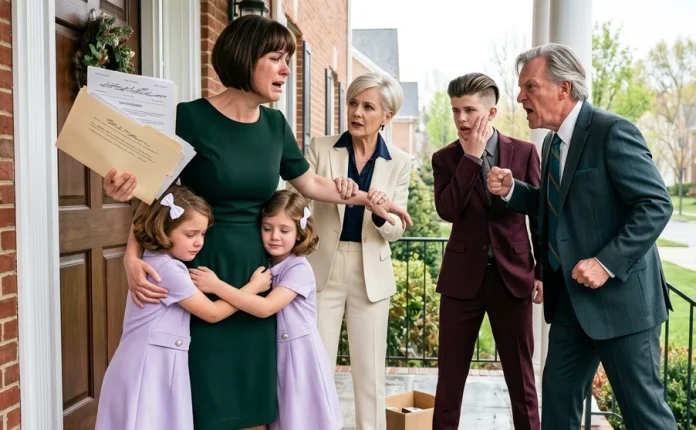
Why did you come to Christmas? My mom said, “Your 9-month-old baby makes people uncomfortable.” My dad smirked. “She’s right. Sit this one out.” I answered, “Then I will stop financing your lifestyle.” They all laughed. Then I reached into the diaper bag for my phone…
I hadn’t even taken my coat off when my mother said it.
“Why did you come to Christmas?”
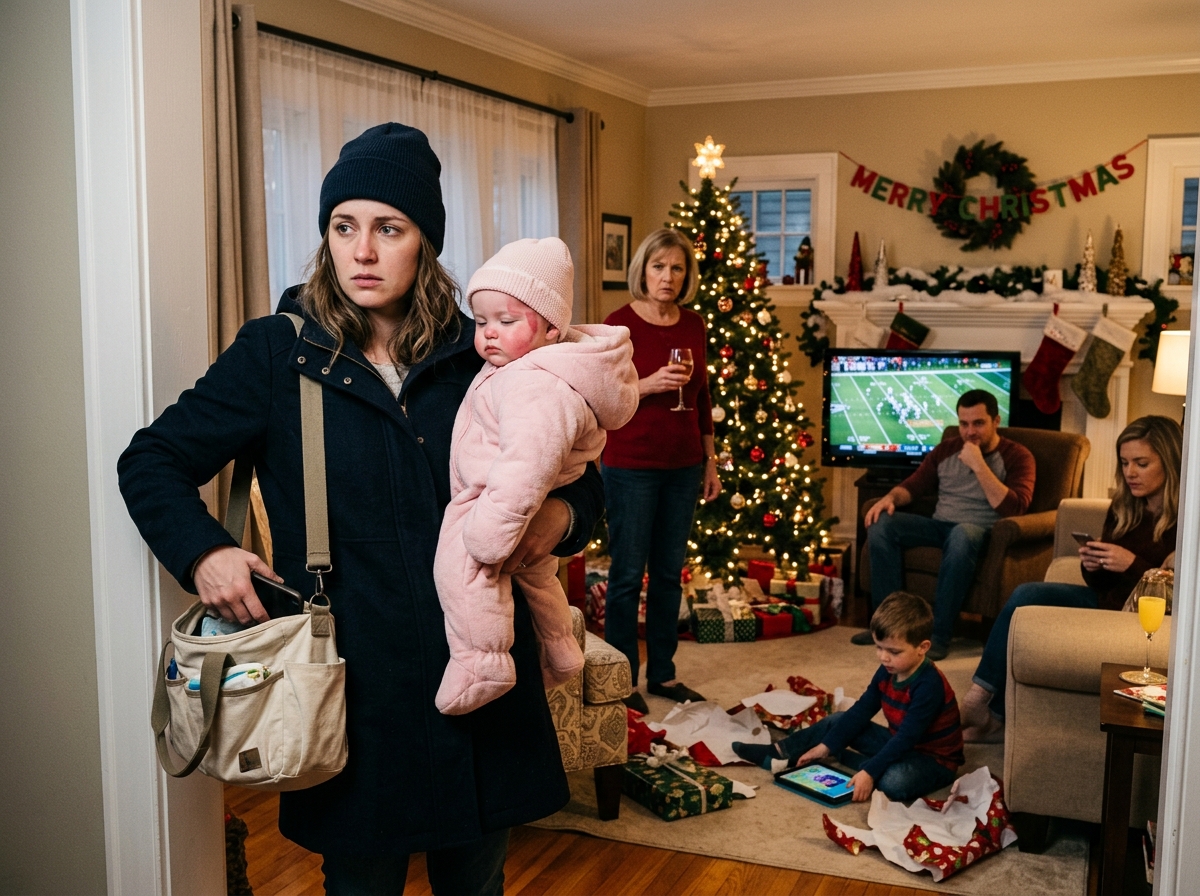
She was standing by the tree with a wine spritzer in her hand, staring not at me but at my daughter—at the red birthmark curling from my baby’s temple to her cheek, like my child was a stain on the room instead of a person in it.
My daughter was nine months old. She had just woken up from the drive, cheeks pink from the cold, fingers wrapped around the edge of my scarf. She wasn’t crying. She wasn’t loud. She was just looking around at the lights, the ornaments, the fake snow on the mantel.
But my mother looked at her and said, “Your baby makes people uncomfortable.”
I honestly thought I’d heard her wrong.
Across the room, my father didn’t even turn all the way from the football game. He just smirked.
“She’s right,” he said. “Sit this one out.”
I stood there with my daughter on one hip and a giant reusable bag of wrapped gifts cutting into my wrist. My coat was damp from the snow. My back still ached from the drive, from sleepless nights, from a body that hadn’t finished healing. I’d had mastitis the week before. Fever. Chills. Pain so sharp I cried in the shower and still showed up today anyway.
No one offered to take the bag.
No one asked how I was doing.
My sister Jenny drifted in from the kitchen with a mimosa in her hand and looked at me like I’d dragged a problem into her perfect holiday. One of her kids was already on the floor with a brand-new iPad I was pretty sure I had paid for.
She didn’t say hi.
She rolled her eyes and said, “Oh my God, are we doing this?”
That was the moment something in me went completely still.
“If I’m not welcome,” I said, “that’s fine.”
Now they all looked at me.
“But this is the last time I do any of this.”
My mother blinked. Jenny laughed. My father actually chuckled like I was performing for attention.
So I made it plain.
“If you don’t want me or my daughter here,” I said, “then I will stop financing your lifestyle.”
They laughed harder.
Not the warm kind. The mean kind. The kind people use when they think they’ve already decided what you are.
My father clapped once.
Jenny said something about postpartum hormones. My mother muttered that I always needed to make everything about me. Like I was the unreasonable one. Like I hadn’t spent the last three years paying their mortgage shortfalls, covering Jenny’s daycare, buying holiday gifts, filling their pantry, and answering every little emergency text that somehow ended with my card number.
I didn’t flinch.
I just repeated it.
“No more mortgage transfer. No more daycare draft. No more truck payment. No more family phone plan. No more rescuing grown adults who can humiliate a baby and still hold out their hands.”
That was when my father’s smile slipped.
Jenny set her glass down too fast.
My mother finally looked at me instead of through me.
Then she said, very softly, “Don’t be dramatic.”
I shifted my daughter higher on my hip, set the gift bag by the door, and reached into the diaper bag for my phone.
Because if they wanted to act like I was bluffing, they were about to find out what I already knew from a message thread they never meant for me to see.
I reached into the diaper bag for my phone, unlocked it, and opened the message thread I had found three nights earlier while I was up at 2:14 a.m. feeding my daughter in the blue light of the kitchen. I hadn’t meant to see it. Jenny had sent me a screenshot earlier that week about daycare money, and when I opened our family chat to find it again, I saw a string of messages above it they had forgotten to delete.
At first, I thought I was reading it wrong.
Then I realized I wasn’t.
There was my mother calling my daughter’s birthmark “hard to look at.”
There was Jenny saying, “Please don’t let her bring the baby to Christmas and make it all weird.”
There was my father writing, “She can still send the money without showing up.”
I looked up from my phone and met my mother’s face. The wine spritzer was still in her hand. My father was still half-turned toward the television. Jenny was standing there in matching holiday pajamas I had bought for her whole family last month, like I was the one who had ruined the room by arriving with proof.
“You said she was hard to look at,” I said quietly.
My mother’s mouth tightened.
Jenny went pale for a second, then recovered fast, the way people do when they still believe denial is stronger than evidence.
My father muttered, “Don’t start.”
I held the phone up.
“No,” I said. “You started this three days ago.”
The room changed then. Not loudly. Not all at once. Just enough for everyone to feel the lie crack. My nephew looked up from the iPad for half a second before Jenny snapped at him to go to the den. One of the cousins near the dining room doorway suddenly found the cheese board very interesting. My mother set her drink down with controlled precision, like she could still turn this into a conversation about my tone instead of their cruelty.
“That was private,” she said.
Private.
That word almost made me laugh.
You can say monstrous things in a family group chat about a nine-month-old baby and still believe the true offense is that someone read it.
I shifted my daughter higher against my shoulder. She had started chewing on the edge of my scarf again, calm and sweet and completely unaware that the people smiling in matching red plaid around her had decided she was an embarrassment before she even arrived. My chest hurt so badly it felt like something sharp had been lodged behind my ribs.
“You discussed whether my baby should be hidden from Christmas like she was something shameful,” I said. “And you still expected me to pay for all of this.”
Jenny folded her arms.
“Oh my God, that is not what we said.”
I looked down at the screen.
“You said, ‘Please don’t let her bring the baby and make it all weird.’”
Then at my mother.
“You said, ‘The mark is just… a lot.’”
Then at my father.
“And you said I could still send the money without showing up.”
Nobody answered right away.
That was answer enough.
My mother stepped forward then, lowering her voice into that soft, poisonous register she used when she wanted to sound reasonable while saying something unforgivable. “You’re exhausted. You’re emotional. You had a difficult birth, and now you’re obsessed with taking everything personally. We were trying to protect the atmosphere for the other children.”
“The atmosphere?” I repeated.
My daughter made a small sleepy sound and pressed her warm cheek against my collarbone.
“The atmosphere,” I said again, louder this time. “You mean the atmosphere where Jenny’s kids get brand-new iPads and custom bikes and matching holiday pajamas because I paid for them, but my daughter is too uncomfortable to be seen near the tree?”
My father finally turned all the way around.
“Watch your mouth.”
Something in me went still at that.
Not afraid. Not shaky.
Still.
“No,” I said. “You watch yours.”
Jenny let out a short disbelieving laugh. “You’re acting like we owe you our lives because you help out sometimes.”
Sometimes.
I stared at her.
Three years of mortgage shortfalls.
Fourteen months of daycare drafts.
The truck payment after her husband “fell behind.”
The Christmas gifts.
The groceries.
The family phone plan.
The emergency dentist bill.
The school uniforms.
The summer camp deposit she cried over and promised to repay.
Sometimes.
I opened my banking app and started reading out loud.
“December third. Mortgage transfer, eight hundred and sixty dollars.”
I looked at my father.
“December seventh. Truck payment, four hundred and twenty.”
At Jenny.
“December eleventh. Daycare draft, five hundred and ninety.”
At my mother.
“December fifteenth. Grocery delivery, three hundred and twelve.”
Their faces changed one by one.
Not with shame.
With panic.
That was the part I will never forget.
Not one of them looked horrified about what they had said about my baby.
They looked horrified that I might finally stop paying.
My mother reached for my arm. “Enough,” she hissed. “Not here.”
I stepped back before she could touch me.
“Why?” I asked. “Because people might hear who’s actually been carrying this family?”
My father stood up too fast, the recliner kicking backward behind him.
“You don’t get to threaten us in our own house.”
I looked at him.
Then at the tree.
Then at the stockings.
Then at the wrapped gifts with those expensive foil bows Jenny always picked because she knew somebody else would end up paying.
“Your house?” I said softly. “Interesting.”
He knew instantly.
His face lost color.
Because the part none of them ever wanted to say out loud was that I wasn’t just helping them survive. I was helping them keep the house itself. After my father’s “temporary” layoff turned into a year and a half of excuses and odd jobs, I had stepped in to stop them from missing enough payments to lose everything. Quietly. Repeatedly. With promises every month that it was only until they got stable again.
Stable never came.
Comfort did.
Jenny saw it too. I watched the realization spread through her expression in slow motion, ugly and desperate. “You wouldn’t.”
I looked down at my daughter. At the red birthmark curling across her temple and cheek, the one doctors told me would likely fade but might never fully disappear. I remembered every appointment. Every sleepless night Googling treatments. Every whispered promise into her hair that nobody would ever make her feel less than beautiful while I was alive.
Then I looked back up.
“You laughed at my child,” I said. “And you counted on my love to keep funding it.”
Nobody moved.
Nobody even pretended to.
I opened the banking app fully.
My mother’s voice turned sharp. “Put that phone away.”
My thumb hovered over the first scheduled transfer.
“No more,” I said.
And then, right there in the glow of their perfect Christmas tree, with my daughter on one hip and my coat still half on my shoulders, I canceled the January mortgage transfer.
Jenny actually gasped.
My father took one step forward.
My mother said my name the way people say stop at the edge of a cliff.
I canceled the daycare draft next.
Then the truck payment.
Then the phone plan.
Each tap sounded louder in my head than the last.
“You’re being insane,” Jenny snapped.
I canceled the grocery auto-order.
My father’s voice dropped low and ugly. “After everything we’ve done for you—”
I laughed then.
Not because it was funny.
Because it was.
“Everything