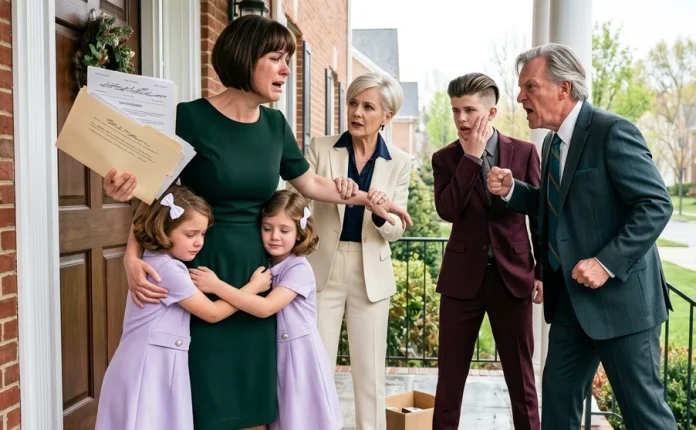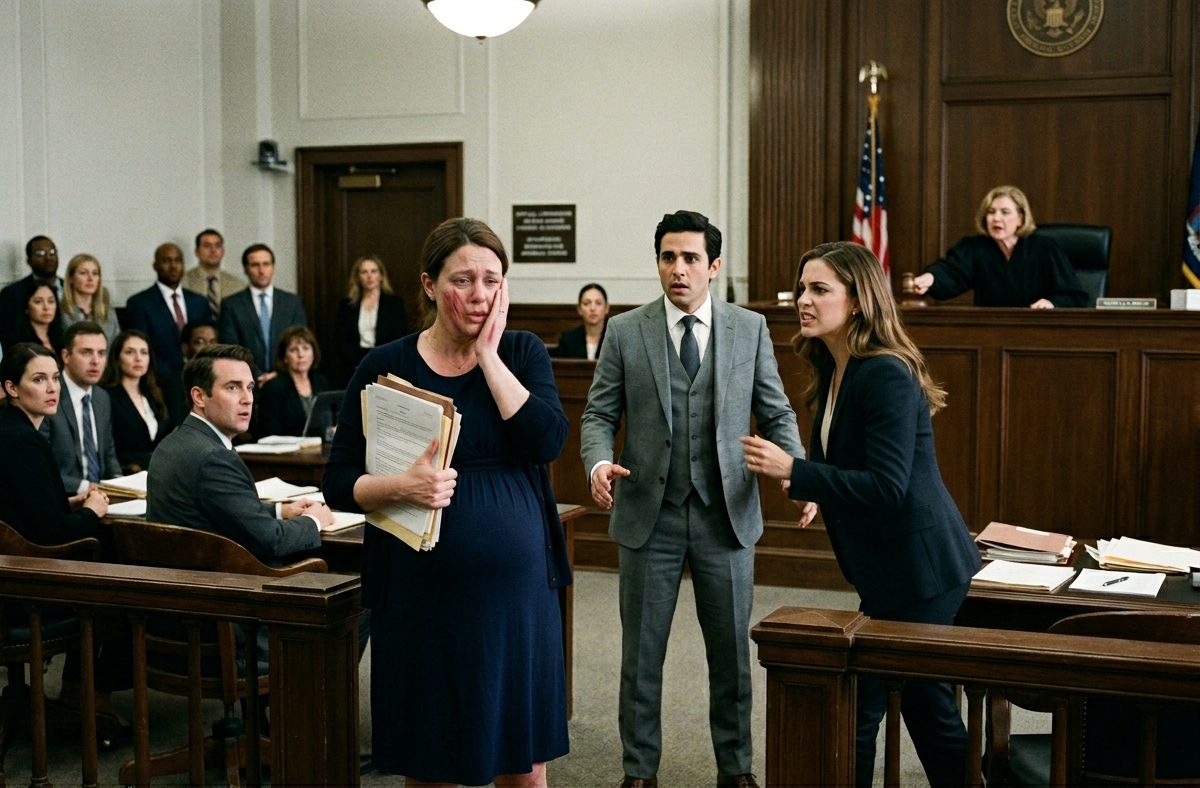
Eight months pregnant, I came to court for a divorce — but when my husband’s mistress hit me in front of everyone, the judge suddenly ordered the courtroom sealed.
I thought the hardest part would be walking into family court alone. I was eight months pregnant, swollen, sore, and doing everything I could not to break down in a hallway full of strangers clutching folders like mine. Divorce is not always loud. Most of it is quiet and humiliating. It is sorting bills at midnight, sleeping on borrowed sheets, and pretending the baby inside you is enough to make the future feel stable. That morning, I told myself I could survive the embarrassment. After everything else, I had already survived the marriage.
My husband, Caleb Whitfield, had always been the kind of man people trusted instantly. CEO. Public speaker. Charity face. He knew exactly how to look generous from across a room. At home, it was different. Kindness came with strings. Silence came with consequences. Money became control. Every grocery receipt, every doctor visit, every tank of gas somehow turned into proof that I was expensive, difficult, ungrateful. Even then, I was not there for revenge. I wanted fair child support. I wanted a reasonable arrangement for the house since both our names were on it. I just needed enough stability to bring my baby home without wondering where we would sleep.
Then Caleb walked in.
Not alone.
He stepped through the courtroom doors in one of those dark tailored suits he wore when he wanted to look serious and wounded at the same time. Beside him, holding a leather folder against her chest like she belonged there, was Marissa Vale. Twenty-six. Smooth hair. Smooth smile. Smooth little expression of concern arranged so carefully it made my stomach turn. The woman Caleb had sworn for months was “just helping with PR.”
The bailiff called our case, and I rose carefully, one hand under my stomach, the other gripping the back of the bench. The baby shifted hard, as if even he could feel the tension in the room. Caleb glanced at me once. Long enough to register the belly, the flats, the tired face, the fact that I was visibly carrying the child he had already started treating like an inconvenience. Marissa stood half a step behind him, chin lifted, eyes running over me with that smug calm women like her wear when they think they’ve already won.
Judge Miriam Sloane was older, sharp-eyed, and visibly tired in the way only family court judges ever are. She started with the usual questions. Temporary support. Housing possession. Medical continuity before delivery. She asked if both sides were prepared to discuss interim arrangements with urgency given the pregnancy.
“I am,” I said.
Caleb’s attorney nodded. “We are, Your Honor.”
Then the judge looked directly at Caleb. “Mr. Whitfield, given your wife’s condition, I expect basic cooperation regarding housing and prenatal stability. Is that understood?”
Before Caleb could answer, Marissa laughed.
It was small.
Soft.
Barely there.
But everyone heard it.
The judge’s eyes moved to her. “And you are?”
Caleb’s lawyer shifted. “A support person, Your Honor.”
Support person.
I almost laughed myself.
Judge Sloane did not. “Then your support will remain silent.”
For a second, I thought maybe the morning would still stay ugly but controlled. Maybe Caleb would keep performing decency long enough for us to get through the hearing. Maybe Marissa would enjoy herself quietly and let the lawyers do the damage the civilized way.
Then the discussion turned to the house.
The house Caleb had insisted we buy together because a stable family image “looked better” for investors. The house I helped pay for, decorate, maintain, and then got quietly pushed out of after discovering the affair. His attorney framed it like generosity. Caleb would “assist” me temporarily with a smaller rental arrangement more appropriate for “my new circumstances.”
My new circumstances.
As if the baby had appeared from the weather.
I lifted my chin and said, “I’m not asking for charity. I’m asking for the home I also paid into, especially while I’m about to give birth.”
Caleb finally spoke then, voice smooth, patient, almost pitying. “You’re being emotional, Nora. A big house isn’t practical for one person and a newborn.”
One person.
I looked at him.
“You mean me and your son?”
His jaw tightened.
Marissa smiled.
The judge asked another question about temporary occupancy, but I barely heard it because Marissa leaned toward Caleb and whispered something that made him smirk. Then she said, loud enough for the whole room to hear:
“Maybe if she spent less time playing fragile and more time planning, she wouldn’t be here begging in court.”
The room went still.
Even Caleb looked startled that she had said it out loud.
Judge Sloane’s voice sharpened instantly. “Ms. Vale, one more interruption and you will be removed.”
Marissa lifted a hand. “Of course, Your Honor.”
But the damage was done.
Because something in the way she looked at me then — at my stomach, my shoes, my folder, my tired face — made it clear she did not just want me defeated. She wanted me humiliated. She wanted me to feel reduced in public. Small. Disposable. Replaceable.
The hearing resumed, but it had changed. Caleb’s attorney kept pushing for temporary possession, deferred valuation, language about financial practicality, every polished phrase designed to leave me unstable and grateful. Then Judge Sloane looked directly at me and asked the question that split the room open.
“Mrs. Whitfield, do you feel safe in the arrangement your husband is proposing?”
My whole body went cold.
Caleb’s attorney objected before I could answer, but the judge raised one hand. “You’ll have your turn.” Then she looked back at me. “Answer the question.”
I took a breath and told the truth.
“No,” I said. “I don’t.”
Caleb’s face changed.
Not guilt.
Anger.
Judge Sloane’s eyes narrowed slightly. “Explain.”
I looked at the notes I had written and rewritten during sleepless nights and said the words I had been forcing myself to prepare for.
“He never hit me,” I said. “He was too careful for that. But he controlled every expense, tracked every purchase, threatened to leave me with nothing, and moved his mistress into our life before I had even packed my bag. I am eight months pregnant, living in borrowed space, and I do not believe he wants the house because it’s practical. I believe he wants me scared.”
Nobody moved.
For one second, not even Marissa.
Then she snapped.
It happened so fast my mind rejected it at first. One moment she was standing beside the counsel table, face composed. The next she was striding across the courtroom in heels, eyes blazing, one hand raised.
And then she hit me.
Hard.
Across the face.
The sound cracked through the courtroom like something wooden breaking. My head jerked sideways. I stumbled and instinctively threw both arms over my stomach before I even understood what had happened. Somebody shouted. A chair scraped. Caleb stood up so fast it knocked backward.
And Judge Miriam Sloane slammed her hand down and shouted, “Seal this courtroom. Now.”
The courtroom exploded for exactly three seconds.
Then it went deadly quiet.
The bailiff moved first, stepping between me and Marissa as she lunged again, still wild enough that two officers had to grab her arms. Caleb shouted her name. His attorney was on his feet, pale, stammering something about misunderstanding, emotion, stress. Judge Sloane stood up so abruptly her chair rolled back into the wall.
“Clear the room,” she snapped. “No one enters. No one leaves without my order. This proceeding is sealed effective immediately.”
The clerk froze for half a heartbeat, then started moving. Doors shut. Spectators were rushed out. Even the hallway noise seemed to collapse as the courtroom sealed around us. My cheek burned. My ears rang. But all I cared about was the baby. I was bent over one armchair, both hands over my stomach, barely breathing.
“Nora,” the judge said, her voice suddenly lower and sharper at once. “Are you having pain?”
I looked up. “I— I don’t know.”
That was the truth. My face hurt. My heart was pounding so hard I couldn’t tell what was fear and what was something worse. The baby moved once, then again, a deep rolling shift that almost made my knees give out with relief.
“I need a medic in here now,” Judge Sloane barked.
Marissa was still struggling against the officers. “She’s lying! She thinks being pregnant makes her untouchable!”
That was the moment Caleb’s mask broke.
“Shut up, Marissa.”
He didn’t say it like a man defending me.
He said it like a man realizing his life had just cracked open in public.
Judge Sloane turned on him next. “Mr. Whitfield, if you say one more word that is not directly responsive to this court, I will hold you in contempt before lunch.”
He went silent.
The paramedic arrived within minutes. Blood pressure. Pulse. Questions. Any cramping? Dizziness? Fluid? Bleeding? I answered as steadily as I could while sitting in a courtroom chair with one hand pressed to my stomach and half my face still throbbing from another woman’s hand. When they told me the baby’s heart rate sounded stable, I nearly cried.
Then Judge Sloane did something I did not expect.
She ordered Marissa removed in restraints.
Not escorted.
Removed.
The whole time Marissa kept shouting that I had provoked her, that I was ruining Caleb’s life, that none of this would have happened if I had just “accepted reality.” The officers dragged her toward the side door while her heel caught on the carpet and snapped sideways. It should not have been satisfying. It was.
When the door shut behind her, the silence in the courtroom changed. Heavier. Cleaner.
Judge Sloane looked directly at Caleb. “Your mistress physically assaulted your pregnant wife during an active family court proceeding. I want to be absolutely clear, Mr. Whitfield: whatever benefit of the doubt you imagined this court might extend to you is gone.”
Caleb’s attorney tried once more. “Your Honor, Mr. Whitfield cannot be held responsible for the independent actions of—”
“Sit down,” she said.
He sat.
Then she looked at me.
“Mrs. Whitfield, before we continue, I want to ask again: do you feel safe?”
This time the answer came faster.
“No.”
She nodded once, like something had just locked into place.
What followed no longer felt like a divorce hearing. It felt like an excavation. Judge Sloane asked for financial disclosures. Immediate ones. Housing records. Account access. Communication history. Temporary transfers. Who had been paying what, from which account, and when. And because Caleb had spent so many years believing I would stay too tired, too embarrassed, too scared to document anything, I had more than he expected.
Much more.
Screenshots.
Bank transfers.
Texts.
Emails.
A private message from Marissa sent to a friend that ended up forwarded to me by someone who still had a conscience.
My attorney hadn’t even needed to say much. By then Judge Sloane was reading for herself.
There was Caleb refusing to pay my prenatal co-pays while spending freely on “client hospitality.”
There were messages threatening to freeze me out financially if I did not agree to vacate the house quietly.
There were hotel charges lining up perfectly with the months he insisted he was “traveling for work.”
And then there was the message that changed the entire tone of the room.
Marissa, to Caleb, two weeks earlier:
If she pushes this in court, remind her how ugly custody can get when a woman looks unstable and overemotional that close to birth.
Judge Sloane read that one twice.
Then she removed her glasses and looked straight at Caleb.
“Did you know your companion intended to weaponize your wife’s pregnancy and mental state in litigation?”
Caleb didn’t answer quickly enough.
That was answer enough.
The judge leaned back, folded her hands, and said, “Temporary exclusive possession of the marital home goes to Mrs. Whitfield effective today. Mr. Whitfield will vacate by six p.m. tomorrow. Full temporary support is ordered pending formal review. All prenatal and delivery expenses are to be covered without delay. And given the conduct witnessed today, I am ordering immediate supervised-only contact after the birth until this court has completed a full custody evaluation.”
Caleb went white.
His attorney stood up. “Your Honor—”
“No.”
Just that.
No.
The kind of no that ends men who are used to negotiation.
Caleb finally found his voice then. “You can’t be serious.”
Judge Sloane looked at him without blinking. “Your mistress assaulted your eight-months-pregnant wife in open court, and you are concerned with seriousness?”
He actually looked at me then, really looked at me, as though waiting for me to soften this somehow. To rescue him from the consequences the same way I had once rescued him from late fees, bad press, forgotten anniversaries, and every sharp edge of his own behavior.
I didn’t.
I sat there with one hand on my stomach and watched him realize I was done.
Then the judge asked if I wanted to make any additional statement for the sealed record.
I did.
I stood carefully, ignoring the ache in my hips, ignoring the burn in my cheek, and looked directly at the man I had once loved hard enough to excuse almost anything.
“I did not come here to destroy you,” I said. “I came here to leave with enough dignity to keep our child safe. You made even that difficult.”
Caleb said nothing.
For the first time in our entire marriage, he had no usable expression. No charm. No wounded professionalism. No polished explanation. Just panic, stripped of its suit.
I looked at the empty side door where Marissa had been dragged out and then back at him.
“You spent years making me feel like I was too emotional, too expensive, too dependent, too much. But the truth was always simpler than that.” I let the silence hold him for a second. “You were just cruel enough to need me small.”
His eyes dropped.
That was all I needed.
The hearing ended with signatures, orders, clerk stamps, instructions to counsel, and one final reminder that the record was sealed pending related criminal review. By then, the adrenaline was wearing off and my whole body felt wrecked. A deputy escorted me to a private exit so I would not have to pass the main hallway. My attorney kept talking — next steps, protective filings, property inventory, hospital bag, call me if anything changes — but I only really heard one thing.
You got the house.
When I stepped outside, the air hit my face like cold water. For the first time in months, maybe longer, I could breathe all the way in. Not because everything was fixed. It wasn’t. I was still eight months pregnant. Still exhausted. Still bruised. Still standing in the ruins of a marriage I had not wanted to end like this.
But for the first time, the ground under me was not moving.
I put one hand on the curve of my belly and waited.
A second passed.
Then another.
Then the baby kicked.
Strong.
Certain.
Alive.
And right there on the courthouse steps, with half my face burning and my whole life rearranged in a single morning, I laughed. Not because anything was funny. Because after all that humiliation, all that fear, all that careful cruelty, the one thing Caleb had wanted most — my uncertainty — was the one thing he no longer had.
He had lost the house.
He had lost the narrative.
He had lost the courtroom.
And before long, once the charges from that sealed hearing began moving where they needed to move, he was going to lose a great deal more.
I walked to my car slowly, one hand still under my stomach.
Not broken.
Not begging.
Not scared.
Just done.