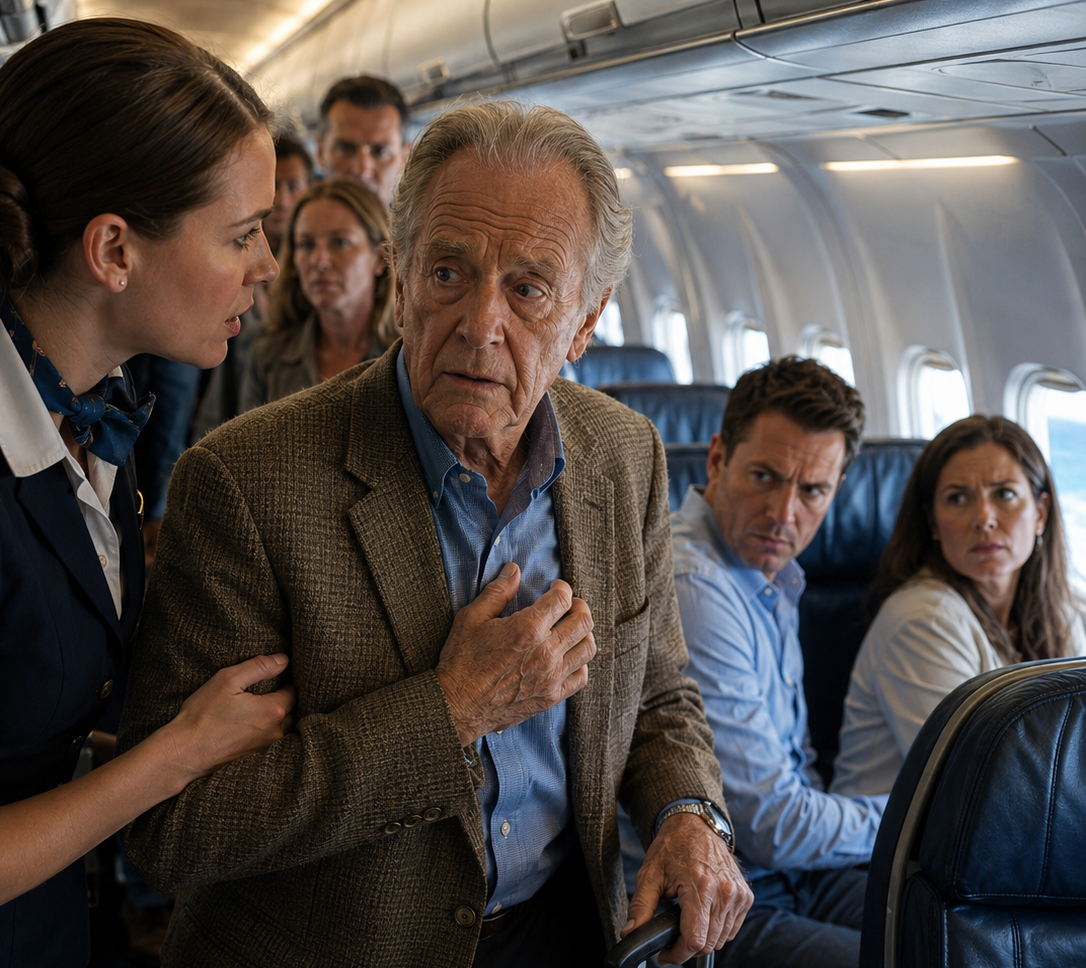
The flight attendant leaned close as if she were checking my boarding pass, but her voice landed colder than the air blowing from the overhead vents.
“Pretend you’re feeling ill and leave this aircraft.”
For a second, I simply stood there in the aisle with my suitcase in one hand and a line of irritated passengers stacking up behind me. Three rows ahead, my son Christopher and his wife Edith were pretending not to notice me, both staring at their phones with the kind of practiced indifference people wear when they have already decided what role you are allowed to play.
The plane smelled like coffee, recycled air, and the sharp chemical trace of too many rushed cleanings. Through the oval window, Florida sun flashed across the wing like a signal.
I should have kept walking.
That was what Christopher expected.
That was what Edith expected.
Instead, I looked at the flight attendant’s face and saw something I had spent forty years teaching teenagers to identify in primary sources, witness statements, and old legal transcripts.
Fear.
Not nervousness.
Not confusion.
Fear.
My name is Francis Wilson. Most people, for most of my life, called me patient. My students called me steady. My late wife used to say I could sit through a thunderstorm without raising my voice.
My son mistook all of that for weakness.
Christopher and Edith had moved into my Orlando house eight months earlier after what he called “a temporary turn” in his career. I did not press for details. He was my son. I gave them the downstairs bedroom, cleared room in the garage, and made sure the coffee he liked was always in the pantry. I told myself their distance was embarrassment. Pride. Adulthood sitting awkwardly on a man who had once asked me to help fix a bicycle chain and cried if he thought I was disappointed in him.
But silence has different shapes.
There is the silence of shame.
And there is the silence of calculation.
They used my kitchen like a hotel breakfast bar. They moved through the hallway with the stiff politeness of strangers subletting from someone they planned to outlast. Edith spoke to me in that soft, careful tone people use when they want witnesses to believe they are kind.
“Francis, you should rest.”
“Francis, don’t worry yourself.”
“Francis, let Christopher handle that.”
Small things at first.
A bank statement missing from my desk.
A letter from my insurance company shifted from the mail tray.
Edith asking, too casually over dinner, “Your life insurance policy is still five hundred thousand, right?”
Christopher’s fork froze halfway to his mouth that night.
I remember the sound.
Metal on china.
A tiny scrape.
Then he said, too quickly, “Dad and I talked about it once.”
We had not.
I taught history long enough to know truth rarely arrives with a trumpet. More often it taps once on the window and waits to see if you are paying attention.
Then came Miami.
They stood in my study on a Tuesday afternoon while I graded essays from a night class I still taught twice a week at the community center. Edith had that perfect smile women like her save for church greeters and funeral lines. Christopher stood just behind her, hands in his pockets, shoulders too tight.
“We’ve been thinking,” he said, “about family.”
“Quality time,” Edith added.
That was the phrase she used.
Quality time.
A week in Miami, fully paid. Flights booked. Hotel arranged. All I had to do was say yes.
I should have asked why the tickets were already printed.
I should have asked why Edith looked relieved before I answered.
I should have asked why my seat, according to the envelope she set on my desk, was nowhere near theirs.
Instead, I did what fathers do when love and habit blind them at the same time.
I tried to believe the story they offered was the true one.
The night before the flight, I found the confirmation pages spread across the dining table. My medication list had been copied out in Edith’s neat handwriting. My seat assignment was in the rear of the plane. Theirs were together near the front. I stood there under the warm pendant light above the table where Christopher once practiced spelling words and felt something inside me go still.
Not anger.
Clarity.
The next morning, the drive to the airport was nearly silent. Palm trees blurred by. Edith deleted messages in the front seat as fast as she typed them. My suitcase sat on my lap because Christopher insisted the trunk was full, though I had seen it open and empty when he pulled out of the driveway.
At security, Edith pressed her hand lightly between my shoulder blades and smiled for the TSA agent.
“There you go, Francis. Easy.”
Easy.
At the gate, they boarded early. Christopher did not look back. Edith did once, but not with concern.
With measurement.
As if she were checking whether a door had locked behind her.
And now, on the plane, the flight attendant named Mildred had leaned close and begged me to get off.
The first time, I thought I must have heard her wrong.
The second time, she touched my sleeve and whispered, “Sir, please. I’m begging you. Pretend you’re sick and leave this aircraft.”
I looked at Christopher.
He finally noticed me standing there.
“Dad?” he called, too sharp. “Everything okay?”
That was when I understood the room had changed. Not because I knew everything. Because someone else knew enough.
I put one hand to my chest.
“Oh,” I said, loud enough for the nearby passengers to hear. “I don’t feel right.”
The woman behind me stepped back immediately. Mildred moved with impressive speed.
“Sir, come with me.”
Christopher half rose in his seat. “What’s going on?”
Mildred turned with the kind of professional calm that usually means the opposite of calm. “Possible medical event. We need him off the aircraft.”
Edith stood then, and for the first time that morning, her face slipped. Not outrage. Alarm.
“He’s fine,” she said too quickly.
Mildred did not even look at her. “Sir, lean on me.”
So I did.
I let my shoulders sag. Let my steps go unsteady. Let them guide me back up the jetway while the other passengers stared with that curious discomfort people reserve for someone else’s potential crisis. Behind me, I heard Christopher say my name once. Edith said nothing at all.
The moment the aircraft door shut behind us, Mildred straightened and dropped the performance.
“Can you walk?” she asked.
“Perfectly.”
“Good.”
She looked left, right, then grabbed my wrist and steered me toward a quiet service alcove near the top of the jet bridge. Her face had gone pale beneath the makeup.
“I’m only going to say this once,” she said. “I found your daughter-in-law’s phone in the lavatory during pre-boarding. It was unlocked when I picked it up. A message came in.”
She swallowed.
“It said, ‘Once his heart meds kick in and he’s unresponsive, keep your face calm till landing.’”
For a second, the sounds of the airport — rolling bags, overhead announcements, a child crying somewhere in the terminal — all went distant, as if the whole world had taken one long step backward and left me alone inside that sentence.
Mildred kept talking, probably because if she stopped she might lose her nerve.
“There were more messages. A lot more. Between her and your son. About insurance. About dosage. About how nobody would question a medical emergency on a flight to Miami.”
I looked at her.
She looked back like she was still deciding whether she had done something brave or something that might ruin her life.
“Where is the phone now?” I asked.
She hesitated.
Then she slipped it from the pocket of her service apron.
“Here.”
Every part of me went cold and strangely clear at once.
I took the phone.
Edith had not even changed the lock screen. A beach at sunset. The kind of picture women use when they want to look softer than they are. But the messages underneath it were all teeth.
Insurance forms.
Medication notes.
Flight times.
Words like if needed and just enough and easiest in the air.
There it was in black and white:
Once his heart meds kick in and he’s unresponsive, keep your face calm till landing.
And below that, from Christopher:
You sure the dosage won’t look weird?
My son.
My own son.
For one terrible second, I felt nothing at all. Not because it didn’t hurt. Because some pains are so large they arrive first as absence.
Mildred touched my sleeve again.
“Airport police are on their way. I already called.”
I looked up from the screen.
“Good.”
My voice sounded steady. Stranger than before, but steady.
She drew in a breath. “I’m sorry.”
I almost told her she had nothing to apologize for. Instead I said the thing that mattered.
“You got me off that plane.”
She nodded, and that was when her eyes finally filled.
Airport police arrived within minutes. Two officers, then a supervisor, then one plainclothes investigator who read the messages in silence and immediately asked where the original medications were. I gave them the bottle from my carry-on and told them exactly what I took, exactly when, exactly who had packed my morning dose.
Edith.
Always Edith.
The officers moved fast after that. Not dramatic. Efficient. The way people move when they understand they have just stepped into something much darker than a domestic misunderstanding. The plane had not yet pushed back from the gate. Christopher and Edith were escorted off before most of the passengers even knew why the delay had happened.
I was standing near the terminal window when they came up the jetway.
Christopher saw me first.
The look on his face will stay with me until I die.
Not relief.
Not concern.
Recognition.
He knew instantly that whatever they thought would happen in the air had already failed on the ground.
Edith’s composure held half a second longer. Then she saw the phone in the investigator’s hand and everything left her at once.
They separated us immediately.
One officer sat me down with bottled water and questions. Another took their statements elsewhere. Mildred remained in view just long enough for me to nod once in her direction. She nodded back.
I never heard all of what Christopher said to them. I heard enough.
“It wasn’t like that.”
“We were just trying to get him help.”
“He gets confused about his meds.”
That last one almost made me laugh.
Confused.
The same man who had relied on my steadiness his whole childhood now trying to turn it into frailty because greed had outrun whatever conscience he had left.
The investigation widened quickly. The phone messages were only the doorway. By the time they checked the financial records, they found policy change requests drafted but not yet finalized, inquiries into accelerated death benefits, and emails between Edith and someone at a private care brokerage in Miami about long-term placement options for “an elderly male with likely cardiac decline.”
Placement.
They had not just planned my death.
They had planned the paperwork around it.
Hours later, the investigator returned and asked whether there was anywhere safe I could stay.
I said yes.
My own home.
Then I added, “Though I suspect I’ll need new locks.”
He gave me a grim little smile. “That can be arranged.”
By sunset, Christopher and Edith were in custody pending formal charges. The house was secured. My bank accounts were locked down. My insurance agent, who sounded physically ill after hearing why I was calling, froze every pending adjustment on my policies and asked if I wanted to file fraud alerts across the board.
I said yes to everything.
That night, I sat alone at my kitchen table with a cup of coffee gone cold and stared at the empty chair where Christopher used to sit as a boy, swinging his legs and asking whether the Civil War would have happened if adults were less stupid.
Back then I always told him history is full of people who confuse entitlement for inevitability.
Turns out he learned the wrong lesson.
The strangest part was not the betrayal itself. Not once the shock wore off. Families contain ugliness all the time if you live long enough to see their masks crack. No, the strangest part was the silence that came after they were gone. The house felt bigger. Cleaner. As if truth, terrible as it was, had still made the air easier to breathe.
The next morning, airport police returned my bag and asked whether I wanted the boarding pass back too. I looked at it for a long second.
Miami.
Quality time.
A week they had fully arranged.
Then I folded it once and dropped it into the trash.
Three days later, I met Mildred for coffee at the airport café near Terminal B. She looked younger out of uniform, though not by much. The strain had not entirely left her face.
“I almost didn’t say anything,” she admitted.
I nodded. “But you did.”
She looked down at her cup. “My father died in a nursing home because people kept deciding not to say anything. I promised myself I’d never do that again.”
That hit harder than I expected.
I reached across the table and put my hand over hers.
“You saved my life.”
She shook her head once, eyes bright now. “No. I just believed what I saw.”
Maybe that is the same thing sometimes.
People still call me patient. Steady. Calm. I suppose I am. But none of those things mean harmless. And none of them mean blind. My son had spent so long mistaking my restraint for weakness that he never understood the truth until it was too late:
The quiet man in the room is often the one paying closest attention.
He thought I would board that plane, take the pills he packed, and drift gently into the version of me he had already written into his future.
Instead, I stepped back into the jetway.
And in the end, it was not rage, not panic, and not even heartbreak that saved me.
It was a frightened flight attendant, a forgotten phone, and the one thing they had been stupid enough to leave unlocked.