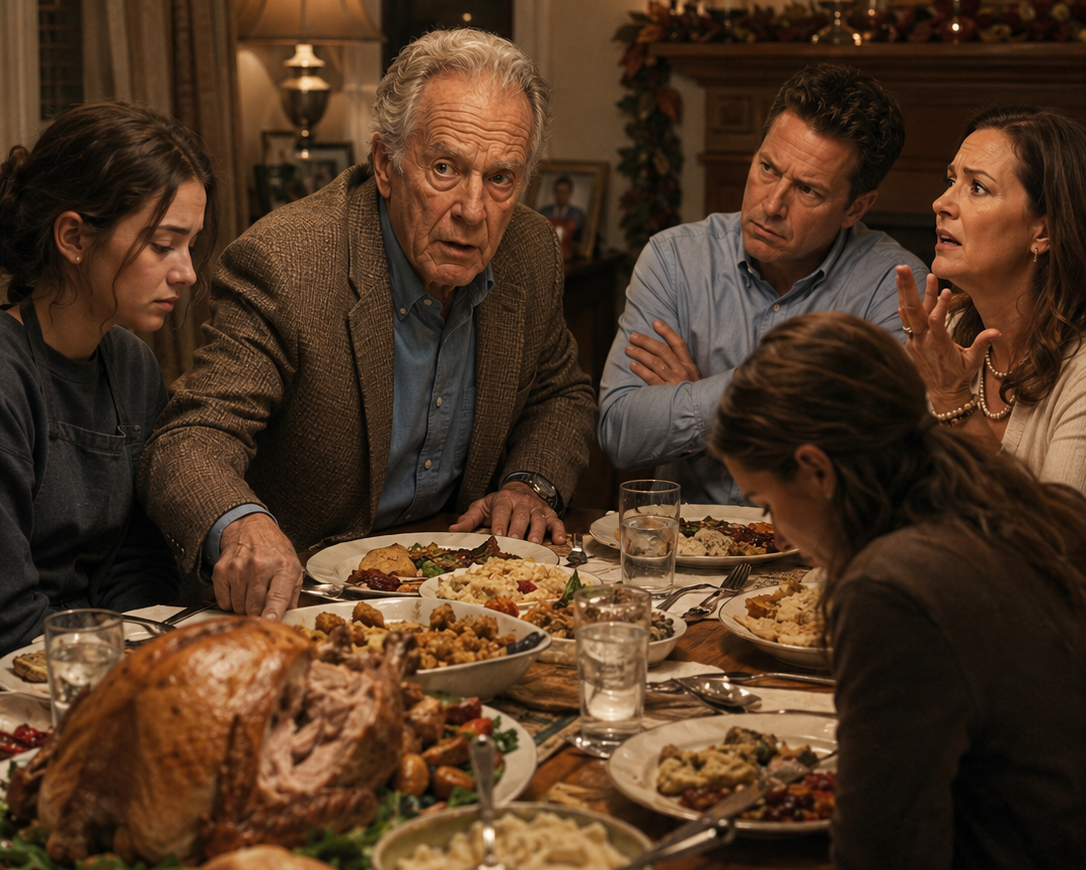
During Thanksgiving dinner, my grandfather suddenly set his fork down with a hard little clink that silenced the entire table.
He looked straight at my parents and asked, “Wait… why is my granddaughter paying nine hundred dollars a month just to sleep in an unfinished basement?”
My father gave a short, dismissive laugh.
“She owes the family.”
My mother sighed the way she always did when she wanted to sound burdened and saintly at the same time. “She’s become selfish and ungrateful.”
My sister Vanessa kept her eyes on her plate while everybody else waited for me to do what I had always done before.
Lower my head.
Soften my voice.
Apologize for surviving.
I didn’t.
Instead, I told the truth.
I explained that I had tried to move out twice, but every time I finally saved enough for a deposit, another “family emergency” somehow drained what I had scraped together. Tires. Utilities. Vanessa’s crisis. Always something. Always urgent. Always framed like refusing would make me heartless.
The color drained from Grandpa’s face.
A few minutes later, he quietly asked me to join him in the kitchen.
The sounds of Thanksgiving carried on behind the swinging door — silverware, laughter too loud to be sincere, my father restarting some story like he could talk over the damage. I stood near the sink in my worn black bakery shoes, still dusted with flour from the four o’clock shift I had worked that morning before rushing home to help cook food I could barely afford to eat.
“It’s really not that bad, Grandpa,” I said automatically.
I heard myself saying it and hated how practiced it sounded.
“I work overtime. Dad says paying rent builds responsibility. Mom says it’s only temporary, until Vanessa gets back on her feet.”
Grandpa folded his arms and leaned against the sink.
He didn’t believe a word of it.
“Do you buy your own groceries?” he asked.
I nodded.
“What about your phone, gas, and doctor bills?”
“I pay for all of those too.”
“And they still charge you nine hundred dollars every month for a basement?”
His voice was calm, but underneath it was something much sharper.
I swallowed hard.
“I tried to leave,” I admitted. “Twice. I skipped meals to save enough for a security deposit. But every time I got close, something happened. Dad needed new tires. Mom said the electric bill had doubled. Vanessa needed money urgently. And whenever I said I couldn’t keep paying for everyone, Mom cried and asked when I became such a cold-hearted daughter.”
Grandpa slowly turned his head toward the dining room.
The warmth had gone out of his face.
Then he looked back at me and asked in a dangerously quiet voice, “Roxanne… did you ever receive a letter from the downtown credit union?”
My stomach dropped.
“No,” I said. “Why?”
For a moment, he said nothing.
Then he reached into the inside pocket of his blazer and pulled out a folded envelope, old and softened at the corners from being opened and closed too many times. My name was written across the front in his handwriting.
“I sent this six months ago,” he said.
My hands started shaking before I even took it.
Inside was a photocopy of a bank document and a short note.
Roxanne, this account was set up for you by your grandmother before she passed. I told your parents not to touch it. When you turn twenty-four, it becomes fully yours. I asked the credit union to mail you the final paperwork directly. If you haven’t seen it, call me.
I read it twice.
Then a third time.
My grandmother had died when I was sixteen. She used to tuck twenty-dollar bills into my winter coat pockets and whisper that every woman needed a little money no one else could count. I thought those small secrets had died with her.
Apparently not.
I looked up slowly.
“There was an account?”
Grandpa nodded once.
“Forty thousand, when it was first set aside. More now.”
My knees nearly gave out.
Forty thousand.
I had been skipping lunch to save for a deposit while sleeping beside a washer and dryer in a basement with one painted cinderblock wall, paying my parents nine hundred a month for the privilege of being told I was lucky to have them.
And all the while, there had been money.
Mine.
Protected for me.
Unless, of course, someone had gotten to it first.
Grandpa saw the answer cross my face.
“Call the credit union,” he said.
I did.
Right there from his kitchen wall phone because my own phone was still charging in the basement I suddenly couldn’t bear to think about. The woman at the credit union was polite until I gave my full name and account reference, and then she became careful in that particular way bank employees do when they realize they are standing near fraud.
She asked me to verify my birthday.
My address.
The last four of my Social Security number.
Then she said, “Ms. Hale, according to our records, your mother accompanied you last spring to authorize a structured withdrawal.”
I went cold all over.
“I never came in.”
Silence.
Paper shuffling.
Then, very carefully, “We have a notarized identification form and a withdrawal schedule signed under your name.”
Grandpa’s hand tightened around the back of the chair beside him.
I could hear my own heartbeat in my ears.
“How much?” I asked.
Another pause.
“Thirty-two thousand dollars.”
For a second, I could not speak.
Thirty-two thousand dollars.
Gone.
Not borrowed.
Not reallocated.
Taken.
The kitchen door swung open behind us.
My mother stood there holding the cranberry dish in both hands like she had just remembered she was supposed to be doing something normal. But the second she saw my face, she knew.
“What’s wrong?” she asked, too quickly.
I turned toward her slowly, still holding the phone.
“You tell me.”
The dish rattled slightly in her hands.
Grandpa stepped forward before she could perform confusion.
“You stole from her.”
My mother actually tried to laugh.
“Dad, please, don’t be dramatic.”
The woman from the credit union was still on the line, still politely waiting in my hand while my whole life rearranged itself. My mother saw the phone, saw the paper, saw Grandpa’s face, and for one second the truth looked straight out of her before she managed to cover it.
Then came the next mask.
The tired one.
The martyred one.
“We were going to pay it back,” she said.
That was when my father came in.
“What’s going on?”
Grandpa turned on him with a fury I had never seen in my life.
“You tell me, Frank. Tell me why your daughter’s inheritance was emptied while you charged her rent to sleep next to a furnace.”
My father’s face changed.
Not surprise.
Not innocence.
Recognition.
He knew too.
Of course he did.
Vanessa appeared behind him in the doorway, suddenly pale and quiet. She did not have to say anything. Her new car out front said enough. The one she claimed her friend helped her finance. The one my mother said was “a blessing.”
I remembered then.
The sudden kitchen remodel my parents somehow afforded.
The tires.
The “emergencies.”
Vanessa’s salon appointments and weekend trips.
Every crisis they wrung out of me while spending money that had my grandmother’s fingerprints on it.
“I needed it,” Vanessa said weakly.
I laughed once.
A terrible sound.
“You needed my inheritance?”
She flinched like I had slapped her.
My mother set the cranberry dish down and reached for me. “Roxanne, please try to understand. You were still living here. We were covering so much for you—”
“No,” I said.
My voice came out steadier than I felt.
“You were charging me to survive your theft.”
That silenced even my father.
Grandpa took the phone gently from my hand and spoke to the credit union himself. His voice, when he gave instructions, was so clipped and exact that I suddenly understood where my grandmother must have gotten her private stubbornness from. He told them no further access was to be granted. He requested copies of every signed document, every withdrawal authorization, every identification record, every surveillance image if available.
Then he hung up and turned to my parents.
“I gave you one job,” he said. “Protect that girl until she could stand on her own.”
My mother started crying.
Real tears this time, but too late to mean anything.
My father’s face had gone gray in the way men’s faces do when they realize authority is leaving them and not coming back. He looked at me like I was still supposed to be the softest person in the room. The easiest one to bend.
“Roxanne,” he said, “don’t destroy this family over money.”
That sentence did something final to me.
Because it was never just money.
It was every grocery bill.
Every guilty check I wrote.
Every deposit I never reached.
Every hour I stood behind a bakery counter smiling at customers while my own future was being siphoned through the walls of the house I slept under.
I looked at him and said, “You destroyed it over money.”
No one had anything to say after that.
Thanksgiving dinner was still waiting in the dining room, but nobody seemed hungry anymore. The turkey. The candles. The pies cooling on the sideboard. It all suddenly looked ridiculous, like a magazine spread staged inside a crime scene.
Grandpa went upstairs, came back down ten minutes later with his overnight bag, and said he was staying in a hotel.
Then he looked at me.
“You’re coming with me.”
My mother gasped. “Dad—”
“No.”
Just that one word.
He looked at my father, then Vanessa, then my mother, and whatever they saw in his face made them finally stop talking.
I packed in under fifteen minutes.
One duffel bag.
My bakery uniforms.
A shoebox of receipts I had stupidly kept every month to prove to myself I really had paid what they asked.
And the old photograph of my grandmother in her gardening hat, smiling like she already knew exactly how this would end.
As I carried my bag upstairs, I heard my mother sobbing in the kitchen and my father saying we could “work something out.” Vanessa stayed silent.
Maybe because she knew.
Maybe because she had always known.
Before I walked out, I turned once in the hallway and looked at the basement door. That ugly little space with its unfinished ceiling, its winter dampness, the mattress on a frame too low to the ground, the tiny lamp by the hot water heater. I had spent three years down there convincing myself sacrifice was the same thing as love.
It wasn’t.
Outside, the air was cold and smelled like leaves and chimney smoke. Grandpa put my bag in the trunk, then came around and opened the passenger door for me like I was something worth handling carefully.
I cried the whole drive to the hotel.
Not because I missed them.
Because I finally understood what they had done.
The next week moved fast. The credit union sent copies of forged documents. The signature was mine in shape only, the kind of fake that works best when the victim is expected to stay quiet out of loyalty and shame. There was security footage too. My mother at the counter. Vanessa beside her. My father in the background, arms folded, waiting.
I filed the report.
All of them.
Fraud.
Forgery.
Financial abuse.
And for the first time in my life, I did not feel guilty while doing the right thing.
Grandpa helped me rent a one-bedroom apartment over a florist shop on Maple Street. It smelled like eucalyptus and roses every morning. The landlord was a widow who called me honey and did not ask questions when she saw how little furniture I had. I bought a secondhand couch, two plates, and a bright yellow kettle that made the place feel like mine even before the boxes were unpacked.
At night, I still woke up sometimes thinking I heard my mother calling me selfish from upstairs.
Then I would open my eyes and see my own ceiling, my own walls, my own lock on the door, and remember:
I was free.
The charges are still moving through the system. My parents tell relatives I misunderstood. Vanessa says I’m being vindictive. They say family should have stayed family.
But family should not need your poverty to stay comfortable.
Family should not steal your future and charge you rent while doing it.
Family should not call exploitation responsibility just because they raised you to apologize for everything.
Grandpa comes by every Sunday now with bakery boxes from my shop and updates from his lawyer. Sometimes we sit at my tiny kitchen table drinking coffee while the florist downstairs sweeps petals off the sidewalk, and he shakes his head like he still cannot believe what they did.
I can.
That’s the saddest part.
Because once the shock wore off, I realized they had been telling me who they were for years. I just kept translating it into love because that was easier than admitting the truth.
Now I know better.
And if anyone ever asks me when everything changed, I’ll tell them it started with a fork set down too hard at Thanksgiving dinner and one old man asking why his granddaughter was paying nine hundred dollars a month to sleep in a basement built on lies.