You do not expect someone to bang on your front door a little after midnight when you have spent the evening doing absolutely nothing dramatic.
I was in sweatpants, staring at a spreadsheet that refused to balance, with brownie crumbs on a plate beside me and the television muted in the background. My daughter Lily had said good night about an hour earlier. I heard her bedroom door click shut, then the soft thump of the playlist she always used to fall asleep.
Normal Thursday night.
Wild, I know.
So when the doorbell rang once, then again, followed by a knock hard enough to make me jump, I thought it was a neighbor. A package mistake. Maybe somebody’s dog had gotten loose.
Not two police officers standing on my porch.
“Ma’am,” the taller one said, checking his clipboard, “Aaron Collins?”
“Yes.”
“Are you the registered owner of a silver Honda Civic?”
He read the plate number.
My stomach tightened instantly.
It was my car.
Lily’s car, really.
I had bought it for her fifteenth birthday. Brand-new, safe, silver, and boring. Freedom with airbags. She only had her permit, but the car was supposed to be hers once she was fully ready.
“Yes,” I said slowly. “What happened?”
The other officer spoke more gently.
“Your vehicle was involved in a collision about forty minutes ago. Single-car crash into a tree outside your parents’ residence on Oakridge Lane.”
For a second, my brain snagged on too many things at once.
Forty minutes ago.
A tree.
My parents’ house.
Lily’s car.
“I haven’t left the house all night,” I said. “And the car should be in my driveway.”
The officers exchanged a look.
Not the good kind.
“Ma’am,” the taller one said carefully, “we need to speak with your daughter. Witnesses at the scene identified her as the driver who left after the crash.”
My whole body went cold.
“Lily?”
“Yes.”
“No. She’s been here. She’s asleep.”
“We’re not here to accuse her,” the shorter one said. “But multiple people at the scene reported otherwise, so we have to follow up.”
Multiple people.
Not one confused neighbor.
Multiple.
“Give me a second.”
I left the door open and went down the hallway to Lily’s room. The nightlight painted the door a soft amber. I knocked once and opened it.
“Lil?”
She was in bed, hair wild, face creased from the pillow.
“What?” she mumbled. “Is it morning?”
She wore the same oversized camp T-shirt she had changed into after her shower. There was still a mascara smudge under one eye. Lavender lotion hung in the air. She looked like exactly what she was.
A sleepy fifteen-year-old girl.
Not someone who had just crashed a car and sprinted home.
“There are police at the door,” I said quietly.
That woke her all the way.
“Why?”
“They say there was an accident with the car. They say you were driving.”
Her mouth opened.
“I haven’t. Mom, I haven’t. I was here.”
“I know.”
We walked back together. She tucked herself partly behind my arm, suddenly looking nine instead of fifteen.
“Lily Collins?” the shorter officer asked.
She nodded.
“Can you tell us where you’ve been tonight?”
“She’s a minor,” I said automatically. “She’s not answering questions without counsel present.”
The officer gave me a measured look.
“We understand. We just need to confirm details.”
“Where is the car?” I asked.
“In impound,” he said. “It wasn’t drivable. The front end has significant damage.”
My chest tightened.
“Who said she was driving?”
The taller officer hesitated.
That pause told me more than the answer.
“We can’t disclose that right now.”
Lily’s hand found mine.
“Mom,” she whispered, “I didn’t.”
“I know.”
I looked at the officers.
“She has a permit. She has driven that car with me in daylight twice. You can check any camera on this street. She did not take that car tonight.”
“The concern,” the shorter officer said, “is that she left the scene.”
I stared at him until he stopped talking.
“I understand your concern,” I said slowly. “Here’s mine. Someone is giving you a story that does not match reality. Until we talk to a lawyer, my daughter is not saying another word.”
The taller officer nodded.
“We’ll note that. Detective Owens or the DA’s office may follow up.”
“Trust me,” I said. “We’ll be available.”
When they left, I closed the door and locked it. For a second I leaned my forehead against the wood and just listened to my own breathing.
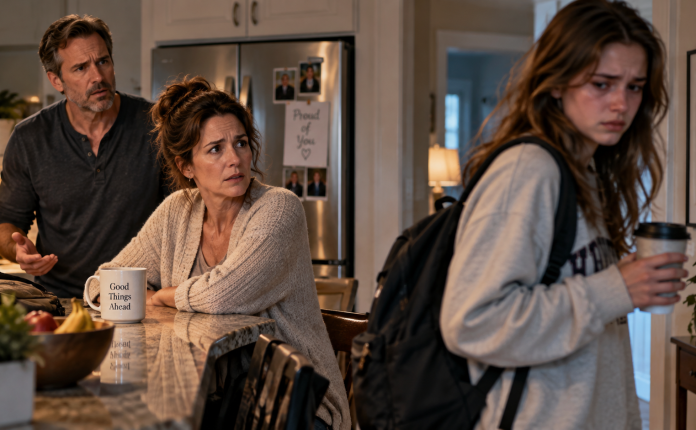
“Mom?”
I turned.
Lily’s eyes were wide and bright, but she was trying not to cry.
“Am I in trouble?”
That question hurt more than the officers had.
Old enough to be accused.
Young enough to still ask if the monsters at the door were real.
I crossed the room and cupped her face in both hands.
“Look at me.”
She did.
“You did nothing wrong. I believe you.”
Her chin trembled.
“I swear I didn’t touch the car.”
“I know.”
She wiped one tear away fast, almost angry at herself for letting it fall.
“Do you think Grandma and Grandpa really said it was me?”
I didn’t know.
Not yet.
But my stomach already knew the shape of the truth.
“I don’t know who talked to the police,” I said. “But whoever did, they lied.”
The next morning, I called an attorney.
By noon, we had a plan.
By evening, we had footage.
Attorney Ari Kaplan told me exactly what to do.
“Lily doesn’t speak to police without me. Gather proof she was home. Gather proof someone else took the car.”
So we did.
Lily’s phone showed uninterrupted messages with her best friend during the crash window. Memes. Texts. A whole dramatic argument about a TV plot twist. Every timestamp placed her in her room.
Then I went across the street to my neighbor.
He had a doorbell camera that caught everything.
On the footage, my silver Civic sat in the driveway.
Then Jenna walked into frame.
Alone.
Keys in hand.
She got into the driver’s seat and pulled away.
No Lily.
No second person.
No mystery.
Just my golden-child younger sister stealing my daughter’s birthday car.
Ari pulled the incident report that same afternoon.
The worst part was even uglier than I expected.
Jenna claimed she had been inside my parents’ house the whole time and saw Lily driving.
My mother backed her up.
My father backed her up too.
Both signed statements saying they saw my daughter behind the wheel. They even added little details about Lily “pushing boundaries lately,” just enough to make me look careless and make her look believable.
I looked at Lily and told her the truth.
“They lied.”
She didn’t cry.
She just whispered, “Oh.”
That tiny sound nearly broke me.
Three days later, we sat in a conference room with Detective Owens, the DA, my parents, Jenna, Ari, Lily, and me.
Ari placed a flash drive labeled FOOTAGE in the center of the table.
The room went silent.
Detective Owens played the video without ceremony.
There was the driveway.
There was the Civic.
There was Jenna, in my daughter’s hoodie, glancing once over her shoulder before climbing in and driving away.
No one spoke for several seconds after it ended.
Jenna’s face emptied first.
Then my mother started.
“Well, there must be some explanation—”
“There is,” Ari said calmly. “Your daughter stole a vehicle, crashed it, fled the scene, and you all blamed a minor.”
My father tried next.
“She borrowed it—”
“No,” I said. “She took it.”
He looked at me as if I had broken some sacred rule by not helping him find a softer word.
I didn’t care anymore.
Detective Owens slid the incident report toward himself and folded his hands.
“So your sworn statements were false.”
No one answered.
Jenna finally did, voice thin. “I panicked.”
That almost made me laugh.
Panic.
As if panic explained why she stole my daughter’s car.
As if panic explained why my mother and father looked police officers in the face and pointed them toward Lily’s bedroom.
As if panic explained the years of this same pattern in smaller forms: Jenna breaks something, and somebody else gets told to be mature about it.
Ari turned to the DA.
“My client’s daughter was falsely accused, woken by police after midnight, and put at legal risk because three adults decided protecting Jenna mattered more than the truth.”
The DA gave one slow nod.
My mother reached for the edge of the table.
“We were trying to keep this from becoming a big deal.”
I looked at her.
“No,” I said. “You were trying to keep Jenna from facing consequences.”
That landed.
Because it was the one thing in the room none of them could deny.
Jenna had been this way since childhood. The one who got caught shoplifting and somehow got called spirited. The one who flunked classes and somehow needed more support. The one who borrowed money, wrecked trust, crossed lines, and still got defended like the rest of us were all responsible for cushioning her from reality.
And for years, I had helped.
I had handed over spare keys when she was “between cars.”
Let her stay over after fights.
Covered little disasters because my parents always promised she was finally maturing.
Now my daughter was the one who paid for that habit.
That was where something in me ended.
Detective Owens asked Jenna if she wanted to revise her statement.
She burst into tears.
Real ones, this time.
Not because she was sorry.
Because the story had collapsed.
She admitted taking the car keys from the bowl near my front door two days earlier when she stopped by “just for coffee.” She admitted driving to my parents’ house because she’d been drinking and didn’t want to be alone. She admitted hitting the tree. She admitted running because she knew she wasn’t supposed to be behind the wheel at all.
Then she looked at Lily.
“Can you tell them I’m not a bad person?”
Lily stared at her.
My daughter’s face had gone strangely calm over the previous three days. Not cold. Just older somehow. Like being falsely accused by your own family rearranges something permanent inside you.
“You let them come to my room,” Lily said quietly.
Jenna started crying harder.
That was her answer.
The meeting ended exactly how it should have.
A revised report.
A recommendation for charges.
A note entered clearing Lily fully.
And one very uncomfortable discussion about false statements to police.
Afterward, my parents tried to stop us in the parking lot.
My mother caught my elbow first.
“Aaron, please. Don’t do this to the family.”
I looked down at her hand until she let go.
Then I said the thing I should have said years earlier.
“The family did this to Lily.”
My father’s face hardened.
“You’re really going to let Jenna’s life be ruined over one mistake?”
I laughed once.
Just once.
Because the nerve of that sentence was breathtaking.
“One mistake?” I said. “The crash was a mistake. Blaming my daughter was a decision.”
They had nothing for that.
Lily and I got into the car and drove home in silence. Halfway there, she asked if we could get fries. I said yes. We sat in the parking lot of a burger place eating salty fries out of the bag while the sun went down, and I watched some of the tightness leave her shoulders for the first time in days.
Then she asked, “Do I still get to keep the car?”
It was such a fifteen-year-old question that I almost cried.
“Yes,” I said. “Just not with your aunt anywhere near the keys.”
That made her smile.
A small one.
But real.
Jenna was charged.
My parents weren’t arrested, but they did spend a very unpleasant month with attorneys and statements and the humiliating discovery that police reports are not family stories you can rewrite once the truth shows up on video.
And me?
I changed the locks.
Not because I wanted drama.
Because I wanted peace.
I blocked Jenna.
I stopped answering my mother’s calls.
I told my father that if he ever tried to speak about Lily’s “boundaries” again, he could do it from outside my closed front door.
The Civic came back from impound a few weeks later with a crushed front end and an estimate that made me feel sick. Insurance helped. The rest came from Jenna’s repayment plan, court-ordered and painfully overdue in every possible sense.
But the bigger repair wasn’t the car.
It was Lily.
For a while, every knock at the door made her flinch. Every unknown number made her ask if it was the police. Every time she left her room at night, she checked first to make sure my keys were still in the bowl and the front door was locked.
I hated that.
Not because it was dramatic.
Because trust, once broken in a child, doesn’t shatter loudly. It changes their posture. Their breathing. The little calculations they make before feeling safe again.
So I stayed steady.
I kept believing her out loud.
I let her talk when she wanted.
I stayed quiet when she didn’t.
And when the rebuilt Civic finally came home, I taped one thing to the new key ring before handing it back to her.
A little silver tag that said:
I believe you.
She looked at it for a long time.
Then she hugged me so hard she dropped the keys.
There are moments when family reveals itself.
Not the family you came from.
The family you are responsible for protecting.
Mine was not the night the police came.
Not really.
It was the next day, when the camera showed the truth and I realized with perfect clarity that if I kept making excuses for my parents and Jenna, one day Lily would learn the worst lesson a child can learn:
That being loved does not guarantee being defended.
I refused to teach her that.
So yes, the camera footage showed who really took the car.
But what it exposed more clearly than anything was this:
The crash into the tree wasn’t the ugliest part.
The ugliest part was how quickly the adults in my family were willing to place the blame on a fifteen-year-old girl who had done nothing except trust that the people around her would tell the truth.