The phone rang at exactly 11:38 on a Tuesday night.
I almost let it go to voicemail because I was standing barefoot in my kitchen in Olympia, Washington, completely exhausted, trying to convince myself that a bowl of cereal counted as dinner. Unknown calls after ten usually meant spam, a wrong number, or someone from work pretending urgency gave them permission to ignore personal boundaries.
Still, something made me answer.
“Is this Ms. Alice Kensington?” a woman asked.
“Yes.”
“This is Riverside General Hospital. We have a young boy here, and your name is listed as his emergency contact.”
I frowned and looked at the phone screen again.
“I’m sorry… what?”
“A minor. A boy. Around eleven years old. His name is Toby.”
“I don’t have a son,” I said carefully. “I’m thirty-two, I’m single, and you definitely have the wrong Alice Kensington.”
The line went quiet for a beat. I could hear papers shifting in the background before the nurse spoke again, this time much more softly.
“He keeps asking for you. Please… just come.”
A knot tightened low in my stomach.
“How does he have my phone number?”
“We’re still trying to determine that. He was brought in after a traffic accident near the main highway. He’s awake, but frightened. Inside his backpack, we found a card with your full name, your phone number, and your home address.”
I gripped the edge of the kitchen counter.
“Is he seriously hurt?”
“He’s stable. He has bruising, a mild concussion, and a fractured wrist. But he refuses to answer questions unless we contact you.”
I should have said no.
I should have told them to call child services, the police, literally anyone else.
But somewhere in that hospital, a hurt and frightened child was asking for me by name.
There was no way I could ignore that and go to bed.
Twenty minutes later, I walked into Riverside Hospital with damp hair, mismatched socks, and a heartbeat pounding so hard I could hear it in my throat.
A nurse named Brenda greeted me at the front desk.
“Thank you for coming,” she said. “He’s in Room Twelve. But before you see him, I need to ask you something… Do you recognize the name Olivera Blackwood?”
“No.”
“Do you know a woman named Danielle Blackwood?”
The name hit me like ice water.
I hadn’t heard it spoken in twelve years.
Danielle had once been my college roommate, my closest friend, the person who knew every version of me before I learned how to hide parts of myself to stay functional. Then came one terrible night, one accusation, and a silence so complete it swallowed us both whole.
“I knew her,” I whispered.
Brenda studied my face for a moment.
“Toby says she’s his mother.”
My knees nearly gave out.
I followed Brenda down the hallway in a daze. The fluorescent lights felt too bright. My shoes squeaked too loudly. Every breath sounded borrowed.
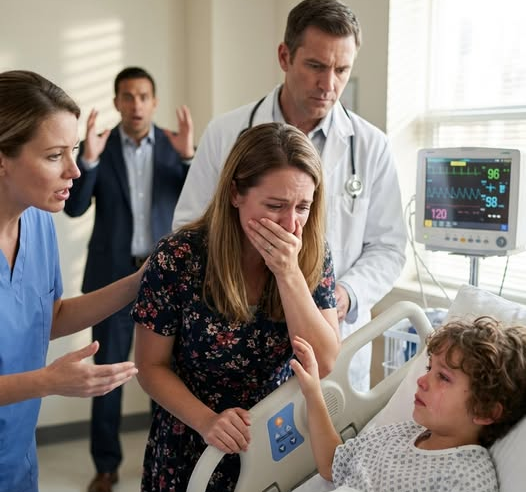
Inside Room Twelve, a small boy sat upright in the bed. His left wrist was wrapped in a cast. Dark hair clung to his forehead. His face was pale, one lip split, one cheek bruised. But the thing that struck me hardest was his eyes.
They locked onto mine the second I entered.
For a few long seconds, neither of us spoke.
Then, in a trembling voice, he whispered, “Alice?”
My throat went dry.
“Yes.”
His chin quivered.
“Mom told me… if anything bad ever happened… I had to find the lady with two eyes.”
That sentence made my whole body go cold.
Because Danielle used to call me that.
Back in college, I had heterochromia so subtle most people missed it unless the light hit just right — one eye deep brown, the other hazel-green around the pupil. Danielle thought it was beautiful. She used to joke that if the world ever ended, she’d still recognize me anywhere because I was “the only woman alive with two different eyes and too many opinions.”
I hadn’t heard that phrase in over a decade.
I sat down beside the bed slowly.
“What happened?” I asked him.
Toby looked toward the doorway, then back at me.
“The car crashed,” he whispered. “Mom told me if I ever couldn’t find her, I had to use the card. She said you’d know what to do.”
I looked at Brenda.
“Where is Danielle?”
Brenda’s face changed, just slightly.
“He was found alone.”
The room seemed to tilt.
Toby must have seen it happen in my face because he started talking faster, like he was afraid I might disappear if he didn’t get all the words out in time.
“She dropped me off in the parking lot behind the gas station first,” he said. “She said wait there. Then she came back. Then there were lights and yelling and she told me to run if the car stopped. But I didn’t run. I hit my head.”
His breathing got shaky.
“I don’t know where she is now.”
I took his good hand carefully.
“You’re safe right now,” I said, even though I had no idea whether that was fully true. “I’m here.”
The second I said it, his whole body loosened just a little.
That was what undid me.
Not the mystery.
Not even Danielle’s name.
The trust.
This child had been carrying my address in his backpack like a lifeline.
Brenda gave us a little privacy after that. Toby didn’t say much more at first. He was tired, scared, and eleven years old with a mild concussion and no reason to trust hospitals or strange adults asking too many questions. So I stayed. I got him apple juice. Adjusted his blanket when he looked too small under it. Answered the easy questions.
Yes, my name was Alice.
Yes, I knew his mother a long time ago.
Yes, I would still be there when he woke up.
At some point, a social worker named Maren came in, followed by a police officer with tired eyes and a notebook. They asked me if I had legal standing to claim the child.
“No,” I said. “But if his mother gave him my contact information, then for tonight I’m not leaving him alone.”
That answer must have been good enough, or maybe they saw something in Toby’s face when I said it, because no one pushed back.
They asked what I knew about Danielle.
Almost nothing recent.
That was the truth.
Twelve years earlier, during our last year of college, Danielle had vanished from my life after a scandal that spread too fast and made too little sense. She had accused a professor of cornering her after a department event. I believed her instantly. Most people didn’t. Then the story shifted. The administration got involved. Someone claimed Danielle had been drinking. Someone else said she was unstable. Then suddenly my name got dragged into it because I had walked her home and publicly defended her.
Things became ugly quickly.
I lost a scholarship opportunity.
Danielle left school before spring term ended.
And after one final screaming fight in the rain outside our apartment — more pain than logic, more fear than truth — we stopped speaking.
I never knew where she went.
Now her son was in a hospital bed asking for me.
Around two in the morning, Toby finally fell asleep. I stepped into the hallway and called my older brother, Sam. He was a family law attorney in Tacoma, which meant he answered his phone at awful hours with the voice of a man already halfway into tomorrow’s problems.
“Alice?”
“I’m at a hospital with a child who isn’t mine,” I said.
There was a pause.
“Alright,” he said. “Start at the beginning.”
By the time I finished, Sam was fully awake. He asked the right questions immediately. Was the child identified? Was Danielle officially missing or simply absent? Had CPS opened a temporary file? Had the police said why the car crashed, who it belonged to, or whether Danielle might be avoiding someone?
That last question caught on something in me.
Because Toby had not looked frightened in a general way.
He had looked hunted.
When I went back into the room, he was awake again, eyes open in the dark.
“Did I wake you?” I asked.
He shook his head.
Then, after a long silence, he whispered, “If they find me, don’t tell.”
I sat down again.
“Who?”
He curled his fingers into the blanket. “The Blackwoods.”
The name from earlier.
Olivera Blackwood.
Danielle Blackwood.
Only now it sounded less like a last name and more like a warning.
I kept my voice as calm as I could.
“Who are the Blackwoods, Toby?”
He swallowed hard.
“My dad’s family.”
That answer opened the door a crack.
Little by little, over the next hour, the shape of the story started to emerge. Danielle had married into the Blackwood family years after disappearing from my life. Rich family. Old money. Private schools, gated drives, polished cruelty. Toby’s father had died two years earlier. Since then, according to Toby, his father’s mother — Eleanor Blackwood — had been trying to take control of everything.
The house.
The trust.
Toby.
Danielle kept saying no.
Recently, the pressure got worse. Lawyers. Visits. Threats dressed as concern. Toby didn’t understand most of it, but he understood enough to know his mother had become scared. She started moving them around. New apartment. Then motels. Then a car trip at night.
Then the crash.
And somewhere in the middle of all that, she had told him: if anything happens, find Alice Kensington. The lady with two eyes.
By dawn, CPS had opened emergency protective paperwork, and Sam was driving down to the hospital. The police had found the crashed vehicle registered to a shell leasing company tied to Blackwood Holdings. Danielle was still missing.
That was the point where my fear stopped being confusion and became decision.
I told the social worker I was willing to take temporary emergency placement if the court allowed it.
She looked surprised.
“You barely know him.”
I looked through the room’s window at Toby sleeping again, curled around the stuffed sweatshirt the nurses had given him.
“No,” I said. “But his mother did.”
Sam arrived just after seven. He hugged me once, hard, then went straight into lawyer mode. He spoke to Maren, the officer, hospital administration, and the on-call judge handling emergency child placement review. He did what Sam always does best — took emotional chaos and built a legal staircase out of it.
By ten-thirty, Toby was discharged into temporary protective placement.
With me.
That should have felt impossible.
Instead it felt like the only thing in the world that made sense.
I took him home to my small townhouse. I put fresh sheets on the guest bed, then changed my mind and made up the couch instead because it felt less lonely. He chose the couch. Ate dry cereal from a mug. Watched the rain at the window. Asked if my house had locks on all the doors.
“Yes,” I said.
Then he asked if they were strong.
That question stayed with me.
The first Blackwood call came that afternoon.
Not to me.
To the social worker.
Eleanor Blackwood herself, demanding to know where her grandson had been taken.
The second call came to Sam’s office.
The third to the hospital.
The fourth, somehow, to my cell phone.
I didn’t answer.
But when the voicemail played, I recognized the voice instantly.
Cold.
Educated.
Controlled.
“Ms. Kensington, you are involving yourself in a family matter that does not concern you. Toby belongs with his family. Do not mistake temporary confusion for standing.”
I saved the message.
Then I made tea for Toby and asked if he liked honey.
The hearing happened forty-eight hours later.
Danielle was still missing.
Eleanor Blackwood arrived in cream wool and diamonds, flanked by two attorneys and the expression of a woman who had never once entered a room expecting to lose. She looked at me like I was a stain.
Toby’s whole body locked up when he saw her.
That mattered more than anything her lawyers said.
The judge noticed it too.
Eleanor called me an opportunist. Said Danielle had a history of instability. Claimed the child had been coached. Suggested I had reinserted myself into a vulnerable situation for personal revenge over “ancient misunderstandings.”
Then Sam stood up.
He played the voicemail.
Presented the hospital intake card in Danielle’s handwriting.
Entered Toby’s statements about fear of the Blackwoods.
And, most importantly, submitted a sealed affidavit from the police detective handling the crash investigation.
The vehicle’s brake line had been deliberately cut.
The room went silent.
Eleanor did not.
She went colder.
Not shocked.
Exposed.
That was different.
The judge granted temporary protective custody to the state, with physical placement remaining with me pending further findings. Eleanor Blackwood was ordered to have no direct contact with Toby.
When we got home, Toby sat at my kitchen table and asked, “Does that mean she can’t come here?”
“No,” I said. “She can’t.”
He nodded once and finished his toast.
That was how children process terror sometimes. Not with speeches. With whether they can now eat safely in a kitchen.
Danielle was found three days later.
Alive.
Bruised.
Exhausted.
Hiding in a church shelter in Tacoma under a different last name.
When she saw me, she stopped in the doorway like the ground had shifted under her.
I had imagined that moment a hundred different ways in the days leading up to it.
Anger.
Blame.
Tears.
Nothing.
What actually happened was stranger and sadder.
She looked at Toby first, safe in my living room, then at me, and whispered, “You came.”
It nearly broke me.
So much time had passed. So much damage. But in that moment, none of it mattered as much as the fact that a frightened boy had carried my name because somewhere inside the ruin of her life, Danielle still believed I would come if he called.
“I should have found you years ago,” I said.
She shook her head and started crying.
“No,” she whispered. “I should have never disappeared.”
The truth of the old scandal took longer to untangle, but it came. Danielle had not lied in college. The professor had terrified her into silence. Eleanor Blackwood, who was related to a board member at the university through marriage, had helped bury it once Danielle became inconvenient to the family’s future plans. Later, when Danielle married into the Blackwoods, Eleanor used that old buried shame like a leash. Control disguised as protection. Threats disguised as family management.
Danielle had been running from her for years.
But she had also been planning.
The card in Toby’s backpack was not the only thing she carried.
Once she was safe enough to speak fully, she gave the detective copies of trust documents, offshore transfer records, and a private journal detailing the Blackwoods’ attempts to isolate Toby as sole heir after his father’s death. Eleanor had wanted custody not out of love, but because Toby controlled access to a family trust his father quietly moved beyond her reach before he died.
Everything cracked after that.
Criminal inquiries.
Emergency injunctions.
Financial freezes.
The Blackwoods, so polished from a distance, turned ugly the second the light got close enough.
Months later, Toby was still with me when Danielle came by one Saturday morning holding a plant and looking more like the girl I once knew than the frightened woman from the hospital. She was in therapy now. So was Toby. So, truthfully, was I. They rented a small apartment ten minutes away. Toby still slept with the hall light on. Danielle still checked mirrors too often. Healing did not make for clean scenes.
But it was happening.
We had dinner together most Thursdays.
One night, after Toby had fallen asleep on my couch with his cast finally gone and crumbs on his shirt, Danielle stood in the kitchen drying a plate and said, “I always told him if anything happened, he had to find the one person who would believe him before asking whether it was inconvenient.”
I looked down at the dish towel in my hands.
“That’s a lot to trust someone with.”
She smiled sadly.
“You were always the bravest person I knew.”
“No,” I said. “Just the one who stayed.”
But maybe those are the same thing sometimes.
I was thirty-two, single, and I did not have a son.
That was true the night the hospital called.
But by the time I stepped into Room Twelve and saw that frightened little boy whisper my name like a prayer someone had packed away for years, my whole world did stop.
Not because it ended.
Because it opened.
And sometimes that is harder.
And holier.
And far more life-changing than you ever expect from a Tuesday night and an unknown number.