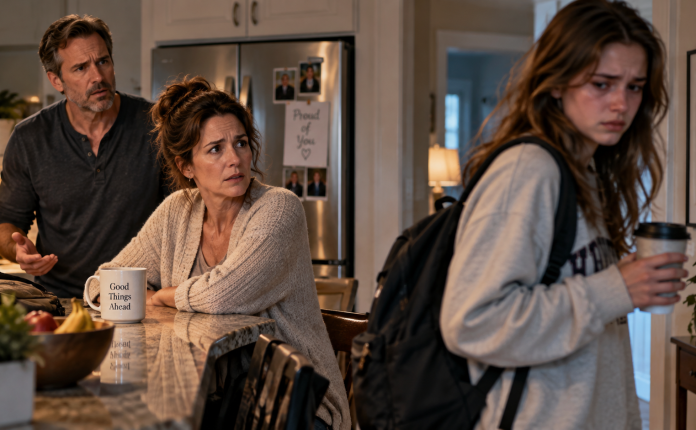
My mother said her stomach had been burning for weeks, but my husband kept insisting she was only trying to get attention.
At first, I tried to believe him.
Not because I trusted his judgment more than hers, but because exhaustion makes lies easier to live with when the truth would demand action. My mother, Elena, had moved in with us three months earlier after her rent went up and her knees got bad enough that climbing stairs felt like punishment. She was sixty-eight, proud, tidy, and apologetic about everything. The kind of woman who folded blankets no one had used and thanked you for meals she had helped cook.
She never complained unless something really hurt.
That was why her voice bothered me.
Not loud.
Not dramatic.
Just quieter than usual.
“It burns again,” she would whisper some nights, one hand pressed to her stomach.
I would look up from the sink or the laundry or whatever else was swallowing the evening and ask if she wanted tea, medicine, broth, a heating pad, anything. Before she could answer, my husband Wade usually did it for her.
“She’s fine,” he would say from the couch without even looking up. “It’s indigestion. Or nerves. Or another excuse to make everybody revolve around her.”
The first time he said it, I snapped at him.
The fifth time, I just went quiet.
By the tenth, I hated myself.
Because my mother started shrinking around her pain.
She stopped mentioning it at dinner.
Stopped touching her stomach when Wade was in the room.
Stopped asking if I could drive her anywhere because he always made a point of sighing loudly when I grabbed my keys.
Still, the burning got worse.
I could see it in the way she moved. In how carefully she lowered herself into chairs. In the way she pushed food around her plate and said she wasn’t hungry. She lost weight in that strange, frightening way older people do — not all at once, but enough that one morning you notice their sweater hanging differently and your heart starts beating too fast.
One Thursday night, I found her standing alone in the kitchen at two in the morning, bent slightly over the counter, breathing through her teeth.
“Mom?”
She turned too quickly and forced a smile that fooled neither of us.
“Go back to bed, sweetheart.”
I stepped closer. “How long has it been this bad?”
She looked down.
“A few weeks.”
A few weeks.
And I had let Wade keep talking me out of listening.
The next morning, while he was at work, I told her to get her coat.
She looked startled.
“Why?”
“Because I’m taking you to the hospital.”
Her face crumpled before she could stop it.
“No, no, honey. Your husband will be upset.”
That sentence turned something over inside me.
Not because she was wrong.
Because she was thinking about his mood while doubled over in pain.
“I don’t care,” I said.
But that was a lie.
I did care.
I cared too much.
That had always been the problem.
She squeezed my hand the whole drive there and apologized every few minutes like pain was a social inconvenience she should have managed more gracefully.
“I’m sorry to bother you.”
“I should have waited.”
“It may be nothing.”
“You are not a burden,” I told her.
The words came out so fast they almost sounded angry.
She looked out the window after that.
I don’t think she believed me yet.
The emergency room smelled like disinfectant and burnt coffee. The television in the waiting area played some home renovation show with the captions on and the sound off. My mother sat hunched beside me in a plastic chair with both hands folded in her lap like she was trying to take up less space than her own suffering.
Once they finally took her back, things moved quickly.
Bloodwork.
Questions.
A nurse with tired eyes and surprisingly gentle hands.
Then a scan.
I stayed beside her as long as they let me. She held my fingers the way I used to hold hers at school assemblies when I was small and overwhelmed.
After the scan, they rolled her back into the curtained room and told us to wait for the doctor.
My mother looked exhausted.
“See?” she whispered. “Now they’ll tell us it’s gas and you’ll have lost half your day.”
I smiled because she needed one from me.
But I didn’t believe that for a second.
I had seen the doctor’s face when he looked at the first image.
Not panic.
Recognition.
A different kind of fear.
About twenty minutes later, he came back.
Not alone.
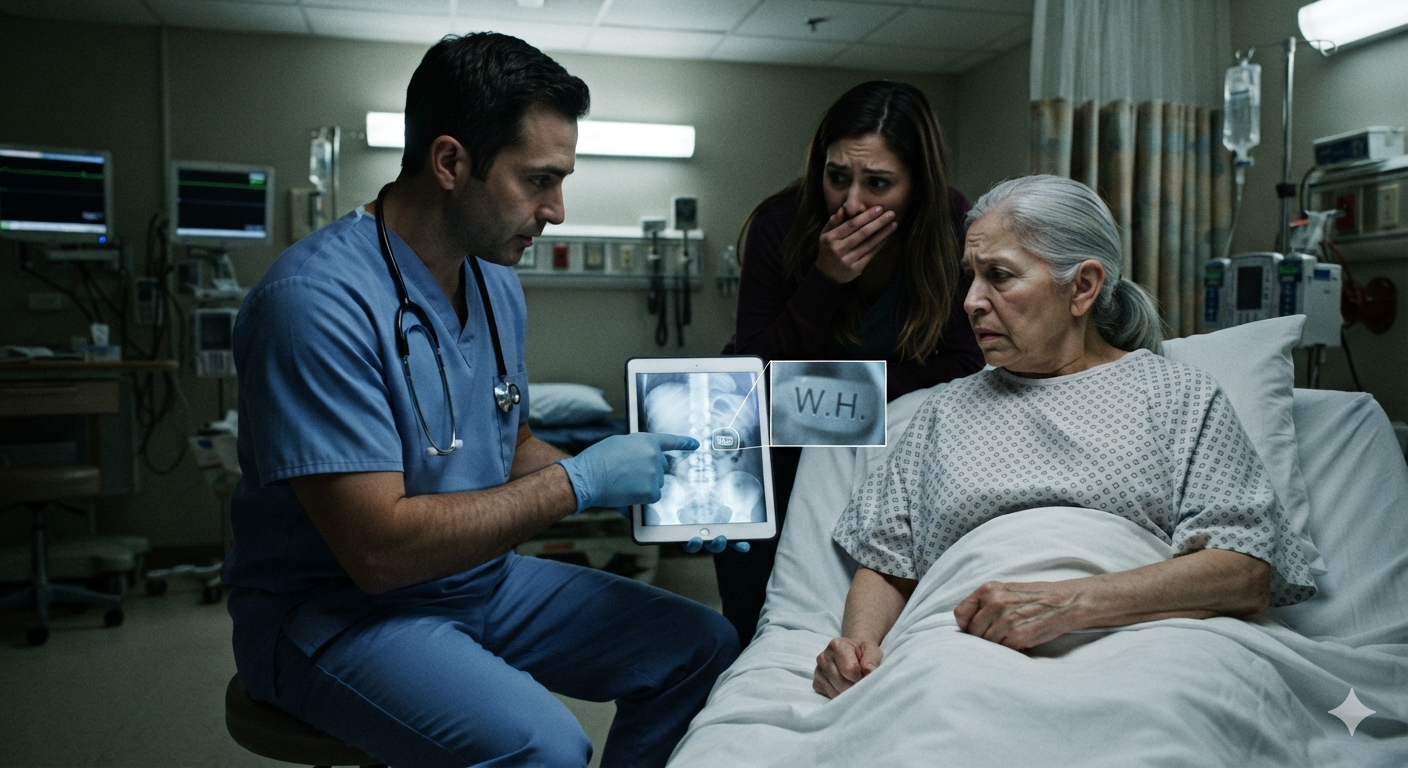
Another doctor was with him, older, quieter, carrying a tablet against his chest. The younger one closed the curtain completely, then closed the door to the room behind it.
That was the first thing that made my pulse spike.
The second was his face.
Doctors learn how to wear calm professionally. This man had that calm on, but I could see strain underneath it. Like whatever he needed to say required him to arrange the words carefully before they hit the air.
He pulled a stool closer to the bed.
“Mrs. Alvarez,” he said gently, “I need to ask you something unusual.”
My mother blinked at him.
“Of course.”
“Have you swallowed anything recently? Anything metallic, perhaps. A charm, part of a utensil, a piece of jewelry, anything at all?”
She frowned in complete confusion.
“No.”
He glanced at me.
Then he turned the tablet toward us.
“There’s an object in your stomach,” he said.
I looked at the screen.
At first, I didn’t understand what I was seeing. Gray shapes. Shadows. Blurred anatomy I had no language for. Then he tapped once near the center of the image.
There.
A small metal object.
Smooth.
Solid.
Deliberate.
Not something that could have been swallowed by accident.
And engraved on one side, faint but visible even through the scan, were two initials I knew as well as my own.
W.H.
Wade Harper.
That was the moment everything inside me went cold.
Because suddenly I understood why my husband kept begging me not to bring her in.
Why he insisted she was dramatic.
Why he got angry every time she mentioned the pain.
He wasn’t afraid she was sick.
He was afraid they would find what he had done.
PART 2 👇
For a second, I honestly thought my mind had made it up.
That grief, guilt, and shock had pulled familiar letters out of static.
But the doctor zoomed in.
There they were again.
W.H.
My husband had those initials engraved on everything he considered “important.” His golf flask. His silver money clip. The cuff links he wore at weddings. Even the heavy stainless steel toothpick case he kept in the kitchen junk drawer because, according to him, a man should carry useful things, not sentimental ones.
I knew that object.
I had bought it for him three Christmases earlier.
My mother turned her head slowly toward me.
Not understanding yet.
Only frightened by my face.
“What is it?” she asked.
I couldn’t answer.
The doctor looked between us, then asked, more carefully this time, “Do those initials mean something to you?”
I heard myself say yes.
It came out barely above a whisper.
My mother’s fingers gripped the blanket.
“What initials?”
I swallowed hard.
“My husband’s.”
Silence dropped into the room like something heavy.
The older doctor straightened slightly. The younger one lowered the tablet and set it face down on his lap, which somehow made everything feel even more real. No one was pretending now. No one was trying to keep this in the safe language of medical uncertainty.
My mother stared at me.
Then shook her head.
“No.”
But I could tell by the sound of her voice that memory was already moving.
The younger doctor asked if she had ever felt something odd in her mouth while eating. Anything sharp. Anything unusually hard in her food. Any choking, gagging, or sudden coughing spell.
My mother looked down at her hands.
Then at the wall.
Then somewhere beyond both.
Three days earlier, Wade had made soup.
That memory came to me whole and ugly.
He never cooked unless there was a reason for it. He had come home from work in one of his good moods, kissed my cheek, and said he was “trying to be nicer” because he knew things had been tense. He made chicken soup from scratch, even brought a bowl to my mother on a tray like some kind of devoted son-in-law.
She cried after he left the room.
Said maybe she had judged him too harshly.
I almost threw up thinking about it.
My mother made a small sound in her throat.
“The soup,” she whispered.
I closed my eyes.
Of course.
The doctor asked one more question.
“Did the pain begin after that meal?”
She nodded.
Not dramatically.
Not with certainty.
Like she hated the answer already.
Everything after that became movement and signatures and hospital language I could barely process. They had to admit her immediately. The object would need to come out. There was internal irritation already, maybe worse. They needed to know how long it had been there, whether it had shifted, whether there was infection.
Someone asked if I felt safe going home.
That was the moment I realized my face must have been telling the whole story.
A hospital social worker came in next. Then security. Not because they thought Wade was coming, but because once intentional harm enters a hospital room, everyone starts looking at doors differently.
I stepped into the hallway to call him.
Not because I wanted to warn him.
Because I wanted to hear his voice before I decided whether I still had one marriage left to save.
He answered on the second ring.
“What?”
No hello.
No concern.
Just irritation.
“We’re at the hospital,” I said.
The pause on the line was tiny.
Too tiny.
Then he said, “Why?”
That one word told me more than a confession would have.
Because innocent people ask if you’re alright.
If she’s alright.
What happened.
They do not ask why first.
“She had a scan,” I said.
Silence.
Then, very flatly, “And?”
I leaned my shoulder against the wall because my legs suddenly felt unreliable.
“They found something inside her.”
Still no response.
So I said it.
“They found a metal object with your initials on it.”
The silence on the other end deepened until it felt less like absence and more like calculation.
When he finally spoke, his voice was lower.
“You should be careful what you repeat in public.”
My whole body went cold.
Not denial.
Not confusion.
A threat.
I looked through the small glass window in the room door. My mother was lying in the hospital bed looking smaller than I had ever seen her, with two nurses around her and a pulse monitor clipped to her finger. She looked like someone who had spent months apologizing for pain because the wrong man taught her suffering was inconvenience.
“I’m not coming home,” I said.
He laughed once.
A short ugly sound.
“Where exactly do you think you’re going?”
That question settled something in me.
Because it was not asked by a husband worried about losing me.
It was asked by a man who believed I still belonged inside the limits he had set.
Then he said the sentence that finished the rest of it.
“She should have minded her business.”
I pulled the phone away from my ear and stared at it.
Then I hung up.
Not because I was overwhelmed.
Because if I heard one more word from him, I might lose the ability to think clearly.
The social worker brought me into a small office two doors down and asked if there had been prior incidents.
I said no at first.
Then I corrected myself.
Not no.
Never this.
But Wade had always hated my mother.
Not openly in the beginning.
He was too smooth for that.
At first it was only comments. About how long she stayed after holidays. How much she “interfered.” How older women create drama when they’re bored. Then he started criticizing her directly. Her medicine schedule. Her stories. Her memory. The way she folded laundry. The fact that she still said grace out loud before dinner.
When she moved in, it got worse.
He said she walked too loudly.
Watched too much television.
Used too much hot water.
Took up too much space.
A woman with arthritis and two cardigans had somehow become a threat in her own daughter’s house.
And now there was a metal object in her stomach with his initials engraved on it.
The surgery happened that night.
They wouldn’t let me in, of course. I sat in a hard waiting-room chair under a muted television and watched the doors every time they opened, like I might be able to read the ending on someone’s face before they spoke it.
I thought about the soup.
The tray.
His smile.
My mother’s tears.
And for the first time in eleven years, I stopped trying to explain him to myself.
PART 3 👇
The surgeon came out just after two in the morning.
He still had his cap on and looked tired in the deep, used-up way doctors do when they’ve spent the last hour inside somebody else’s pain.
“We got it out,” he said.
I stood so fast the chair scraped behind me.
He held up a clear evidence bag.
Inside was a small silver cylinder, no longer polished, but still recognizable.
W.H.
There was no room left for doubt.
I put my hand over my mouth.
The surgeon’s expression softened just slightly.
“She’s stable,” he said. “There was inflammation, but no perforation. You brought her in in time.”
Brought her in in time.
If I had listened to Wade one more day, one more night, one more apology from my mother about being a burden, the ending might have been very different.
The police came before dawn.
Not local patrol this time.
Detectives.
The hospital had already documented everything. The scan. The object. My statement. My phone call. His response. The soup timeline. My mother’s account of the meal and the pain that followed.
One detective asked to hear my husband’s exact words on the phone again.
I repeated them.
“She should have minded her business.”
He wrote it down carefully.
By eight in the morning, officers were at my house with a warrant.
They found the matching set in the kitchen drawer. Four identical stainless steel toothpick cases, all engraved. One missing. They found the receipt too, tucked inside a holiday card box in the hall closet because Wade was the kind of man who kept records of expensive gifts but not records of the harm he caused.
The rest fell apart faster than I expected.
Not because he confessed.
Because cruel men are rarely as smart as they believe.
He had searched whether small metal objects show up on scans.
Searched how long stomach pain from “accidental swallowing” lasts.
Searched whether engraved stainless steel dissolves in acid.
The detectives showed me those searches three days later.
I felt sick and strangely calm at the same time.
This had not been rage.
Not an impulsive moment.
He had planned it.
When they arrested him, he still tried to frame it as an accident. Said my mother must have swallowed it somehow. Said maybe it fell in while he was cooking. Said everyone was turning a misunderstanding into a criminal case because families love drama.
The detective who questioned him asked why, then, he spent weeks insisting she not see a doctor.
Wade had no good answer for that.
Only anger.
By the time my mother woke fully from the anesthesia, the police had already been in my kitchen, the evidence had already been tagged, and my husband was already being moved through the system in handcuffs.
She looked at me with dry lips and tired eyes.
“Did I make trouble?” she whispered.
That question nearly broke me worse than the scan had.
I took her hand and held it against my cheek.
“No,” I said. “You survived.”
She cried then.
So did I.
The hardest part to explain afterward was not the object.
Not even the surgery.
It was the apology in her voice.
How completely she had accepted the idea that suffering quietly was the best thing she could offer the people around her. How naturally she believed being hurt was less serious than being inconvenient.
That was the real legacy of men like Wade.
Not only the violence.
The way they train everyone nearby to shrink around it.
I filed for divorce before he made bail.
His family called me vindictive.
His sister said stress makes people act out.
His mother actually left me a voicemail saying older women can be provoking and perhaps I should examine the pressure I had created by bringing my mother into the house.
I saved that one too.
Then I blocked them all.
My mother came home two weeks later.
Not to my house.
To an apartment above my friend Clara’s bookstore while I found a smaller place for both of us. Somewhere without his shadow in the hallway. Somewhere my mother could drink tea by a window and never again apologize for existing in the wrong room.
The first night there, she stood in the little kitchen with one hand on the counter and said, almost shyly, “It’s peaceful.”
I looked around at the secondhand chairs, the mismatched mugs, the borrowed casserole dishes, the yellow curtains Clara had hung before we arrived, and nodded.
“Yes,” I said. “It is.”
Then my mother looked at me and asked the question I think she had been carrying for years.
“Was he always like that?”
I thought about it honestly.
No.
Not always.
At first, Wade was charming in the way men like him often are. Helpful in public. Attentive in visible ways. He learned my favorite takeout order, sent flowers to my office once when we were dating, remembered birthdays, made my friends say I was lucky.
Then came the corrections.
The tone.
The small humiliations.
The way my confidence somehow always became selfishness when it inconvenienced him.
By the time cruelty arrived with no disguise, I had already spent years learning how to explain it away.
“He got worse,” I said finally.
My mother nodded.
But she did not let me soften it too much.
“And you stayed,” she said.
Not accusing.
Just true.
“Yes,” I answered.
She took my hand.
“Not anymore.”
No. Not anymore.
He took a plea in the end.
Not because he was sorry.
Because the evidence was too clean.
Aggravated assault.
Poisoning by means likely to cause bodily harm.
Domestic abuse enhancements because of the threat, the coercion, and his history of intimidation.
The prosecutor called it deliberate and disguised violence.
That sounded exactly right.
At sentencing, Wade looked at me only once. Not with remorse. With annoyance. As if all of this had happened because I had chosen to be difficult instead of obedient.
I looked back without flinching.
That was new.
Months later, my mother was stronger. Still careful with food. Still nervous sometimes when soup arrived in front of her. But stronger. She started planting herbs in pots on the windowsill above the bookstore apartment. Basil. Mint. Parsley. Small green things that require patience and return it slowly.
One evening, while we were eating grilled cheese at the little table by the kitchen window, she said, “I’m sorry I kept saying I was a burden.”
I put my sandwich down.
“You were never a burden.”
She nodded, but she didn’t look fully convinced yet.
Healing is slow that way.
Sometimes the body recovers first.
Then the mind.
Then the language.
My husband spent weeks telling me my mother’s pain was fake, that she was dramatic, that she wanted attention. He begged me not to take her in, not to drive her to the hospital, not to waste money on “nothing.”
Then a doctor turned the screen toward me, and inside her body was a metal object engraved with his initials.
That was the moment I understood why he had worked so hard to keep us home.
And that was the moment he lost everything he thought fear had bought him.