My husband and I waited six years for a child.
Six long years of calendars, specialist appointments, whispered hope, hormone shots, surgeries, negative tests, and that specific kind of silence that settles into a marriage when two people love each other deeply but keep taking turns pretending they are the stronger one. I learned how to smile at baby showers. He learned how to leave the room before commercials about diapers were over. We both learned how to answer the question “So when are you two starting a family?” without letting strangers see the bruise it left.
Nothing worked.
By the time I was thirty-eight, I had stopped saying “when we have a baby” and started saying “if it happens.” My husband Daniel hated hearing that, not because he thought I was wrong, but because it sounded too close to surrender. He never surrendered easily. That was one of the first things I loved about him.
We adopted Lily from a hospital in Nashville when she was nine months old.
I still remember that night with a sharpness that makes no sense after so many years. The hospital smelled like bleach and old coffee. Rain tapped against the windows in narrow silver lines. A social worker with tired eyes kept smoothing the same folder over and over, like she was trying to iron the sorrow out of the paperwork. I was so nervous I couldn’t stop rubbing my thumb over the seam of my purse. Daniel kept one hand on the small of my back, steady and warm, like if I floated too far away, he would pull me down gently.
Then the nurse walked in carrying Lily.
She had a soft pink sleeper on, one sock half twisted, and the fattest solemn brown eyes I had ever seen in my life. She didn’t cry. She didn’t smile. She just looked at me with this strange, calm seriousness, like she was deciding whether I was worth trusting.
The nurse leaned down and placed her in my arms.
That was it.
That was the moment I became a mother.
Not at birth.
Not with paperwork.
Not with the judge months later when the adoption was finalized.
In that room.
With a baby who smelled like powder and formula and something heartbreakingly new.
I burst into tears so fast I embarrassed myself, and Daniel laughed while wiping his own eyes because he was crying too. The nurse smiled softly and said, “She likes to be held close. She sleeps better when she can hear a heartbeat.”
Her name tag said Elena Ward.
I remember because I looked at it three times while she adjusted Lily’s blanket and explained feeding times.
That name would come back to me years later with enough force to make my stomach drop straight through the floor.
But that night, she was only a kind nurse with tired hands who helped place my daughter into my life.
Lily became ours in every way that mattered long before the court said so.
We raised her with Sunday pancakes, ballet shoes, bedtime prayers, library cards, lavender bubble bath, and the same blue stuffed rabbit she insisted needed his own seatbelt in the car. She hated peas, loved music, and used to fall asleep on the living room rug halfway through animated movies as if exhaustion always waited just outside joy. Daniel taught her to ride a bike in the church parking lot behind our street. I sewed ribbons back onto ballet slippers and sat through recitals with tears in my eyes like every mother before me.
She never asked about her birth mother.
Not once.
Other people seemed more troubled by that than she was. There were always articles and advice columns and well-meaning women at church saying children need the truth early, need open language, need room to ask questions before the questions become pain. We believed all of that in theory. We kept her papers in a locked box. We promised each other we would tell her anything she wanted to know the moment she asked.
But Lily seemed content.
Safe.
Loved.
And I never wanted to tear open a door she had not even tried to touch.
Then last Christmas, everything shifted because of a bracelet.
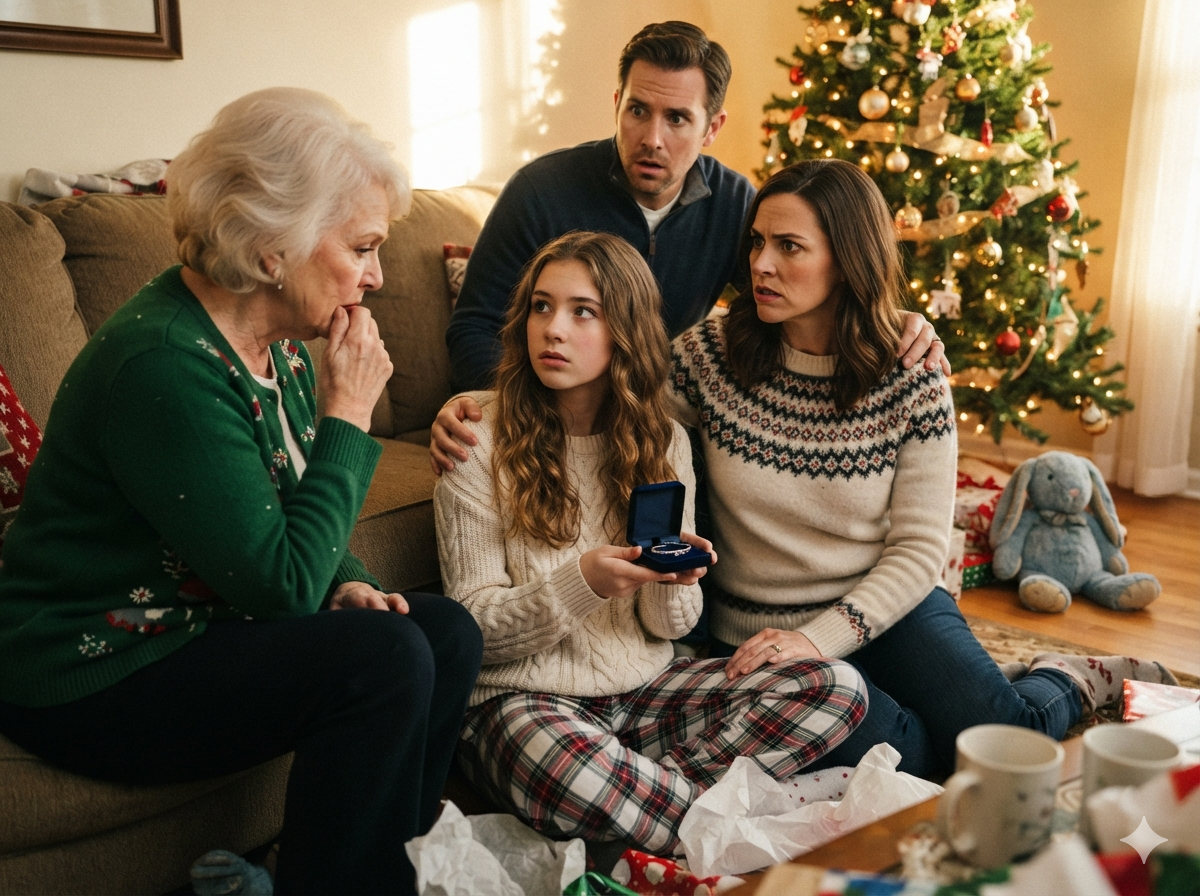
It was one of those cold bright Tennessee mornings when the house still smells like cinnamon rolls and pine and wrapping paper before anyone has fully woken into the day. Daniel was in his recliner with coffee. I was on the floor in plaid pajama pants handing out gifts and pretending not to mind that my mother had once again brought too many. My mother, Joan, always believed affection should arrive in bags with tissue paper and receipts tucked discreetly in the bottom.
Lily was fifteen then.
Tall already, with her father’s patience and none of my ability to fake excitement over things she didn’t want. She sat cross-legged near the tree, sleepy-haired and beautiful, opening gifts one by one with the half-smile teenagers wear when they are trying to look older than wonder.
Then she opened the small velvet box from my mother.
Inside was a silver bracelet.
Simple. Elegant. The kind of thing my mother bought when she wanted a gift to feel meaningful without being too emotional about it.
Lily lifted it out carefully.
I smiled.
“That’s beautiful, honey.”
But she didn’t smile back.
She turned the bracelet over.
Her expression changed.
Not dramatically.
Not enough for anyone else to notice at first.
Just a tiny stillness.
She looked at the back longer than seemed normal, then glanced up at my mother with a face I couldn’t read.
“What is it?” I asked.
Lily handed me the bracelet without a word.
On the front, engraved in tiny script, was her birth date.
On the back was a name.
Elena Ward.
I knew it instantly.
My fingers went cold around the silver.
Not maybe familiar.
Not vaguely remembered.
I knew it.
It belonged to the nurse who had placed Lily into my arms at Saint Matthew’s Hospital fifteen years earlier.
For a second, the whole room felt tilted. The Christmas tree lights blurred. Daniel asked, “What’s wrong?” and my mother said too quickly, “Isn’t it lovely?” and all I could hear was the blood rushing in my ears.
I looked up.
My mother was smiling.
Too brightly.
I had seen that smile before. It was the one she used when she was trying to get through a moment before anyone asked the right question.
“Mom,” I said slowly, “where did you get this?”
Her hand fluttered to her necklace.
“Oh, an estate shop outside Franklin. One of those little antique places. I thought the date made it feel special.”
Lily was watching us now.
Really watching.
Daniel stood up from the chair.
“Why does that name look familiar to you?” he asked me.
I looked at him, then back at my mother.
Because suddenly I remembered something else.
The night we brought Lily home from the hospital, after everyone else had left and the house had finally gone quiet, my mother had held her longer than anyone. She cried harder than I expected. When I asked if she was alright, she kissed the baby’s head and said, “Some things come back to you when you least deserve mercy.”
At the time, I thought she meant me. My infertility. The years of waiting. The grandchild she thought she might never have.
Now I wasn’t so sure.
“Mom,” I said again, quieter this time, “where did you get this?”
Her smile slipped.
Only for a second.
But it slipped.
Daniel saw it too.
Lily sat very still on the rug, not speaking, not interrupting, but suddenly older than she had looked a minute earlier.
“Grandma?” she asked.
My mother’s eyes filled instantly, which annoyed me more than if she had lied again. Crying had always been her last defense when truth got too close.
“I was going to tell you someday,” she whispered.
The room went silent.
Daniel’s voice sharpened. “Tell us what?”
My mother pressed both hands together in her lap and looked not at me, not at Lily, but at the fire in the grate.
“When I was volunteering at Saint Matthew’s,” she said, “I met a young nurse named Elena Ward.”
The name made my stomach tighten harder.
“She was unmarried,” my mother continued. “Twenty-three. Terrified. She had just given birth to a baby girl in the same hospital where she worked. She hid the pregnancy as long as she could. Said the father was married. Said keeping the baby would ruin both their lives.”
Lily didn’t move.
I couldn’t either.
My mother finally looked up at me.
“I knew, before you did, that you and Daniel were being considered for a hospital-connected infant placement. Elena asked to meet the adoptive family without being identified. She wanted to see, just once, where her daughter might go.”
Every word seemed to land half a second late, like my mind was trying to reject them before they settled.
“No,” I said.
But I didn’t know what I was denying.
My mother wiped her eyes.
“She was the nurse,” she whispered. “The one who handed Lily to you.”
Daniel actually took a step backward.
“What?”
“She asked for that assignment herself,” my mother said. “She wanted to hold her one last time, then place her with the mother she chose.”
Lily looked at me then.
Not crying.
Not angry.
Just searching my face for something solid to stand on.
I went to her immediately and sat beside her on the floor.
“I didn’t know,” I said.
And God, that was the truth.
I didn’t know.
Not that night.
Not later.
Not any of the years in between while I brushed her hair or signed school forms or packed lunchboxes or sat awake through fevers and first heartbreaks and all the ordinary sacred work of raising a child.
Daniel sank slowly back into the recliner like his knees had stopped listening to him.
“Why would you keep that from us?” he asked my mother.
She gave a broken little laugh.
“Because it wasn’t my secret to tell.”
That would have sounded noble if not for the next thing she said.
“And because Elena came to me again.”
The air changed.
“When Lily was four,” she said, “Elena wrote. She had moved to Atlanta. She was married by then. Said she didn’t want contact, only updates. Photos if possible. Just enough to know Lily was loved.”
I turned so fast my neck hurt.
“You had contact with her?”
My mother winced.
“Only letters. A Christmas card once. A birthday note. I never told her where you lived. I never gave names. I just… I couldn’t bear not answering.”
I stared at her.
For years my mother had mailed oversized birthday checks, monogrammed backpacks, little “just because” packages that always arrived with no explanation except that she had found something she thought Lily would like. I used to joke she was making up for all the strict years when she mothered me like love had to be earned.
Now I wondered how much of that generosity had been carrying someone else’s grief.
Lily finally spoke.
“Did she want me?”
That question went through me like a blade.
My mother started sobbing for real then.
“Yes,” she said. “She wanted you so badly it nearly ruined her. That was the problem.”
No one spoke for a long moment.
The fire popped softly in the grate. Wrapping paper sat half-open around us. Somewhere outside, a neighbor’s dog barked and a child laughed in the street and our whole house had somehow become divided into before and after.
Lily looked down at the bracelet in my hand.
“Is she alive?”
My mother nodded.
The answer hit all three of us at once.
Alive.
Not a file.
Not an unknown woman somewhere in the abstract.
Not a sealed chapter in a cabinet.
Alive.
Daniel rubbed both hands down his face.
“How long have you known all of this?”
My mother closed her eyes.
“Since before you brought Lily home.”
I felt something sharp rise inside me then.
Not jealousy.
Not exactly.
Betrayal.
Not because Lily had another beginning before us. Of course she did. I had always known that intellectually. But because my mother had stood inside the center of that truth for fifteen years while letting me believe she was only being generous, only being overbearing, only being herself.
“You let me raise her without telling me her birth mother put her in my arms,” I said.
“She wanted it that way,” my mother whispered.
“You still should have told me.”
“Yes,” she said, and there was no defense left in it now. “I should have.”
Lily took the bracelet from my hand.
Then she stood up and walked to the window with it, staring out at the dark glass where our Christmas tree reflected back at her in colored fragments. I wanted to go to her. I wanted to give her space. I wanted to turn back time by fifteen minutes and keep us all ignorant a little longer.
Instead, I stayed where I was and let her feel what she had to feel.
After a while she asked, without turning around, “Do you have the letters?”
My mother nodded.
“At home.”
“I want to read them.”
I looked at Daniel.
He looked at me.
Then I stood and went to my daughter.
When she turned, her eyes were wet but steady.
“Are you mad?” she asked me.
The question nearly destroyed me.
I put both hands on her face.
“No,” I said. “Never at you.”
“But everything is weird now.”
“Yes,” I said honestly. “It is.”
She let out a shaky breath.
“Did you ever think she might come back?”
I swallowed hard.
“No,” I said. “I thought if you ever looked for her, it would start with papers and maybe a name. Not this.”
That night, after my mother left and the house was finally quiet, Lily sat cross-legged on my bed with the bracelet around her wrist, not because it matched anything, but because I think she needed to feel the weight of the truth physically.
Daniel and I sat across from her like the parents of a much younger child, even though fifteen is old enough to understand more than anyone wants.
“We can stop here,” I told her. “We can go slow. We can do nothing tonight.”
Lily looked at the silver on her arm.
“No,” she said. “I think she wanted me to know.”
The next day, my mother brought the letters.
A ribbon-bound bundle.
Dates written in the corner.
Some unopened where my mother, apparently, had decided not to interfere too much. Others read and re-folded soft from hands and time.
The first letter Elena wrote after the adoption began:
I know I do not have the right to ask, but if she smiles in her sleep, please tell me. She used to.
The second:
Today is her first birthday. I bought a tiny cake and cried in my kitchen like a fool. I hope she was loved loudly.
Another, years later:
I got married. He knows about her. He says loving someone from a distance is still love, but he has never had to practice it.
And one, written when Lily was twelve:
If she ever wants to know me, I will answer. If she never does, I will still spend the rest of my life being grateful she was placed into warm arms.
Lily cried reading that one.
So did I.
Not because I feared losing her.
Because I finally understood the shape of the miracle I had been handed.
Elena had not abandoned her.
She had chosen her as carefully as she could while breaking her own heart.
Three months later, after therapy and slow talks and more tears than I thought our house could hold, Lily asked if she could write back.
Not meet.
Not call.
Write.
So she did.
Dear Elena,
I still smile in my sleep sometimes. Mom says I talk too. I like ballet and pancakes and astronomy. I don’t know what to call you yet, but I wanted you to know I’m okay.
She let me read it before we mailed it.
By then I had learned that love is not less because it must stretch. Sometimes it becomes larger for exactly that reason.
The reply came two weeks later.
No pressure.
No demands.
No attempt to reclaim anything.
Only gratitude, trembling through every line.
And when they finally met, six months after Christmas, it happened in a quiet garden behind a therapist’s office in Franklin under a white camellia tree that had just started blooming. Lily wore the bracelet. I stood back with Daniel, both of us close enough to protect her, far enough to let the moment belong to her.
Elena looked older than the nurse in my memory, of course. Softer. Sadder. But her hands were the same. Careful hands. And when Lily stepped into her arms, I did not feel replaced.
I felt witness to something holy and painful and right.
That night, after we drove home, Lily came into the kitchen where I was rinsing tea mugs and wrapped both arms around my waist.
“You’re still my mom,” she said into my sweater.
I put the mug down and turned to hold her.
“Yes,” I whispered. “Always.”
Then she looked up and said something I will carry to my grave.
“But now I know how many people loved me before I could even remember.”
That was the truth of it.
We spent six years waiting for a child.
Then we adopted a little girl from a hospital in Nashville and raised her with pancakes, ballet shoes, and bedtime prayers. She never asked about her birth mother, and we never pushed.
Then one Christmas, a silver bracelet with her birth date and a nurse’s name engraved on the back cracked open the story we thought we knew.
And what we found inside was not a threat to our family.
It was the proof that love had been protecting Lily from more than one direction all along.