Part 2 👇
Mr. Bell did not reopen the folder.
That seemed to unnerve Daniel more than anything else.
He looked around the table like a man waiting for reality to correct itself. My mother stood first, nearly knocking over her chair.
“We are not doing this,” she said too quickly. “Not based on some child’s imagination.”
Noah pressed himself against my side.
“I’m not imagining,” he whispered.
“I know,” I told him.
And I did.
Because once he said it, pieces started locking into place with a sickening precision. Grandpa’s phone calls growing more private in his last month. Daniel showing up angrier than usual. My mother asking strange questions about whether I still planned to stay in town. The way Grandpa squeezed my hand at the funeral home and said, “Some people think the dead can’t still interfere.”
At the time I thought grief had made him cryptic.
Now I wasn’t so sure.
Mr. Bell cleared his throat. “I think it would be prudent to verify whether any subsequent estate documents were executed.”
Daniel laughed again, but the sound was thin.
“With who? Some imaginary woman named Wren?”
That name tugged at something in my memory.
Not from Grandpa.
From years ago.
When Grandma was still alive and sharp enough to terrify everyone, she used to mention “Evelyn Wren” every time Daniel got caught lying. Just a name tossed into the room like a warning. I was too young then to understand why.
My mother understood.
I knew because when I said, “Evelyn Wren,” her hand went to her throat.
Daniel saw it too.
And that was when his composure cracked.
“She’s dead,” he snapped.
Mr. Bell looked up sharply. “Who?”
No one answered.
So I did.
“Not imaginary, then.”
Daniel turned toward me with murder in his eyes.
“She was a snake,” he said. “Grandpa cut her off years ago.”
“That’s not what he said,” Noah offered quietly. “He said she was the only one who never lied to him.”
The silence after that was almost unbearable.
Mr. Bell stood. “I’m making a call.”
Daniel moved around the table so fast I actually thought he might lunge for the folder. “You are not calling anyone until we settle this privately.”
“Privately?” I repeated. “You mean the way you’ve apparently been handling Grandpa’s papers?”
My mother finally found her voice.
“Claire, stop. You don’t know what you’re saying.”
I looked at her.
For nine days she had been acting like a grieving widow, though she wasn’t Grandpa’s widow, just his daughter-in-law who learned long ago how to drape herself in family importance. She had cried prettily, organized flowers, and spoken about honoring his wishes.
And now, suddenly, she looked cornered.
“I know enough,” I said. “More than you thought I would.”
Mr. Bell stepped away from the table and dialed on his phone. Daniel followed him halfway into the hall before the attorney turned and said, in a tone that ended it, “Sit down.”
Daniel stopped.
He sat.
But not because he accepted it.
Because he knew something.
I held Noah closer while Mr. Bell spoke quietly in the hall. I could hear only fragments.
Yes, tonight.
No, I’m looking at the original trust file now.
Child witness.
Blue room.
Understood.
Then he came back in looking ten years older.
“She’s alive,” he said.
My mother sank back into her chair.
Daniel closed his eyes once, hard, like a man bracing for impact.
“Mrs. Evelyn Wren will be here within the hour.”
No one spoke.
Noah leaned toward me and whispered, “Am I in trouble?”
That question nearly broke me.
I kissed the top of his head. “No, baby. You did exactly the right thing.”
An hour can be very long when everyone at the table knows a lie is bleeding out and no one knows how much it will stain.
My mother tried once to restart conversation about coffee. No one answered.
Daniel paced.
Sat.
Stood.
Checked his phone.
Paced again.
At one point he looked at Noah and said, “You should be careful about making up stories.”
That was when I stood.
Not dramatically.
Not loudly.
But enough that he stepped back.
“You will not threaten my son in front of me ever again.”
He smiled then, that ugly little family smile that always meant he thought I would fold.
“You don’t even know what he’s dragged you into.”
“No,” I said. “But you do.”
Headlights finally swept the front windows just after nine.
A dark sedan pulled into the circular drive.
When the front door opened, the woman who stepped inside looked nothing like the ghost Daniel had tried to turn her into. She was older, yes. Silver-haired. Perfectly straight-backed. Navy coat buttoned to the throat. Leather folder in one hand.
Evelyn Wren.
She looked around the room once.
At Mr. Bell.
At my mother.
At Daniel.
Then at me.
And finally at Noah.
“So,” she said, “this is the child who wasn’t supposed to remember.”
Daniel stood.
“You shouldn’t be here.”
Evelyn gave him a look so cold it seemed to lower the room’s temperature.
“And yet,” she said, “here I am.”
She laid the folder on the table and opened it with deliberate care.
Inside were documents.
Certified copies.
Notarized pages.
A sealed letter in Grandpa’s unmistakable handwriting.
My mother started shaking her head before Evelyn even spoke.
“No. Harold wouldn’t—”
“Yes,” Evelyn said. “Harold absolutely would.”
Then she looked directly at me.
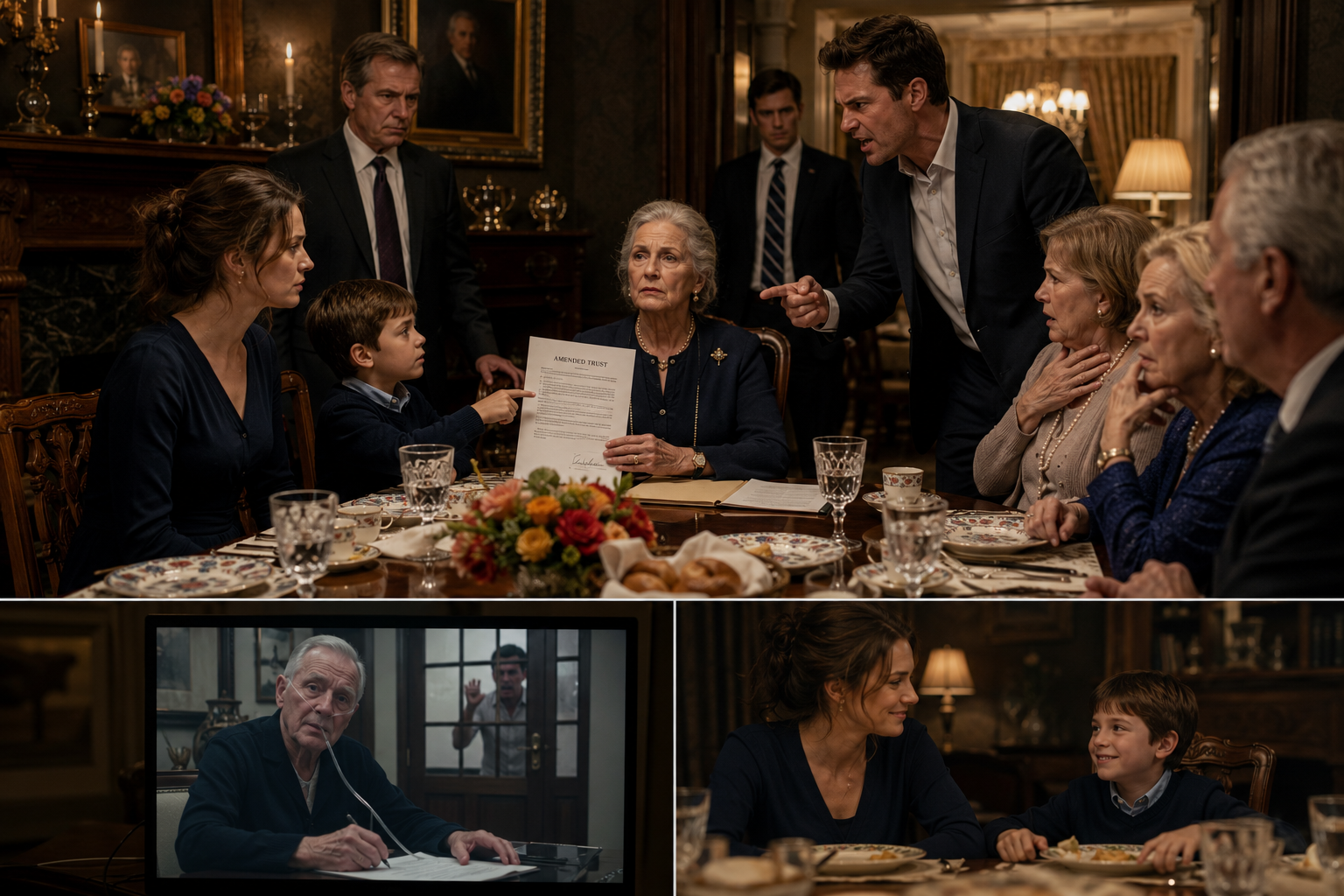
“Your grandfather amended the trust six weeks before his death. He did it because he finally accepted what he should have accepted twenty years ago. Daniel is not fit to control this estate.”
Daniel lunged forward.
Mr. Bell blocked him.
“What did you do?” Daniel shouted.
Evelyn didn’t even flinch.
“I followed his instructions.”
Then she slid the top page toward me.
My name was there.
Not as a beneficiary.
As successor trustee.
I stared at it.
Then at the next page.
And the next.
The family house.
The land.
The investment accounts.
The charitable foundation.
All of it had been moved out of Daniel’s control.
Not to me alone.
But to a trust structure overseen by me until Noah turned twenty-five.
Noah.
I looked up so fast my vision blurred.
Evelyn nodded once.
“Your grandfather never trusted Daniel with legacy,” she said. “He trusted him only with appearance. When he realized Daniel had begun moving money and leveraging the house against side debts, he changed everything.”
My mother let out a horrible little sound.
“You knew?” I asked her.
She didn’t answer.
That was answer enough.
Daniel’s face had gone gray.
“This is fraud.”
“No,” Evelyn said. “This is correction.”
Then she picked up the sealed letter and handed it to me.
“Read it.”
My hands shook as I opened it.
The first line made the whole room disappear.
Claire, if this letter is in your hands, then I have run out of time and Daniel has run out of places to hide.
I kept reading while my mother started crying and Daniel started swearing under his breath.
Grandpa wrote that Daniel had been siphoning from estate funds for years. That my mother knew and helped cover it. That he had delayed action because he was ashamed of what the family had become. And that in the end, the only people he trusted were me — because I never asked him for anything — and Noah, because “children still see what adults rearrange.”
At the bottom, in a sharper hand than I would have believed possible from a dying man, Grandpa wrote one final sentence.
If they fight this, burn them with the truth.
When I looked up, Daniel was staring at me like I had become someone dangerous.
Maybe I had.
Because the old version of me would have cried first.
The new one only folded the letter neatly and asked Evelyn, “What happens now?”
She answered without looking at Daniel.
“Now,” she said, “he explains the missing money.”
And for the first time in his life, my brother looked like the golden child had finally run out of gold…
PART 3 👇
Daniel tried denial first.
Of course he did.
He said Grandpa had been manipulated. Said Evelyn had turned him against the family. Said the trust amendment was invalid because of medication, timing, pressure, anything he could grab fast enough to sound plausible.
But Evelyn came prepared for exactly that.
She set down one document after another like laying stones on a grave.
A physician’s cognitive certification signed the same day as the trust amendment.
Two witness statements.
Video from the blue room.
Bank records tracing the withdrawals.
Loan paperwork Daniel thought no one had seen.
With each page, the room changed.
Not loudly.
But completely.
My mother stopped crying and started shrinking. Mr. Bell looked physically sick. Daniel kept speaking, but his words had lost shape. He sounded like someone trying to outrun a flood with polished shoes.
“Those were temporary transfers.”
“Grandpa approved that.”
“The house was collateral, not theft.”
Evelyn looked at him with something almost like pity.
“You used trust-backed assets to cover private debt and forged timing approvals after Harold’s stroke. Do not insult us both by calling that collateral.”
I turned to my mother.
“How much did you know?”
She started shaking harder.
“Claire, please—”
“How much?”
Her face crumpled.
“I thought he could fix it,” she whispered.
That was somehow worse.
Not ignorance.
Not innocence.
Hope that fraud would become acceptable if the right child survived it.
Noah was quiet beside me, but I could feel the tension in his little body. He didn’t understand the paperwork. He understood the tone. The danger. The adult fear.
So I pulled my chair closer to him and kept one hand on his shoulder while the rest of the family came apart.
Daniel slammed both hands onto the table.
“This is my house.”
Evelyn didn’t even blink.
“No. It was your grandfather’s house. Then it became his trust. And now, because you treated it like a private casino chip, it no longer belongs to the version of your life you built around stealing it.”
That hit.
Hard.
Because for the first time, Daniel had no audience left.
Not my mother.
Not Mr. Bell.
Not even me.
He looked at me then, really looked, and I think he expected softness. Family loyalty. History. The old Claire who cleaned up messes quietly so holidays could continue pretending.
Instead I said, “How much did you take?”
He laughed bitterly.
“Enough that Grandpa panicked.”
“No,” I said. “Enough that Grandpa changed his legacy to protect it from you.”
The rest of the night became procedural in the way disasters sometimes do once truth gets its uniform on. Calls were made. Mr. Bell contacted the estate accountant. Evelyn contacted litigation counsel. Daniel was told, in plain language, not to touch any estate property, digital records, or financial accounts pending formal review.
He shouted.
Threatened.
Pointed at me.
Pointed at Noah.
Then he made the mistake that finished him.
He said, “You’re putting this in the hands of a woman and a child?”
The room went dead still.
Evelyn closed her folder.
Slowly.
Deliberately.
Then she said, “Yes. Because between the two of them, there is still one functioning conscience.”
That ended the family version of the night.
By morning, the legal version had begun.
Daniel’s access to the accounts was frozen.
The house was placed under emergency trust control.
A forensic audit was filed.
And my mother, who spent her whole life protecting the wrong son, was formally removed from any advisory role she thought she had.
Noah and I went home just after sunrise.
He fell asleep in the passenger seat clutching the little wooden sailboat Grandpa had carved for him two summers ago. I drove with the windows cracked, cold morning air in my face, trying to understand how grief could split open and reveal a second death hidden inside it.
Not Grandpa’s.
The family we thought still existed.
Over the next weeks, everything Daniel swore was exaggerated became documented.
The “temporary transfers” were six figures.
The private debts were tied to gambling, speculative real estate, and one truly embarrassing side venture involving luxury horse syndication he clearly did not understand.
The forged authorizations were real.
The tax exposure was worse.
Worse still, Grandpa had not acted suddenly.
He had been watching Daniel for years.
Watching.
Confirming.
Waiting for proof strong enough that no one — not even my mother — could soften it into a misunderstanding.
And somehow the final proof came from a seven-year-old boy saying one innocent sentence over dinner.
That part never stopped haunting me.
How close it all came to holding.
How easily adults build whole rotten houses out of silence and assumption.
Daniel tried to fight in court. Publicly he called it elder manipulation. Privately he begged. He called me three times from unknown numbers before I changed mine. Left one voicemail I only listened to once.
“You know I’m still your brother.”
Maybe.
But brothers don’t hollow out a dying man’s legacy and then threaten his great-grandson for remembering the wrong paper.
The hearing came six weeks later.
Noah didn’t attend, obviously. He stayed with my friend Julia and spent the day making pancakes shaped like dinosaurs, blissfully unaware that half the family’s mythology was being dismantled in probate court.
I went with Evelyn.
Daniel was already there in a navy suit, looking like a man trying to iron dignity over panic. My mother sat behind him in pearls and quiet misery. She looked older than she had at the funeral, older than she had the night of the reading, as if truth had stripped the varnish off her all at once.
The judge was not patient.
That helped.
Forgery irritates probate judges in a very particular way. So does family greed dressed up as filial devotion. Once the physician certification, financial records, and trust amendment video were entered, Daniel’s case lost whatever little air it had left.
Then Evelyn played the final piece.
The blue room video.
Not the full thing. Just enough.
Grandpa at the table, thinner than I remembered, oxygen line at his nose, one hand shaking slightly as he signed. Evelyn beside him. And from outside the closed door, Daniel’s voice raised in anger.
“Open this damn door.”
Grandpa looked straight into the camera and said, clear as day, “This is why.”
There was no coming back from that.
The trust stood.
Daniel was removed.
Restitution proceedings began.
And me?
I became responsible for more than I had ever wanted.
The house.
The land.
The estate.
The decisions.
Not as a reward.
As a duty.
That mattered to me.
Because Grandpa had not rescued me with wealth. He had burdened me with stewardship because he believed I would choose responsibility over appetite. That kind of trust is not flattering. It is heavy.
But I accepted it.
For him.
For Noah.
For the version of the family that still deserved to survive.
Months later, when the leaves started turning, Noah and I moved into the house.
Not because I wanted a grand life.
Because I wanted his memory to grow up somewhere honest.
The first thing Noah asked when we unpacked was whether Grandpa’s chair would stay by the library window.
“Yes,” I said.
“Good,” he replied. “He still likes that spot.”
Children understand inheritance better than adults sometimes. Not as ownership. As presence.
The first dinner we had there alone, Noah looked around the long table and said, “It’s quieter now.”
“It is.”
He stabbed a carrot with all the solemnity of a judge and asked, “Is Uncle Daniel bad?”
I thought about that for a long moment.
“No,” I said carefully. “But he did bad things for a long time and expected everyone else to help him pretend they weren’t.”
Noah nodded as if that made perfect sense.
Then he said the line that finished the whole story for me.
“Grandpa was waiting for somebody to be brave.”
I put down my fork and looked at him.
Maybe that was true.
Maybe brave doesn’t always look like speeches or battles. Maybe sometimes it looks like a child telling the truth because no one taught him yet that family lies should be protected.
At my brother’s Trident of an inheritance dinner, my son looked at the family lawyer and said, “That’s not the paper Grandpa cried after signing.”
That one sentence exposed fraud, shattered the golden-child myth, and brought a dead man’s real wishes back to the table.
And in the end, the child they expected to ignore everything was the only one in the room who had seen the whole truth clearly enough to say it out loud.