Part 2: The Unexpected Visitors
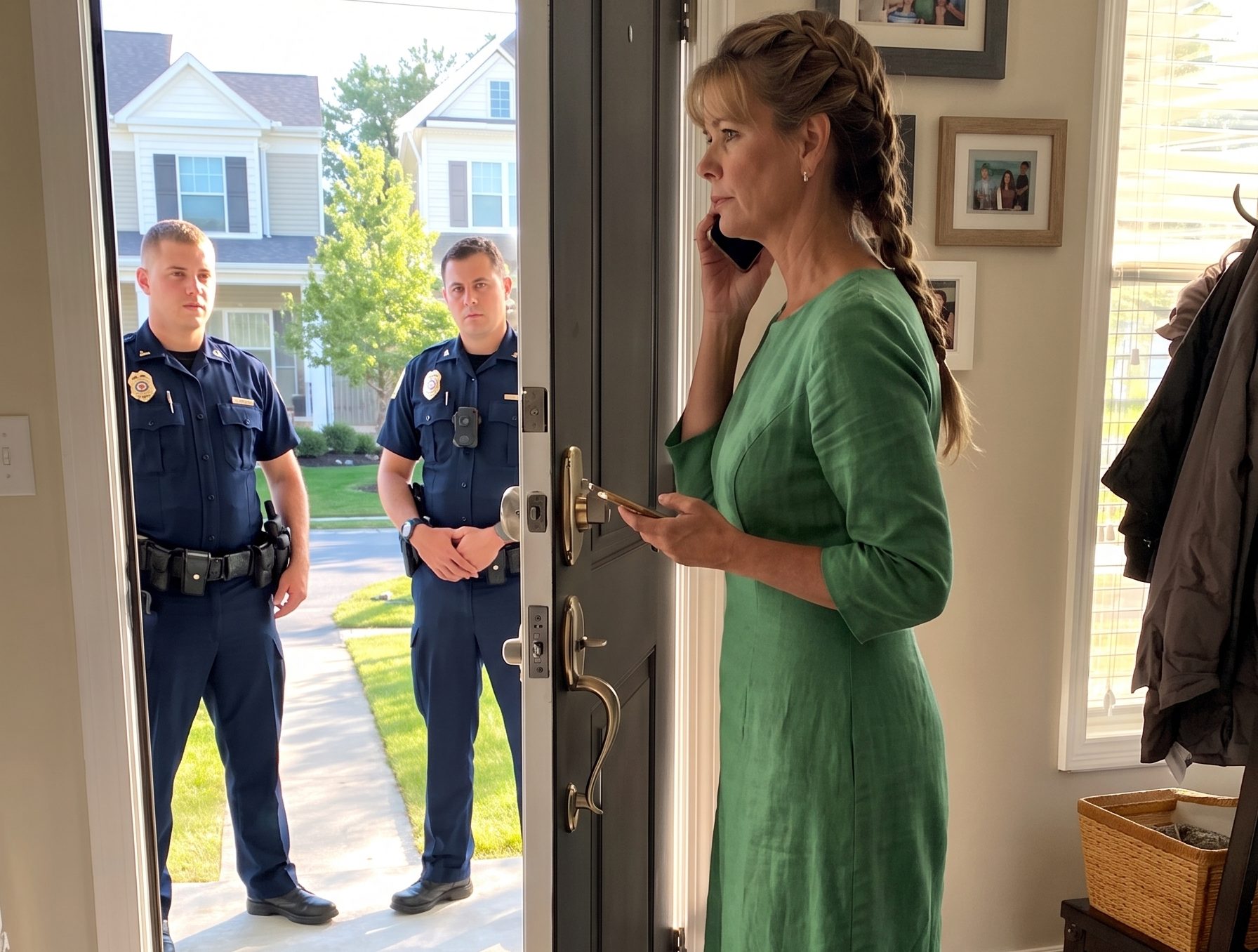
The brass deadbolt felt cold and solid under my thumb as I disengaged it. I swung the door open, not with fear, but with a detached curiosity. The two officers, a man and a woman, looked professional and distinctly unimpressed by the early hour.
“Are you Elena Vance?” the male officer asked, his eyes sweeping past me into the now-hushed interior of my home.
“I am,” I replied, my voice steady enough to be recorded for a deposition.
“We received a report of potential domestic disturbances and a request for a wellness check on this property,” the female officer added, her gaze lingering on the fresh drill marks on the doorframe. “Also, we have a report filed by a David Vance regarding an illegal lockout.”
I didn’t blink. David, in his infinite, arrogant stupidity, hadn’t just left me; he had tried to weaponize the police against me to force his way back into a home he had abandoned.
“David Vance does not live here,” I said, stepping aside to let them see the empty, echoing foyer. “He is currently in Cancun, Mexico, with another woman. He is not locked out; he chose to leave. I simply secured my property against an intruder who keeps trying to access my bank accounts from halfway across the world.”
The male officer looked at his partner, then at the tablet in his hand. “He claimed you were being erratic, Ma’am. He mentioned you were having a mental health crisis.”
I let out a short, sharp laugh. “Is it a crisis to stop a thief? I have the logs of the credit card transactions he made while he was supposedly ‘worried’ about my health. Do you want to see the photos he posted on social media yesterday? The ones of him and my former best friend on a yacht?”
The female officer’s expression hardened. “That won’t be necessary. We were just responding to the call. If he’s not on the premises, there’s nothing for us to do.”
“Wait,” I said, reaching for my tablet. “If you’re here, you might as well take this down. I want to file a report for financial fraud and unauthorized use of my private accounts. I have the digital trail right here.”
As I detailed the systematic theft David had committed, I saw the officers’ demeanor change. They weren’t there to serve a husband anymore; they were there to investigate a felony. I had planned for every contingency, but David’s decision to call the police was the best gift he could have given me. He had effectively paved the way for his own legal ruin.
NEXT PART and the FULL ENDING are coming. Type ‘YES’ and press ‘LIKE’ so we can post full story. Your [LIKE] helps these honest stories reach the people who need them most. Thank you for the support.
Part 3: The Price of Absolute Clarity
The transition from the chaos of the police visit to the absolute stillness of my home felt like entering a different dimension. As the cruiser pulled away, leaving nothing but tire tracks on my driveway, I went to the kitchen and made a pot of coffee—black, hot, and bitter. I sat at my dining table, the one David had always complained was “too formal,” and began the process of dismantling his life.
For years, I had played the role of the supportive wife, the one who kept the books, filed the taxes, and managed the investments while he focused on his “career.” He believed that by keeping me focused on the domestic, he had kept me ignorant of the financial. He never realized that I was the one who had written every contract, negotiated every loan, and, most importantly, kept the master keys to every single asset we owned.
“He thinks he’s playing a game of poker,” I whispered to the empty, echoing room, “but he doesn’t realize that I own the casino.”
I spent the next six hours on my laptop, systematically pulling the strings that would leave him completely exposed. I started by isolating his personal bank accounts, the ones he thought were hidden behind sophisticated digital firewalls. I had designed those firewalls, and I had left myself a back door in every single one. I moved every cent of his personal funds into a holding account, labeling it clearly as ‘Repayment for Unsolicited Vacation Expenses and Breach of Marital Trust.’
Then, I moved to the real objective: the company.
David was a minority shareholder in a firm that I had actually bankrolled with my own inheritance. He had spent years strutting around like he was the architect of its success. I pulled up the board documents, the ones I had personally drafted years ago, and initiated the ‘Executive Clause of Moral Turpitude.’ It was a clause I had added to the bylaws specifically for this kind of scenario, though I had never thought I would actually have to trigger it.
It was a simple, elegant piece of legalese: any director found to be engaged in gross financial impropriety or behaviors that brought the company into public disrepute could be summarily dismissed, with all shares forfeited to the majority holder—me.
I clicked “Submit” and watched as the notification was sent to every member of the board.
“Game over, David,” I murmured.
The reaction was instantaneous. By noon, my phone was ringing incessantly. I didn’t answer. By 1:00 p.m., emails were flooding my inbox, ranging from begging to incoherent screaming.
David was in Cancun, likely holding a margarita in one hand and my “best friend” in the other, completely oblivious to the fact that his bank accounts were frozen, his company shares were gone, and his legal standing was evaporating into the tropical air.
He had tried to use the police to intimidate me. So, I used the law to erase him.
But the final blow was the one that would haunt him the most.
I contacted the hotel in Cancun—a property he had specifically chosen for its exclusivity and status. I had the confirmation number from his emails. I called their front desk, my voice a perfect, icy imitation of the elite clientele they catered to.
“I’m calling regarding the reservation for David Vance and Sarah Miller,” I said, providing the credit card details. “There has been a fraudulent use of my account, and I am formally withdrawing all payment authorization. I am also informing you that the guests in question are associated with an ongoing investigation into multi-jurisdictional financial fraud.”
The hotel, eager to avoid any association with a scandal, acted within minutes.
When David and Sarah returned from the beach, they were met not by luxury, but by hotel security and a notice that their rooms had been cleared. They were essentially stranded, thousands of miles from home, without a penny, without a room, and with a mounting list of legal hurdles that would keep them tied up for years.
I walked to the front door, unlocked it, and stepped onto my porch. The air was crisp, and the neighborhood was waking up, oblivious to the fact that one of its most arrogant residents had just been deleted.
I felt a sense of liberation that was almost physical.
I had spent so much of my life making myself small, making myself accommodating, making myself the foundation that allowed him to stand tall. I realized that my own strength hadn’t been compromised by our marriage; it had been held in reserve.
I turned back into the house, and for the first time, I didn’t see it as a shared space, but as my sanctuary.
I walked to the closet and pulled out his clothes—expensive suits, designer shirts, items that had been paid for with my money, worn by a man who had betrayed me. I didn’t destroy them. I packed them, every single piece, and left them on the porch for a charity collection.
The next few weeks were a relentless pursuit of my own freedom. I filed for divorce, not as a victim, but as the primary owner of our assets. I liquidated the shared properties. I moved the final, remaining capital into a private trust that he would never be able to touch, let alone understand.
He came back eventually—I heard from neighbors that he showed up at the front door, looking ragged, unshaven, and utterly broken.
I didn’t answer the door.
I watched through the window as he stood there, banging on the wood, shouting about “his house” and “his life.”
I just took a sip of my coffee, turned on the music, and let the sound drown him out.
He didn’t belong to my life anymore.
He was a mistake I had corrected.
I spent the following year learning who I was outside of the shadow he cast. I took up the hobbies he had mocked—the art classes, the long-distance hiking, the quiet nights of reading. I found that I was capable of much more than I had allowed myself to be. I was talented, I was independent, and I was finally, truly, in charge.
I realized that the biggest gift he had given me was the opportunity to start over, not because I was forced to, but because I wanted to.
I met a new group of people, friends who valued my intellect and my kindness, people who had no idea who David Vance was, and who liked me precisely for who I was when I didn’t have to carry his weight.
I looked at the mirror one morning, seeing the woman who stared back at me, and I didn’t see the wife of a cheater.
I saw a survivor who had turned the tables in the most definitive way possible.
The legal fallout for David was a masterpiece of my own design. He ended up facing a series of lawsuits—some from the company, some from the creditors he hadn’t realized were actually tied to me, and some from the very people he had tried to swindle during his time with the firm.
He became a ghost in the corporate world, a man whose name was synonymous with failure and dishonesty.
I never heard from him again.
I didn’t need to.
The silence of my home was the ultimate victory.
It was the sound of a woman who had finally reclaimed her narrative.
I walked through the house, touching the walls, feeling the texture of the life I had built from the ground up, and I realized that I wasn’t just safe—I was sovereign.
The fear I had felt when I saw that first message from Cancun?
It was gone, replaced by a permanent, steady, and unbreakable calm.
I had survived, I had won, and most importantly, I had found the version of myself that had been hiding beneath the surface all along.
I was Elana Vance, and I was nobody’s second choice, nobody’s accessory, and nobody’s victim.
I was the author of my own life, and the story I was writing now was the best one yet.
It was a life of purpose, of passion, and of an integrity that could never be compromised.
I looked out the window at the morning light, feeling the warmth on my face, and I knew that the rest of my life was a blank slate, and I had all the time in the world to fill it with the things that truly mattered.
No more games.
No more betrayals.
No more hidden agendas.
Just me, my home, and the absolute freedom that comes when you stop trying to save a man who never had a place in your life to begin with.
I sat down at the table, opened a fresh notebook, and began to write, not for anyone else, but because I finally had a voice that deserved to be heard.
The house was quiet, the coffee was warm, and the future was wide open.
I had finally, truly, come home to myself.
The cycle was broken, the debt was paid, and the peace I had found was the most valuable asset I had ever acquired.
And as I looked at the sunrise, I knew that I would never, ever go back to who I was before that day in Cancun.
I was stronger, I was smarter, and I was finally, at long last, undeniable.
The story of our marriage was over, but the story of my life was just getting started.
And that, more than anything else, was the greatest revenge of all.
I closed the notebook, feeling a deep, resonant sense of fulfillment.
Everything had been reclaimed.
Everything had been restored.
And for the first time, I was simply, beautifully, free.
The silence wasn’t a void; it was a sanctuary.
And in that sanctuary, I had finally found the one person I had been neglecting for three decades: myself.
It was a new beginning, a clean slate, and a path forward that was entirely, unequivocally mine.
I stepped out onto the porch, breathed in the fresh morning air, and smiled.
The game was over, the prize was won, and I was finally ready to live the life I had always deserved.
The house was peaceful, the world was bright, and the future was mine to shape.
And that was all that mattered.