Part 2: The Breach
I was cleaning my gear when the notification hit my phone—not an email, but a direct alert from my bank’s security department. A request for a withdrawal of eighty thousand dollars from my long-term savings account. The attempt was marked as “Initiated via joint authorization request.”
I didn’t panic. My pulse remained steady, the rhythm of a person who has operated under fire. I pulled up the security logs on my laptop, my fingers flying across the keys with the same precision I used in a field hospital.
The authorization hadn’t come from my father. It had come from a spoofed email address linked directly to my father’s home network, sent by someone who had clearly spent months studying my security protocols.
“They didn’t just want the money,” I whispered to the empty, dimly lit room. “They wanted the whole account.”
I didn’t call my father. I didn’t call Vivian. I called a contact in the Judge Advocate General’s office, someone who knew exactly how to handle civilian interference with military finances.
“Elena, you’re sure?” he asked.
“I’m sure,” I replied. “They tried to access my retirement fund. I want them flagged, and I want an official inquiry opened into the identity theft.”
Within an hour, the request was denied, but the damage was already done—my resolve had shifted from defense to total dismantling.
Vivian hadn’t just been greedy; she had committed a federal offense. She had assumed that because I was serving overseas, I was blind to what was happening at home. She didn’t realize that my military training included forensic intelligence. I traced every digital footprint she left behind, every inquiry she made about my service benefits, and every conversation she’d had with my father about “securing the family legacy.”
The logs were clear. My father wasn’t just complicit—he had been feeding her the login information, terrified that if he didn’t, she would leave him.
The realization was sharper than a scalpel. He wasn’t the victim of her greed; he was her accomplice.
I wasn’t just going to stop them. I was going to ensure that their version of a “family legacy” was burned to the ground.
“You think you’re untouchable in that house,” I murmured, staring at the evidence of their betrayal on my screen. “But you’ve never dealt with someone who actually understands how to fight.”
I opened a new window and began drafting a legal document that would freeze every asset my father owned, ensuring that Vivian’s access to his bank accounts would be severed by the end of the week.
They wanted my money? I would take theirs, and then I would take their peace.
Part 3: The Price of Disdain
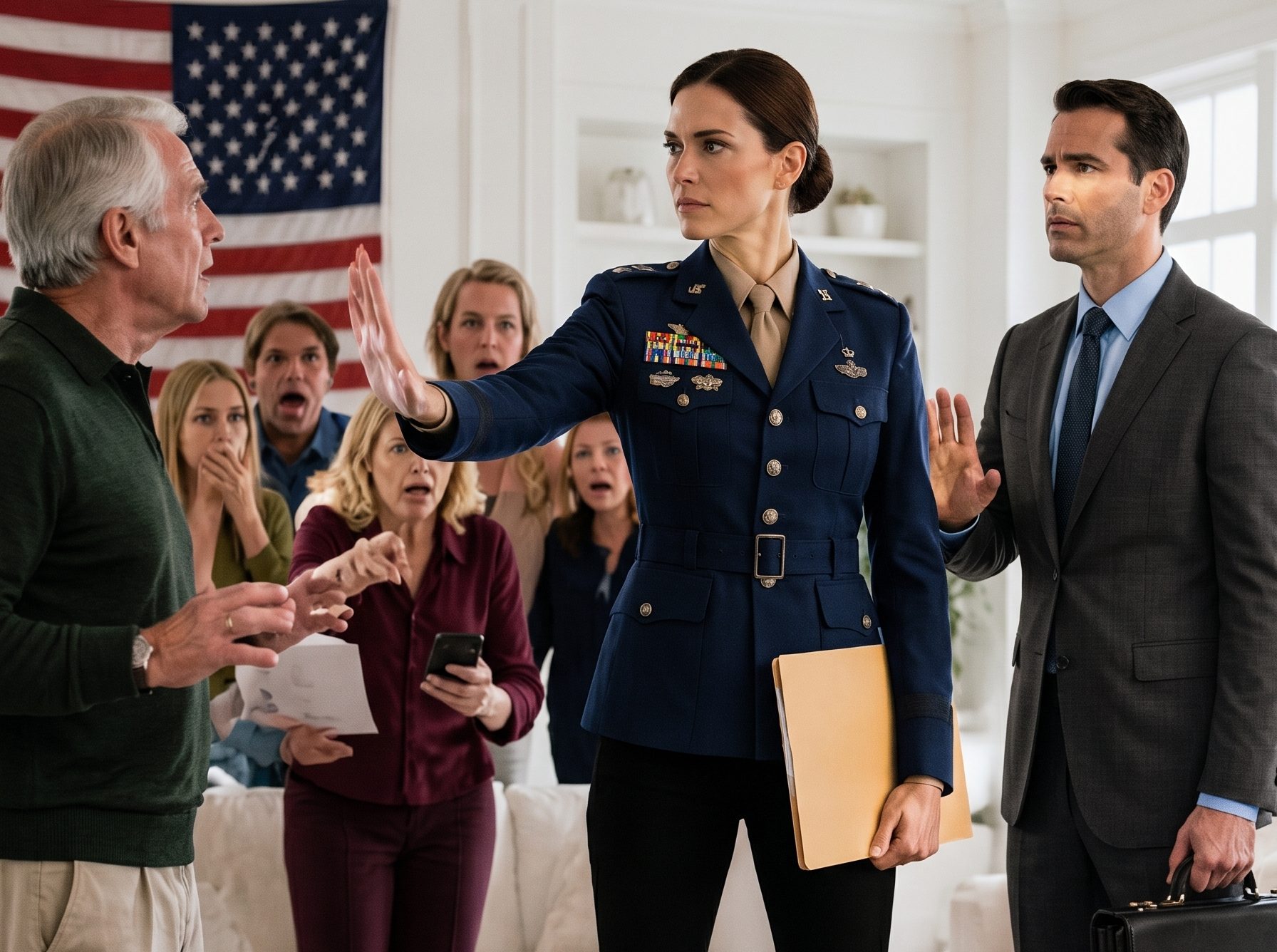
The sun was barely above the horizon when the heavy, authoritative thud of the envelope hitting the front door echoed through the halls of my father’s estate.
I had requested the delivery be made by a courier who didn’t believe in discretion or half-measures.
I watched the unfolding drama via the security feed I had meticulously maintained for “emergency purposes”—an insurance policy I had purchased years ago, just in case the family dynamic ever shifted from toxic to terminal.
My father, Harold, was the one to pull the door open, his movements sluggish and fearful.
He blinked, squinting against the harsh morning light as he accepted the thick, legal-sized packet from the courier.
He looked confused, shaking his head and sighing with the irritation of a man whose morning comfort had been interrupted, but as he tore the envelope open, I watched his face shift.
The irritation evaporated.
In its place came a look of absolute, bowel-shaking terror.
“Vivian!” he shouted, his voice cracking, a high-pitched sound that signaled the end of his comfortable, pampered existence. “Vivian, get in here! Right now! What the hell is this?”
My stepmother emerged from the kitchen, still clutching her bone-china tea cup, her face pinched and irritable, her hair still set in rollers from the night before.
“What are you screaming about, Harold? It’s six in the morning. Have you lost your mind?”
She snatched the papers from his hands, her fingers trembling slightly as she scanned the top page.
I leaned in closer to the monitor, savoring the way her face, usually so composed and cruel, began to drain of every drop of color.
She read the first page—the formal notice of default, typed in cold, unyielding legal jargon.
She read the second—the itemized, brutal list of every bank transfer, every secret account access, and every unauthorized request she had made, now officially reclassified as ‘attempted identity theft’ with supporting forensic evidence from my JAG contact.
She read the third—the eviction deadline, set for the end of the month, non-negotiable.
“This… this isn’t possible,” she hissed, her voice vibrating with a panic that was entirely foreign to her. “She’s just a soldier! She’s always been the quiet one! She’s always been the one who took the crumbs!”
“She’s clearly done it, Vivian!” Harold yelled, his composure completely shattered. He began to pace the foyer, his face a mottled, ugly red. “Look at the signature at the bottom of the order! She has a federal injunction against our house! We’ve been living in her house, under her roof, eating her food, and stealing her money for years! We’ve been sitting on a powder keg and you told me you could handle her!”
The scene in the foyer was a masterclass in the disintegration of a family built entirely on lies and vanity.
My father started dialing my number, over and over, his thumb hitting the screen with frantic, repetitive force.
I watched the phone on my desk vibrate, the caller ID flashing “ELENA” in bold, frantic letters, accompanied by a ringtone that once signaled love, but now sounded like a siren.
I didn’t answer.
I simply pressed the “Block” button and felt a weight lift from my shoulders that I hadn’t realized I was carrying since I was a child sitting at the edge of a family photograph.
“Do you see that screen?” I whispered to the empty barracks room, pointing to the footage of the house where they had been humiliated just hours before.
I watched as my father began frantically stuffing belongings into a designer suitcase, his face red with a combination of rage and total, suffocating humiliation.
“That,” I said, my voice steady, “is what happens when people mistake a soldier’s patience for weakness. You assumed that because I was quiet, I was fragile. You assumed that because I endured, I was broken. But I am not here to be your utility bill anymore.”
Over the next month, the drama was exquisite.
My father tried to drag me to court, but the contracts were airtight.
They tried to tell the extended family that I was the villain, that I had “abandoned” them during a crisis, but when the bank moved in to finalize the transfer, the truth finally leaked out: I hadn’t just been serving my country; I had been shielding them from their own financial incompetence for years.
I had been the ghost in the machine, keeping the lights on while they looked down their noses at me.
When they finally vacated the house, it was stripped of everything—the expensive antiques, the fine china, even the silk curtains.
They left behind nothing but the cold, hollow echoes of their own arrogance.
I didn’t want the house. It held too many ghosts, too many memories of being the outsider at my own father’s table.
I sold it, and with the proceeds, I set up a trust for my future that they would never even know existed—a legacy they could use to build a life far away from the reach of their cruelty, which is to say, they were on their own.
I moved to a different state, into a home that was smaller, brighter, and entirely, unmistakably mine.
The first holiday in my new house was a revelation.
There were no “glittering gift bags” from Vivian, no subtle, stinging jabs at my military career, and no tension in the air.
Instead, there was laughter.
I sat at my own table, and I realized that I had finally broken the cycle.
My father reached out one last time, a year later, via a long, handwritten letter sent to my base.
He wrote about “forgiveness,” he wrote about “family values,” and he wrote about how “the holidays just aren’t the same without the family.”
I didn’t read it.
I didn’t burn it, either.
I simply placed it in the industrial shredder, watching the paper turn into fine, meaningless confetti.
The silence that followed was not the kind that felt like submission; it was the kind that felt like sanctuary.
I had spent my entire life trying to earn a place at a table that wasn’t built for us, and the moment I decided to build my own, everything changed.
My life grew into something confident and kind, a life that I led unconditionally.
I never had to wonder if I was “good enough” for my father’s affection, because I had seen myself stand up for my worth in the most undeniable way possible.
The house on the hill, the one filled with rosemary and cruelty, became a distant memory, a story I told myself only to remind me of who I absolutely refused to be.
I never saw them again.
And honestly? I never missed them.
I realized that the greatest gift I had ever given myself wasn’t a medal or a commendation; it was the model of a soldier who knew exactly when to walk away from a toxic situation.
As I sat on my porch in my new life, watching the sun rise on a clean, peaceful world, I felt a deep, resonant peace in my soul.
I was the author of my story now, and for the first time, every chapter was written in the ink of my own choosing.
The New Year’s gift I had sent had been the end of our old life, but it was also the beginning of everything that truly mattered.
The table was mine.
The home was mine.
And the peace was something no one could ever take away from me again.
It was a life reclaimed, a dignity restored, and a future that was finally, unequivocally, wide open.
The transition wasn’t easy.
There were nights when the doubt crept in, whispering that I had been too harsh, that I had destroyed a family, that I had been a “bad daughter.”
But then I would look at the service flag on my wall, or watch myself confidently leading my team, and the doubt would vanish.
I realized that my father’s definition of “family” was just another word for “possession.”
He didn’t love me; he loved the way I looked when I was serving his needs.
He loved the way I kept his image pristine, the way I shielded him from the consequences of his own bitterness.
When I took my savings back, I wasn’t destroying a family; I was dismantling a machine that had been designed to erode my soul.
The local community in my new town knew nothing of the drama.
They only saw a woman who worked hard, who led her team, and who kept her house in order.
They didn’t know the woman who had once sat in a dining room listening to her stepmother insult her career while her own father nodded in silent agreement.
And that was the greatest luxury of all.
I started a new path, a consultancy that helped others navigate the financial planning they were too afraid to do themselves.
I found that many people, especially service members, were stuck in the same position I had been—terrified to take the wheel because they had been told for years that they didn’t know how to drive.
I became their secret weapon.
I taught them that money was not just currency; it was autonomy.
I taught them that if you own the foundation of your life, you are the only one who can decide when to build and when to clear the land.
My father occasionally tried to contact me, sending angry emails about how “Vivian is struggling” and how “we all need to be adults.”
I deleted them without reading.
“Struggling” was a relative term.
She was struggling to live without a subsidy.
She was struggling to live in a world where she couldn’t buy affection with gifts she didn’t actually pay for.
She was struggling to be just another person, rather than the matriarch of a dynasty of sycophants.
That wasn’t my problem.
It was their own long-delayed consequence.
One afternoon, I walked through the park near my new home.
It was mid-winter, the kind of day that felt crisp and clear.
I saw a father sitting on a bench, holding a gift bag, watching a group of children play.
For a fleeting second, the old reflex hit me—the fear that I should have stayed, the fear that I was missing out, the fear that I had failed the “family mission.”
But then a teammate came running over, face flushed with joy, coat unzipped, yelling about how we’d just finished the training module.
He grabbed my hand, not because he wanted something, but because he was happy to be near me.
I was safe.
I was whole.
And I was me, in the way that love is, not in the way that property is.
I looked at the man on the bench, and I didn’t feel jealousy.
I felt pity.
I felt pity because he had spent his life trying to control his lineage, and he had ended up alone, sitting on a bench with a bag of plastic trinkets, waiting for a validation that would never truly come.
I walked home, my heart light, and I thought about what I wanted for dinner.
I thought about life, about service, about the future.
I thought about things that were real.
When I got back, the house was warm.
I looked around at the life I had built—the sturdy chairs, the well-read books, the quiet corners where I could just be myself—and I realized that I had done it.
I had gone from a woman who didn’t exist to a woman who owned her own existence.
The warning I had sent was the most honest thing I had ever done.
It was the truth, delivered in a manila envelope.
It was the end of the performance.
It was the beginning of the reality.
As I lay in bed that night, the house silent and secure, I realized that I didn’t fear the holidays anymore.
I didn’t fear the judgment of people who didn’t understand that love is not a transaction.
I had been the one who was punished for years, but I was also the one who held the keys.
And I would never, ever hand them over again.
I drifted off to sleep, feeling the weight of the past finally falling away, replaced by the lightness of a future I had authored myself.
The story had ended the way all good stories should—with the protagonist finding her strength, her voice, and her own way home.
It was a life, not a performance.
It was a home, not an asset.
And it was peace—finally, unequivocally, peace.
The next morning, I woke up early, just as the sun was rising over the horizon.
I walked to the kitchen and started the coffee.
I looked out the window at the quiet street, at the neighbors walking their dogs, at the world that was moving forward, oblivious to the history of a woman who had once been the invisible servant in a house of gold.
I was different now.
The woman who had left that house after that warning, the one who had driven away with a cold, steady heart, was a stranger to me.
I was the woman who had seen the trap, triggered it, and walked out the door without looking back.
I was the woman who had realized that you cannot be destroyed by people who don’t actually see you.
And as I poured the coffee, I realized I was smiling.
Not a thin, forced smile for the cameras.
A real, deep, satisfied smile.
The kind that reaches your eyes and stays there.
The kind that says, “I am finally here.”
And for the first time in my life, I knew exactly what that meant.
It meant I was home.
It meant I was free.
It meant I was the one in control.
It meant that the story was, and always would be, exactly as I had written it.
The silence of the house was a symphony, a soft, rhythmic melody of a life lived on my own terms.
I sat down at the table, opened my journal, and began to write the next chapter.
There were no more lies to tell.
There were no more people to appease.
There were no more gifts to buy for those who didn’t deserve them.
There was only the blank page, the fresh ink, and the life I had saved from the wreckage of their expectations.
And as the sun rose fully, I knew that the rest of the book was going to be better than anything I had ever dared to dream.
Because it was finally mine.
It was my story.
It was my life.
And I was finally, truly, finally at peace.
Every morning now, I wake up and I check the doors.
Not because I am afraid someone is coming in, but because I am confident that I am the one who decides who stays outside.
I have become the architect of my own boundaries.
When I see people in the park, or at the grocery store, or in the quiet moments of the day, I observe the way they hold their bodies—the way they lean in to be liked, the way they apologize for taking up space, the way they trade their dignity for a moment of validation.
I recognize those habits because I once wore them like a second skin.
I see a mother yelling at her child for not sitting still, and I want to tell her that one day, that child will stop being still and start walking away.
I see a father ignoring his daughter to watch a game, and I want to tell him that he is trading a lifetime of memories for a few hours of static.
But I don’t say anything.
I walk by, living proof that you can change the trajectory of your own life at any moment.
I realize now that the most important thing I ever did wasn’t calling the lawyer or signing the deed; it was the decision to believe that I was worth more than the role they assigned me.
I was worth more than the “quiet one.”
I was worth more than the “servant.”
I was worth more than the “good daughter.”
I am worth my own life.
I spend my weekends now planting a garden—a real one, with flowers that bloom because they want to, not because they are supposed to.
The dirt under my fingernails feels honest.
The sweat on my brow feels earned.
The silence in my home feels like an invitation, not a void.
I don’t need the validation of a family who saw me as a bank account.
I have a family of choice now—friends who call just to talk, colleagues who respect my voice, teammates who love me for my presence rather than my utility.
I look at the life I have and I know that I would do it all again.
I would take the risk, I would make the call, and I would lock the door.
Because a life without dignity is no life at all.
And I have chosen dignity.
I have chosen myself.
And I have finally, after all these years, found a place where I truly belong.
The story is complete.
The record is set.
The past is buried.
And the future, oh, the future is everything.
It is bright.
It is honest.
It is mine.