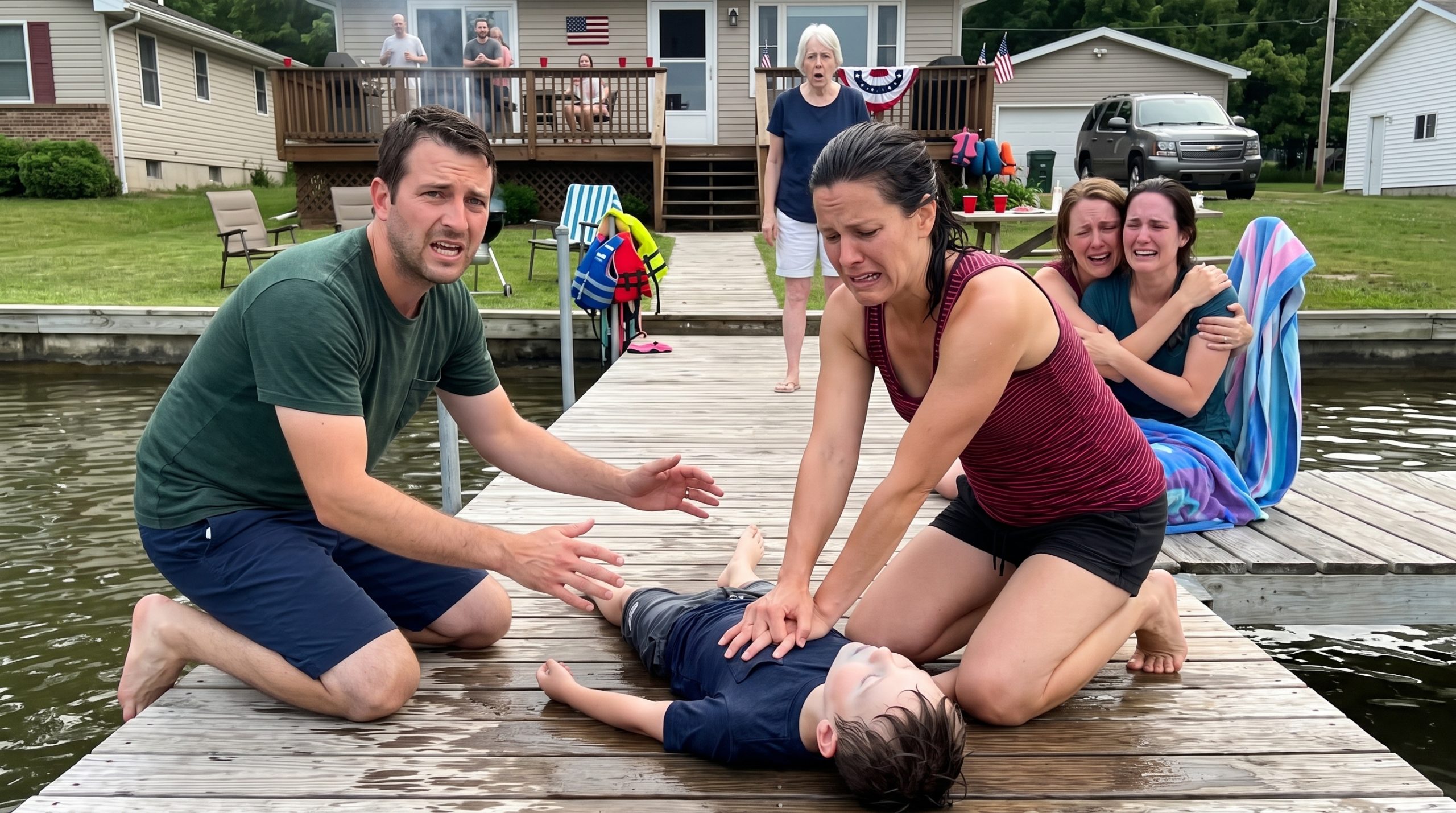
The waiting room of the hospital fell into an absolute, suffocating silence as Dr. Thorne’s words echoed off the high ceiling panels. My mother stood frozen in place, her mouth opening and closing like a fish pulled out of water, while my sister-in-law choked back a fresh wave of tears, her hands trembling violently against her chair. “Chief Attending Trauma Surgeon?” my mother whispered, her voice barely carrying across the small space as she stared at me as if she were seeing a stranger for the first time in thirty years.
“Piper… you’re a chief surgeon?” she asked, her hands shaking.
“Why didn’t you ever tell us?!”
I stood up from the vinyl waiting room chair, pulling my wet denim jacket straight around my shoulders while looking my mother dead in the eye. “I told you every single day for ten years, Mother,” I replied, my voice smooth, flat, and completely devoid of emotion.
“I told you when I matched into residency,” I reminded her quietly.
“I told you when I completed my fellowship,” I added.
“And I told you when I was appointed head of the trauma department.”
“You… you said you worked at a clinic!” my brother Mark stammered, scrambling to his feet, his face red with a mixture of overwhelming shame and deep, agonizing guilt.
“You always wore scrubs when you came over!” he yelled, his voice cracking.
“We thought you were just a clinic assistant!”
“You thought what was convenient for your ego, Mark,” I told him, stepping past him toward the double doors where Dr. Thorne stood waiting. “You needed me to be smaller so you could feel bigger at your backyard barbecues. You turned my twelve-hour surgical shifts into jokes because you couldn’t stand the fact that I built a life without your approval.”
Dr. Thorne looked between my family and me, his professional expression hardening into pure, unadulterated disgust as he realized why the top trauma surgeon in the region had been sitting outside in soaked party clothes.
“Doctor Vance,” Dr. Thorne said firmly, holding the interior door wide open. “Your nephew Colton’s CT scans came back. He has secondary pulmonary edema from the lake water, and his airway is restricting. Dr. Miller is requesting you in trauma bay two right now.”
My brother let out a choked, desperate sob, dropping down onto his knees in the middle of the waiting room tile, reaching out toward my hand. “Piper! Please!” Mark wept, his voice echoing off the walls.
“Please save my son!” he begged, tears streaming down his face.
“I’m sorry! I’m so sorry for everything I said!”
I stopped at the threshold, looking down at my brother kneeling on the floor, the same man who two hours earlier had been laughing on his deck while calling my career a fake joke.
“I don’t save Colton because you apologized, Mark,” I said, my voice carrying an unshakeable, razor-sharp authority that made him instantly go quiet.
“I save him because I am Dr. Piper Vance,” I declared.
“And I take my oath seriously.”
I pushed through the double doors, stepping into the sterile, high-energy environment of the trauma unit, leaving my family behind in the waiting room to chew on the bitter, toxic lies they had cultivated for a decade.
I scrubbed in within three minutes, replacing my wet lake clothes with sterile surgical gowns, snapping latex gloves over my hands, and stepping into trauma bay two where four nurses and an anesthesiologist were working frantically around my small, pale nephew.
“Dr. Vance is on the floor!” the head nurse announced loudly.
“Vitals are dropping,” Dr. Miller reported quickly, stepping aside to hand me the primary laryngoscope. “Oxygen saturation is at eighty-two percent, fluid in the lungs, upper airway swelling rapidly.”
“Intubation tray, size four tube,” I commanded smoothly, my hands moving with absolute, practiced precision, completely free of hesitation or fear.
“Deliver two milligrams of sedative,” I instructed the team.
“Suction ready on my mark.”
For forty-five intense, hyper-focused minutes, my team and I worked over Colton’s tiny body. I cleared the fluid from his bronchial tubes, secured a clear breathing pathway, stabilized his blood pressure, and administered targeted medication to prevent secondary lung collapse.
When the digital monitors finally settled into a steady, rhythmic, green-line heartbeat, a collective sigh of relief washed through the trauma room.
“Airway is fully secured, oxygen saturation back to ninety-nine percent,” the anesthesiologist reported with a bright smile. “Brilliant work, Dr. Vance. You saved this kid’s life twice today.”
“Move him to the pediatric ICU,” I ordered, stripping off my bloody surgical gloves and tossing them into the biohazard bin. “Keep him on continuous monitoring for twenty-four hours.”
I walked out of the surgical wing an hour later, dressed in a clean set of navy hospital scrubs, holding Colton’s updated chart in my hand.
I pushed through the double doors back into the main waiting room, where my mother, my brother, and my sister-in-law were pacing frantically back and forth across the floorboards.
The moment the doors clicked, all three of them rushed toward me, their faces pale, terrified, and desperate for any word.
“Piper!” Mark cried out, his hands shaking as he reached for my arm, though he stopped himself short of touching me.
“Is he… is he going to make it?!” he whimpered.
“Please tell me he’s alive!”
“Colton is stabilized,” I stated clearly, my tone strictly professional.
“The intubation was successful, his lungs are cleared, and he is resting comfortably in the pediatric ICU,” I explained.
“He will make a full recovery without any neurological damage.”
My sister-in-law fell against Mark’s shoulder, weeping tears of pure, overwhelming gratitude, while my mother sank into a chair, holding her face in her hands.
“Thank God…” my mother sobbed softly through her fingers.
“Thank God you were there, Piper…” she wept.
“We were so wrong about you…”
“You weren’t just wrong about me, Mother,” I replied, standing tall in my navy scrubs, looking down at her with complete, unshakeable clarity.
“You spent ten years degrading my hard work because you wanted to keep me in a small, convenient box,” I told her firmly.
“You laughed at my sacrifices while I was saving human lives.”
Mark stepped forward, his head hung low in complete, pathetic humiliation. “Piper… how can we ever make this up to you?” he asked, his voice barely a whisper.
“What can I do to fix this?” he begged.
“You can start by never calling my career a joke again,” I said coldly.
“And you can pay your medical bill when the hospital sends it,” I added.
“I have a shift to finish.”
I turned on my heel and walked down the long, sunlit corridor toward the chief’s office, my footsteps echoing with firm, confident rhythm against the polished floorboards.
Over the next two days, news of what had happened at the lake spread through our extended family and community like wildfire.
Neighbors who had heard my mother laughing on the deck learned that the woman she called a “fake nurse” was actually the lead trauma surgeon who had pulled her drowning grandson from the water and performed emergency airway surgery to save his life.
My brother sent three large arrangements of flowers to my office, accompanied by long, written letters of apology from both him and my mother, begging me to come to Sunday dinner so they could honor my accomplishments properly.
I left the flowers in the nurses’ lounge for the staff to enjoy, and I sent a short, simple text message back to my family group chat: I am busy saving lives this Sunday. Do not call me again.
A week later, Colton was formally discharged from the hospital, healthy, happy, and fully recovered, running into my office to throw his small arms around my waist to give me a big hug before his parents led him home.
I stood by my office window overlooking the city skyline, holding a warm cup of coffee under the bright morning sun, feeling a deep, quiet sense of peace settle into my heart.
My family had spent years trying to make me feel small, using mock jokes and condescending insults to hide their own insecurities.
But when the storm came and the water claimed my nephew, their empty words dissolved into nothingness, leaving only the truth of who I really was.
I adjusted the stethoscope hanging around my neck, took a slow, deep breath of fresh air, and smiled, knowing that my worth had never been defined by their laughter—and it never would be again.