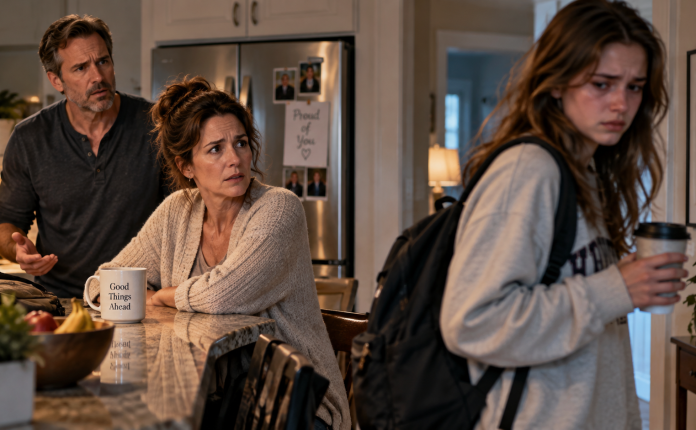
For several seconds, nobody spoke after Tommy pointed toward the hallway. Lauren’s face lost all its color, and then she began shaking her head so quickly that her hair came loose around her shoulders.
“That isn’t true,” she said. The detective stayed calm.
“Tommy, take your time.” My son pulled the hospital blanket tighter around himself.
“He gets mad when Mom leaves.” I felt my hands clench.
“Who gets mad?”
“Evan.”
That was the first time I heard the name. Evan was Lauren’s boyfriend, and I had met him twice before; he had always been polite, always smiling, always saying the right things when I picked Tommy up.
Tommy continued carefully. “Mom says Evan is just strict. She says I have to listen because he’s helping her.”
The detective sat beside him. “What does strict mean?”
Tommy looked at me first, then at the floor. “It means I get punished if I say no.”
My chest tightened. The detective asked questions slowly, never pushing him to describe more than he could handle.
I learned that the injuries had not come from one incident. There had been several, and the pain from that Sunday had become so severe that Tommy could barely walk when he came to my house.
The doctor later explained that the injury was consistent with prolonged physical pressure and blunt impact. The exact cause would require further examination, but there was no reasonable medical explanation for the condition Lauren had tried to dismiss as a tantrum.
I remembered every time she had smiled at school meetings, every time she told teachers that Tommy was sensitive, and every time she said I was imagining problems. Suddenly all those little moments looked different.
The detective asked whether Tommy had ever told anyone before. He nodded.
“My teacher.”
My heart stopped. “What did you tell her?”
“I told her I didn’t want to go home.” He said the school had once asked Lauren about it.
She had responded that Tommy was having trouble adjusting to the divorce. That explanation had been accepted.
The detective asked whether anything else had happened. Tommy nodded again.
“I drew a picture.”
“What kind of picture?”
“A man hurting me.”
My throat tightened. “Where is it?”
“Mom threw it away.” The detective wrote something down.
Then she asked the question that finally cracked the wall around him. “What are you most afraid will happen now?”
Tommy’s eyes filled with tears. “That Daddy will go to jail because Mom said I made everything up.”
I reached for his hand. “You will never go to jail because you told the truth.”
The detective looked at me. “And neither will you.”
The next several hours became a blur of interviews, examinations, and phone calls. Child protective services placed an emergency hold that prevented Lauren from removing Tommy from the hospital.
Evan was located that evening at Lauren’s house. Police searched the home after obtaining the necessary authorization.
They found a locked storage box containing printed messages, recordings, and a notebook in which Evan had written about “correcting” Tommy’s behavior. There were also messages between Evan and Lauren.
One of them said, “He needs to learn that his father can’t always rescue him.” Another said, “Don’t let him tell anyone what happens here.”
I read those words later. I wish I hadn’t.
But they mattered. They showed that Lauren had known what was happening.
She had not simply failed to notice. She had helped hide it.
The case moved quickly because there was physical evidence, medical documentation, school records, witness statements, and the messages found in the house. Evan was arrested and charged with offenses related to child abuse and unlawful restraint.
Lauren was also charged after investigators determined that she had participated in the abuse, concealed evidence, and repeatedly intimidated Tommy into silence. She insisted everything had been exaggerated.
Until the evidence was shown to her attorney. After that, she stopped giving interviews.
I never heard her say she was sorry. Not once.
The first court hearing happened several weeks later. I sat behind Tommy’s advocate, holding my son’s hand.
Lauren entered wearing a tailored suit. For a moment, she looked exactly like the woman who had smiled at school meetings.
Then she saw Tommy. She stopped.
He looked away. That was all.
He didn’t need to scream at her. He didn’t need to accuse her.
He simply chose not to look at her.
The judge ordered that Lauren have no unsupervised contact with Tommy. Evan was held while the criminal case proceeded.
Tommy came home with me after the hearing. That first night, he asked whether he could sleep with his bedroom door open.
“Of course.”
The next night, he asked again. I said yes.
For several weeks, he woke from nightmares. Sometimes he didn’t want to eat, and sometimes he sat completely still when someone raised their voice.
We found a trauma therapist who specialized in children. She told me healing would not happen on my timetable.
“His body learned that adults could become dangerous,” she explained. “Now he has to learn that adults can also be predictable.”
So I became predictable. Breakfast at seven, school at eight, homework after dinner, the same bedtime story every night, no sudden punishments, no yelling, and no threats.
And every time Tommy asked the same question, I gave him the same answer. “You’re safe.”
Slowly, he started believing me.
Three months later, his teacher called me. “He sang today,” she said.
I almost didn’t understand. “What?”
“Tommy sang during music class.” I sat down at the kitchen table.
It was such a small thing. But I cried anyway.
He was finding his way back.
The legal case lasted almost a year. Evan eventually accepted a plea agreement and received a significant prison sentence.
Lauren also pleaded guilty to charges related to child abuse and intimidation. The court ordered her to complete counseling and prohibited her from unsupervised contact with Tommy for an extended period.
Her parental rights were later terminated after a separate family-court proceeding determined that reunification would not be safe. Tommy remained with me permanently.
There was no celebration when that happened. I didn’t want one.
It felt wrong to celebrate the destruction of a family. Instead, I took Tommy for ice cream.
He ordered chocolate. Then he asked if we could sit outside.
He took the first bite and looked at me. “Daddy?”
“Yes?”
“Do I have to call her Mom?”
I swallowed. “No.”
He looked relieved. “You can call her whatever feels safe for you.” He thought about it.
“Then I don’t want to call her anything.”
I nodded. “That is okay.”
Six months after that Sunday, Tommy had started sleeping through the night. He joined a soccer team, complained about homework, and laughed loudly again.
One afternoon, he came home with grass stains on his knees and yelled from the hallway, “Dad!”
“What?”
“I scored!”
I ran toward him. He jumped into my arms.
For one second, I forgot every legal document, every hospital hallway, every terrifying phone call. I just held my son.
The family-court case concluded several months later. Lauren lost unsupervised custody and was ordered to have no direct communication with Tommy outside approved channels.
She also lost her right to make independent medical and educational decisions for him. I received sole legal and physical custody.
The court ordered Lauren to complete treatment and counseling before any future contact could even be considered. Evan remained incarcerated.
The house where so much of the abuse had occurred was sold. I never went there.
I didn’t need to.
A year after that Sunday, Tommy and I were sitting on the front porch doing homework. He looked up from his workbook.
“Dad?”
“Yes?”
“Can I tell you something?”
“Always.”
“I don’t think Sunday is scary anymore.” I closed the book.
“Why?”
“Because Sunday is when I come home.”
I couldn’t speak for a moment. Then I smiled.
“Yes.”
He leaned against my shoulder. “I’m glad you called 911.”
I looked at him. “Me too.”
He went back to his homework. The sun was setting over the street.
Cars passed. Someone walked a dog. A neighbor watered flowers.
Everything looked ordinary.
And that was the thing I had wanted most. Not revenge. Not money. Not an apology.
Ordinary.
A home where my son could walk through the front door without fear. A house where silence meant peace instead of danger.
A life where a child could say, “Daddy, I’m hurting,” and know that somebody would listen.
One year later, Tommy still went to therapy, though less often. He still had hard days.
But he also had soccer games, science projects, birthday parties, and a growing collection of terrible jokes he insisted on telling at dinner.
Sometimes he asked difficult questions. I answered them honestly, but never gave him details he wasn’t ready to carry.
He once asked whether his mother loved him. I thought for a long time before answering.
“I believe she had feelings for you,” I said. “But love is supposed to protect people, and adults are responsible for the choices they make.”
He nodded. Then he asked whether he had done anything wrong.
I looked directly at him. “No.”
His shoulders relaxed.
I had spent months waiting for the legal system to give him that sentence. But the most important part was that I had been able to say it myself.
You did nothing wrong.
You’re safe.
You’re home..
One year later, those words were no longer part of an emergency. They were part of our daily life.
And every time Tommy walked through the front door after school, dropped his backpack on the floor, and shouted, “Dad, I’m hungry,” I knew the most important call I had ever made was the one I made before anyone had time to erase the evidence.
I didn’t need to be the loudest person in the room. I just needed to listen when my son told me something was wrong.
Sometimes protecting a child is not about knowing exactly what happened. It is about refusing to ignore the first sign that something did.
And that Sunday afternoon, my son gave me one.
I listened.