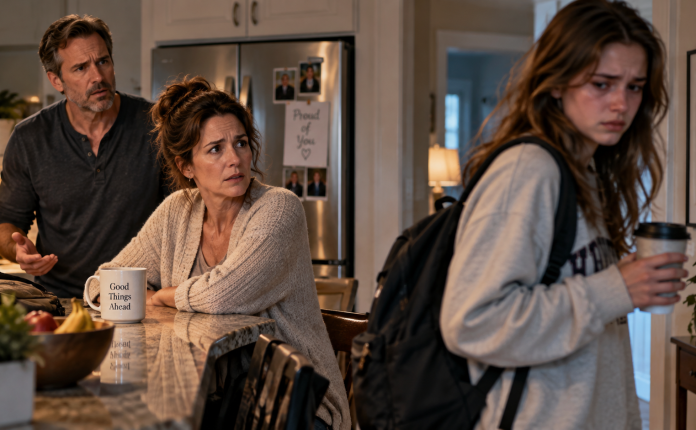
I didn’t raise my voice again that night, not with Tessa still in the house listening to every word through the thin kitchen wall. Instead, I told Denise we’d talk once the kids were asleep, and I spent the next hour giving Tessa a bath, feeding Miles, and tucking my daughter into bed with more gentleness than I think I’d ever managed in my life, trying to make up in twenty minutes for what she’d carried alone all afternoon.
“Am I in trouble?” Tessa asked as I pulled her blanket up.
“No, sweetheart. Not even a little. You did everything right.” I sat with her until her breathing slowed, until I was sure she was actually asleep and not just pretending so I would leave the room.
When I finally went back downstates, Denise was sitting at the kitchen table where I’d left her, the second phone now placed between us like evidence at a trial neither of us had asked to attend. “How long,” I asked, “and don’t tell me it just happened once.”
“Eight months,” she admitted, not meeting my eyes. “It started as nothing. Just texting. Then it wasn’t nothing anymore.”
“And today?”
“He said it was urgent. His divorce papers needed signing in person, some deadline thing, and I panicked and thought seventeen minutes wouldn’t matter.” Her voice cracked on the word “wouldn’t.” “I didn’t think Miles would get fussy that fast. I didn’t think Tessa would struggle that much.”
“She’s nine,” I said. “She shouldn’t have been alone with an infant for any amount of minutes, urgent divorce papers or not. And you told her to lie to me about it.”
Denise didn’t have an answer for that. I don’t think there was one that would have satisfied either of us.
I didn’t sleep that night. I sat in the living room with the second phone, reading through months of messages I probably shouldn’t have read in one sitting, watching a version of my marriage I hadn’t known existed unfold in text bubbles while I was out training other people’s dogs to trust their handlers.
The next morning, I called my sister, Colleen, who lived forty minutes away and had always gotten along well with Tessa. I asked if she could take both kids for a few days while Denise and I figured out what came next. Colleen didn’t ask many questions on the phone; she just said she’d be there within the hour.
Once the kids were settled at Colleen’s, I contacted a family law attorney named Priya Anand, who’d handled a coworker’s divorce a few years earlier. I told her everything, the affair, the phone, the seventeen minutes that turned into over five hours, and she was direct with me from the start. “Infidelity alone won’t determine custody in this state,” she said, “but a documented pattern of leaving young children in an unsafe or inappropriate caregiving situation absolutely can factor into it, especially with a written record like this.”
I filed for divorce two weeks later. Denise didn’t contest it, though she did fight harder than I expected over custody arrangements for Miles and Tessa. Priya used the messages, along with a statement from Tessa’s pediatrician about the stress-related stomachaches she’d started having in the months leading up to that day, to argue for primary custody on my end, with supervised, structured visitation for Denise until she could demonstrate consistent, safe caregiving on her own.
The court didn’t take the situation lightly. A guardian ad litem was appointed to interview both kids, and though Tessa was clearly anxious talking about it, she was honest, telling the evaluator plainly that her mom had told her not to call me. That honesty, hard as it was to watch her go through, ended up mattering a great deal in the final custody decision.
Denise moved out of the house within a month, into a small apartment across town, and Ryan’s own divorce, it turned out, hadn’t been quite as urgent or as close to finalized as he’d claimed to her. Within weeks of the truth coming out, he stopped answering her calls altogether, and Denise found herself navigating the fallout largely alone.
I won’t pretend the months that followed were easy. Tessa needed real support working through what had happened, so I found her a child therapist, Dr. Renata Osei, who specialized in kids who’d been placed in situations beyond their age and capability. Progress was slow at first, but steady. Tessa started sleeping through the night again by the third month, and the stomachaches gradually stopped.
Miles, thankfully, was too young to remember any of it directly, though I made sure never to leave him with anyone, including myself in moments of exhaustion, without a real plan and a real adult present. I cut back my training schedule for almost half a year, taking on only local clients so I could be home every afternoon when Tessa got off the bus.
Denise and I settled into a careful, business-like coparenting rhythm by the fifth month. She got her supervised visitation increased to unsupervised day visits after completing a parenting course the court required, and to her credit, she took it seriously, showing up consistently and never again putting either kid in a position that wasn’t hers to create.
“I know I don’t get to undo it,” she told me once, during a stiff, polite exchange at a custody handoff. “I just want you to know I understand why you don’t trust me right now.”
“I don’t,” I said. “But I also don’t want Tessa and Miles growing up thinking their mom disappeared from their lives entirely. So we keep doing this, carefully, and we see where it goes.”
One year later, Tessa turned ten at a small backyard party with just a handful of close friends and family, Colleen included. Denise came for two hours in the afternoon, brought a gift Tessa had actually asked for, and left before dinner without any tension in the room, which felt like its own kind of quiet victory after everything.
Watching Tessa blow out her candles, laughing with her friends like the kid she was always supposed to be able to be, I thought about that message on the second phone, the casual cruelty of “just tell her not to call her dad unless it’s an emergency,” and how close we’d come to a very different kind of afternoon. I thought about the seventeen minutes that had actually turned into five hours, and how much they’d cost all of us to survive.
Miles took his first wobbly steps that same week, reaching for Tessa’s hands instead of mine, and she caught him every time, laughing, steady, nothing like the exhausted nine-year-old collapsed against the kitchen cabinets a year earlier. I stood back and watched them both, grateful in a way I couldn’t fully put into words, and let myself believe, finally, that we were going to be okay.