I waited until the hallway had gone quiet and the night nurse had finished her rounds before I sat up on the fold-out cot and turned to face him. Ben was still awake, staring at the ceiling the way he always did when something was weighing on him.
“I found the envelope,” I said quietly. “Under the mattress.”
He closed his eyes for a long moment before he answered. “I was going to tell you. I just needed a few more days to figure out how to say it without you feeling like you had to say yes.”
“Say yes to what, exactly?” I asked, moving to sit on the edge of his bed. “A trial that might actually help you, or moving to Houston to take care of you while you go through something experimental and terrifying? Ben, those aren’t things you get to decide for me alone.”
“I already asked so much of you,” he said, his voice cracking. “I married you into this instead of the life we planned. I didn’t want to also drag you across the country for something that might not even work.”
“You didn’t drag me into anything,” I said. “I chose this. I chose you. Every single version of this, including the hard ones.”
The next morning, we called Dr. Reyes’s office together, and I listened on speakerphone as she explained the trial in full detail. It targeted a specific genetic mutation present in Ben’s tumor, and while it wasn’t a cure, early results in a small group of patients had shown meaningful extensions in both quality of life and survival time, something significant enough that his own oncologist here had quietly encouraged him to pursue it rather than accept the original prognosis as final.
“There are no guarantees,” Dr. Reyes said carefully. “But there’s a real chance this buys him more time than the standard timeline suggests, and for some patients in the trial, meaningfully more.”
We made the decision together that same week. I gave notice at my job, arranged for my sister to sublet my apartment, and packed enough for four months in Houston, though neither of us said out loud how much we were both hoping it would turn into longer. Ben’s parents helped cover the costs the insurance didn’t, and a small fundraiser organized by his old coworkers covered the rest of our relocation expenses.
The treatment itself was brutal in ways the pamphlets didn’t fully prepare us for. There were weeks Ben was too sick to get out of bed, infusion days that left him shaking and nauseated for forty-eight hours afterward, and one frightening hospitalization in the second month when his white blood cell count dropped low enough to require isolation precautions. I slept in a chair beside his bed more nights than I can count, learning the rhythms of a hospital floor the way I once knew the halls of our old high school.
But by the third month, the scans showed something none of us had let ourselves fully hope for: the tumor had shrunk, not disappeared, but measurably smaller than when we’d started, enough that Dr. Reyes used the word “response” with real enthusiasm in her voice for the first time.
“I’m not going to tell you this means remission,” she said carefully, sitting across from us in her small office. “But it means the treatment is working, and that changes the timeline we’re working with substantially.”
Ben cried in that office in a way I’d never seen him cry before, not from grief this time, but from something that felt dangerously close to hope, a feeling he’d been almost afraid to let himself have since the day of his original diagnosis.
Six months after our wedding in that hospital room, Ben was strong enough to leave Houston and continue a maintenance version of the treatment closer to home. He still had regular scans, still had hard days, still carried the reality that his cancer wasn’t cured and might never be fully gone. But he was walking without assistance most days, cooking dinner some nights, and slowly, carefully, building a version of a future neither of us had let ourselves plan for months earlier.
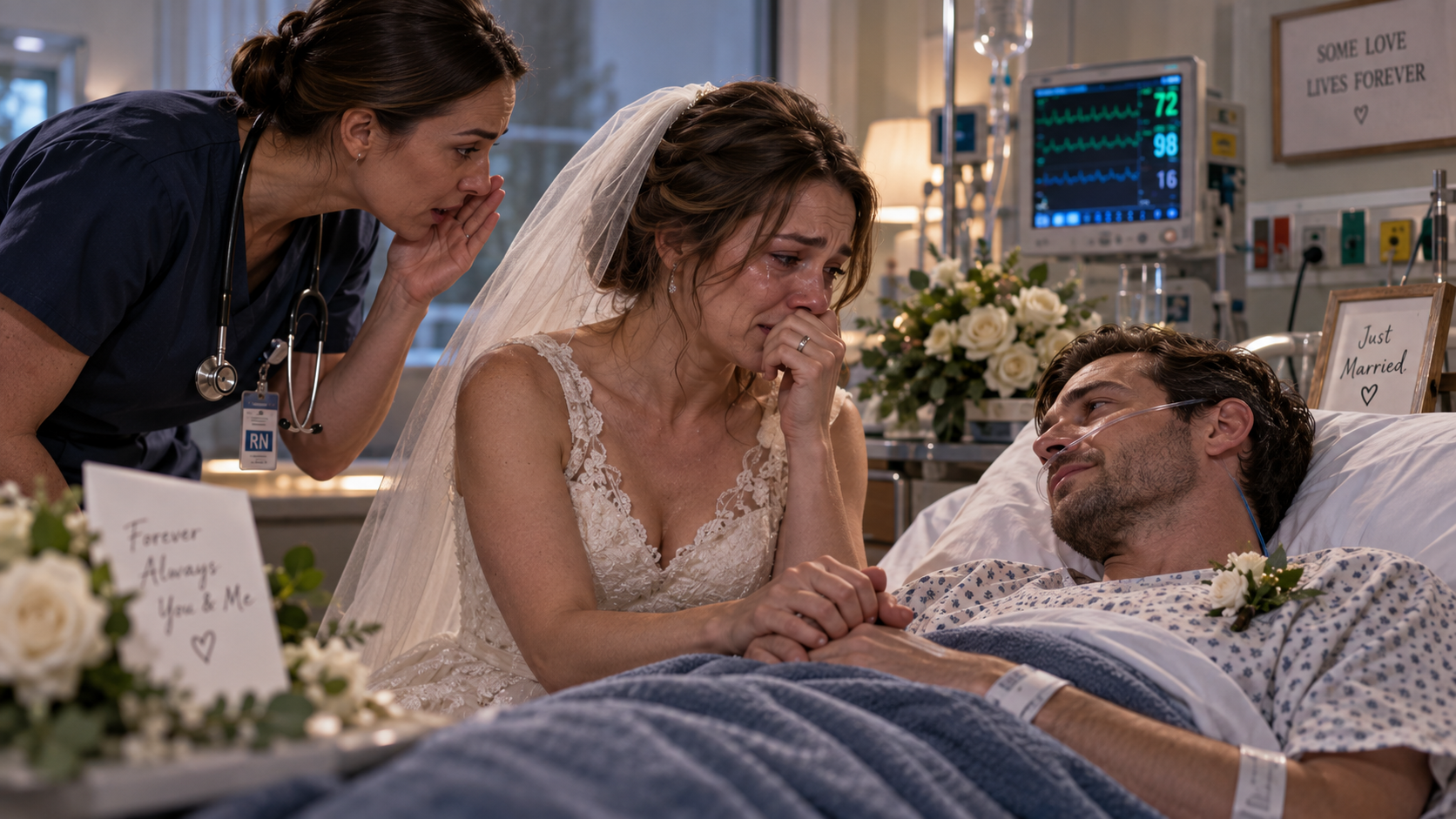
We finally had the wedding reception we’d once cancelled, a small backyard gathering instead of the venue we’d originally booked, with the same ridiculous bow tie Ben insisted on wearing again, this time paired with an actual suit instead of hospital pajamas. His parents cried. My mother cried. Even the nurse who had whispered that warning in the hallway months earlier came, having stayed in touch with us through the whole ordeal, and she hugged me tightly at the door.
“I almost didn’t say anything that night,” she admitted quietly. “It wasn’t really my place. But something told me you needed to know before you left that hospital.”
“You have no idea what that changed,” I told her, and I meant it completely.
One year after our hospital wedding, Ben’s scans showed no detectable tumor activity for the second consecutive check, a word Dr. Reyes was finally, cautiously willing to use out loud: remission. We celebrated quietly, just the two of us, sitting on our back porch with two cheap glasses of wine and the same easy silence we’d shared since we were eight years old trading cookies at a lunch table.
“I used to think the worst night of my life was the day we got that diagnosis,” Ben said, watching the sunset the way he used to watch it from his hospital window. “Now I think it might have been one of the best, because it’s the reason I know exactly how much you love me.”
I reached for his hand, the same hand that had trembled putting a ring on my finger in a hospital room a year earlier, steady now, warm, and entirely present. “I would have found out anyway,” I told him. “The mattress just moved up the timeline a little.”
He laughed, really laughed, in a way that still occasionally catches me off guard with how much I missed hearing it during the hardest months. We didn’t know exactly how many years we’d get, nobody ever really does, but for the first time since that collapse at his job over a year earlier, we were finally allowed to stop counting in months and start counting in something that felt, at last, like an actual future.