“Does she think I’m going to put her out?” I asked. Aaron looked past me at the dark windows of the house where I had just lost my husband. “She doesn’t know what to think,” he said. “Neither do I.”
I got up too quickly, and he reached toward my elbow before stopping himself. That hesitation nearly undid me: a stranger being careful with me when the man I trusted had not been. “Come into the kitchen,” I said. “I can make coffee, but I can’t promise to be kind tonight.” He picked up the shoebox and answered, “You don’t have to make coffee.”
Thomas’s letter was dated before hospice began. “It was sealed,” Aaron said. “He asked Mom to give it to you if he couldn’t tell you himself.” I looked at the torn envelope. “And how was she supposed to know whether he’d told me?” Aaron shook his head; even this, Thomas had left someone else to arrange.
I read the first line aloud. “Ruth, I told you I had never been married because I was ashamed of what kind of husband and father I had already been.” Aaron sat very still across from me. The kitchen clock clicked through several seconds before I could read any further.
Thomas and Maryanne had married young, bought the blue house, and had Aaron. Their divorce had been final before Thomas met me. The letter admitted he had let me believe I was his first wife because correcting the lie became harder each year. “You would have asked why I wasn’t seeing my son,” he wrote, “and I didn’t have an answer that would let you keep looking at me the same way.”
“Did he see you?” I asked. Aaron rubbed a pale mark where his wedding ring usually sat; later, he explained he took it off for work. “Sometimes, when I was little. Less after he moved away.” He looked at the photograph. “We exchanged letters again when I was grown, but you can’t put someone back into the years they missed.”
I thought of the baby Thomas and I had lost, and the years afterward when another pregnancy never came. He had held me through those nights. I had believed we were grieving the same empty future. “He knew how badly I wanted a child,” I said, and Aaron lowered his eyes as though I had accused him of being born.
“I’m not angry that you exist,” I told him. “I need you to understand that.” His shoulders loosened a little. “I didn’t know there weren’t children here,” he said. “He didn’t tell me much about your life, either.”
We called Maryanne from my kitchen. Her voice was lower than I expected, and she said my name carefully. “I’m sorry you found out like this.” I asked, “How did you think I would find out?” There was a long pause before she answered, “I thought you already knew about us, just not all the house arrangements.”
Thomas had told her that discussing his first marriage upset me. He had told Aaron that I preferred not to have contact. “Did you ever ask to speak to me?” I said. “No,” Maryanne answered. “I accepted what he said because I didn’t want another argument with him, and I’m sorry I never checked.”
I told her what he had said to Paula about the blue house. Maryanne’s breath caught, but not in the way I had feared. “He wanted to sell it when we separated,” she said. “I wanted Aaron to have somewhere steady. We finally put an agreement in writing.”
“Did he keep some promise to you?” I asked. “He kept his share of a house,” she said. “He didn’t keep showing up for our son.” Nobody spoke for a moment. Then she added, “I didn’t spend forty years waiting for him, Ruth. Please don’t think that’s what this was.”
Aaron went to the motel he had booked before driving down. At the door, he asked whether he could call the following afternoon. “Yes,” I said, “but I need to speak to a lawyer before I discuss anything about the property.” He nodded. “That’s what I hoped you’d do.”
The next morning, I wrote the date at the top of a clean sheet of paper. I had been counting from Thomas’s death some mornings and from the funeral on others; even time had become something I couldn’t keep straight. My sister came over and found me surrounded by documents. “You don’t have to solve forty-two years before lunch,” she said, and made me eat something.
The estate lawyer, Elena Grant, examined the letter but did not treat it as a deed or a will. “This explains his intentions,” she said. “It doesn’t establish who owns what.” She arranged for a Minnesota attorney to review the title records and the divorce agreement. I asked her to verify everything independently, including the divorce itself.
“They each owned half,” Elena explained when the records arrived. “The recorded agreement lets Maryanne remain until her death or permanent departure and restricts a forced sale while she stays.” Thomas’s interest would pass through his estate subject to those obligations. “You don’t inherit the power to pretend this agreement never existed,” she said. “But you don’t have to make informal promises of your own, either.”
“His will leaves the estate to you,” Elena said. “Aaron’s existence doesn’t automatically divide it in half, but he needs his own lawyer’s advice, not mine.” After reviewing his position, he told me he would not contest the will. “I came because Mom was frightened about her home,” he said. “I didn’t come to make you pay for him.”
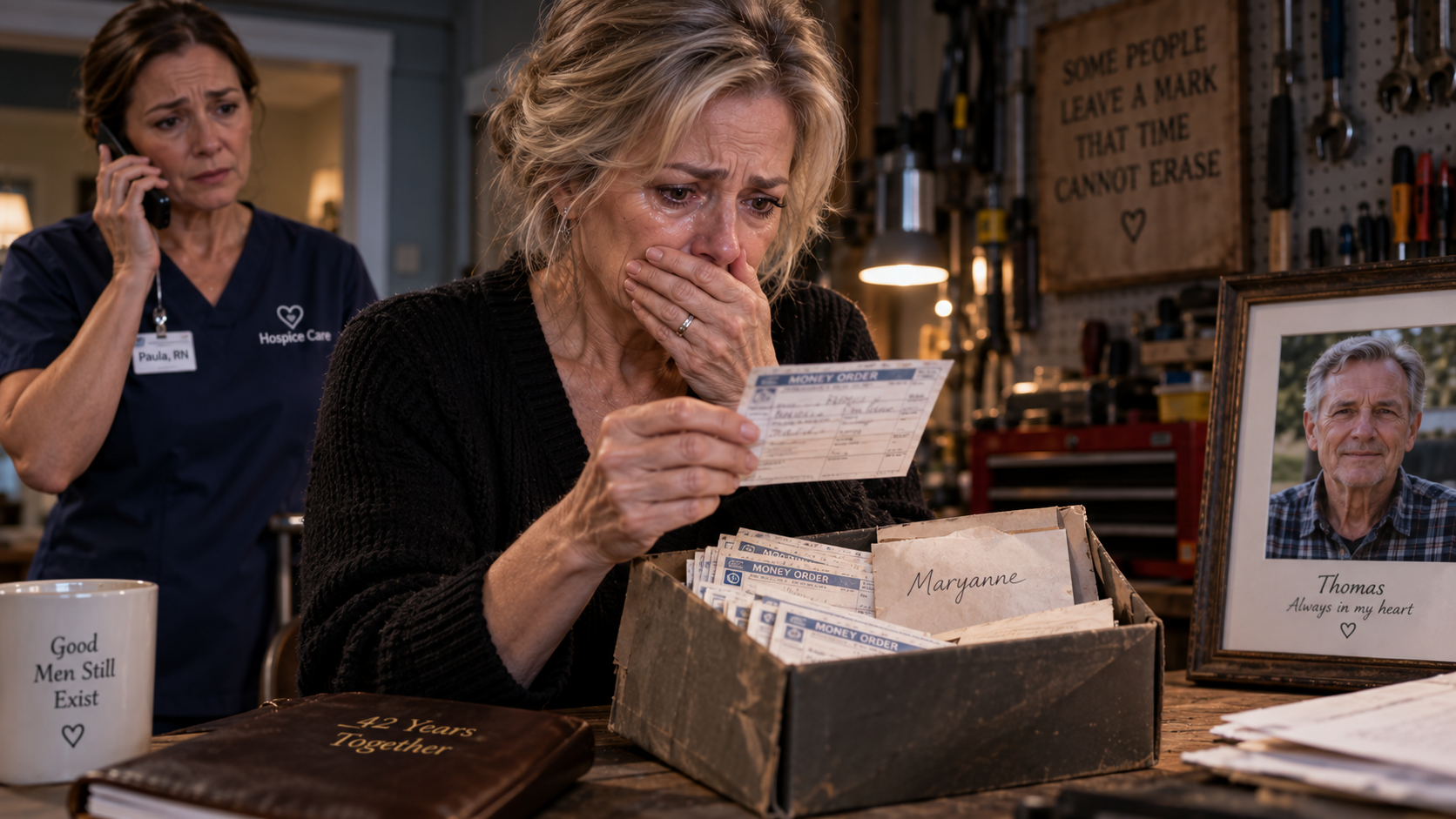
We also reviewed the money orders. They covered roughly fourteen years of irregular contributions toward insurance, taxes, and repairs, not a second household living comfortably on my ignorance. Maryanne provided old receipts, and the earlier support records showed that Thomas had paid child support separately while Aaron was young. “He paid what the order required,” she said. “Being his father was the part nobody could collect for us.”
Knowing the sums were modest did not make the secrecy modest. I remembered postponing work on our own porch because Thomas said we should be careful with money. “Could I have agreed to help her keep her home?” I asked my sister. “Maybe. I never got to find out what kind of woman I would have been if he’d told me the truth.”
Six weeks after Aaron’s visit, my sister drove with me to Duluth. Maryanne opened the blue house’s front door before we reached the steps. The paint was faded around the handle, and one porch post had been patched with wood that didn’t quite match. There was nothing grand about it, which somehow made the whole thing sadder.
“I wasn’t sure whether to put the kettle on,” she said. “Tea would be good,” I answered. We sat at a table scarred by years of ordinary use, with Aaron beside the window. Maryanne asked whether I wanted to see photographs, and I said, “Not all of them today.”
She brought just one: Aaron at eight, holding a model boat. Thomas had made it during one of his visits. I recognized the little brass fittings because there was a tin of them in our workshop. “He promised he’d come back and help me sail it,” Aaron said. “He didn’t, but Mom figured out how the rudder worked.”
I looked at Maryanne then, not as a rival but as another woman who had been left to finish something Thomas started. “I wish you had called me,” I said. “I wish I had, too.” That was all either of us could honestly offer. We did not become friends over one pot of tea.
The legal work took months. I would not surrender an asset out of shame, and I would not use it to frighten Maryanne. “I want this handled at a fair value, with her right to stay protected,” I told Elena. “Not a punishment price and not a gift I’m pressured into making.” An independent appraisal accounted for the property’s condition and the restrictions on Thomas’s share.
“I’d like to buy that share from the estate,” Aaron eventually told me. “I have some savings, and I’ve spoken to the bank about the rest.” His adviser reviewed what he could afford, and each side had separate legal advice. “Mom’s right to stay needs to be protected in the transfer,” he added. I agreed; nothing would change hands on the strength of a kitchen-table promise.
The sale proceeds went into the estate, and the eventual distribution to me followed the ordinary work of paying valid expenses and settling the accounts. The lawyers, appraisal, and title work cost real money. I hated that some of it was necessary because Thomas had made secrecy easier than preparation. When Aaron apologized for the expense, I stopped him. “You didn’t create this paperwork by existing.”
I used part of what I received to repair my own porch. There was no ceremony about it, just two workmen, a stack of lumber, and a bill I paid without asking a dead man whether we could afford it. My sister stood beside me when they finished. “Are you happy with it?” she asked. I said, “I’m happy I chose it.”
Grief became harder before it became easier. At the support group, I finally said, “I miss him, and I’m furious with him.” A woman across the room nodded. “You can do both,” she said. I cried so hard at that simple permission that someone moved the tissue box closer without interrupting me.
“Was any of it real?” I asked my sister one afternoon. “The good parts, I mean.” She set her cup down. “I think you know some of them were, and that’s what makes this so hard.” There had been tenderness in our marriage, and ordinary loyalty, and this enormous deliberate absence of truth. None of those things canceled the others, however badly I wanted one neat answer.
Once, sitting alone in the workshop, I read Thomas’s letter again. “You let me take care of you without letting me know you,” I said aloud. There was no answer from the tools or the peppermint tin. I folded the letter and kept it, not because it excused him, but because I was done throwing away the parts that made me uncomfortable.
Aaron and I found a cautious way to stay in touch. He sent a photograph when his daughter finished her nursing course, then asked whether that had been too much. “No,” I said. “I’d rather you ask than decide for me.” Neither of us called the other family, but we stopped calling every conversation a discussion about the estate.
One year after Paula’s call, Aaron came to visit again. This time, he asked first and arrived in daylight. He brought his mother’s extra tomato seedlings and a photograph of the blue house after its porch had been repaired. “She says you don’t have to send anything back,” he told me. “She’s finally learned that people can give you something without creating a bill.”
I laughed, and then I cried a little, and he stayed where he was instead of trying to fix it. We ate lunch on my repaired porch. He told me about his work, and I told him I had finally turned the front bedroom back into a bedroom. Neither of us asked the other to say something comforting about Thomas.
Before he left, I showed him the copy I had made of the old photograph. The original was back with Maryanne, where I felt it belonged. Under my copy, I had written all three names: Thomas, Maryanne, Aaron. “No ‘before Ruth’?” he asked quietly. “No,” I said. “Your lives weren’t a footnote to mine.”
After his car disappeared, I put the photograph beside my wedding album in the drawer. I did not know whether I would ever forgive Thomas completely, and I had stopped setting myself a deadline. Paula’s word—relieved—no longer sat on my chest the way it had that first afternoon. His relief had belonged to him; the rest of my life belonged to me, and I no longer had to keep his secrets to prove that I had loved him.