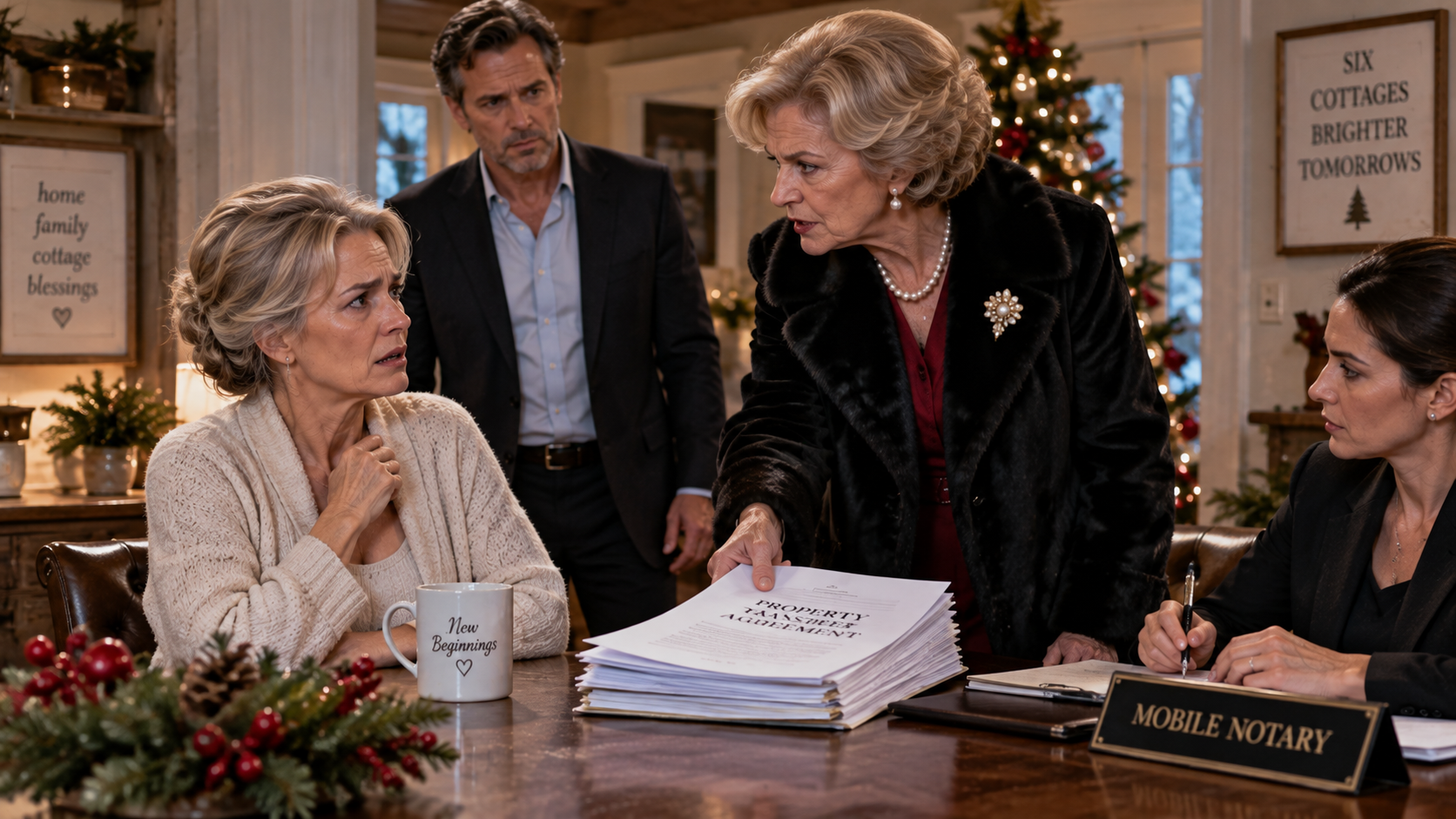
Priscilla met me at her office the following morning, and I brought everything: the trust documents Beatrice had tried to have notarized, Warren’s business card, and a printout of the text I’d seen on Marcus’s phone. She read through it all methodically, her expression giving nothing away until she finally set the papers down.
“I want to be direct with you,” she said. “These documents, as drafted, would have given Marcus co-trustee status and primary beneficiary rights over a holding company containing your cottages, effective immediately upon signing, regardless of what happens to your marriage afterward. This wasn’t retirement planning. This was designed to move ownership before you had time to reconsider.”
“Could they have actually done it? If I’d signed?”
“Completely,” Priscilla said. “Which is exactly why it matters that you didn’t.”
I asked her to check something else that had been bothering me since the kitchen incident: whether Marcus had made any other attempts to access my accounts or property records before that night. Priscilla’s investigator found the answer within a week, and it was worse than I expected. Marcus had contacted the property management company on Tybee Island twice in the two months before our wedding, posing as my fiancé and requesting financial statements “to help plan our future together.” The company, following their own privacy policy, had declined both times, but the attempts were documented.
I confronted him with that information in our living room, Priscilla’s report open on the coffee table between us. “You tried to get my financial statements before we were even married,” I said. “That’s not curiosity, Marcus. That’s reconnaissance.”
“I wanted to know what I was marrying into,” he said, and for the first time, his voice carried something like genuine shame rather than defensiveness. “My first marriage fell apart partly over money, over never really knowing where we stood. I told myself I was being responsible. I can hear now how that sounds.”
“It sounds like you married me the way you’d research an investment,” I said. “Not the way you’d love a person.”
He didn’t argue with that either. Over the following days, I learned that Beatrice had pushed hard for the marriage timeline to move faster than Marcus had originally wanted, specifically once she learned, through his careless mention, that I owned income property “somewhere down South.” She’d been the one to find Warren, a notary willing to make house calls without asking too many questions about the circumstances.
I filed for an annulment rather than a divorce, given how recently we’d married and the fraudulent intent Priscilla believed we could reasonably argue given the documented attempts to access my finances before the wedding even took place. Marcus’s attorney initially pushed back, but the property management records, the text message, and Warren’s own willingness to testify that he’d been hired specifically because a previous notary had “asked too many questions” gave Priscilla more than enough leverage.
The annulment was granted four months later, quietly, without the drawn-out battle Marcus’s attorney had initially threatened. I kept everything: the cottages, my accounts, the modest savings I’d built over decades of careful, private management. Marcus moved out within the month, and Beatrice, notably, never called me again once the legal proceedings made clear there would be no cottages, no trust, and no access to anything she’d hoped to help her son claim.
I won’t pretend the months that followed were easy. I had genuinely loved Marcus, or at least the version of him I’d believed existed for nearly two years, the man who remembered I disliked lilies and brought lemon pie instead of chocolate. Losing that belief hurt in a way that felt disturbingly similar to grief, even though the marriage itself had lasted only a matter of months.
I started seeing a therapist named Dr. Renwick that spring, someone who specialized in financial exploitation within relationships, a category I hadn’t fully understood applied to my situation until she named it plainly during our first session. “What happened to you wasn’t romantic disappointment,” she told me. “It was a calculated attempt to access your assets, dressed up as courtship. Those are different things, and you’re allowed to grieve them differently too.”
That distinction helped more than I expected. I grieved the version of companionship I thought I’d found, the quiet comfort of not being alone in a house that had felt too still for eleven years. I did not grieve Marcus himself, once I understood clearly what he and his mother had actually been building toward from the very beginning.
I finally took that trip to Tybee Island that Christmas, the one I’d originally planned to share with Marcus, except I went alone, driving down the coast highway with the radio on and no one beside me needing an explanation for anything. I stood on the porch of the largest cottage, the one I’d once imagined handing him the keys to, and instead I simply unlocked the door myself and let myself in.
My daughter, Rosalind, flew down to join me for New Year’s, along with her husband and their two children, filling the small pastel house with noise and sand tracked in from the beach and the particular chaos of small grandchildren discovering the ocean for the first time. Watching them from the porch swing, coffee in hand, I thought about how close I’d come to signing away not just property, but the last piece of independence my grandfather had built for me decades before Marcus ever walked into that charity book drive.
I updated my estate plan that spring with Priscilla’s help, structuring the cottages into a trust of my own design, one that named Rosalind as successor trustee and included language specifically addressing what should happen if I ever remarried, a clause I never imagined I’d need to write but was grateful, in hindsight, to have.
One year after that rainy Tuesday evening in my kitchen, I hosted a small dinner at the same table where Beatrice had once spread her leather folder full of documents. Rosalind was there, along with two old friends from the gallery and Warren Miller, of all people, who had become an unexpected friend after everything settled, occasionally stopping by for coffee and, once, bringing his own wife to meet the woman he still called “the smartest signature I never got.”
“I think about that night sometimes,” Warren admitted over dinner. “I’ve notarized thousands of documents in my career. That was the only time I genuinely worried about who I was working for.”
“You did the right thing,” I told him. “You were the only person in that room who asked me a real question.”
I raised my glass that evening, not to Marcus, not to what I’d lost, but to the six small cottages that had quietly supported me for decades without ever asking anything of me in return, and to the grandfather who had given them to me long before I understood exactly how much protection they would one day provide. The rain had stopped outside sometime during dinner, and through the kitchen window, the sky over my own quiet, permanently mine house had finally cleared.