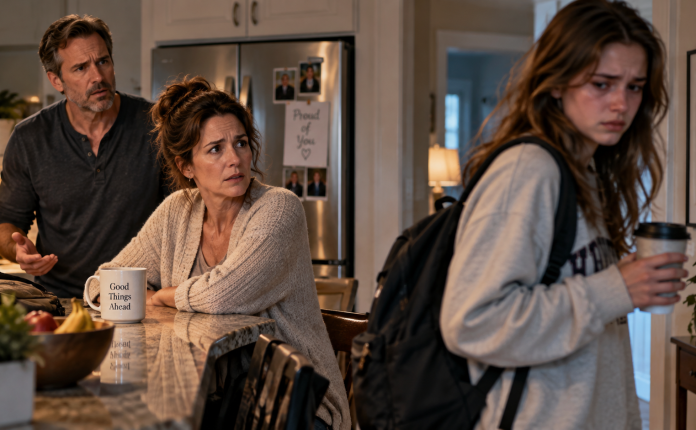
The patrol car arrived within ten minutes, followed shortly by a detective named Gordon Reyes, who recognized the name Daniel Ostrowski the moment I said it aloud. “That case never actually closed,” he told me, standing in my kitchen while a second officer went to open the basement door. “Ostrowski skipped bail eighteen months ago, right before his trial date. He’s been on a fugitive list ever since. Good catch, ma’am. Most people wouldn’t have recognized him after all this time, especially with the different hair color.”
Tyler stood frozen in the doorway to the kitchen as the officers brought Daniel up from the basement in handcuffs, his face streaked with tears, still insisting there had been some kind of terrible mistake. “Tyler, tell them,” he pleaded. “Tell them who I really am.” “I don’t know who you really are,” Tyler said, his voice hollow. “That’s kind of the problem right now.”
Detective Reyes confirmed the identification through fingerprints taken at the station later that evening, and it matched exactly: Daniel Ostrowski, twenty-three years old, wanted on charges of armed home invasion, aggravated assault, and bail jumping. He had spent the eighteen months since fleeing living under a fabricated identity, complete with a fake transcript that had gotten him provisionally enrolled at Tyler’s university under the name “Corey Whitfield,” a name Reyes later confirmed belonged to a real person, a college student in Nebraska whose identity Daniel had partially stolen to construct his cover story.
Reyes explained that Daniel had likely chosen Tyler’s university specifically because its enrollment verification process relied heavily on transferred transcripts rather than in-person identity checks, a loophole he’d apparently researched and exploited before. “This wasn’t impulsive,” Reyes told us. “He built this identity carefully over months. The volunteer work at the shelter, the environmental science classes, even a fabricated LinkedIn profile with fake references. He wasn’t just hiding. He was building a whole new person to hide inside.”
“He built an entire life around a lie,” Tyler said that night, sitting at the kitchen table with his untouched pot roast growing cold in front of him. “The animal shelter. The environmental science major. All of it. Was any of it even real?” “Some details probably were,” I told him gently. “People who construct false identities usually keep pieces of truth mixed in, because it’s easier to maintain that way. That doesn’t mean any of what he showed you was really him, though. A relationship built on a fabricated name can’t actually be with a real person, Tyler, because the person you thought you knew doesn’t exist.”
My sister, Renata, drove up from Cedar Falls two days later, and seeing her sit across from Tyler at that same kitchen table, gently answering his questions about what Daniel had actually done to her that night three years earlier, was one of the hardest and most necessary conversations I’ve ever watched happen in my house. She didn’t spare him the details, but she also didn’t make him feel foolish for having fallen for someone capable of hiding something so monstrous behind an ordinary, likable exterior.
“He knocked on my door claiming his car had broken down and asking to use my phone,” Renata told Tyler quietly. “I almost didn’t answer. Something about him felt off, but I told myself I was being paranoid, that a person that polite couldn’t possibly mean me harm. He was inside within thirty seconds of me opening that door, and it was almost an hour before the police arrived. He was charming to me too, at first, before all of it happened. That’s usually how it works. The charm isn’t fake exactly. It’s just aimed, deliberately, at getting what he wants.”
Tyler asked her the question I think had been weighing on him since the arrest. “Do you think he actually cared about me at all? Even a little?”
Renata considered that carefully before answering. “I think people like that can feel something resembling affection,” she said. “But it’s always secondary to what they need from the situation. If caring about you made his lie easier to maintain, he probably did feel something. If it had gotten in the way of his safety, I don’t think it would have survived the conflict.”
Daniel’s case moved through the court system over the following ten months, this time with considerably tighter security given his history of fleeing. Faced with the original home invasion charges, the new bail jumping charge, and an additional identity theft and fraud charge related to the stolen university enrollment, his attorney negotiated a plea agreement rather than risk trial on the combined weight of everything. The prosecutor, a sharp, no-nonsense woman named Priscilla Okafor, made clear during our one meeting that she intended to push for the maximum sentence available given his flight risk and the elaborate nature of his deception.
“Men like this count on people giving up before the process finishes,” she told Renata and me in her office. “He’s already proven once that he’ll run the moment things get difficult for him. The court needs to understand that pattern clearly before any sentencing decision is made.”
He was sentenced to fourteen years, with the judge specifically noting his continued deception and impersonation as an aggravating factor rather than a mitigating one. During his sentencing hearing, Daniel attempted one final version of the charm that had apparently worked on so many people before, turning toward the gallery and speaking directly, his voice soft and practiced. “I never wanted to hurt Tyler. I really did care about him, in my own way.” The judge cut him off before he could continue. “Your own way apparently involved a stolen identity and a fugitive status you maintained by deceiving an entire family. This court isn’t interested in the version of caring that requires this much dishonesty to sustain itself.”
Tyler struggled considerably in the months following the arrest, not just with the shock of having been deceived so completely, but with a harder, quieter grief over losing a relationship that had genuinely meant something to him, even if the person on the other side of it had been constructed entirely from lies. He started seeing a counselor at his university that fall, a specialist named Dr. Whitfield who focused on trauma related to deception and identity fraud in relationships, a niche Tyler hadn’t known existed until he needed it.
“You’re allowed to grieve what you thought you had,” Dr. Whitfield told him during a session I sat in on during a visit home. “The feelings you had were real, even though the person generating them wasn’t who he claimed to be. That’s a strange, specific kind of loss, and it deserves to be taken seriously, rather than dismissed just because the object of those feelings turned out to be fabricated.”
I worried, in the weeks right after the arrest, that Tyler might carry some resentment toward me for how I’d handled it, locking Daniel in the basement rather than finding some gentler way to confirm my suspicions first. But when I finally asked him about it directly, months later, sitting on the back porch with two mugs of coffee going cold between us, his answer surprised me.
“I was angry that night,” he admitted. “Really angry, actually, for about a week afterward. But you didn’t have time to be gentle, Mom. You recognized a wanted fugitive sitting at our dinner table, someone who had already hurt Aunt Renata badly once before. You did the only thing that actually made sense in that moment, even if it didn’t feel fair to me at the time.”
“I think about it sometimes,” I told him honestly. “What would have happened if I’d waited, tried to confirm it more carefully, given him the benefit of the doubt the way I wanted to for your sake. I don’t think that version of that afternoon ends anywhere good.”
Renata and Tyler grew unexpectedly close over the following year, bonded by a shared understanding of what Daniel was capable of hiding behind an easy smile. She started including him in her semi-regular visits, teaching him some of the practical safety habits she’d adopted since the invasion, checking window locks twice, trusting instinct over politeness, verifying details rather than accepting a good story at face value. Slowly, over long conversations at that same kitchen table, Tyler began trusting his own judgment again, cautiously testing it against smaller, safer decisions before he ever considered dating again.
He also spent time that year rebuilding his sense of his own instincts, something Dr. Whitfield described as one of the harder parts of recovering from this particular kind of betrayal. “It’s not just about trusting other people again,” she explained to him. “It’s about trusting yourself again, believing that your own judgment is worth something, even though it was deceived this time by someone who put real effort into deceiving it.”
By spring, Tyler had returned to campus with a renewed, careful independence, joining a peer support group for students who had experienced relationship deception or identity fraud, a group he told me later was larger and more active than he ever would have guessed before his own experience made him look for it. He said hearing other students describe similarly elaborate deceptions, fabricated names, invented backstories, entire constructed personalities, helped him stop feeling uniquely foolish for having believed Daniel so completely.
One year after that Sunday dinner, Tyler came home for another visit, this time introducing me to someone new, a quiet, steady young man named Marcus who worked at the campus library and had absolutely nothing to hide, a fact Tyler had apparently verified thoroughly and without shame before ever bringing him to meet me, including a conversation early on where he’d simply asked Marcus directly about his background, his family, and his history, rather than waiting to be surprised by anything later.
“I told him about Daniel on our third date,” Tyler admitted to me in the kitchen while Marcus helped Renata set the table in the other room. “I figured if he couldn’t handle hearing that story, or if it made him defensive instead of understanding, that would tell me everything I needed to know early.”
“And?” I asked.
“He just asked how I was doing now,” Tyler said. “Not why I fell for it, not any of the things people sometimes ask that make it sound like it was my fault. Just how I was doing now. I think that’s when I actually started trusting him.”
Watching Tyler and Marcus together at the same table where everything had unraveled a year earlier, passing dishes back and forth with an easy, unremarkable comfort, I noticed something different in the way Tyler carried himself, more careful, more grounded, but no less capable of trusting someone fully when the person actually deserved it. He laughed more easily than he had in the months right after the arrest, and when Marcus reached over to refill his water glass without being asked, Tyler didn’t flinch or overthink the gesture the way he might have six months earlier.
“Thank you for recognizing him,” Tyler told me quietly that evening, doing dishes together after Marcus and Renata had gone to sit on the porch. “I know it cost us a hard year. But it would have cost a lot more if you hadn’t.”
“I keep thinking about how close it came to going differently,” I admitted. “If I’d looked away for one more second before he turned his head. If the light in the kitchen had been dimmer. If I’d doubted myself and said nothing at all.”
“But you didn’t,” Tyler said. “You said something. That’s the part that matters now.”
Marcus told me something himself, later that same visit, while we stood together at the sink drying dishes Tyler had already washed. “He was pretty upfront about all of it early on,” Marcus said. “Some guys would have made it a bigger dramatic reveal, or waited until things got serious to bring it up. He just told me plainly, over coffee, like it mattered to him that I knew the full picture before I decided anything.”
“Did it scare you off, even a little?” I asked.
“Honestly, it made me trust him more,” Marcus said. “Anyone can say the right things early in a relationship. Watching someone actually rebuild trust in themselves after something like that, and still be willing to be honest and a little vulnerable about it, told me a lot more about who he actually is.”
Renata joined us in the kitchen a few minutes later, drying her hands on a dish towel, and the three of us ended up talking for almost an hour about things that had nothing to do with Daniel at all: Marcus’s job at the library, Renata’s plans to finally repaint her kitchen that summer, small ordinary conversations that felt, given everything, like their own quiet kind of victory.
I also spent part of that year doing something I hadn’t expected: speaking, briefly and anonymously, to a local news reporter working on a story about fugitive identity fraud after Daniel’s case became a small regional headline. I didn’t want our names used, and the reporter respected that, but I wanted other parents to hear one specific thing clearly, that trusting your gut in an uncomfortable moment isn’t the same as being paranoid or unkind, and that a single, split-second recognition can matter more than any amount of politeness ever will. Two other families reached out afterward, quietly, through the reporter, describing situations that hadn’t gone nearly as well, and hearing their stories made me grateful, in a way I hadn’t expected, for how that Sunday afternoon had actually ended.
By the time Tyler graduated two years later, Marcus sitting proudly in the audience beside Renata and me, the entire ordeal had settled into something closer to memory than open wound. Tyler gave a short toast that evening, his voice steady in a way it hadn’t been in a long time. “A lot of people helped me learn who to trust again,” he said, raising his glass toward our small table. “I’m grateful every single day that one of them recognized exactly who not to.”
I still keep that memory close, the serving spoon in my hand, the cold that spread through me the instant I recognized his face across my own kitchen. It taught our whole family something none of us had asked to learn, but that all of us carry now, quietly, gratefully, into every new person we let sit at that table.