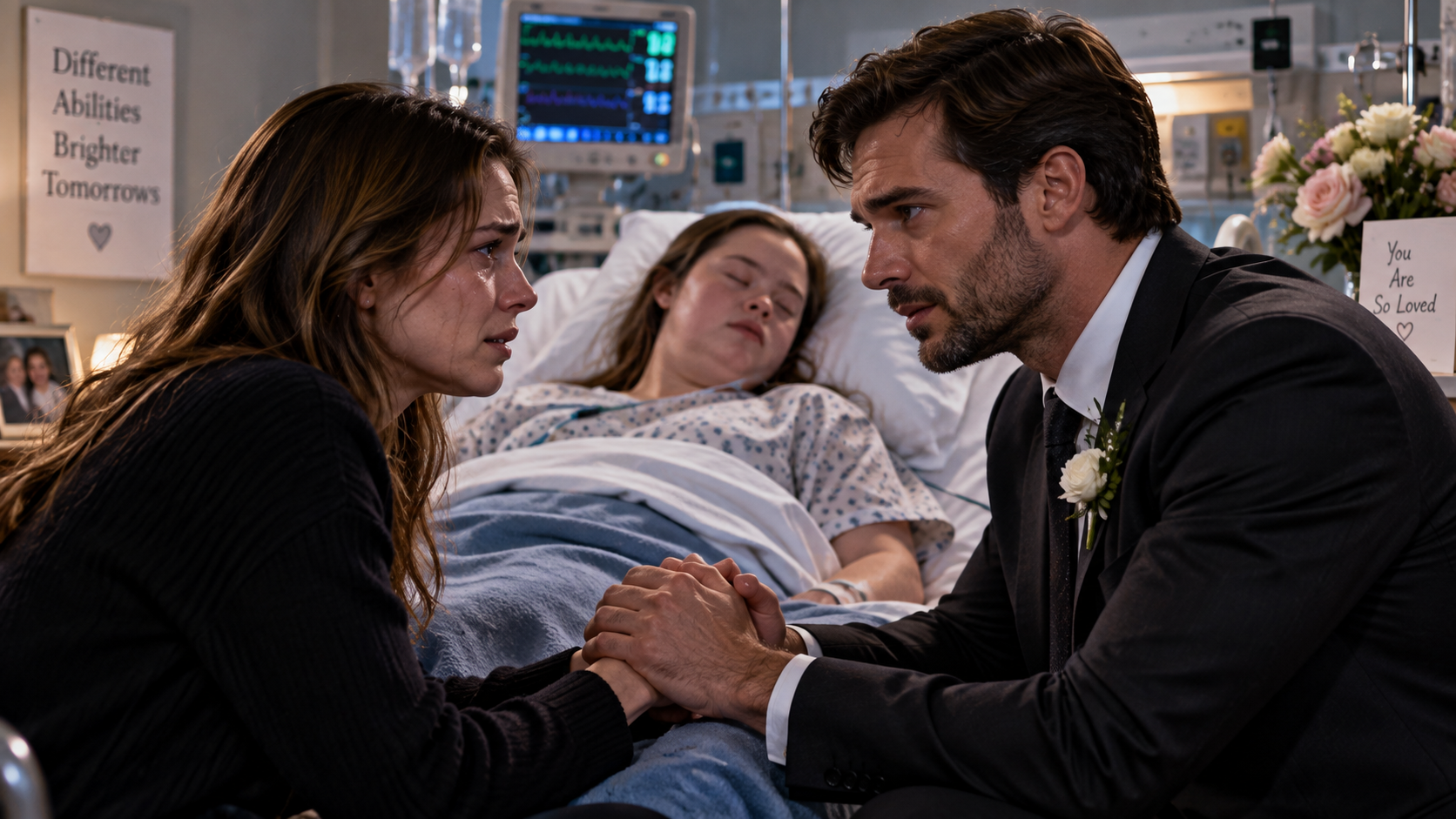
The doctor’s face gave nothing away as he approached, and for a moment I thought my knees might actually give out beneath me. “She made it through surgery,” he said finally, and the relief that broke through my chest nearly buckled me anyway, just from a different direction. “Both babies are stable in the NICU. Rosie lost a significant amount of blood and she’s not out of the woods yet, but she’s fighting, and right now, that fight is going in her favor.”
Ben sank into the nearest chair, his hands covering his face, and I sat down beside him, still holding the letter, still trying to reconcile everything I’d just learned with the fear I’d been carrying for the last several hours. Neither of us spoke for a long time. There didn’t seem to be words big enough for what we’d both just survived, in completely different ways, within the same terrifying hour.
Rosie remained in the ICU for four more days, drifting in and out of consciousness while doctors monitored her recovery closely. The twins, a boy and a girl we would eventually name Caleb and Josephine, stayed in the NICU under careful watch, both born several weeks early but responding well to treatment. I spent those four days shuttling between the ICU and the NICU, holding Ben’s hand through the worst of it, neither of us quite ready to discuss the letter directly again, though it sat between us in every silence.
On the fifth day, Rosie finally opened her eyes fully and recognized us both, her first coherent words a soft, exhausted joke about how she hoped somebody had already named the babies because she certainly hadn’t had the chance. Ben cried harder in that moment than he had during the entire ordeal, gripping her hand like he might lose her all over again if he let go too quickly.
It took another two weeks before Rosie was strong enough to have the conversation the three of us clearly needed to have, sitting together in her hospital room while the twins slept in bassinets nearby. She reached for the letter herself, running her fingers over her own handwriting like she was reading an old diary entry rather than something she’d written with her own hospital bed in mind.
“I meant every word,” she said simply. “I’ve always known about you two. I decided a long time ago that knowing wasn’t going to stop me from wanting the family I wanted. Ben chose me every day since our wedding. That was never in question for me.”
“Rosie,” I started, my voice cracking, “I never wanted you to feel like you were settling for anything. You deserve someone who chose you completely, without complications.”
“I got exactly that,” she said, squeezing Ben’s hand. “The complication was something I decided to handle my own way, on my own terms. That letter wasn’t a burden I was placing on either of you. It was me making sure that if something happened to me, you two wouldn’t spend the rest of your lives torturing yourselves over feelings that existed before any of this even started.”
Ben spoke carefully, choosing his words with more precision than I’d ever heard from him. “I love Rosie,” he said, looking directly at me. “That’s not a lie, and it never has been. What I felt for you years ago was real too, but it’s not the same thing, and it’s not something either of us needs to act on now, regardless of what that letter says. Rosie’s the one I built a life with. That doesn’t change just because she wrote down something true about our history.”
I sat with that for a long moment, watching my sister, exhausted and pale but undeniably present, undeniably alive, holding her husband’s hand with the same certainty she’d shown since the day she announced their engagement. “I don’t want anything to change either,” I finally said. “I just needed to hear both of you say it clearly, out loud, so none of us are carrying secrets into this family anymore.”
The months that followed were a slow, careful process of rebuilding normalcy, learning to be an aunt to two newborns while also learning how to exist honestly within a family dynamic that had just been cracked wide open and, somehow, put back together stronger for the honesty. Rosie’s recovery took the better part of four months, physical therapy and careful monitoring for complications from the blood loss, but she approached all of it with the same steady, unshakeable determination she’d shown her entire life, the same determination that had once made her stand up to classmates who underestimated her simply because of her diagnosis.
I started seeing a therapist that spring, someone named Dr. Halloway who specialized in family systems and complicated grief, because even though Rosie had survived, I found myself needing to process an entire cascade of emotions I hadn’t expected: guilt over feelings I’d buried for years, gratitude for a sister whose generosity of spirit still occasionally left me speechless, and a strange, disorienting grief for a version of honesty our family could have had years earlier if any of us had simply talked to each other sooner.
“You’re allowed to feel complicated things about complicated situations,” Dr. Halloway told me during one of our early sessions. “The fact that your sister handled this with grace doesn’t mean you’re required to process it painlessly yourself. Give yourself room to work through what actually happened here, not just the version that makes for the easiest resolution.”
That permission helped more than I expected. I spent real time examining my own history with Ben, acknowledging honestly to myself what I had felt years earlier without letting that acknowledgment threaten what my sister had built, what she had chosen for herself with clear eyes and full knowledge of everything at stake.
Ben, for his part, made a point of including me fully in the twins’ lives without any of the careful distance either of us might have instinctively created after that hospital hallway conversation. He asked me to be Caleb and Josephine’s godmother, a request Rosie had apparently suggested herself months before the birth, long before any of the hallway conversation had ever become necessary.
“She trusts you completely,” Ben told me the day he asked. “She always has. That letter wasn’t about doubt, Angela. It was about making sure nobody was left guessing if the worst had happened.”
I accepted, and standing at the twins’ baptism six months later, holding baby Josephine while Rosie held Caleb beside Ben, I felt something settle inside me that I hadn’t fully realized had been unsettled for years. There was no lingering tension in that church, no unspoken elephant hovering over every family gathering. Rosie had made sure of that, in the most Rosie way possible: directly, honestly, and without an ounce of the self-doubt other people so often projected onto her because of her diagnosis.
Our parents, once they learned the full story months later, reacted with the same generous acceptance Rosie herself had modeled from the beginning. My mother cried, mostly from relief that everything had been handled with such care rather than falling apart the way she’d initially feared upon hearing there’d been “a letter” at all. My father simply hugged Rosie for a long time, telling her he’d never been prouder of the way she handled hard things, a sentiment I found myself agreeing with completely.
One year after that terrifying afternoon in the hospital hallway, our entire family gathered in Rosie and Ben’s backyard for the twins’ first birthday, balloons tied to every fence post, Caleb and Josephine smashing cake with the gleeful abandon only one-year-olds can manage. Rosie sat in a lawn chair nearby, fully recovered, laughing at something Ben had said, her hand resting easily in his the way it always had since their wedding day.
I sat beside them for a while, watching my niece and nephew cover themselves in frosting, thinking about that letter still folded carefully in my nightstand drawer at home, a document I’d never need to reference again but couldn’t quite bring myself to throw away either. It represented something important now, not a secret or a threat, but proof of exactly how much my sister had been willing to do to protect the people she loved, even from a hospital bed she wasn’t certain she’d walk away from.
“Thank you,” I told Rosie quietly, while Ben chased Caleb across the yard to rescue a wayward balloon. “For trusting us enough to write that. For trusting me enough to hear it.”
“I never doubted either of you,” Rosie said simply, watching her husband and son with an easy, contented smile. “I just wanted to make sure you never had to doubt yourselves.”
Watching her in that moment, completely herself, completely secure in the life she had built and fought to keep, I understood something I don’t think I’d ever fully appreciated before that hospital hallway conversation: my sister had never needed anyone’s permission or pity to build an extraordinary life. She had simply built one, deliberately and with full clarity about exactly what she wanted, and everyone else, myself included, had simply been fortunate enough to be invited into it.