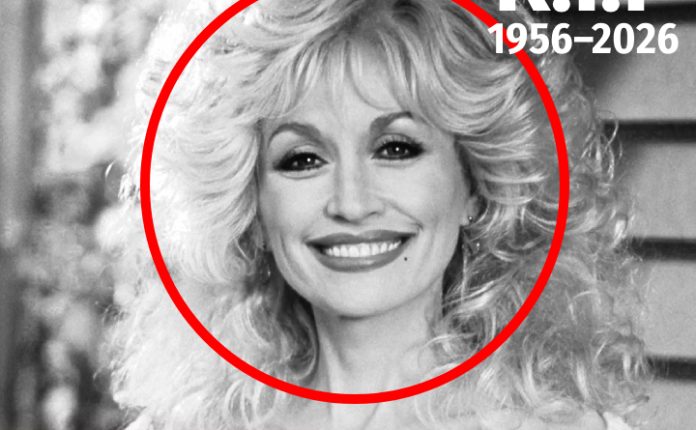
The nine-time Emmy winner known as the “Sultan of Sequins” spent six decades turning American entertainers into living fantasies. He died Monday in Palm Springs.
PALM SPRINGS, Calif. — September 15, 2026
Bob Mackie, the costume and fashion designer whose sequined, feathered, beaded and gloriously unsubtle creations defined what a star was supposed to look like for more than half a century, has died. He was 87.
His death was announced Monday in a statement posted to his official Instagram account, which said that Mackie had lived his eighty-seven years to the fullest and had fulfilled his lifelong ambition of working as a fashion and costume designer — the only thing, the statement noted, he ever wanted to do. It closed by saying that his designs would go on bringing beauty into the world.
He died in Palm Springs, California. His publicist told the Associated Press that the cause was pneumonia.
The response was immediate and enormous, the kind of outpouring usually reserved for the performers a designer stands behind rather than the designer himself. But Mackie was never quite a behind-the-scenes figure. For fifty years his name was spoken in the same breath as the women who wore his work, and in many cases the garment became as famous as the person inside it.
“Good Nite Sweet Prince”
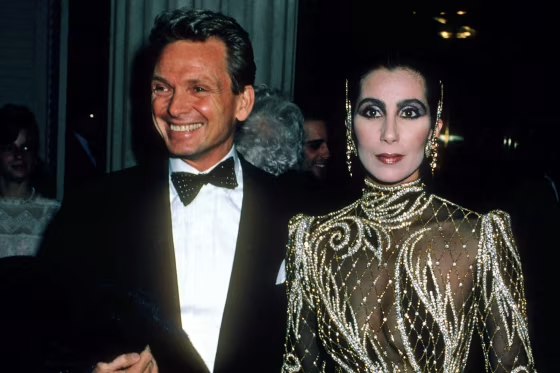
Cher, whose public image Mackie arguably invented, posted on Monday that her dear Bob had gone up to heaven, adding that, knowing him, he had taken sequins, beads and his sketch pad along with him. She signed off with a line borrowed from Hamlet: “Good nite sweet Prince.”
Carol Burnett, 93, for whom Mackie designed every costume across eleven seasons of television, wrote that sadness did not come close to describing what she felt, and that she had loved him very much. She went on to make a distinction that gets at the heart of why Mackie was unusual: there are fashion designers who don’t do costumes, and costume designers who don’t do fashion. Mackie, she said, did all of it, and there was no one else like him.
Sabrina Carpenter, who wore his archival pieces on tour and on award-show stages, called herself “terribly devastated” on her Instagram story, saying she felt lucky to have met him and that his one-of-a-kind creations had brought happiness and confidence into her world.
Tributes arrived from across generations of performers and designers. Kristin Chenoweth called him a legend; Isaac Mizrahi wrote a single word, heartbroken; Alyssa Milano described him as one of the best there ever was. The Canadian model Coco Rocha wrote that “his clothes had wit, drama, fantasy and joy.”
Fern Mallis, the former executive director of the Council of Fashion Designers of America and the founder of New York Fashion Week, had summed up his influence in an interview years earlier, saying that everyone who walks a red carpet or designs for one owes him a debt whether they realize it or not, and calling him a treasure and one of a kind.
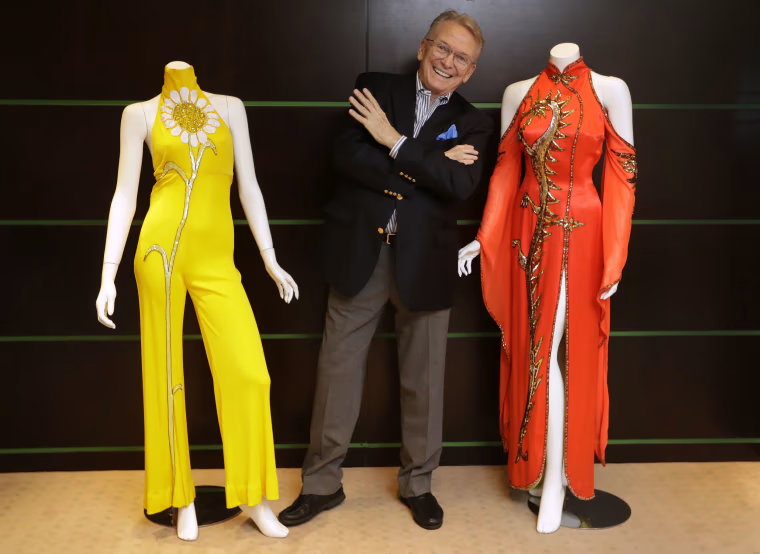
A Boy From Monterey Park Who Loved the Movies
Robert Gordon Mackie was born on March 24, 1939, in Monterey Park, California, a modest suburb east of downtown Los Angeles, to Charles Robert Mackie, who worked at Bank of America, and Mildred Agnes Smith Mackie.
He was, by his own telling, a movie-mad child in a movie-mad family. His mother and sister shared his love of the screen, and as a boy he developed an outsized fascination with Carmen Miranda — the Portuguese-born Brazilian performer whose towers of fruit and ruffled sleeves prefigured a great deal of what Mackie would later put on stage. He was drawn early to the richness and formality of ballet, and to the glitzy wardrobes of the variety-show and pop stars of the 1950s and early ’60s. Those were his textbooks.
He attended Rosemead High School, then Pasadena City College, then the Chouinard Art Institute, the Los Angeles art school that trained a generation of Disney animators and designers. He wanted to draw for the movies, and he got there faster than most.
Mackie began his career as a sketch artist for established film costume designers — the person who renders another designer’s ideas in ink and watercolor so a producer can approve them. It was an apprenticeship that put him in rooms he had no business being in at his age. One of the sketches he worked on as a young assistant became the most photographed dress in American political history: the flesh-toned, rhinestone-studded gown Marilyn Monroe wore to sing “Happy Birthday, Mr. President” to John F. Kennedy at Madison Square Garden in 1962. The dress was credited to Jean Louis. The 22-year-old who put it on paper went uncredited, and the anecdote followed Mackie for the rest of his life.
Between 1960 and 1963 he worked as a novice designer and assistant under Ray Aghayan at Paramount Studios. In 1961, while still at Paramount, he came to the attention of Edith Head, the most powerful costume designer in Hollywood and the winner of eight Academy Awards. Mackie later said that what Head taught him had less to do with designing than with managing producers, directors and actors — that her real genius was in public relations. It was a lesson he absorbed thoroughly. Few designers of his era were as comfortable in front of a camera, or as good at explaining their own work.
Vegas, and the Invention of the Mackie Look
The signature style arrived in 1966, when the singer and dancer Mitzi Gaynor hired Mackie to dress her Las Vegas revue and the television specials that followed. Gaynor’s act demanded clothes that could survive choreography under hot lights while still reading as spectacle from the back of a showroom: lavish gowns, astonishing headpieces, beading that caught every spotlight, and construction that let a performer actually move.
That combination — couture-level embellishment engineered for a working body — became the Mackie formula. In a 1969 NBC variety special, he put Gaynor in an early version of the sheer, strategically beaded “illusion” dress that he would spend the next fifty years refining and that the fashion industry would eventually rename the naked dress.
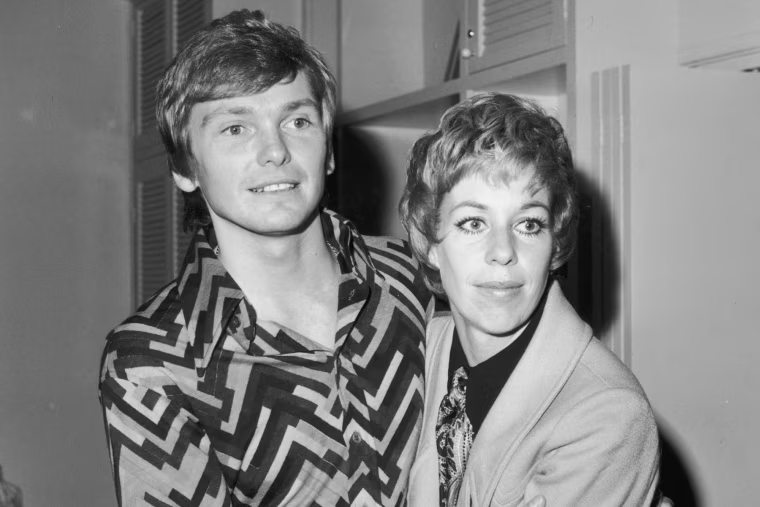
Carol Burnett saw Gaynor’s Vegas extravaganza and recruited Mackie for her new CBS variety show.
Eleven Years, 17,000 Costumes
The Carol Burnett Show ran from 1967 to 1978, and Mackie designed for every performer on it for the entire eleven-season run. Burnett once estimated that he produced more than 17,000 pieces for the program — an almost unimaginable output, executed at the pace of weekly network television, in which a designer had days rather than months to conceive, cut, sew and fit an entire hour of sketches.
The show also revealed a side of Mackie that his glamour work obscured: he was funny. He understood that a costume could carry a joke, and that the joke could land harder than the writing. His most famous creation for the program remains the “curtain rod” Scarlett O’Hara dress from the sketch “Went with the Wind” — a green velvet drapery gown lampooning Vivien Leigh’s in Gone with the Wind, worn with the curtain rod still horizontally lodged across Burnett’s shoulders. The audience’s reaction is one of the longest sustained laughs in the history of American television, and it belonged entirely to the costume.
In a 2024 onstage conversation with Burnett at the Newport Beach Film Festival, Mackie described the show’s ending as bittersweet, saying he had simply loved doing it and loved making the laughs happen. The two continued to work together long after the series wrapped, on specials with Plácido Domingo, Beverly Sills and Julie Andrews, and remained close until his death.
Cher: A Fifty-Year Collaboration
The most consequential meeting of Mackie’s life happened on the Burnett set in 1967, when a young guest star named Cher wandered over while he was working a loose thread on a beaded gown and told him she was going to have one of those someday. He would later recall that they became friends on the spot.
He was right about her instincts. Mackie said Cher already knew her own look when he met her — bell-bottoms, fur vests, quirky details she had assembled herself — and that she was never once intimidated by anything he put on her. Dressing her, he told Women’s Wear Daily in 2013, was not like dressing a regular person; it was “like dressing a crazy goddess,” sometimes Egyptian, sometimes biker.
He designed her costumes for The Sonny & Cher Comedy Hour, which began in 1971, and then for The Sonny and Cher Show in 1976–77, as well as for her tours, her music videos and her magazine covers. The weekly television exposure did something no runway show could: it made high-concept costume design a mass-market American spectator sport. Millions of people tuned in partly to see what Cher would be wearing.
The apex came on a night off. Mackie escorted Cher to the 1974 Met Gala — then a relatively sedate museum benefit, not the fashion circus it is now — and she chose, from his existing archive, the sheer beaded gown with white feathered sleeves and a feathered skirt. Mackie later recalled that the room went crazy, that he had never seen so many photographers materialize out of the shadows, and that the image ran in every newspaper the next morning and has been reprinted continuously for half a century since. Cher and the dress landed on the cover of Time magazine that year. Plenty of people were scandalized; some ripped her photograph off magazine covers. The naked dress, as a genre, starts there.
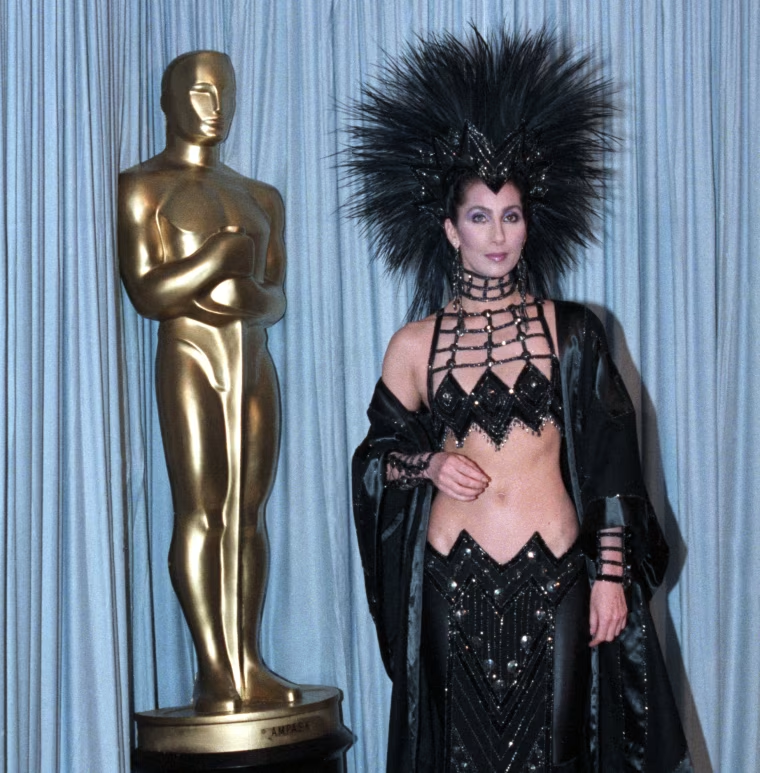
Twelve years later came the other defining Mackie-Cher moment. Passed over for an Oscar nomination for Mask, Cher arrived at the 1986 Academy Awards as a presenter in a black jewel-encrusted bra top, a low-slung skirt slit to the hip, and an enormous feathered Mohawk headdress. Cher has been blunt about the intent — the Academy had decided she wasn’t a serious actress, and this was her answer. Mackie’s recollection of the design meeting is characteristically economical: he asked whether it should have a loincloth, and she said yes. Jane Fonda reportedly begged her to wait until she was back in her seat so she could watch the room react.
Not every collaboration pleased him. Mackie was famously unenthusiastic about the sheer mesh bodysuit Cher wore in the 1989 “If I Could Turn Back Time” video — not because of the garment, which was his, but because of the setting, noting that her twelve-year-old son was playing bass a few feet away.
Everyone Else
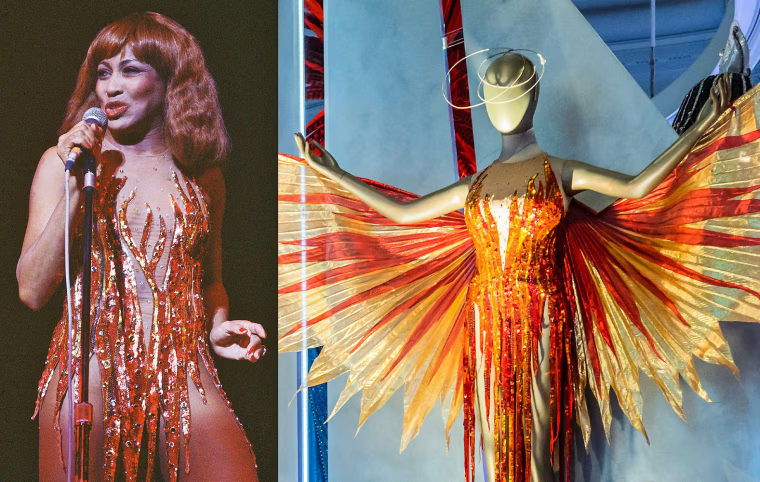
The client list reads like a census of twentieth-century American showmanship. Diana Ross, Tina Turner, Dolly Parton, Elton John, Barbra Streisand, Bette Midler, Liza Minnelli, Lucille Ball, Joan Rivers, Judy Garland, Whitney Houston, Madonna, RuPaul, Pink. Turner’s concert costumes — fringed, short, built to withstand two hours of full-throttle movement — are as much a part of her iconography as the songs.
On Broadway, Mackie dressed On the Town in 1971 and Moon Over Buffalo in 1995, and created costumes for Burnett in the revue Putting It Together, for Debbie Reynolds in Debbie in 1976, and for Liza Minnelli in Minnelli on Minnelli in 1999. He returned to Broadway for The Cher Show in 2018, a production that required a reported 683 costumes comprising nearly 3,500 individual pieces and some 6.5 million feathers.
He also built a consumer business. His ready-to-wear collection debuted in 1982, aimed, in his own frequently repeated formulation, at the woman who isn’t afraid to be noticed. He sold on QVC for years, bringing beading and sequins to shoppers who would never set foot in a Beverly Hills showroom, and he designed a long-running series of collectible Barbie dolls that introduced him to a generation who had never seen a variety show.
The Awards
Mackie was nominated for 32 Emmy Awards and won nine, including the very first Emmy ever given for costume design. He received three Academy Award nominations, among them one for Streisand’s Funny Lady and its sheer batwing gown. In 2002 he was inducted into the Television Academy’s Hall of Fame and given an honorary Emmy.
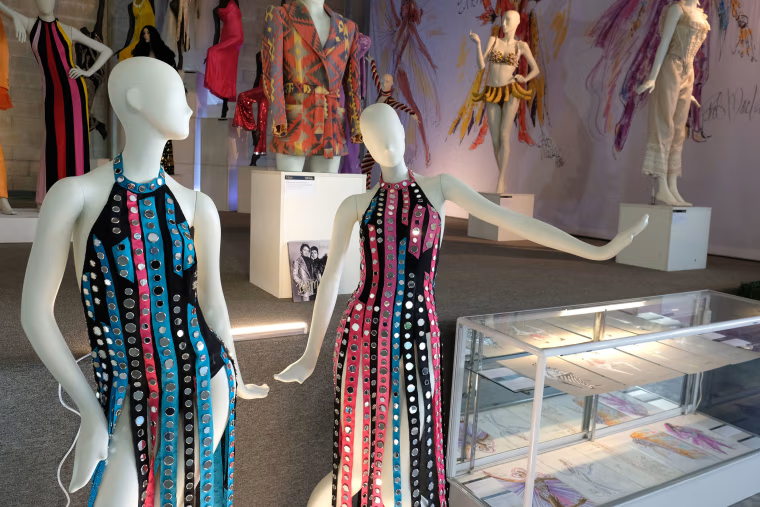
The Museum at FIT mounted a retrospective of his work in 1999. He received a Lifetime Achievement Award from the Council of Fashion Designers of America. In 2019 he won the Tony Award for Best Costume Design in a Musical for The Cher Show — his first Tony, at 80. In April 2023, RuPaul presented him with the inaugural “Giving Us Life-time Achievement Award” at the RuPaul’s Drag Race season 15 finale, an honor that acknowledged a debt drag performers had been paying him informally for decades. In January 2026, the Palm Springs Art Museum honored him at its annual Art Party, with Burnett in attendance.
A Late Renaissance
Mackie’s final decade brought something designers of his vintage rarely get: a second act driven by people young enough to be his grandchildren.
His archive became one of the most coveted resources in celebrity styling. Zendaya wore a Mackie gown to honor Cher at the 2024 Rock & Roll Hall of Fame induction. Miley Cyrus, Anya Taylor-Joy and Pink pulled from his back catalogue — Pink borrowing hers directly from Cher’s closet for the 2022 American Music Awards. Sabrina Carpenter built entire performance looks around his work. When Taylor Swift wanted to look like a showgirl for the cover of her 2025 album The Life of a Showgirl, she turned to Mackie originals; the designer said he was kind of shocked by it. His fingerprints are visible in the red-carpet grammar of Kendall Jenner and Bella Hadid whether or not either has worn him. A dress Cher wore in 1975 sold at auction in 2024 for $101,600, about twenty-five times its estimate.
The 2024 documentary Bob Mackie: Naked Illusion gathered Cher, Burnett, RuPaul, Tom Ford, Pink and Miley Cyrus to say more or less the same thing in different words: that he was without peer. In 2025 the Soho Grand Gallery in New York mounted Bob Mackie: From Sketches to Spotlight, and Mackie, then 86, turned up to open it.
He had complicated feelings about his own legacy, particularly the naked dress. Watching contemporary red carpets, he was unimpressed — he said he had been so bored by one recent Met Ball, with everyone exposed and every gown looking like every other gown, that he turned it off. The point of the original, his complaint implied, was never nudity. It was illusion: the tension between what you could see and what you only thought you could, engineered bead by bead.
Personal Life
Mackie married the singer Lulu Porter in 1960; they divorced in 1963. Their son, the makeup artist Robert Gordon Mackie Jr., died of AIDS at 35.
From 1963 until Aghayan’s death in 2011, Mackie’s life partner was Ray Aghayan, the Iranian-born, Emmy-winning costume designer who had first employed him as an assistant at Paramount. They were together for nearly fifty years, collaborated repeatedly, and shared an Academy Award nomination. With the designer Ret Turner, they also ran a costume rental company stocked with their own work.
The Legacy
It is difficult now to explain how strange Mackie’s project once was. When he started, movie costume design was largely an exercise in discretion — clothes that served a character without announcing themselves. Mackie did the opposite. He made clothes that announced themselves before the performer had opened her mouth, and he did it on television, weekly, for free, in front of tens of millions of people. He turned the garment into a piece of the act.
Nearly every convention of the modern red carpet descends from that decision: the pre-ceremony arrivals as primary content, the archival pull, the strategically sheer gown, the idea that a dress can be a statement of intent or a grievance or a joke. So does a great deal of drag, arena pop staging, and the visual language of the Vegas residency.
He was called the Sultan of Sequins, the Rajah of Rhinestones and the Guru of Glitter, and he never once objected to any of it. There was no irony in Bob Mackie. He believed, straightforwardly and for eighty-seven years, that a person deserved to walk into a room and stop it, and he spent his life engineering the means.
Bob Mackie is survived by an archive that shows no sign of retiring.