Gregory Ashford showed up at Harold’s office four days after the funeral, before I’d even had time to process that I was now, legally, a widow with a fortune I hadn’t asked for and barely understood. He was in his mid-forties, sharply dressed, and furious in the particular way people get when they believe something has been stolen from them rather than simply left to someone else.
“This is insane,” he said, not bothering to look at me directly, addressing Harold instead as though I weren’t sitting in the same room. “My father marries some hospital volunteer a week before he dies, and suddenly she gets everything? This is exactly the kind of predatory scheme these lawyers are supposed to catch.”
“Mr. Ashford,” Harold said calmly, “your father came to me nearly three weeks before the wedding to discuss updating his estate plan. He was of sound mind, which two separate physicians confirmed and documented at his request, specifically anticipating a challenge like this one.”
“He barely knew her,” Gregory snapped.
“I understand this is difficult,” I said quietly, finally speaking for myself. “I didn’t marry your father for his money, Gregory. I didn’t know he had any until the day he died. I visited him because he was alone, and dying, and scared, and nobody else was coming.”
“Nobody else was coming because he cut off contact with our entire family fifteen years ago,” Gregory shot back, some of his anger finally cracking into something rawer. “He wasn’t some abandoned old man nobody cared about. He chose to disappear.”
That detail stopped me cold. “What do you mean he disappeared?”
Harold intervened gently. “Perhaps this is a conversation better suited for mediation rather than a first meeting. Gregory, your father anticipated you might contest the will, and he left a letter addressing exactly that possibility. I think it would serve everyone better if you read it before deciding how to proceed.”
Gregory read the letter in silence, his jaw tightening progressively as he moved through it. When he finished, he set it down on Harold’s desk without a word for nearly a full minute. “He says he tried to reach out three times over the years,” Gregory finally said, his voice unsteady now. “I never got any of those messages. My mother handled all of his old correspondence after the divorce. If he sent letters, I never saw them.”
The mediation that followed over the next several weeks, guided by a family attorney named Priscilla Nakamura whom Harold recommended specifically for her experience with contested estates, revealed a family history far more complicated than either Gregory or I had initially understood. Thomas and Gregory’s mother had divorced acrimoniously when Gregory was twelve, and in the bitter years that followed, Thomas’s attempts to maintain contact with his son had been systematically intercepted by his ex-wife, something Priscilla’s investigator confirmed through old postal records and a handful of returned, unopened letters Thomas had kept in a separate box, letters that had never made it past his ex-wife’s mailbox.
“He kept every single one that came back,” I told Gregory during one of our mediation sessions, sliding the box of returned letters across the table toward him. “Fifteen years of birthday cards, Gregory. He never stopped trying.”
Gregory sat with that box for a long time, opening envelope after envelope with hands that had gone from angry to something closer to devastated. “I spent fifteen years believing he simply didn’t want me in his life,” he said quietly. “My mother told me he chose his business over our family. I built an entire understanding of my childhood around that story.”
“I think your father built a similar story around losing you,” I said. “He told me once, before I knew any of this, that his biggest regret was a relationship he’d let slip away without fully understanding why. I didn’t know he meant you specifically until Harold explained everything after he died.”
The contest of the will, once Gregory understood the fuller context, shifted from an adversarial legal battle into something closer to a genuine reckoning with grief he hadn’t allowed himself to feel properly. He didn’t withdraw his legal claim immediately, and I didn’t expect him to, given how much emotional history was tangled up in the money itself. But the tone of every subsequent meeting changed considerably once the intercepted letters entered the conversation.
We reached a settlement four months later, one Priscilla helped structure carefully to honor both Thomas’s clearly documented wishes and the genuine, painful reality of a father and son who had lost fifteen years neither of them had actually chosen to lose. I retained the bulk of the estate as Thomas’s will specified, but I voluntarily allocated a significant portion into a trust for Gregory’s two children, Thomas’s grandchildren, whom Thomas had never met and had grieved in his final journal entries, which Harold shared with both of us once the mediation concluded.
“He wrote about them constantly in that journal,” I told Gregory, handing him a photocopy of the relevant pages. “He didn’t even know their names, but he wondered about them. He wrote that not knowing his own grandchildren was the loneliest part of his final years, lonelier even than the divorce itself.”
Gregory cried reading those pages, the first time I’d seen him show anything other than anger or icy composure since our first meeting in Harold’s office. “I have two kids,” he said. “Emma and Wesley. He never got to meet either of them.”
“He knew they existed,” I said gently. “He just didn’t know how to reach across everything that had happened to actually find you again. I think, honestly, some part of him hoped that if he left things clearly documented after his death, you’d eventually understand why he never stopped trying, even when it looked like he had.”
Over the following year, something unexpected grew out of that painful beginning. Gregory and I built a cautious, evolving relationship, not quite family in any traditional sense, but something functional and increasingly warm. He brought Emma and Wesley to visit me that spring, and I found myself, somewhat to my own surprise, deeply invested in getting to know the grandchildren Thomas had never met, feeling almost as though I owed it to him to make sure that particular loneliness didn’t simply end with his death unaddressed.
I used a portion of my own share of the inheritance to establish a small foundation in Thomas’s name, funding hospital volunteer programs specifically focused on connecting elderly patients without nearby family to trained companions during their final months, the exact kind of care that had brought Thomas and me together in the first place. Harold helped me structure it properly, and within its first year, the foundation had placed volunteers with over thirty patients across three different hospitals in the region.
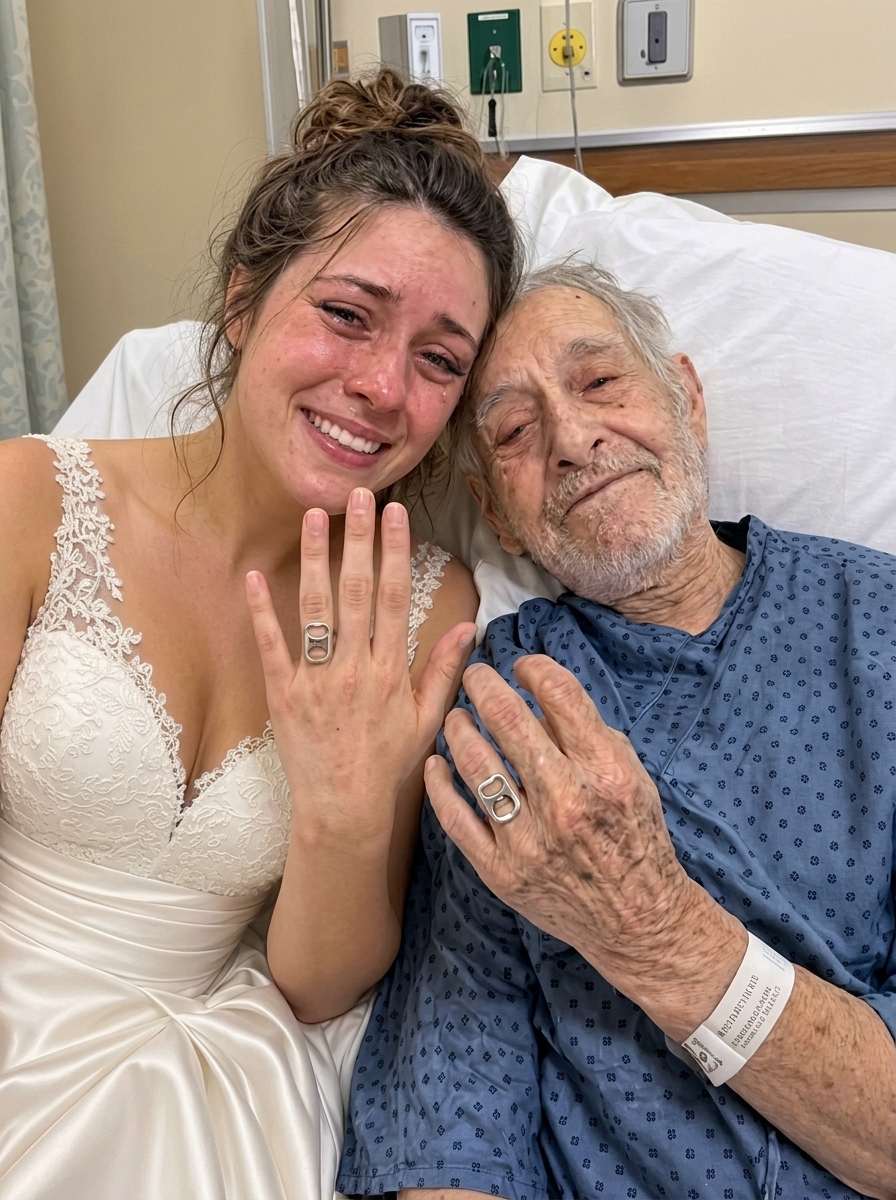
I also kept the soda can pull tab Thomas had slipped onto my finger during our small hospital wedding, having it professionally preserved and set into a simple pendant I wear most days, a strange and deeply meaningful reminder of exactly how little the actual circumstances of our marriage had to do with money, and how much they had to do with two lonely people finding unexpected comfort in each other during the hardest week of one of our lives.
I started seeing a grief counselor that year as well, someone named Dr. Whitcombe who helped me process not just Thomas’s death but the strange, layered grief of losing my mother and then, in an entirely different way, losing a husband I’d known for barely two weeks total. “You’re allowed to grieve him fully,” she told me during one of our early sessions. “The brevity of your marriage doesn’t diminish the reality of what you two built together in that short time. Grief doesn’t operate on a strict timeline correlated to how long you knew someone.”
That permission mattered more than I expected. I stopped feeling strange about how deeply I missed a man I’d known for such a short window of time, and I let myself simply feel the loss fully, alongside the strange, complicated gratitude for everything his final gift had made possible, not just for me, but eventually for Gregory and his children as well.
One year after that hospital room, I stood in Gregory’s backyard at a small gathering he’d organized, half birthday party for Wesley and half informal memorial for Thomas, the anniversary of his death falling just a week before his youngest grandson’s birthday. Emma, now six, had drawn a picture of “Grandpa Thomas” from a photograph I’d shared with her, an old man she’d never met but had clearly built a genuine, tender curiosity about through the stories Gregory and I had both told her.
“Do you think he’d like this?” Gregory asked me, gesturing at the small gathering, the children running across the grass, the modest memorial table set up near the patio with Thomas’s photograph and a small vase of flowers.
“I think he’d have loved it,” I told him honestly. “I think this is exactly the kind of family he spent fifteen years hoping he might somehow get back to, even if he never quite figured out how.”
I still have that green backpack, sitting in my closet, mostly empty now since its original contents have long since been distributed, processed, and folded into the ongoing, complicated work of two families learning to exist honestly together. I keep it anyway, the same way I keep the pendant, not as a symbol of the inheritance it once contained, but as a reminder of exactly how much truth a stranger can hand you in a single afternoon, and how much healing can grow, unexpectedly, from even the most painful and complicated beginnings.