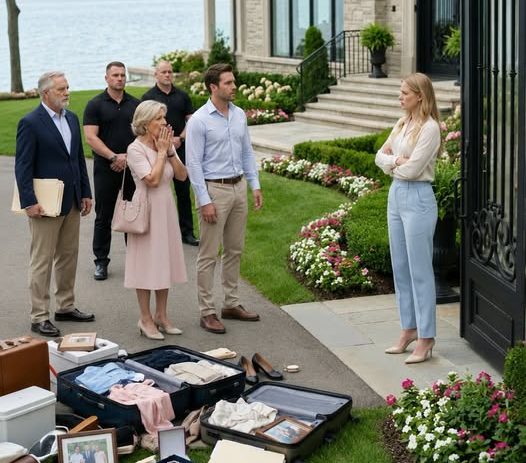
My husband hit me for refusing to let his mother move into my house, then gave me makeup and told me to hide the bruises before lunch. But when he brought her home at noon, his clothes were thrown across the lawn, the police had my recordings, his mother’s shell company was frozen, and he finally discovered the house, the trust, and the power had never been his.
The following morning, he dropped a makeup bag onto the bathroom counter and said, “My mother’s coming for lunch. Cover those bruises and try to smile.”
What he had no idea of was that by noon, his clothes would be spread across the front lawn.
Because the house had never been his.
It was mine.
The makeup bag hit the counter beside my split lip like some cruel joke wrapped in pink plastic. My husband looked at the bruises on my face the way someone might glance at a stain on a shirt.
“Start with the concealer,” Ryan said. “My mother will be here at twelve. Cover everything up and don’t make another scene.”
Morning light flooded the bathroom mirror, bright enough to show every mark he had left behind. One eye was swollen nearly shut. Purple bruising spread across my cheekbone. Dark finger-shaped marks wrapped my upper arm where he had dragged me back from the bedroom doorway after I made the mistake of saying four simple words.
“I’m not living with your mother.”
That had been my crime.
He had answered instantly, violently, and without effort. Then, after it was done, he brushed his teeth, climbed into bed, and slept like a man who believed himself entirely justified. I spent the night on the cold bathroom floor with a towel pressed to my mouth, listening to him snore under the ceiling fan my father had paid to install years before Ryan ever entered this house.
Now he stood behind me in a crisp shirt and expensive shoes, handsome enough to fool strangers and hollow enough to freeze the air around him.
“Victoria wants the downstairs suite,” he said. “And she’s getting it.”
I met his eyes in the mirror.
“And if I say no?”
He leaned in until I could feel his breath near my ear.
“Then everyone will finally see how unstable you really are,” he whispered. “Poor Ava. Always emotional. Always crying. Always making trouble.”
Then he smiled.
For three years, Ryan had confused my silence with weakness. His mother called me “the rich orphan” behind my back, then eventually to my face when she decided subtlety was no longer necessary. Later I became “the quiet wife.” Then “the girl who should be grateful.” Between them, they talked about my house like it was a prize Ryan had won by marrying me.
They admired the marble floors.
The iron gates.
The glass walls facing the lake.
The downstairs suite with its private garden view.
But they never remembered the most important thing.
Whose name was actually on the deed.
First it belonged to my father. Then it belonged to me. Ryan only knew how to act powerful. I had inherited the real thing — along with my father’s patience, his discipline, and his habit of documenting everything before anyone realized they were being measured.
I opened the makeup bag and stared at the tube of crimson lipstick inside.
The same shade I wore on our wedding day.
“How considerate,” I said softly.
Ryan grinned, satisfied with himself. He thought he had already won. He did not know the phone was tucked beneath the folded towel on the counter, still recording. He did not know the hallway security cameras had caught everything from three angles the night before. He did not know that at 4:12 a.m., while he slept like a prince in a stolen kingdom, I had already sent the footage to my attorney.
Her response had come before sunrise.
Stay calm.
Let him leave for the office.
We move before lunch.
I dabbed concealer carefully beneath one eye and watched him in the mirror.
“Don’t worry,” I said.
“By lunchtime, everything will be covered.”
Just not the way he imagined.
He left at eight-thirty with a kiss blown casually from the doorway, like we were still a normal married couple and not a crime scene waiting for witnesses. The second his car disappeared down the drive, I called Lena.
My attorney answered on the first ring.
“Police report is filed,” she said without preamble. “They have the recordings, the camera footage, and the medical photographs. And Ava — listen carefully — the financial investigator found the shell company.”
I closed my eyes for a moment.
Victoria’s shell company.
Of course she had one.
I had discovered it two weeks earlier while organizing household tax files. A blandly named LLC tucked into some routine-looking insurance paperwork Ryan clearly thought I would sign without reading. The company had been quietly positioned to absorb renovation payments, property maintenance contracts, and eventually, if their timing had worked, a transfer structure that would have given Victoria long-term control over the house while leaving me legally boxed out of my own inheritance.
It was clever.
Not clever enough.
The house itself was protected by a trust my father had written with the kind of caution wealthy men develop when they’ve spent their whole lives watching people circle money like sharks around blood. Ryan knew I had inherited well. He did not know he had inherited nothing. Not directly. Not indirectly. Not now, not ever. He had married a woman with assets. He had not married into ownership.
Lena’s voice cut back through my thoughts.
“The shell company accounts are frozen pending fraud review,” she said. “And the police are waiting for him to come back to the property. Are you ready?”
I looked around the bedroom.
At the framed photographs I had already taken down.
At the closet where his side stood open and empty.
At the boxes lined neatly by the front door, each one labeled in my own handwriting.
Dress shirts.
Golf things.
Watches.
Shoes.
Office files.
Miscellaneous entitlement.
“Yes,” I said. “I’m ready.”
By ten o’clock, two patrol officers had already come and gone after taking my full statement. One of them, a woman in her fifties with a voice like gravel and patience, paused at the doorway before leaving and said, “Men like him always think the worst thing they did was hit you. It usually isn’t.”
She was right.
The hitting was horrible.
But the planning was colder.
The way he and his mother had built this together.
The way they assumed my bruises could be blended out with makeup and lunch could proceed as usual.
The way they had mistaken my composure for surrender.
That was uglier than violence.
That was contempt.
At eleven-forty, I carried the last box outside and set it beside the others on the lawn. The June heat was already rising off the stone walkway. The lake beyond the back garden looked calm enough to be painted. Everything about the day was offensively beautiful.
At eleven-fifty-three, Victoria arrived first.
She stepped out of a silver sedan in a cream suit, pearls at her throat, sunglasses perched in her hair, every inch the elegant widow she believed herself to be despite the fact that she was very much not a widow and had spent the last decade surviving mostly by attaching herself to richer people’s certainty.
She stopped when she saw the boxes.
Then she smiled.
Not confused.
Not alarmed.
Amused.
“Oh,” she said as she reached the porch, “someone’s finally learning how to make room.”
I said nothing.
I stood in the doorway with one hand resting lightly against the frame and let her take in the full picture. The boxes. The changed lock. The legal envelope balanced on top of the nearest suitcase.
She frowned then, very slightly.
“Where’s Ryan?”
“Almost here.”
Her eyes narrowed. “And what exactly is all this supposed to be?”
I tilted my head.
“Your move-in.”
That was when Ryan’s car turned into the drive.
He parked fast, got out quickly, and for one stupid second he actually smiled — probably thinking he was arriving to find me compliant at last. Then he saw the lawn. The boxes. His mother standing stiffly on the porch. Me holding the door without welcoming either of them inside.
He stopped dead.
“No,” he said immediately. “No. What is this?”
I think that may have been my favorite moment.
Not because he was frightened.
Because he was finally uncertain.
The man who had spent years manufacturing uncertainty in me suddenly had nowhere solid to place his feet.
Victoria recovered first, of course.
“Ava, enough theatrics,” she snapped. “Take these ridiculous boxes inside.”
“No.”
Just that one word.
Ryan looked from me to his mother, then back to me. “What did you do?”
I handed him the envelope.
His hands were steady when he took it.
They were not steady after he read the first page.
His face changed almost line by line. The police report. The notice of pending domestic violence charges. The emergency protective order. The documentation regarding the frozen shell company accounts. And beneath those, on crisp white paper embossed with my father’s trust seal, the language that clarified what neither of them had ever truly understood.
The property was trust-held.
The beneficial interest remained solely mine.
No spouse had occupancy rights independent of my consent.
No in-law had claim.
No shell company would ever touch it.
Victoria leaned over his shoulder and read too.
For the first time since I had known her, she looked old.
“Impossible,” she whispered.
Behind them, the first police cruiser turned into the drive.
Ryan spun around at the sound.
Then another cruiser followed.
And then another.
The woman officer from earlier stepped out and closed her door with calm, deliberate force.
Ryan’s entire body went rigid.
“What the hell is this?” he demanded.
“This,” I said, “is what happens when you confuse my silence with permission.”
Victoria tried to step past me into the house as if status alone still counted for something.
The officer blocked her cleanly.
“Ma’am, stay where you are.”
Ryan looked at me with a kind of panic he had never allowed himself to show before.
“You called the police?”
“No,” I said. “I called my lawyer at 4:12 this morning. The police came after they saw the recordings.”
His face lost color.
Not because of the bruise.
Not because of the report.
Because of the word recordings.
He knew exactly what that meant.
The threat in the bathroom.
The violence in the hallway.
The way he laughed when he said everyone would believe I was unstable.
It had all been caught.
Not just by my phone.
By the house cameras too.
Victoria’s voice turned sharp and ugly. “You stupid girl. Do you have any idea what you’re doing?”
I looked at her and felt absolutely nothing.
“Yes,” I said. “For the first time in this marriage, completely.”
The officer asked Ryan to step forward. He didn’t move. Two more officers did. His lawyer instincts must have kicked in then, because he finally raised his hands slightly and asked whether he was under arrest.
The answer was yes.
Domestic assault.
Coercive control allegations pending.
Financial fraud investigation connected to the shell company.
He turned to me like he still expected this to be reversible if he just said the right thing.
“Ava, listen to me—”
“No,” I said. “You listen.”
He stopped.
“You hit me because I would not hand my father’s house to your mother. Then you brought me makeup and told me to smile for lunch.” I took one step forward. “I want you to remember this moment for the rest of your life. The boxes. The lawn. The police. The fact that the house, the trust, and the power were never yours. You were only ever standing in something that belonged to me.”
He stared at me.
And I watched the truth finally sink in.
Not just that he had lost the house.
That he had never possessed it at all.
Victoria tried one last tactic, of course. Outrage. Class. Reputation. She demanded names and badge numbers. She threatened lawsuits. She used the phrase “misunderstanding” three times in less than a minute. The older officer let her talk until she ran out of elegant fury.
Then he said, “Ma’am, your company accounts are frozen. I suggest you call your attorney instead of your son.”
That shut her up.
Ryan was placed in the back of the cruiser. Not roughly. Just finally. Victoria stood on the driveway in pearls and disbelief while the man she had helped turn cruel sat handcuffed in the rear seat staring straight ahead like his mind had left before his body did.
I should tell you I felt triumphant.
I didn’t.
Not exactly.
I felt clear.
That was better.
Because triumph burns hot and fades. Clarity stays.
After the police left, after Victoria’s car disappeared down the road and the lawn was quiet again except for the breeze moving through the hedges, I stood alone on the porch and looked out at the house my father left me.
The marble floors.
The iron gates.
The glass walls facing the lake.
They had loved every inch of it except the part they could not control.
Me.
Lena called once more that afternoon.
“It’s done,” I told her.
“No,” she said gently. “The arrest is done. The rest begins now.”
She was right.
There would be statements. Hearings. Financial reviews. Divorce filings. There would be people who whispered and people who chose sides and people who suddenly “never really liked him anyway.” That always happens. But the hardest part was already over.
The hardest part is the moment you understand you are not trapped.
That someone only seemed powerful because you were still speaking to them from inside fear.
That evening, I took the makeup bag from the bathroom counter and dropped it into the trash.
Foundation.
Powder.
Crimson lipstick.
All of it.
Then I washed my face slowly in the mirror and let every bruise remain exactly where it was.
Nothing covered.
Nothing softened.
Nothing hidden.
By noon he wanted me smiling at lunch.
By sunset, he was in custody, his mother’s accounts were frozen, and his last name had been reduced to labels on cardboard boxes fading slowly on the lawn.
If you ask me, that was a much better use of the day.