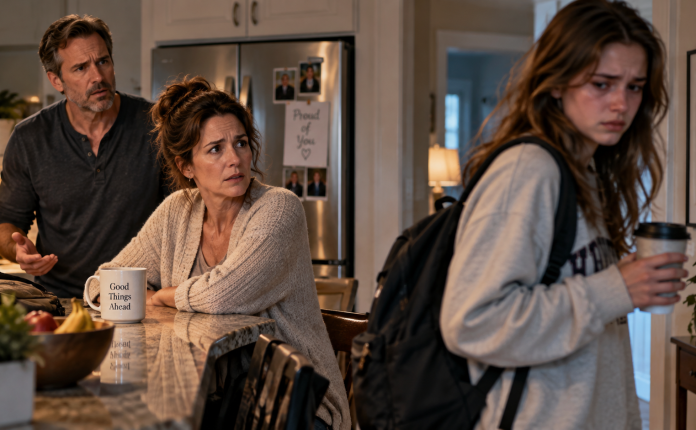
“If you don’t reactivate that card right now, I swear I’m cutting you out of my life by tomorrow!”
That was the line Mauro shouted at me over the phone from the airport, not knowing that while he was making threats, I had already made the decision that would break his family apart for good.
“Are you even listening to me, Rebecca?” he roared. “My mom is here, my dad is here, Jamie is crying, and you’re leaving us stranded as if we were common criminals.”
I smiled, even though he couldn’t see me.
“I didn’t leave you stranded,” I said. “I canceled a card that was used without my permission.”
There was a brief silence on the other end. Then I heard the shrill voice of his mother, Patricia, cutting into the call like she always did with everything.
“Don’t be ridiculous!” she snapped. “You are my son’s wife. What Mauro has belongs to you, and what you have belongs to him. That’s how a decent family works.”
I let out a cold, dry laugh.
“It’s funny that you talk about a decent family, Patricia.”
“Don’t get insolent,” she shot back. “And you’d better fix this right now. Because when we get back, you’re getting the hell out of our house.”
Our house.
Every time she said that, something inside me boiled.
For three years, I endured her humiliations, her backhanded little remarks, her orders disguised as advice. Her daughter, Jamie, was worse: a thirty-year-old woman who still lived like an angry teenager and treated me like I was renting a corner of their air. And Mauro… Mauro always found a way to excuse it.
“That’s just how my family is, babe. Don’t take it personally.”
It wasn’t personal, he always said, while letting them crush me a little more each month.
Two nights earlier, I had come home from a charity dinner exhausted, heels in my hand, makeup fading, already thinking about bed. Instead I found a note on the kitchen island in Mauro’s handwriting.
We went to Vail for a week with my parents and Jamie. You cover everything. After the stress you cause us, we deserve this.
At first I thought it was a joke.
Until I opened the hidden drawer in my office and saw my Platinum card was gone.
I checked the bank app.
There it was.
Four first-class tickets.
A luxury ski resort.
An SUV rental.
Snow gear.
Restaurants.
Prepaid shopping.
More than any family with a shred of dignity would dare spend without asking.
But dignity was never their priority.
Only appearances.
I did not cry. I did not scream. I did not break anything.
I called the bank, reported the card as stolen, froze every transaction, and asked for an immediate investigation. Then I called my lawyer, Veronica Saldana.
“It happened exactly the way we expected,” I told her. “Now I want to go all the way.”
Because the card theft was not the beginning.
It was the final confirmation.
For years, Mauro had been living off my success while pretending to the world that he was the architect of our life. At dinners, he spoke like a visionary. At networking events, he floated near my investors and clients, laughing too loudly and using words like expansion, leverage, strategy, as if my business had not existed before him and would not outlive him by decades. His family helped maintain the myth because myths are easier to live inside than debt.
The truth was uglier.
Hidden loans.
Unpaid business taxes.
Failed ventures quietly buried.
And a trail of “temporary” financial patches funded, one way or another, by proximity to me.
The house Patricia kept threatening to throw me out of wasn’t theirs either. Legally, it belonged to a trust created by my grandfather. I was the sole beneficiary. Mauro never understood that because Mauro never bothered to read anything he believed he could someday control out of habit.
He married me thinking my life would eventually become his through repetition.
He was wrong.
“Rebecca, I’m ordering you,” Mauro shouted on the phone. “Reactivate the card, or never speak to me again.”
“Don’t worry,” I said. “Very soon, I won’t have to speak to you as my husband at all.”
Patricia let out a furious little gasp.
“Are you threatening us?”
“No,” I said. “I’m just letting you know it’s over.”
Then I hung up.
Over the next few hours, Jamie sent me twenty messages.
Envious.
Broke.
Trashy.
Mauro should have left you years ago.
I did not answer any of them. I forwarded everything to Veronica. Then I sent my CFO a list of suspicious company transactions I had been tracking quietly for weeks. Small amounts. Cleverly disguised. Repeated often enough to matter, never large enough to scream at a casual glance. Vendor payments that led nowhere. Consulting fees with vague descriptions. Reimbursements without supporting invoices.
By midnight, three separate investigations were moving.
By 2:00 a.m., I slept better than I had in months.
Three days later, they came home early.
Not by choice.
By force.
The bank had frozen the card. The hotel had demanded payment. Their SUV reservation had been canceled. The shopping bags Jamie had filled “just in case” had to be abandoned in a boutique because Patricia’s personal card had already hit its limit. Mauro called twice from Chicago during the layover. I let it ring.
By the time their black town car pulled into the driveway, everything was ready.
Not dramatic.
Precise.
His key no longer worked.
The front gate access had been revoked.
His office passwords were disabled.
The alarm recognized only my code.
And every one of his belongings — every suit, golf club, monogrammed dress shirt, leather loafer, watch box, and smug little relic of entitlement — was already stacked in labeled containers under the covered side porch.
When he pounded on the front door, I didn’t rush.
I let him knock long enough to understand that the old rules had ended.
Then I opened it.
Mauro looked terrible. Travel-worn, furious, humiliated. Patricia stood rigid beside him in a cashmere wrap that no longer looked expensive enough to protect her. Jamie’s mascara had smudged. Good.
“What the hell is this?” Mauro demanded.
I stood in the doorway and rested one hand lightly against the frame.
“Your return.”
Patricia tried to push forward.
“This is our home.”
“No,” I said. “This is the house you kept threatening me from while never once understanding who actually owned it.”
Mauro’s face darkened. “Move.”
I didn’t.
Instead, I handed him a thick envelope.
He snatched it open and began pulling out pages too quickly to understand them at first. The legal notice. The trust summary. The separation filing. The financial freeze order. The letter from Veronica informing him that any further attempts to access company funds, trust property, or accounts in my name would be treated as fraud and prosecuted accordingly.
His hands slowed.
Then stopped.
Patricia leaned over his shoulder, and for the first time since I had met her, I watched certainty leave her face.
“This is ridiculous,” she said. “This means nothing.”
“It means,” I said, “that the shell company tied to your son’s ‘consulting fees’ has already been flagged, the suspicious vendor payments are under review, and the trust property you thought you’d be moving into next month was never available to either of you in the first place.”
Jamie actually looked confused.
“What shell company?”
That part was almost funny.
Because of course Mauro had kept even some of his own family in the dark. Men like him always think they are smartest when they are the only ones fully aware of the game.
Mauro looked up from the papers.
“You were spying on me?”
“No,” I said. “I was married to you. It forced me to become observant.”
He stepped inside anyway, anger winning over caution.
Big mistake.
Two people stood from the living room the second he crossed the threshold.
Veronica, in a charcoal suit, slim folder in hand.
And beside her, a forensic accountant from my firm who had spent the last forty-eight hours reconstructing exactly how much money had quietly bled out under Mauro’s watch.
Mauro stopped dead.
“You brought lawyers into my house?”
Veronica smiled without warmth.
“No,” she said. “She brought them into hers.”
That landed harder than anything I had said.
Because until that moment, some part of him still believed this was bluff, performance, a tantrum dressed in paperwork. But seeing professionals seated calmly in the room where he thought he held authority cracked something in him that threats had not.
Patricia tried indignation next.
“This family sacrificed for Rebecca!”
I looked at her.
“No,” I said. “You fed off proximity to me and called it family.”
Jamie rolled her eyes, but even she looked less certain now. “This is insane. Over a credit card?”
I turned to her.
“No. Over theft. Fraud. Years of manipulation. And the simple mistake of assuming I would keep swallowing it.”
Veronica set another document on the entry table.
“Your husband,” she said, glancing at me, “has until tomorrow morning to contest the temporary financial restraints. He will fail.”
Mauro stared at her.
Then at me.
Then, with the kind of desperation men only show when they realize the performance is over, he said, “Rebecca, come on. We can work this out.”
That was the first time in years he had used my name like it belonged to a real person and not a resource.
I almost pitied him.
Almost.
“You took my card,” I said. “You stole from my company. You let your mother threaten me in a house she thought she could claim. There is no version of work this out that still includes you.”
Patricia’s voice rose. “After everything my son gave you—”
I laughed then.
A real laugh this time.
Short.
Sharp.
Final.
“Your son gave me debt in an expensive suit.”
Silence dropped over the whole room.
Even Jamie shut up.
Mauro’s face changed.
Not guilt.
Not remorse.
Fear.
Because he could finally see it now: the bank would talk. The company accounts would be audited. The shell invoices would be traced. The golf-club version of him, the entrepreneur, the provider, the man who made things happen — all of it was already collapsing under facts.
He looked toward the hallway like he was still imagining he could power his way back into control.
Then the doorbell rang.
No one moved for half a second.
Then Veronica said, almost pleasantly, “That should be the investigator.”
Mauro turned so fast he nearly dropped the folder.
When I opened the door, two men stood there in dark coats holding credentials.
One from the bank’s fraud division.
One from the district attorney’s financial crimes unit.
I stepped aside.
Patricia actually whispered, “No.”
Mauro did not say anything at all.
That was the moment he understood there would be no private clean-up. No shouting me back into softness. No calling this a misunderstanding and sweeping it into marital fog. The world beyond our walls had entered. And the world beyond our walls dealt in records, transfers, signatures, timestamps, not charm.
They asked Mauro a few quiet questions first.
Did he authorize certain disbursements?
Did he create or direct vendor payments through Halcyon Consulting LLC?
Did he use a card not issued to him for personal travel?
He answered badly.
Very badly.
Patricia interrupted twice before the investigator told her, flatly, that speaking for him was not helping.
Jamie started crying the second the words account seizure were mentioned.
I did not comfort her.
I had spent too much time comforting people who only showed up to feed on my patience.
Eventually, the men left with copies, contact numbers, and enough information to make the rest of Mauro’s week unforgettable. Veronica stayed just long enough to watch him sign receipt of service for the legal filings.
When he finished, he looked at me like he had never seen me clearly before.
Maybe he hadn’t.
For years, he confused my restraint for softness.
My work for support.
My love for access.
Now, with his mother pale beside him, his sister crying into a phone, and his own future narrowing by the minute, he finally looked at me the way I had always deserved to be seen.
As a woman who had let him stand in the light too long.
“What am I supposed to do now?” he asked.
I looked toward the stacked boxes under the porch.
Then back at him.
“Start by taking your things.”
They left just before dark.
Not gracefully.
Not all at once.
Patricia muttering.
Jamie dragging luggage.
Mauro carrying more boxes than his pride knew what to do with.
When the car finally pulled away, the house went still in that deep, rare way it only does after the wrong people are gone.
Veronica gathered her papers, touched my arm once, and said, “Get some sleep. Tomorrow will still be unpleasant, but at least now it will be yours.”
After she left, I stood alone in the entryway and looked around the house.
My grandfather’s trust.
My own walls.
My own silence.
Not the silence of fear this time.
The silence of something ending exactly the way it should have.
People always think the breaking point is the dramatic moment. The theft. The airport call. The threat of divorce.
It isn’t.
The breaking point is the moment a woman stops confusing survival with loyalty.
By the time Mauro shouted from that airport, it was already over.
He just didn’t know it yet.
And that, more than anything, was what made the look on his face when he came home so satisfying.