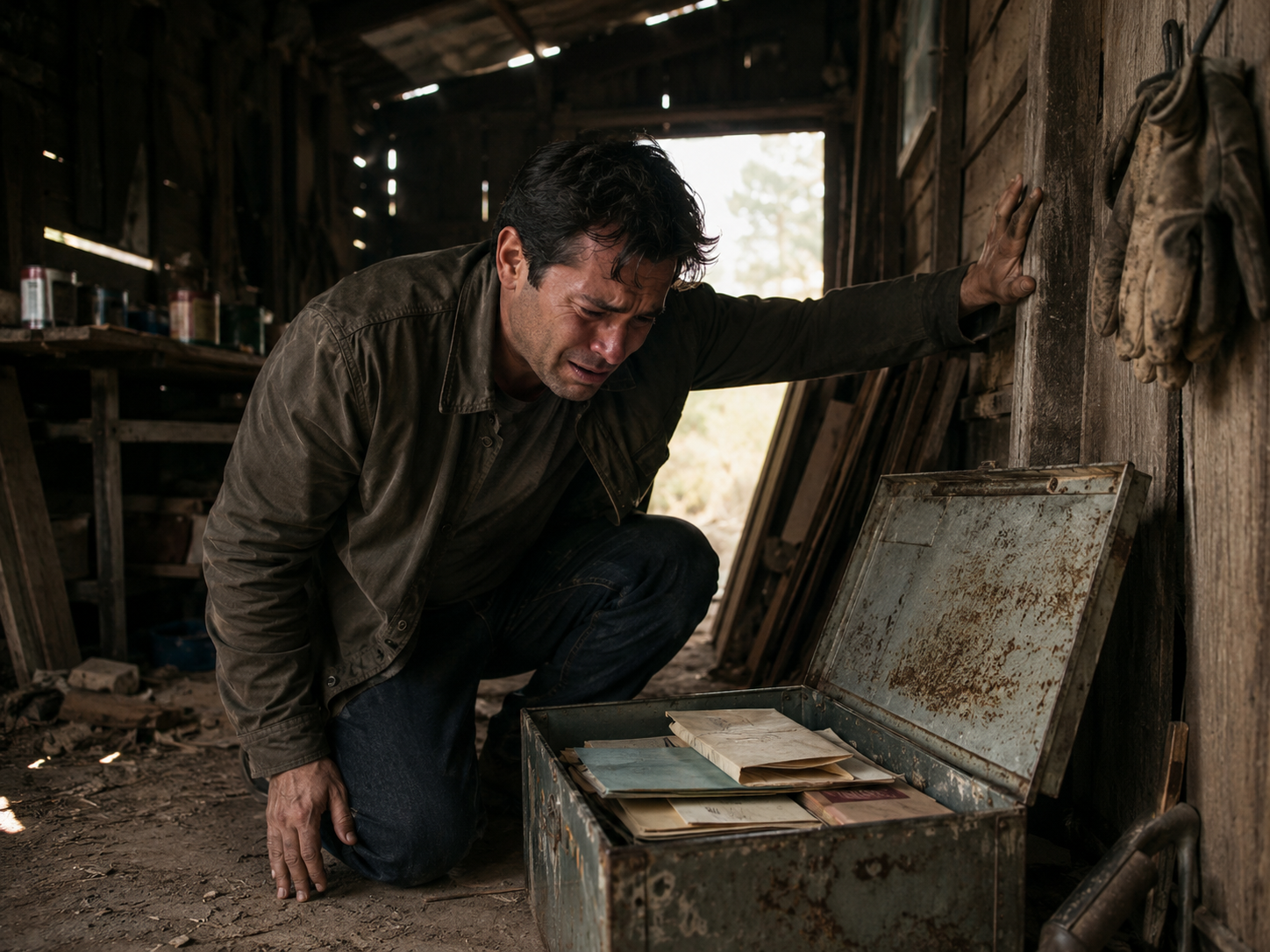
I crouched down, opened the metal box, and had to catch myself against the wall.
Inside there wasn’t cash.
There were papers.
At first my eyes couldn’t make sense of them in the dim light. I had spent the whole day raw and hollowed out, listening to my brother and sister talk about “Dad’s wishes” while they divided the house, the vehicles, the account balances, and every easy thing that looked valuable from the outside. By the time I came out to the shed, I was too tired to expect anything except one last insult wrapped in sentiment.
Then I read the top page.
And my knees nearly gave out.
It was a deed.
The shed.
And the half-acre it leaned on.
In my name.
Filed and notarized the same year Dad got his diagnosis.
I just stared at it.
Then I turned the page.
Another deed.
Then another.
Then another.
Four of them altogether.
The little blue house on Mercer Street I had reroofed for that widow who couldn’t pay me in anything but canned peaches and apologies. The duplex by the tracks I spent one freezing winter rewiring because no one else would touch it for what the owner could afford. The bungalow off Route 9 with the porch I rebuilt board by board while my brother called me an idiot for “sweating over other people’s junk.”
All of them.
Every run-down place I had patched up over the years for whatever folks could scrape together.
Dad had quietly bought every one of them behind me when nobody else wanted them. And after I made them whole again, he put them in my name and rented them out. The rent had been piling into an account I never knew existed.
Folded on top was a passbook.
I won’t say the number.
I’ll only say my sister’s precious “savings” would not have covered the taxes on it.
Under that was the letter.
The envelope had my name on it in Dad’s blocky handwriting, the same one he used on toolboxes and feed receipts and the labels he stuck on old coffee cans full of nails. I sat down right there on the dirt floor before I opened it because suddenly my legs no longer felt like anything I should trust.
The first line hit hard enough to make me stop breathing.
Son — your brother and sister think a job is something with a title on a door. You and I know better.
I read the rest slowly.
A job is a leaking roof made tight. A cold house made warm. A thing that was dying, brought back by a man’s two hands. I watched you do that for strangers your whole life and ask for nothing. So I started buying up the wrecks you fixed, because somebody ought to pay you what you’re worth, and Lord knows the world never would.
I put the paper down after that and just stared into space for a while.
Because no one had ever said it to me like that.
Not my brother, who talked like I was the family mule.
Not my sister, who treated me like background noise until she needed something lifted, patched, hauled, or fixed.
Not even me.
Especially not me.
I had spent so many years believing I was the one who got what was left over. The one you called when the pipe burst, when the truck wouldn’t start, when the porch sagged, when the old man needed help to the bathroom at three in the morning. The useful one. The dependable one.
The forgettable one.
But Dad had been watching.
That was the part that broke me.
Not the money.
Not even the properties.
The fact that he had seen me clearly the whole time.
I picked the letter back up and kept reading.
The last lines I had to read sitting down.
They told you to fix up the shed and live in it, for all they cared. So do it. Then walk out the door and go collect rent on everything else you saved. You were never one step above begging, boy. You were the only one of my children who ever built anything that lasts. Including the years you gave me at the end. I had no way to repay those. This is me trying.
That was when I finally cried.
Not the neat kind.
Not one dignified tear rolling down a weathered cheek like in some movie about hard men and harder lives.
I cried bent over on that dirt floor with Dad’s work gloves still hanging from the nail by the door, the smell of old sawdust and motor oil around me, and the letter shaking in my hands so badly I had to press it against my leg to keep reading the same lines over and over.
You were the only one of my children who ever built anything that lasts.
All day my brother had been talking about square footage and resale value. My sister kept asking whether Dad had left instructions about the silver, the truck, the certificates, the “liquid money.” They wanted what looked like inheritance.
Dad gave me what actually was.
Proof.
Proof that all those years had not disappeared into other people’s emergencies.
Proof that skill counts even when nobody claps for it.
Proof that quiet labor still leaves a mark.
The family got the house.
They got the cash they could count in front of each other with stiff smiles and fake sorrow. They got the easy story, the visible part, the version of the estate that would let them go on congratulating themselves for how things turned out.
I got the truth.
And the truth was worth more.
When I finally came out of the shed, it was dark enough that the porch light from the main house barely reached the path. I could hear my brother and sister inside, still talking, probably still dividing. I stood there for a long time with the letter in one hand and the deeds in the other, listening to their voices drift through the screen door.
For the first time in my life, I did not feel smaller than them.
I felt apart from them.
That is different.
Smaller means you still want their approval.
Apart means you understand you never needed it.
The next morning, my brother found me sweeping out the shed.
He leaned in the doorway with coffee in his hand and that smug look he had worn since the lawyer read the will.
“You really gonna live out here?” he asked.
I looked at him.
Then I folded the passbook shut and slid it back into the metal box.
“No,” I said. “I’m just fixing up something that’s mine.”
He laughed at that.
Of course he did.
He had always laughed first when he didn’t understand the room he was standing in.
It took another week before Rebecca from the county records office called me back and confirmed everything. The deeds were real. The account was real. The trust instructions attached to the rental income were real. Dad had not just left me sentiment and a patch of dirt behind the shed.
He had left me a working life.
Four houses.
A rental account.
And enough control over it all that I could either manage them myself or hire it done.
I drove past every property that week.
The blue house on Mercer.
The duplex by the tracks.
The bungalow off Route 9.
The little corner place with the broken fence I had forgotten about until I saw the deed and remembered replacing all its floor joists one summer so hot I thought I’d melt into the subfloor.
Everywhere I looked, I saw my own hands.
Not in some poetic way.
Literally.
The porch rail I cut too short the first time and had to redo.
The shingles I laid in a storm because the widow said one more rain would finish her ceiling.
The wiring I pulled through walls older than I was.
I thought I had been patching up other people’s lives for cash that barely lasted the month.
All along, Dad had been turning those repairs into foundation.
By the time my brother finally figured out what had happened, he was furious.
He came at me in the driveway waving one of the county printouts like it was an insult.
“Dad hid this from us?”
I let him talk.
When he ran out of breath, I said the only thing worth saying.
“No. He protected it from you.”
That shut him up.
My sister cried when she heard. Claimed Dad had been unfair. Said he manipulated things because I “hung around him more” at the end, as if changing bedding, managing pills, lifting dead weight into wheelchairs, and spooning soup into a man too proud to ask for help was some kind of strategy instead of what love looks like when it gets old and tired.
I didn’t argue.
There wasn’t any point.
Dad had already answered all of it in writing.
A man’s two hands.
A thing that was dying, brought back.
You were the only one who built anything that lasts.
I still keep that letter in the metal box.
Not because I need the reminder of the properties.
Not even because of the money.
Because some men leave you an inheritance.
Mine left me my own worth, written down where I can’t argue with it anymore.