The key would not turn.
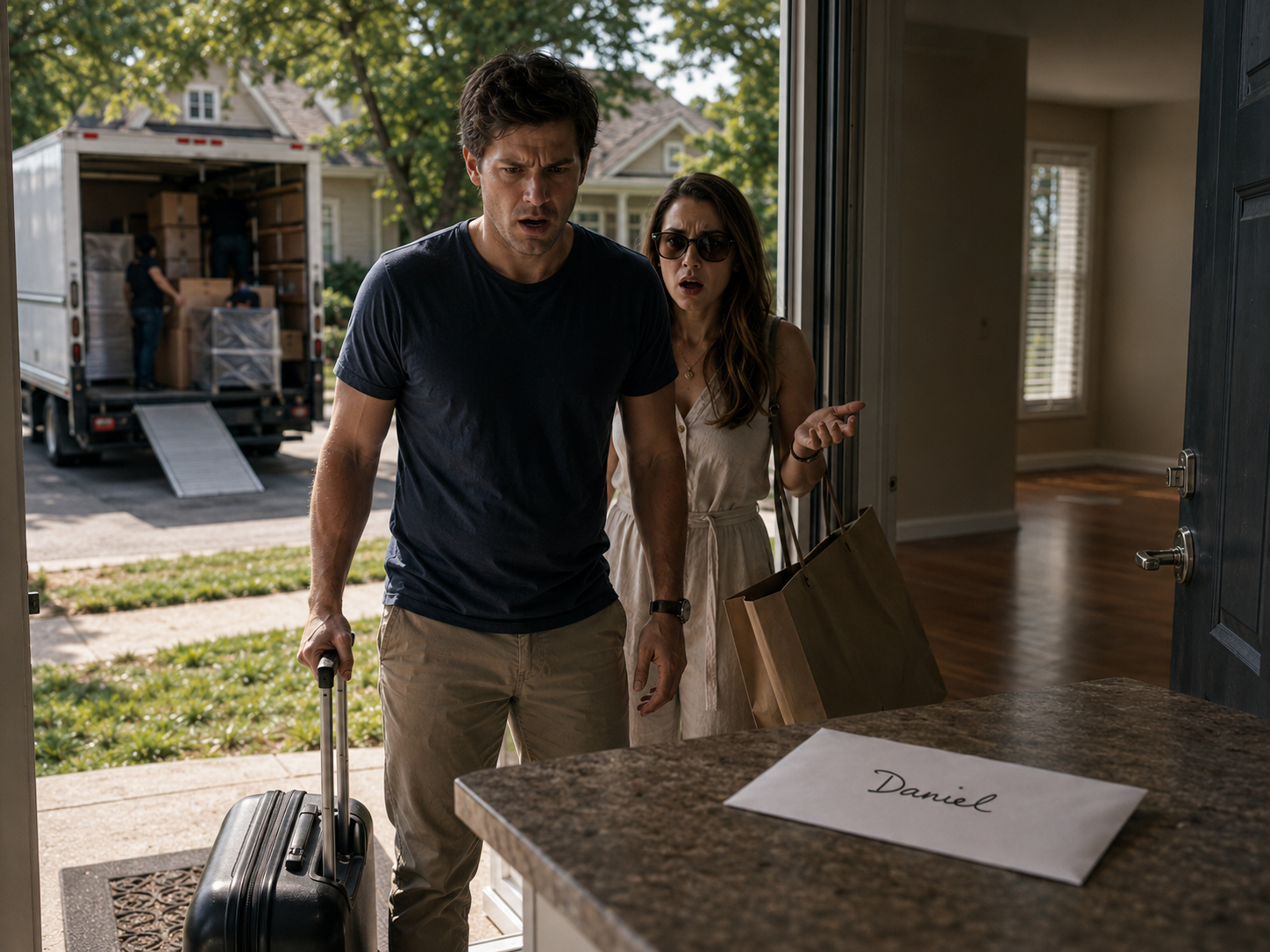
Daniel stood on my front porch in his airport clothes with one hand on a hard-shell suitcase and the other twisting that silver key again and again like the lock had made some stupid mistake. Melissa stood beside him in dark sunglasses, shopping bags looped over her wrist, still smiling the first time it jammed.
Then Daniel tried harder.
The smile vanished.
He pulled the key out, stared at it, and looked at the door like the house had betrayed him.
It hadn’t.
I had.
Three weeks earlier, my house was still full of framed family photographs, Frank’s old chair by the window, and the pencil marks on the laundry room wall where we measured Daniel as he grew. Cedar Grove was the kind of town where people trimmed hedges on Saturdays and waved from porches with coffee mugs in hand. Frank and I built our whole marriage inside that house. In a way, we buried it there too, after grief and money slowly turned our son into someone I barely recognized.
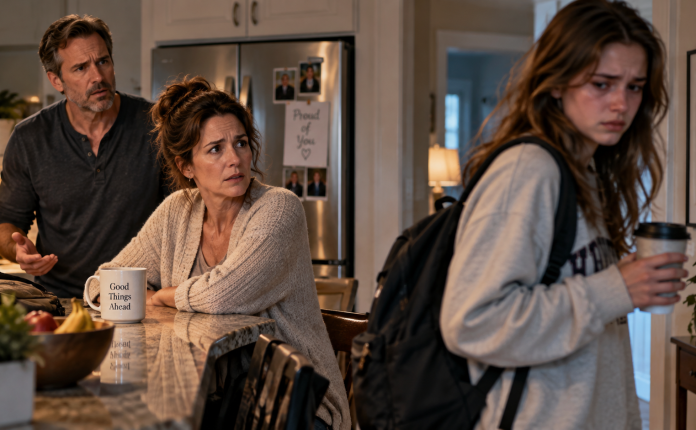
After my husband died, Daniel and Melissa started showing up more often. Everyone said I was lucky. My son brought groceries. My daughter-in-law brought soup in elegant little paper containers and spoke in that polished voice of hers that made selfishness sound thoughtful.
But then the comments began.
This house is too much for one person.
Stairs can become dangerous.
You should think ahead.
Daniel started talking about trusts and taxes. Melissa started sending me photographs of cheerful senior communities with white fences and flower beds. They called it planning. What they were really doing was circling.
I heard the truth by accident.
The day before their Europe trip, Daniel called while I was upstairs folding laundry. I missed it. A minute later, I saw he had left a voicemail. I hit play expecting something ordinary.
Instead, I heard a car door shut, Melissa’s real laugh — the sharp one — and then my son’s voice.
“She’s a burden, Mel. She doesn’t see it, but she is. We’ve put our lives on hold long enough.”
I sat down so fast the towels slipped from my arms.
Then Melissa said, “Once the house is finally handled, everything gets easier.”
That was the line that changed me.
Not the greed.
Not even the insult.
The calm.
I wasn’t a mother in that message. I was a delay. A problem. An old woman standing between them and something they had already begun counting.
I cried that night. Of course I did. I walked through every room in the dark touching the banister, the piano, Daniel’s old bedroom door, the kitchen counter where Frank used to stand drying dishes. I kept hearing burden until it stopped sounding like a word and started sounding like a verdict.
By morning, the tears were gone.
I opened Frank’s file drawer. Then Daniel’s old study box. And what I found there made everything colder. Emails. Notes. Questions about power of attorney. Language about confusion, decline, safety, transition. They had not simply been waiting for me to get tired.
They had been building a story around me.
So I built one of my own.
I called a real estate agent who knew how to move quietly. I called Frank’s lawyer. I called my bank. I moved every account Daniel once assumed he would someday “help manage.” I put the house into a private sale.
No sign in the yard.
No family discussion.
No warning.
While they were eating pasta under foreign lights and posting anniversary pictures with wine glasses raised high, movers wrapped my dishes, boxed my photographs, and carried my whole life out through the front door.
The buyer closed fast.
I rented a furnished place by the lake.
And I left one thing behind.
A note.
So when Daniel and Melissa came home tanned and smiling and full of expensive little purchases, they did not come back to my house.
They came back to an empty shell.
From inside the parked moving truck across the street, I watched Daniel finally force the front door open after trying the key three more times. I watched Melissa step in behind him. I watched them both stop at once when they saw the bare rooms, the stripped walls, the silence where my life had been.
Then Daniel saw the white envelope standing alone on the kitchen counter with his name written across the front.
He crossed the room fast.
Too fast.
Panic has a speed to it even when pride is still pretending not to show.
He tore the envelope open. Melissa hovered over his shoulder while he unfolded the letter and read the first lines. Even from across the street, I could see the color leaving his face.
Because it wasn’t only a note.
It was a copy of the sale confirmation.
A notice from my attorney.
And a letter in my own hand.
Daniel,
Since I am apparently such a burden, I thought the kindest thing I could do was remove myself — and the house you had already started planning around.
You will not find me confused.
You will not find me waiting.
And you will not find a front door that opens for people who mistook patience for surrender.
By then Melissa was talking with her hands, sharp quick motions like she thought outrage might somehow reverse paperwork. Daniel looked around the empty kitchen, the naked windows, the missing furniture, and for the first time in his life seemed to understand what absence really looks like when a mother chooses it.
He called me immediately.
I let it ring twice before answering.
“Where are you?” he demanded.
I looked out at the house from the truck window. The house Frank and I paid for over thirty-two years. The house where Daniel lost his first tooth. The house where I sat on the laundry room floor and held him after nightmares when he was five. The house he thought had become his simply because I stayed kind long enough to be underestimated.
“Somewhere lighter,” I said.
“Mom, what the hell did you do?”
“I sold my house.”
“Our house.”
“No,” I said. “That’s exactly the misunderstanding that got you here.”
Melissa grabbed the phone from him then.
“You can’t just do this to us!”
I nearly laughed.
Do this to us.
As if I had wandered into their lives and ruined something fragile, rather than simply stepped out of the trap they had been carefully building around me.
“I didn’t do anything to you,” I said. “I just stopped doing everything for you.”
Daniel took the phone back.
His voice changed then. Softer. Hurt. Reaching for the old lever.
“Mom… you heard that voicemail?”
Yes.
There it was.
Not Did we misunderstand?
Not Can we talk?
You heard it.
Because he knew.
He knew exactly where the break happened.
“Yes,” I said.
Silence.
Then, quietly, “I didn’t mean it like that.”
That was the first lie.
Not because the words were false, but because intent hardly matters when the truth comes out that clean. People rarely mean to be overheard. They just mean every word until they are caught.
“I think you did,” I said.
Melissa started up in the background again, talking about inconvenience, hotels, “all our things,” how unreasonable this was, how cruel it was to do this while they were away.
Cruel.
That word sat strangely in my ear.
Because I remembered every casserole I brought down when Melissa had migraines. Every ride to the pharmacy. Every time I slipped grocery money into Daniel’s hand when he was “between contracts.” Every night I stayed quiet when they talked around me instead of to me. Every suggestion that I move into someplace smaller “for my own good.”
They had mistaken my silence for agreement.
They had mistaken my love for access.
They had mistaken my grief for weakness.
“I left your things in the garage under the side code you both know,” I said. “You have forty-eight hours to collect them before the buyers take possession.”
Daniel sounded genuinely shaken now.
“Buyers?”
“Yes.”
“You really sold it.”
I looked again at the front porch.
The hydrangeas.
The brass light fixture Frank installed himself.
The cracked third step we always meant to replace and somehow never did.
“Yes,” I said. “I really did.”
He tried anger next.
Of course he did.
That was always the family language when love failed to produce obedience.
“You blindsided us.”
I sat there for a moment letting that sentence hang between us.
Then I said, “No, Daniel. I listened.”
He had no answer to that.
When the call ended, I stayed in the truck another minute and watched him stand in the doorway with the paper still in his hand while Melissa paced circles around the empty living room. They looked exactly like what they were: two people who had built a future on something they never owned and were now furious that reality had arrived before they were ready.
I didn’t go over.
There was nothing left to explain.
The moving truck pulled away slowly, and as we turned the corner, I caught one last glimpse of Daniel standing on the porch holding that note with the same stunned expression he used to wear as a boy when he opened a report card he had not studied for and still somehow expected to pass.
At the lake house, the air smelled different.
Cleaner.
Pine and water instead of dust and old obligation.
The furnished place was smaller, yes. But it was quiet in a way my old house had not been quiet for a long time. Not empty. Peaceful. There is a difference, though it took me most of my life to learn it.
The next morning, I drank coffee on the screened porch and listened to the water tap lightly against the dock. No one asked where the electric bill was. No one “casually” brought up wills. No one sent me brochures for places they hoped I would disappear into.
Just sun.
Water.
Breathing room.
Daniel came by two days later.
Alone.
I knew it was him before I opened the door because he still knocked in the same rhythm Frank used to. For one terrible second, that almost undid me.
But when I opened it, there was only my son. Rumpled. Tired. Smaller somehow without my house framing him.
He looked around the lake porch, the rocking chairs, the hanging fern, and said, “So this is where you went.”
“Yes.”
He shoved his hands into his pockets and nodded like a man trying to find the right doorway back into a room he had already set on fire.
“I’m sorry,” he said.
I believed that he was sorry.
I just didn’t believe he was only sorry for the right things.
So I asked the only question that mattered.
“For what?”
He looked down.
Not at me.
At the floorboards.
And that told me almost everything.
“For the voicemail,” he said finally. “For how it sounded.”
How it sounded.
Not for the circling.
Not for the planning.
Not for the way he had already begun imagining my absence as convenience.
Just for the sound of it.
I stepped back from the door slightly, not enough to invite him in, only enough to make the boundary visible.
“That’s the problem, Daniel,” I said. “You still think the wound was the sentence. It wasn’t. The wound was that you meant it.”
He looked up then, and I saw the boy he had once been flicker briefly behind the man he had become. That hurt. More than the voicemail, if I’m honest. Because children do not vanish all at once. Sometimes they are simply replaced, layer by layer, by entitlement, convenience, and the quiet belief that parents are resources before they are people.
“I was frustrated,” he said.
“Yes,” I replied. “And that’s when people usually tell the truth fastest.”
He cried then.
Not much.
Just enough to make the moment ugly.
I let him.
Some grief belongs to the person who caused it.
When he finally left, I sat on the porch until sunset and thought about Frank. About what he would have said. Probably something plain and exact, the way he always did when Daniel got too full of himself: A man who starts measuring his mother by property was raised wrong somewhere along the line.
Maybe we both missed it.
Maybe grief sharpened it.
Maybe Melissa merely gave it somewhere warmer to grow.
I don’t know.
What I do know is that a home is not a reward for waiting for someone older to disappear. It is not a prize for strategic kindness. It is not a future you build around another person’s slow erasure.
It is earned.
Paid for.
Protected.
And in the end, when my son called me a burden, he was right about only one thing.
I was carrying too much.
So I put it down.
The house.
The expectation.
The version of motherhood that keeps giving long after love has stopped being met with respect.
Some people inherit property.
My son inherited a lesson the hard way: if you start counting what is yours before the person is gone, you may find yourself standing on a porch with a useless key and no place left to go.