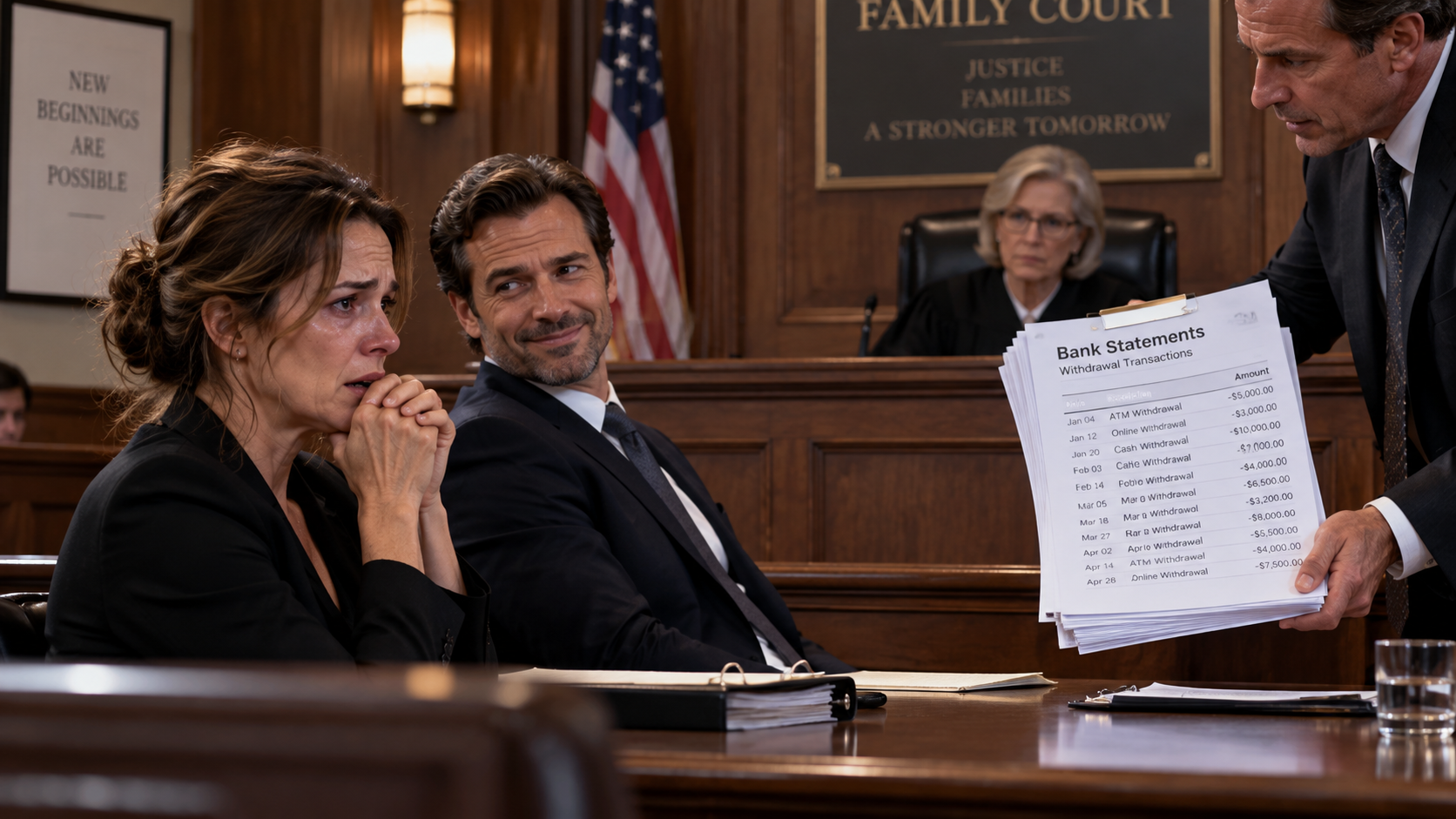
The judge called a recess before anyone could say another word, and I sat in the hallway outside the courtroom with Marisol while bailiffs quietly separated my husband, his mother, and Denise into different rooms, a precaution the judge apparently thought necessary once the accusations started flying in three directions at once. Mrs. Wilkes sat beside me on the hard wooden bench, her hands still trembling slightly in her lap.
“I almost didn’t call,” she admitted. “I kept telling myself it wasn’t my place, that maybe I was misremembering the ring. But I’ve spent twenty-two years watching people’s hands across that counter, honey. I don’t forget details like that.”
“You saved my entire life,” I told her, and I meant every word of it.
When the hearing resumed an hour later, the judge had clearly reviewed additional material during the break, because her tone had shifted from procedural patience to something considerably sharper. “Mr. Brooks,” she said, addressing my husband directly, “your attorney’s original filing characterized these withdrawals as evidence of financial misconduct by your wife. Given the surveillance footage and the text messages just entered into evidence, I need to understand exactly what role you played in orchestrating this.”
David’s attorney requested a brief conference with his client, and when they returned, his tone had changed entirely from adversarial to defensive. “Your Honor, my client maintains that any communication with Ms. Halloway was unrelated to the withdrawals themselves.”
“The text specifically references withdrawals and a ring belonging to the plaintiff,” the judge said flatly. “I find that characterization difficult to accept at face value, counselor.”
David finally spoke for himself, his voice smaller than I’d ever heard it in nine years of marriage. “Your Honor, I didn’t think it would go this far. Denise is… she’s someone I’ve known for a while. My mother suggested it would be easier to get the divorce settled favorably if there was a paper trail showing Angela had already taken money out. I never thought about what it would actually do to her, to her reputation, to anything beyond just winning.”
Denise, when finally brought back into the courtroom, offered little defense of her own. “David told me it was harmless,” she said quietly, her earlier composure completely gone. “He said Angela wouldn’t even notice, that the money was already half his anyway, that this would just make sure the divorce went faster. He gave me the ring to wear because he said it would ‘complete the look’ if anyone ever checked footage. I didn’t think it would come to this.”
The judge did not take kindly to any of it. She ruled that the entire withdrawal claim against me was fraudulent, ordered David and his mother, Patricia, held jointly responsible for restoring the full sixty-one thousand dollars to my name, and referred the matter to the district attorney’s office for criminal review, given the clear evidence of identity theft, forgery, and bank fraud.
The criminal case moved forward over the following months. David was charged with conspiracy to commit fraud and identity theft; Patricia faced the same charges, along with an additional charge for providing the stolen ring used to complete the impersonation; Denise was charged with forgery and impersonation for her direct role at the teller window. Given the clarity of the surveillance footage, the text message trail, and Mrs. Wilkes’s firsthand testimony, none of their attorneys pushed for trial.
David pleaded guilty to conspiracy and fraud, receiving three years of probation, mandatory restitution, and a permanent record that effectively ended his standing at the pipeline company once his employer learned the nature of the charges. Patricia pleaded guilty to conspiracy and theft related to the ring, receiving a similar probation sentence along with a smaller restitution obligation tied specifically to the jewelry’s appraised value. Denise received the harshest individual sentence, eighteen months, given her direct hand in the actual bank fraud itself, though her attorney successfully argued for a reduced term citing her cooperation once confronted with the evidence.
“I keep thinking about how close I came to losing everything because nobody believed me,” I told Marisol during one of our final meetings, once the criminal cases had all resolved. “If Joyce hadn’t called, if she hadn’t recognized that ring, I would have walked out of that courtroom labeled a thief for the rest of my life.”
“You would have found another way to prove it eventually,” Marisol said. “But I understand why it doesn’t feel that certain looking back. Sometimes the truth needs exactly the right person to notice exactly the right detail, and you got remarkably lucky that the right person happened to be paying attention.”
The divorce itself was finalized three months after the fraud hearing, on terms considerably more favorable to me than anything David’s original settlement offer had proposed. I received the restored savings in full, my grandmother’s ring, recovered from evidence once the criminal case concluded, and a portion of David’s pipeline pension that our original marriage had entitled me to but that he’d tried to strip away entirely through the fraudulent withdrawal claim.
I moved out of the rental within the year, using the restored savings as the down payment on a small house with a genuinely enormous backyard, the kind of yard David and I had once talked about buying together before I understood how little any of those conversations had actually meant to him. I planted a garden that spring, something I’d wanted to do for years but had never felt settled enough, or safe enough, to actually start.
Mrs. Wilkes and I stayed in touch long after the case concluded, meeting for coffee every few months, an unlikely friendship built entirely out of one phone call she almost didn’t make. “I think about that ring every time I see anyone wearing green stones,” she told me once, laughing softly. “Twenty-two years behind that counter, and that’s the detail that finally mattered.”
“It mattered because you were the kind of person who actually looked,” I told her. “Most people wouldn’t have remembered.”
I started seeing a therapist that year as well, someone who specialized in financial abuse and gaslighting within marriages, a category I hadn’t fully understood applied to me until Dr. Alderman named it plainly during one of our first sessions together. “You spent nine years being told your paychecks, your instincts, and eventually your own memory couldn’t be trusted,” she said. “Rebuilding confidence in your own perception after that takes real, deliberate work. It doesn’t happen just because the court ruled in your favor.”
She was right about that. It took most of a year before I stopped double-checking every bank statement three times, before I stopped flinching slightly whenever a lawyer’s letter arrived in the mail, a reflex built entirely from months of being told my own memory was unreliable.
One year after that hearing, I sat on the back porch of my new house, watching the garden I’d planted finally come into its own, tomatoes climbing their stakes, sunflowers taller than the fence line, the emerald ring back on my hand where it belonged. Mrs. Wilkes visited that afternoon, bringing a pie the way she always did, settling into the chair beside me with the easy comfort of someone who’d become genuine family rather than simply a witness in a courtroom.
“You built all this yourself,” she said, looking out at the yard.
“I built it because someone finally believed me when it mattered,” I told her. “That’s the part I don’t think I’ll ever stop being grateful for.”
I still keep the printed transcript from that hearing folded inside my jewelry box, right next to the ring itself, not because I need reminding of what David and his mother tried to take from me, but because I need reminding of exactly how close the truth came to never surfacing at all, and how much one retired teller’s memory of a single piece of jewelry ended up mattering more than every lawyer, every document, and every confident lie in that entire courtroom.