My name is Diane. I am fifty-five years old. I was married for twenty-eight years to a man named Paul. We have two children, both grown, both out of the house. I thought we were happy. I want to be precise about that, because people will ask, and they will mean: were there signs? And the honest answer is that I thought we were happy, and I had twenty-eight years of mornings to base that on.
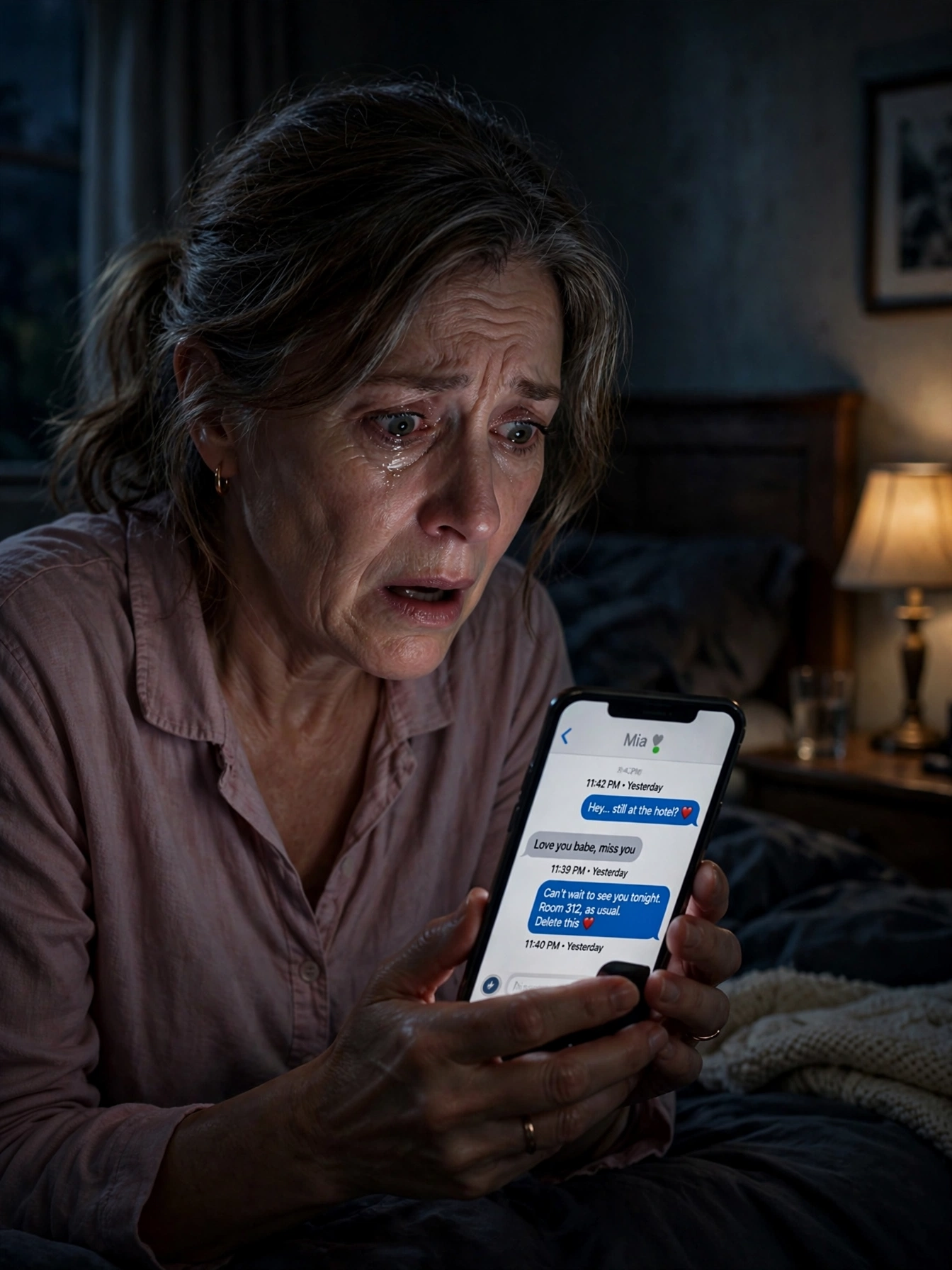
Last Tuesday, Paul’s phone buzzed on the nightstand at 2 AM. He was snoring — he has snored for twenty years, and I had long ago learned to sleep through it the way you learn to sleep through a train if you live near the tracks long enough. The screen lit up the dark bedroom.
The preview said: “I miss you. Last night was perfect. Same time Thursday?”
My hands went numb. I remember that specifically — not my heart racing, not tears, but my hands going numb, as if my body understood before my mind did and was shutting down the extremities to protect the core.
Last night, Paul had said he was working late. He came home at eleven, kissed my cheek, and fell asleep in his clothes. I had covered him with the blanket and felt fond of him. Fond. That is the word that haunts me now.
I picked up his phone. It was unlocked. He had never had anything to hide before — or so I believed, which amounts to the same thing as far as the lock screen is concerned. I opened the messages.
They went back six months.
Six months of “I miss you.” Six months of hotel receipts forwarded to his email. Six months of a woman named Lisa K. who apparently saw my husband every Thursday.
I scrolled. There were photos. I wish I had not looked at the photos, but I did, because once you have started you cannot stop — it is like pressing on a bruise to see how deep the pain goes.
I sat on the edge of our bed — the bed we had shared for twenty-eight years, the bed where I had recovered from two childbirths and the flu and a broken ankle — and I read six months of my husband’s other life.
Then I did something I never thought I was capable of. I typed a reply.
“Hi Lisa. This is Paul’s wife. I’d love to meet you. Coffee Thursday? Just us girls.”
She replied in two minutes. “Oh my god. He told me he was divorced.”
Divorced. Twenty-eight years, two children, a house we had paid off together, and he told her he was divorced.
We met at a café on Thursday at noon. I got there early and chose a table in the corner. Lisa was forty-eight, nervous, twisting her wedding ring — yes, she was married too, which I learned the way you learn everything in that conversation: all at once, and too late.
“He said his wife died,” she whispered. “Three years ago. He said he was lonely.”
I took out my phone and showed her our family Christmas photo from last year. All four of us in front of the tree. Her face crumpled.
“He was at my house for New Year’s,” she said. “He told me he spent Christmas alone.”
We compared notes. It was methodical, almost clinical — two women laying out evidence on a café table between the sugar packets and the napkin dispenser. Same restaurants. Same lies. The same Thursday pattern. He had told each of us the other didn’t exist. To me, Thursdays were his late nights at the office. To her, Thursdays were the one night a grieving widower allowed himself company.
Lisa was crying now. “I’m so sorry. I never would have—”
“I believe you,” I said. And I did. We had both been played by the same man with the same hands.
Then Lisa said something that chilled me in a way the affair hadn’t. “Diane… he told me he’s leaving ‘her’ — you — in the spring. He said he’s selling the house.”
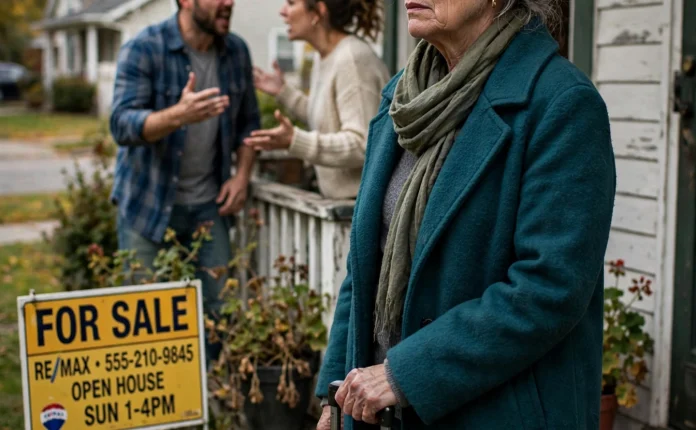
Selling the house. Our house. The one we had paid off last year, the one where our children had grown up, the one with the marks on the doorframe where we measured their heights.
I drove home in a daze. Paul was in the garage, tinkering with something. He looked up and smiled at me — smiled — and I walked in, held up his phone, and said:
“Hi, honey. Lisa says hi.”
The look on his face — I will remember it forever, the way the smile died before it finished forming, like a light going out in an empty room. But what he said next was worse than the affair.
He didn’t deny it. He didn’t beg. He said: “Diane. Sit down. We need to talk about the house.”
The house. Not “I’m sorry.” Not “forgive me.” Not “let me explain.” The house.
“What about the house?” I asked.
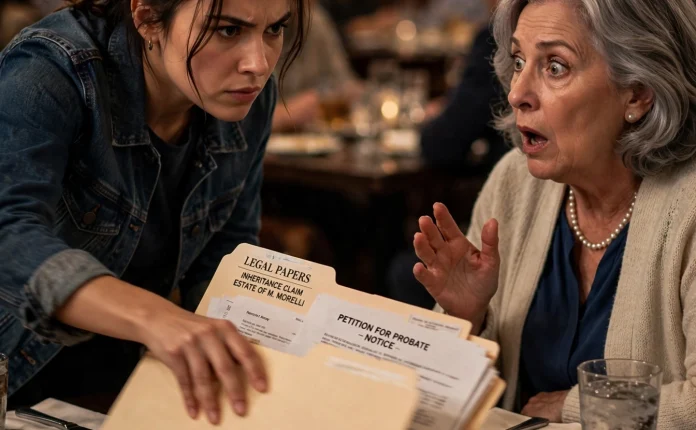
“I’ve been talking to a realtor. The market’s incredible right now. We could get seven hundred thousand. Split it, both start fresh—”
“Start fresh?” My voice was shaking so hard I could barely get the words out. “You’ve been cheating for six months, you told her I was dead, and you want to talk about real estate?”
He had the decency to look ashamed. It was a small decency, and it came far too late. “I was going to tell you. After the holidays—”
“After the holidays.” I laughed. It was a terrible sound, and I heard myself making it as if from another room. “You were going to blow up my life after the holidays. How considerate.”
I called a lawyer the next morning. Her name was Janet. She had heard it all before — I could tell by the way she didn’t flinch at any of it, the way she took notes in a steady hand. “Diane,” she said, “in this state, adultery affects the settlement. Document everything.”
So I did. The texts. The photos. The hotel receipts I found in his email, the ones he had been too careless or too arrogant to delete. Lisa gave me her statement in writing — she insisted on it, said it was the least she could do.
Paul tried to play nice. He suggested mediation, as if we were negotiating a fence line. He offered me the house if I “kept things quiet.”
“Quiet?” I said. “You told a woman I was dead, Paul. The quiet days are over.”
The divorce took eight months. Because of the adultery evidence — the texts, the photos, Lisa’s statement — I was awarded the house, sixty percent of the retirement accounts, and alimony for five years. Paul got the car and his Thursdays back.
Lisa divorced her husband too. He had known for months and hadn’t told her, which was its own separate betrayal, the kind that doesn’t make the story but hollows it out from underneath. Lisa and I have coffee once a month now. We are not friends, exactly. We are survivors of the same man, and that is a bond with its own grammar.
Last month, Paul called. “Diane,” he said, “I made the biggest mistake of my life.”
“You made a thousand mistakes,” I said. “The text at 2 AM was just the one that woke me up.”
I hung up. I felt nothing. And that nothing felt like freedom — the first clean thing I had felt in a year.
The house is mine. I repainted the bedroom a color Paul always hated — a deep, warm terracotta that makes the morning light look like honey. I got a dog, a rescue with one floppy ear who follows me from room to room. I sleep like a baby now, because the only phone buzzing at 2 AM is spam.
People ask me if I have advice. I am fifty-five years old and I have learned this: check the phone. Not because you are paranoid — because you deserve the truth. And if the truth is ugly, you deserve better than the man who made it ugly.
Twenty-eight years taught me that the best revenge isn’t anger. It’s a good lawyer, a fresh coat of paint, and a life that is finally, completely yours.