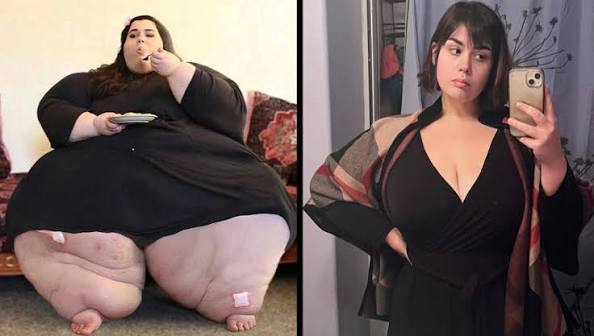
A transformation that captured viewers’ attention
Amber Rachdi weighed 657 pounds when viewers first met her on TLC’s My 600-lb Life in 2015
- The Oregon native struggled with limited mobility, anxiety and a difficult relationship with food
- At just 23, Amber needed help with everyday activities and feared what her future might hold
- She sought treatment from Dr. Younan Nowzaradan and underwent gastric bypass surgery
- Her widely reported 377-pound weight-loss milestone made her one of the show’s most memorable success stories
- Therapy helped her address anxiety and develop healthier ways to cope with emotional distress
- Later photographs revealed a striking transformation, but Amber has emphasized that her life is about more than her appearance
- In a December 2025 update, reporting on her own social-media video described an even larger total loss of approximately 470 pounds
- Amber has spoken candidly about loose skin, privacy and the pressures of being recognized online
Amber Rachdi’s appearance on My 600-lb Life introduced viewers to a young woman whose world had become painfully restricted. At 23, she weighed 657 pounds and struggled to move comfortably, leave home and manage ordinary activities without assistance. Years later, her transformation would become one of the program’s most widely discussed success stories. A reported 377-pound weight-loss milestone drew particular attention, but the significance of her journey reached beyond the number. Amber was working toward something more personal: a life with greater mobility, independence and room for experiences that had once felt out of reach.

The contrast between Amber’s early television appearance and later photographs is striking. Images shared over the years show someone exploring fashion, makeup and different hairstyles while presenting herself with a distinctive sense of style. Yet those photographs tell only part of the story. They cannot show every difficult decision, medical appointment or emotional challenge behind the change. Amber’s experience involved professional treatment, surgery, changes in eating habits and attention to her mental health. Reducing it to a dramatic before-and-after image would overlook the sustained work involved in changing a life that had become increasingly difficult to navigate.
Life at 657 pounds

When Amber appeared in the third season of the TLC series in 2015, severe obesity affected much of her daily routine. Her size made standing and walking difficult, while restricted mobility increased her reliance on the people around her. Activities that many young adults take for granted required preparation, assistance or considerable physical effort. Leaving home was not simply a matter of deciding where to go. The demands of moving around could make an outing uncomfortable and intimidating, narrowing her opportunities to participate in the world beyond her immediate surroundings.
Amber’s circumstances also affected how she thought about herself and her future. At an age when many people are beginning careers, developing relationships and exploring independence, she was dealing with major health concerns. Anxiety added another layer of difficulty, particularly when she considered the changes required to qualify for treatment. Her story showed how physical limitations and emotional distress can reinforce one another. Feeling anxious or discouraged could make changing familiar habits harder, while the consequences of those habits created further distress. Seeking help meant confronting both sides of that cycle rather than treating weight as an isolated issue.
A difficult relationship with food began early

Accounts of Amber’s story describe weight-related difficulties beginning in childhood, around the age of five. By adulthood, food had become connected to emotional coping as well as physical hunger. That history matters because it helps explain why a new diet alone could not address everything she was experiencing. Eating patterns developed over many years do not necessarily disappear when someone understands that their health is at risk. The challenge was not simply learning which foods to choose. It also involved recognizing why eating had become a familiar response to uncomfortable feelings.
Anxiety was an important part of Amber’s experience. She worried about whether she could follow Dr. Nowzaradan’s expectations and maintain the changes required for surgery. That fear could make the prospect of treatment feel daunting even though she wanted her circumstances to improve. Her journey illustrates why people facing severe obesity may need support that addresses emotional well-being alongside nutrition and medical care. It is possible to want change deeply while still feeling frightened by it. Amber’s willingness to proceed despite those concerns became an important part of her progress.
Turning to Dr. Now for help

Amber sought treatment from Dr. Younan Nowzaradan, the Houston-based surgeon widely known to viewers as Dr. Now. His program required her to make changes before undergoing bariatric surgery. The early phase was an opportunity to begin adjusting her eating habits and demonstrate that she could participate in the treatment plan. For Amber, this meant moving away from routines that had become deeply established. The first steps were less visually dramatic than the photographs that later circulated online, but they were essential to making further medical treatment possible.
She lost weight before surgery and eventually qualified for gastric bypass. That approval represented a major milestone, but it was not the conclusion of the process. Bariatric surgery can help people manage food intake and achieve substantial weight loss, yet it also requires follow-up care and lasting adjustments. Amber still needed to build habits that supported her health after the operation. Her experience challenges the assumption that surgery makes the rest of the journey effortless. It provided medical assistance, while the ongoing responsibility of eating differently, attending appointments and coping with difficult emotions remained.
Surgery was one part of a larger change

After gastric bypass, Amber continued working toward improved health and mobility. Losing weight reduced some of the physical burden she had been carrying, opening possibilities that were previously difficult to imagine. However, progress was not limited to what could be measured at a weigh-in. Developing more sustainable routines and learning to manage anxiety were also important. Her story became compelling because it showed these aspects unfolding together. A medical procedure helped create an opportunity for change, but that opportunity still had to be supported by daily decisions and attention to the problems surgery could not resolve.
Reports about Amber’s weight loss have not always used the same totals or clearly distinguished between different stages of her journey. Some accounts describe approximately 267 pounds lost during the original televised period, while others highlight a 377-pound milestone. Those figures should not automatically be treated as measurements taken at the same time. The 377-pound loss remains a widely reported part of her story, but it is best understood as a milestone rather than a verified statement of her current weight. Her progress continued beyond the original episode, making the timing of any number important.
The emotional work behind the transformation

Amber began attending therapy after surgery, according to reporting on her journey. That support helped her examine anxiety, identify triggers and consider healthier coping mechanisms. These were not minor additions to a physical transformation. They addressed patterns that could continue affecting her life even after she lost a substantial amount of weight. Medical treatment could change how much she ate, but it could not automatically remove the feelings associated with food. Therapy offered a way to explore those experiences more directly and develop responses that were not built entirely around eating.
This part of Amber’s story is easy to miss when attention focuses on photographs. A new hairstyle or a smaller clothing size can be visible immediately, while emotional progress is often private and less straightforward. Learning to recognize a trigger, tolerate discomfort or ask for help may not produce an obvious image, but those changes can be meaningful. Amber’s experience suggests that a successful outcome should not be judged solely by appearance. Greater understanding of her own needs and better tools for managing anxiety were important elements of the broader life she was building.
Greater independence meant more than a smaller body
For someone who had needed help with everyday tasks, improved mobility carried practical significance. Weight loss could make it easier to move around, participate in activities and make choices without the same level of physical difficulty. These changes matter because independence is not an abstract reward. It affects how a person spends their time, interacts with others and manages ordinary responsibilities. Amber’s transformation attracted attention for its scale, but the ability to live with fewer restrictions was a more substantial achievement than simply looking different in a photograph.
Her changing circumstances also created room for self-expression. Later images showed her interest in makeup, clothing and personal style, helping audiences see more of her personality than the original episode had captured. That visibility should not imply that she became worthy of attention only after losing weight. She was already a person with interests, preferences and ambitions. The difference was that viewers were seeing her outside the narrow context of a medical crisis. Her online presence offered a reminder that no one should be permanently defined by the most vulnerable period of their life.
A recognizable face beyond reality television
Amber developed a substantial social-media following after her television appearance. Fans watched for updates, admired her style and continued sharing photographs associated with her transformation. That ongoing interest made her recognizable long after the original episode aired. For many viewers, she represented evidence that the difficulties documented on My 600-lb Life did not have to determine every chapter that followed. Yet a large audience also meant that ordinary changes in her posting habits could be interpreted as clues about her health, appearance or personal circumstances.
Despite being described as an influencer, Amber has pushed back against the idea that social media is her livelihood. In a January 2024 update discussed in subsequent reporting, she explained that she worked in information technology and had not earned money as an influencer. That distinction reveals the gap between public perception and everyday reality. Followers might see a familiar television personality, while Amber was also managing work and ordinary demands on her energy. Maintaining an online audience was not necessarily her priority, nor did her previous visibility create an obligation to keep posting.
Amber asked to be allowed a private life
When Amber became less active online, some people speculated that she had regained weight. She addressed those assumptions in 2024, explaining that she was tired, working extensively and focused on other matters. Her response challenged the notion that a social-media absence must indicate a failed transformation. People stop posting for many reasons, and a quiet account does not provide reliable evidence about their health. Amber’s comments emphasized that the years since filming had brought a life beyond the television story, including responsibilities that did not need to be displayed for an audience.
She also expressed a clear wish to be allowed to gain or lose weight without public scrutiny. That request is particularly significant for someone whose body had become central to her public identity. Appearing on a weight-loss program does not mean consenting to endless commentary about every later photograph. Amber’s position makes room for a more respectful understanding of recovery and health: progress may change, circumstances may shift, and the person involved remains entitled to privacy. Fans can appreciate what she achieved without expecting access to every measurement or treating her appearance as public property.
Later progress went beyond the 377-pound milestone
The 377-pound figure in many headlines does not represent the final publicly reported chapter of Amber’s journey. A December 2025 report covering one of her Instagram videos described a total loss of approximately 470 pounds. That later figure should be presented with its date and context rather than used to imply a continuously verified current weight. It nevertheless indicates why older headlines can offer an incomplete picture. Amber’s life did not stop when a particular article was published, and the number that made her transformation famous was one stage in a much longer experience.
In that later video, Amber focused on something before-and-after stories often leave out: loose skin. She showed the skin beneath her arms and spoke about living with it after substantial weight loss. The update offered a more realistic view of transformation than carefully posed photographs alone. A smaller body can still come with practical challenges, and losing hundreds of pounds does not necessarily result in the appearance people imagine. Amber’s openness made those realities visible without treating them as evidence that her progress was incomplete or less valuable.
Loose skin and the reality behind the photographs

Reporting on the December 2025 update said Amber hoped to have skin-removal surgery when she could afford it. Until then, she was managing the extra skin as part of daily life. That detail highlights a financial aspect often missing from dramatic transformation stories. Medical changes can produce further needs, and additional procedures may be costly or difficult to access. Weight loss does not guarantee that every resulting concern will be resolved immediately. The practical realities continue after the celebratory headlines, requiring patience and decisions shaped by resources as well as personal preference.
Amber approached the subject with humor, playfully comparing the loose skin beneath her arms to “Batman” wings. Her tone did not deny that the skin could be inconvenient. Instead, it showed that she could acknowledge a challenge without allowing it to become the sole definition of her body. The update gave followers a glimpse of someone living with the results of major change rather than presenting a flawless finish. That honesty adds depth to her story: she could recognize what remained difficult while still accepting and appreciating the life she had worked to build.
Why her journey continues to resonate
Amber’s transformation remains memorable because it involved more than a change in appearance. Viewers first saw a young adult facing serious health concerns, restricted mobility and anxiety. Later updates revealed someone with a career, a personal style and boundaries about what she wanted to share. Those developments make the story more substantial than a collection of weight-loss statistics. The number of pounds lost is significant, but it does not capture every form of progress. Independence, emotional awareness and the ability to direct attention toward interests beyond weight are also meaningful parts of the picture.
Calling Amber a “living legend” may express a fan’s admiration, but the most compelling version of her story does not require presenting her as superhuman. She has described tiredness, emotional difficulty and the desire to be left in peace. Those admissions do not weaken her achievements. They remind readers that substantial progress can coexist with ordinary vulnerability. A person can make extraordinary changes and still have difficult days, shifting priorities or concerns about their appearance. Allowing Amber that complexity is more respectful than expecting her to remain a permanently upbeat symbol of transformation.
More than a before-and-after story
From her starting weight of 657 pounds to the widely reported 377-pound milestone and later updates, Amber’s journey reflects sustained change supported by medical care and emotional work. Surgery played an important role, but so did adjusting habits, addressing anxiety and continuing beyond the period captured by television cameras. Her photographs make the physical difference easy to see. The fuller story explains why that difference should not be mistaken for a simple process—or why one snapshot cannot establish everything about her health, happiness or current circumstances.
Ultimately, Amber Rachdi’s lasting impact lies in the life beyond the headline. She is not only the young woman viewers met during a vulnerable period, nor is she merely the subject of a striking later selfie. She is someone who sought help, made substantial progress and continued developing a life outside the show. Her transformation deserves recognition, but so does her right to define what comes next. The most meaningful ending is not a perfect photograph or a final number on the scale. It is the freedom to keep living without being reduced to either.