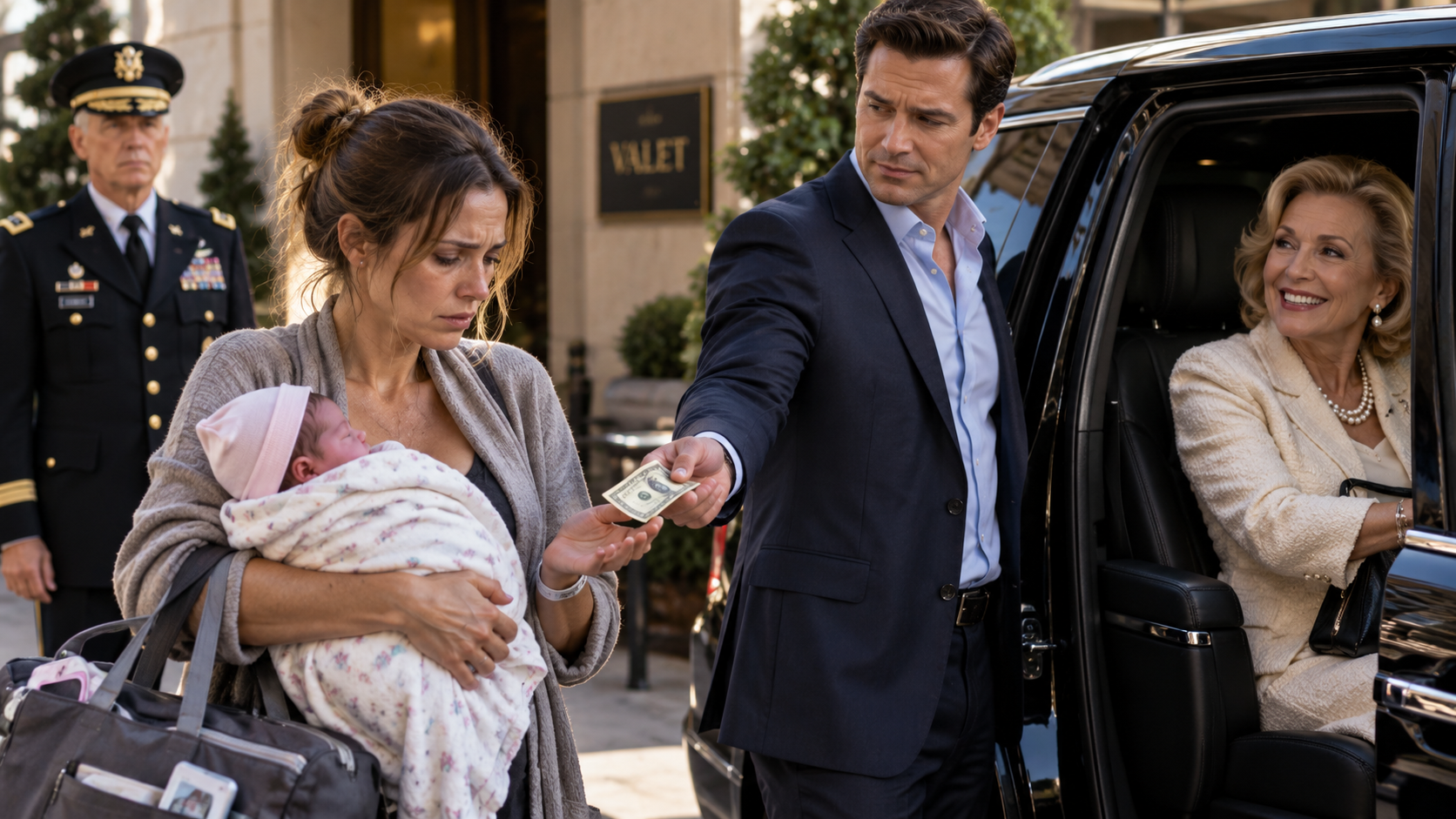
The silence on the other end of the phone lasted so long I thought the call had dropped. “General Brooks,” Dominic finally repeated, his voice smaller than I’d ever heard it. “Charles Brooks. The one who—” He stopped himself, and I could practically hear him recalculating everything he thought he knew about the woman he’d left standing outside a hospital with twelve dollars and a newborn.
“The one who commanded the Third Infantry Division,” I said. “The one who spent two years at the Pentagon before you and I ever met. Yes, that Charles Brooks. My father.” I let that settle before continuing. “I never told you because I wanted you to love me, not the access my name might give you. I’m very glad now that I never told you, because it means everything you did to me these past nine months, you did believing there was nothing behind me at all.”
He tried calling back three more times that evening. I let my father’s attorney, a sharp, unflappable woman named Denise Faulkner, handle every subsequent conversation instead. Denise had already begun drafting divorce paperwork by the time Dominic showed up at the guest house gate that night, hoping to talk his way past the security detail my father had quietly stationed there the moment I’d called him from the bus.
“I just want to see my son,” Dominic told the guard, loud enough that I could hear him from the porch. My father stepped outside before I could, still in the green uniform jacket he’d worn to a ceremony that afternoon, medals catching the porch light.
“Mr. Castillo,” my father said, his voice calm in the particular way that made subordinates straighten their spines for thirty years. “You will see your son through the custody arrangements our attorneys establish, on a schedule that accounts for what you did to his mother five days after major surgery. Not before, and not by showing up unannounced at a gate.”
Dominic tried to argue, mentioning investors, mentioning the embarrassment at the restaurant, mentioning everything except the actual harm he’d caused. My father listened for exactly as long as military patience required and no longer. “You had a wife recovering from a cesarean section,” he said. “You gave her twelve dollars and a bus stop. I have led men through combat who showed more basic human decency to strangers than you showed my daughter. This conversation is over.”
The following months moved with the kind of quiet, thorough efficiency I imagine my father had applied to every serious operation of his career. Denise handled the divorce filing, citing abandonment and neglect during postpartum recovery, supported by hospital discharge records, nurse statements, and the timestamped security footage from St. Vincent’s showing exactly what had happened on that sidewalk. Dominic’s attorney tried to argue for shared custody without restriction, but the judge, reviewing the same footage, granted me primary custody with supervised visitation until Dominic completed a court-mandated parenting course.
Dominic’s business, which had relied heavily on investors impressed by a lifestyle built partly on my father’s SUV and the appearance of connections he didn’t actually have, began quietly unraveling once word spread through his circle about the divorce and its cause. Nobody needed to spread rumors; the facts alone were damaging enough once people started asking why his wife had left him five days after giving birth.
I moved into a modest apartment near my father’s estate rather than staying in the guest house long-term, wanting to build something that was mine rather than simply borrowed from his name a second time. I hired a nanny for the mornings so I could finish the graduate degree in public policy I’d paused when I got pregnant, work that had nothing to do with my father’s rank and everything to do with the career I’d been quietly building for myself since college.
“You never needed my name to be capable,” my father told me one evening, watching me feed Leo while balancing a stack of coursework on the kitchen table. “You just needed people around you who could see that without being told.”
Victoria called twice in the following months, each time attempting some version of reconciliation on Dominic’s behalf, framing his behavior as “stress” and “new-father exhaustion” rather than the pattern it actually was. I declined both calls politely and let Denise handle any further communication from his family directly.
Six months after the divorce was finalized, Dominic’s visitation remained supervised, following two missed appointments that the court didn’t view kindly, and his business had shrunk to a fraction of what it had been, its early growth revealed to have depended more on borrowed appearances than genuine capital. I felt no satisfaction in that particular consequence, only a quiet confirmation of something I’d suspected long before the hospital sidewalk: that the man I married had built very little of substance underneath the confidence he wore so easily.
Leo grew steadily through that first year, and I found myself, for the first time since the wedding, building a life shaped entirely around choices I made for myself rather than accommodations I made for someone else. I finished my degree in the spring, walked across the stage with Leo watching from my father’s arms in the front row, and accepted a policy position with a nonprofit focused on maternal healthcare access, work that felt, given everything that had led me there, like the most honest use of my name I could imagine.
One year after that morning outside St. Vincent’s, I stood in my own apartment’s small backyard, watching Leo take wobbling steps across the grass toward my father, who knelt waiting with the same steady patience he’d shown every difficult moment of that year. Dominic’s visitation had improved slightly by then, supervised sessions transitioning cautiously toward unsupervised ones as the court required, though our relationship remained purely functional, built around Leo’s needs and nothing more sentimental than that.
“You did left him,” my father said that afternoon, echoing his own words from the phone call that started everything, watching Leo collapse giggling into his arms. “And look what you built instead.”
I thought about the twelve dollars still folded somewhere in an old coat pocket, a small, absurd artifact from the last morning I let anyone treat me as smaller than I actually was. I never spent it. I kept it as a reminder, not of Dominic’s cruelty, but of the exact moment I finally stopped allowing it.