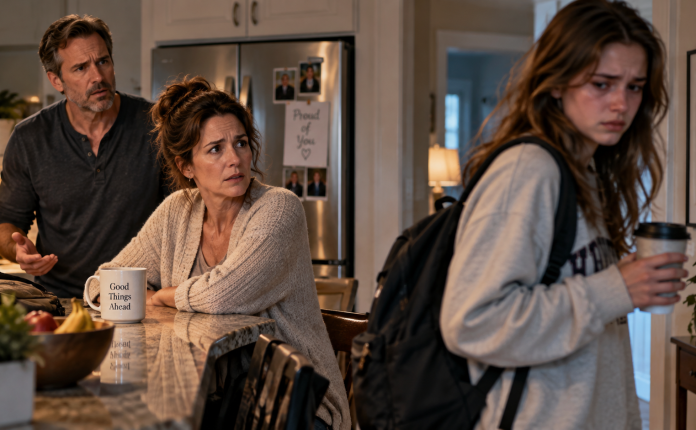
Liam came alone that afternoon, sitting across from me at the same kitchen table where his father had once promised we’d help him “start well.” He looked younger than his twenty-eight years, the way people sometimes do when they’re finally facing something they’ve spent months avoiding.
“I’ve been going through the group chat all morning,” he said. “Every message from the last two years. I never noticed how many times we asked you for something and just assumed you’d say yes.”
“You usually did,” I said. “That’s not entirely your fault. I trained you to expect it by never saying otherwise.”
“The seat wasn’t even really about the seat,” he said quietly. “I think I knew that on the platform. I just didn’t want to deal with what it actually meant.”
I pulled out the folder I’d prepared the night before, the caterer cancellations, the florist notice, the printed transaction history from the savings account. I slid it across the table. “I want you to see all of it. Not to punish you. So you understand exactly what’s been happening, in full, instead of piece by piece.”
He read through it slowly, his jaw tightening at the transfers into Jessica’s account, the reimbursed bridal-shower receipt, the total the caterer had already collected before I cancelled. “I didn’t know it added up to this much,” he admitted. “I don’t think Jessica did either. We just kept asking, and you kept saying yes, so it never felt like a real number to either of us.”
“It was always a real number,” I said. “I just never made you look at it.”
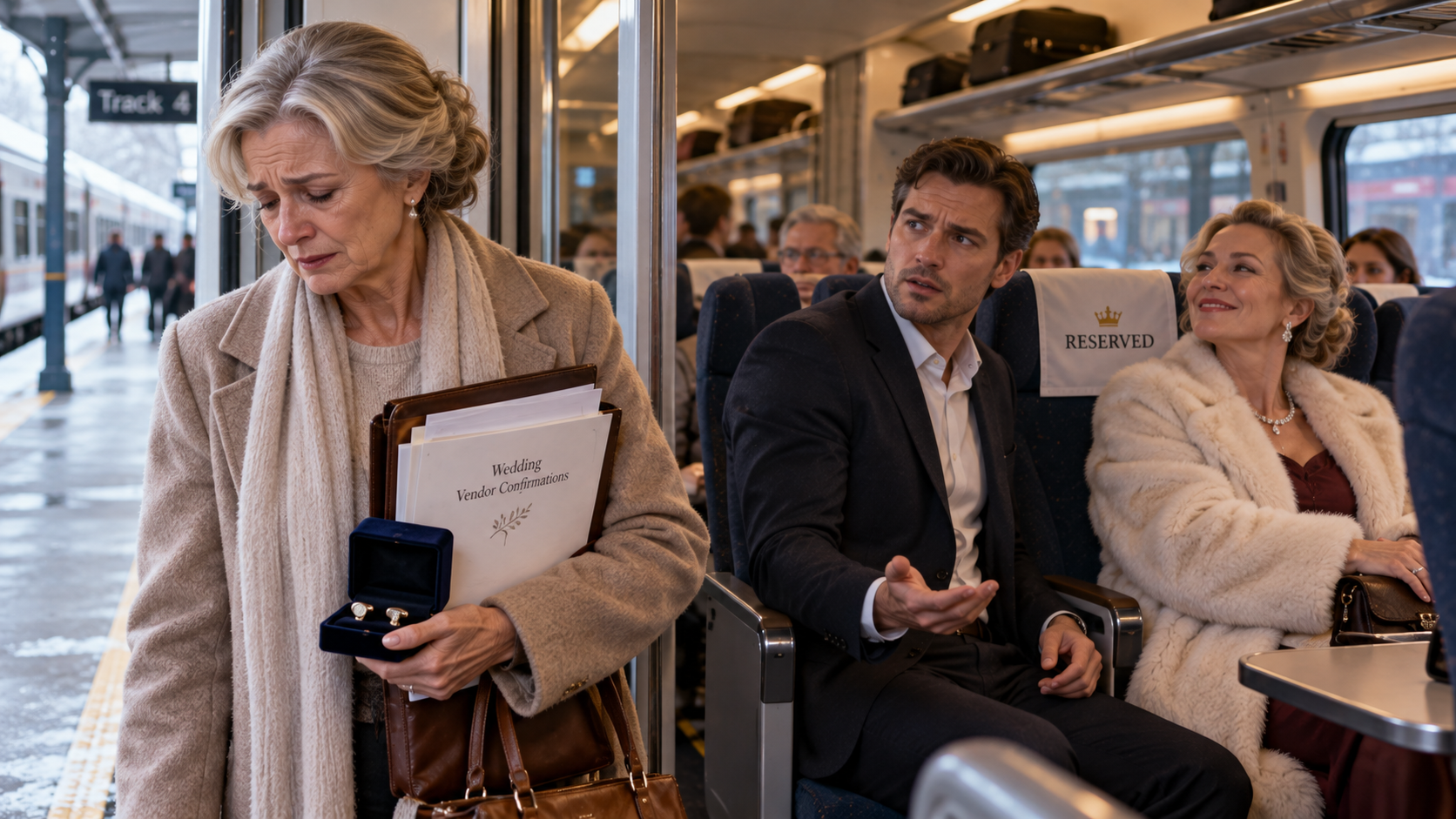
We talked for almost two hours that afternoon, longer than any conversation we’d had in years that wasn’t centered on wedding logistics. I told him about the promise his father and I made, about the difference between helping and carrying, about watching that difference disappear so gradually I hadn’t noticed until a stranger’s cashmere coat was sitting in my reserved seat.
“What happens now?” he finally asked. “With the wedding, I mean. Some of that stuff can’t be un-cancelled.”
“That’s between you and Jessica,” I said. “I’m still coming to your wedding, whatever size it ends up being. I’m still your mother. But I’m not underwriting a lifestyle where my presence and my money got treated as separate, negotiable things.”
Liam and Jessica spent the following two weeks scaling the wedding down considerably, moving it from the original venue to a smaller inn that Jessica’s coworker had recommended, cutting the guest list nearly in half, and covering the remaining vendor costs themselves by dipping into savings neither of them had wanted to touch. It wasn’t the wedding they’d originally planned with my money, but it was, by every account afterward, the one that actually reflected what they could sustain on their own.
Jessica and I had one difficult conversation during that stretch, shorter and more honest than I expected. “I think I convinced myself you didn’t mind, because it was convenient to believe that,” she said. “I’m not saying that to excuse it. I’m saying it because I actually mean it now.”
“I believe you,” I said. “I’d like to see it reflected in how things go from here, not just in what you say today.”
The wedding took place seven weeks later than originally planned, smaller, simpler, paid for almost entirely by Liam and Jessica themselves, with the exception of one gift I chose to give freely: George’s cufflinks, which I placed in Liam’s hands the morning of the ceremony, the same velvet box I’d been carrying on that train the day everything finally came into focus.
“Dad would have liked this version better anyway,” Liam said, turning the box over in his hands. “Smaller. Less performance. More like what you two actually had.”
I didn’t disagree.
Maya stood beside me at the ceremony, and afterward, at the small reception, Susan approached me with an envelope. “I know you said you didn’t want reimbursement,” she said, “but I needed to do this for myself, not really for you.” Inside was a check covering the bridal shower and both deposits she’d once claimed to be short on. I accepted it, not because the money mattered as much anymore, but because the gesture did.
Over the following months, Liam rebuilt something with me that had quietly eroded over two years of automatic yeses: he called to check in without needing anything, he asked before assuming, and when Jessica became pregnant the following spring, he asked, plainly and without entitlement, whether I’d be comfortable helping with a portion of the nursery costs. I said yes, gladly, because it was finally a request rather than an assumption.
One year after that train pulled away from the platform without me, I sat in my kitchen again, the same table, the same quiet house, though it felt different now, lighter somehow, the way a room feels once you’ve finally stopped holding your breath in it. Liam called that afternoon, not about money, not about logistics, just to tell me Jessica had felt the baby kick for the first time.
“We’re naming her Nora,” he said. “After Dad’s mother. Jessica thought you’d like that.”
I did. I sat with the phone against my ear for a long moment after we hung up, thinking about seat 12A, the yellow legal pad, the folder of cancellations that had once felt so final and now simply felt like the moment I’d finally learned the difference between helping my son start well and quietly disappearing so he could.