I spent weeks in the hospital fighting to survive, and not a single person from my family came to visit me. Not my mother. Not my father. Not my sister.
Then, one month after I was finally discharged, my father suddenly texted me.
“We need $12,000 for your mother’s surgery.”
I sent him one dollar and replied:
“Good luck.”
A few hours later, the police were standing on my porch because of the accusation my father had made against me.
The first sound I heard when I woke up was a machine counting the seconds I had almost lost.
Beep.
Silence.
Beep.
The steady sound came from somewhere beside me. Above me, harsh fluorescent light glowed through a plastic ceiling panel. The room smelled like disinfectant, metal rails, and the lemon-scented lotion nurses used after washing their hands again and again. When I tried to swallow, my throat burned.
“Easy,” someone whispered.
I slowly turned my head and saw Ethan, my husband, sitting in a blue hospital chair that looked too small for all the fear he had carried. His shirt was wrinkled. His beard had grown unevenly. Dark circles shadowed his eyes. One of his hands covered mine, as if he had been afraid I would disappear the moment he let go.
When he realized I was awake, relief broke across his face.
“Oh, thank God.”
My name is Mallory Hayes. I was thirty-three, a senior payroll manager in downtown Omaha, and for most of my life, I had mistaken being useful for being loved.
The last thing I remembered was standing near the copier at work, reports pressed against my chest. My coworker Jenna had called my name from the hallway.
Then the floor tilted.
And the ceiling rushed toward me.
“How long?” I whispered.
Ethan squeezed my hand so tightly his knuckles turned pale.
“Nine days since you collapsed,” he said. “You were unconscious for most of it.”
Nine days.
I stared at him, trying to make sense of that number, but everything in me felt slow and distant, like I had been poured back into my body before it was ready. My chest ached. My muscles felt hollow. There was an IV taped to my arm. A pulse clip glowed red against my finger.
“What happened?”
Ethan looked down for a second before answering.
“Your appendix ruptured,” he said quietly. “It turned septic before they caught it. The doctors said…” He stopped and swallowed. “They said if Jenna hadn’t called 911 when she did, you might not have made it.”
Might not have made it.
That sentence settled over the room like dust.
I closed my eyes.
And my family never came.
Not once.
Not during surgery. Not while I was unconscious. Not while I was learning how to sit up again without crying. Not while I threw up broth and pain medicine and tried to remember how to be grateful for my own breathing. My mother texted exactly twice. The first time was to ask if the doctors thought it was stress-related because “these things usually are.” The second was a thumbs-up after Ethan told her I was stable.
My father never called at all.
My sister, Melanie, reacted to Ethan’s Facebook update with a praying hands emoji and then disappeared back into whatever life she had decided mattered more.
Ethan never said anything cruel about them.
He didn’t have to.
Their absence did all the talking.
When I was finally discharged, I came home weaker than I had imagined possible. Walking from the bedroom to the couch felt like hiking uphill. My hair started falling out in the shower. Food tasted wrong. Sleep came in thin, nervous scraps. Recovery was not dramatic. It was humiliating. It was needing help to stand. It was crying because opening a jar hurt. It was realizing how close death had come and then having to fold laundry anyway.
My family remained silent through all of it.
Not because they didn’t know.
Because they did.
My father and mother had always been that way. Useful when they needed something. Distant when someone else needed care. Growing up, I learned very early that love in our house came disguised as transaction. If I helped, if I fixed, if I paid, if I showed up, then I belonged. If I needed, I was inconvenient.
Still, some stupid part of me had expected illness to change things.
Apparently almost dying was not enough to make me worth the drive.
Then, one month after I came home, my phone lit up with my father’s name.
No hello.
No how are you feeling.
No acknowledgment that I had nearly died.
Just this:
We need $12,000 for your mother’s surgery.
I read it three times.
Then I laughed.
Not because it was funny.
Because it was so perfectly them that it almost felt scripted.
A month of silence. Then a bill.
I stared at the message for a long time before opening my banking app. Ethan was in the kitchen making tea. Sunlight was coming through the window in those soft late-afternoon stripes that usually made the house feel calm. But sitting there with that text glowing in my hand, I felt something in me harden with an almost peaceful clarity.
I sent one dollar.
Then I replied:
Good luck.
My father answered immediately.
What the hell is this?
I locked my phone and set it face down on the coffee table.
For once, I did not explain myself.
For once, I did not rush to fix the discomfort they created.
I just sat there and let the silence belong to them.
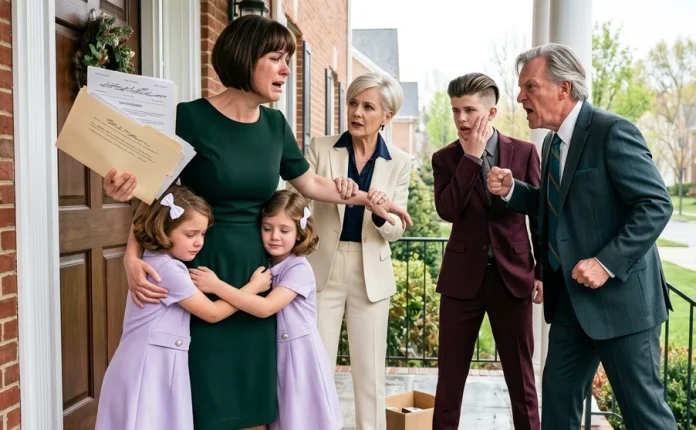
Three hours later, the police knocked on my door.
Not one officer.
Two.
That was the first thing I noticed.
The second was Ethan’s face when he looked through the peephole and turned back toward me.
“Mallory,” he said carefully, “did you do something I should know about?”
I stood up too fast and felt the pull in my abdomen where the surgical pain still flared if I moved wrong. My whole body went cold. For one wild second, I actually wondered if my father had somehow managed to twist the one-dollar transfer into fraud or harassment or some other ridiculous claim.
I opened the door.
The older officer gave me a measured look. “Mrs. Hayes?”
“Yes.”
“We need to ask you a few questions regarding a complaint your father filed this afternoon.”
There it was.
Of course.
I stepped back and let them in. Ethan stayed close enough beside me that I could feel the heat coming off his arm. The officers remained standing in the front room, hats in hand, professional but uneasy in the way people get when they already know they’ve walked into family ugliness.
“What kind of complaint?” I asked.
The younger officer glanced at his partner, then at his notebook.
“Your father alleges that you have been withholding funds that belong to your mother and may have accessed money promised for her medical care.”
I stared at him.
Then at Ethan.
Then back at the officer.
“Promised by whom?”
The older one answered that. “By you, according to him.”
I actually laughed again, softer this time.
“No,” I said. “What I sent him was one dollar and the words good luck.”
The younger officer blinked. Clearly that was not what the report had sounded like.
I motioned toward the couch. “Please sit down. Both of you. Because whatever story my father told you, I promise it gets stupider from here.”
They sat.
I showed them the texts.
All of them.
His original message asking for $12,000.
My one-dollar transfer.
His furious response.
Then the string of escalating messages after that, each one uglier than the last. Ungrateful. Cold. Disrespectful. A disappointment. Then the part that made the older officer’s expression flatten completely:
After all we spent on you, you owe this family.
There it was.
Not concern for my mother.
Not fear about surgery.
Debt.
I opened my laptop and logged into the shared family spreadsheet I had not touched in months. I keep records. Payroll work teaches you to keep records, but being raised by my parents taught me even earlier. There, in neat dated columns, sat fifteen years of history: car repairs for my father, credit-card bailouts for my sister, mortgage help for my parents, dental work, utility shutoff rescues, “temporary” loans that were never temporary and certainly never loans.
Ethan went to the filing cabinet and brought back the folder.
Because yes, there was a folder.
Every transfer.
Every check.
Every wire.
Every promise to repay.
I handed the top page to the older officer.
He read the number silently.
Then he looked up.
“You gave them this much?”
I nodded.
Over the years, it totaled just over $186,000.
That made the room go very still.
The younger officer turned slowly toward me. “And they’re accusing you of withholding family money?”
I leaned back against the arm of the couch, suddenly more tired than angry.
“That would be the part where my father mistakes my refusal to keep funding them for theft.”
Ethan crossed his arms. “They didn’t visit her once in the hospital.”
I did not mean to cry at that.
But I did.
Because somehow that was still the part that hurt most. Not the accusation. Not the police. Not even the money. It was that I had almost died, and the same people who could not bother to sit by my hospital bed for ten minutes suddenly had the energy to mobilize law enforcement over a boundary.
The older officer closed the folder and stood.
“I think we have what we need.”
But before they left, he hesitated.
Then he said, “Ma’am… if your father contacts you again like this, you may want to consider filing your own report. This is beginning to look more like harassment than misunderstanding.”
After the door shut behind them, I sat down so hard the couch springs complained.
Ethan knelt in front of me and took both my hands.
“You okay?”
No.
I wasn’t.
But I was clearer than I had ever been.
Because something about seeing police officers stand in my living room over a lie my father told had finally burned away the last soft, hopeful part of me that kept trying to believe my family might change if the circumstances got serious enough.
They wouldn’t.
Not for illness.
Not for fear.
Not for almost losing me.
Not for anything.
The next morning, I called the hospital where my mother’s surgery was supposedly scheduled.
There was no surgery.
Not under her name.
Not in the last month.
Not in the next three.
I thanked the billing clerk, hung up, and just sat there at the kitchen table staring at the wall.
Even that had been a lie.
Not desperate.
Not panicked.
Calculated.
They had invented a medical crisis to get money out of the daughter they could not even pretend to care about when she was the one in a hospital bed.
That was the moment I blocked all three of them.
My father.
My mother.
My sister.
Then I called a lawyer.
Not because I wanted drama.
Because I wanted peace.
A cease-and-desist letter went out that week. So did a formal notice regarding any future false reports or fraudulent claims made in my name. I changed my banking credentials, froze the old linked emergency account my parents still had partial visibility into from years ago, and pulled every last root of access they had ever managed to grow into my life.
My father left one voicemail before the block fully took.
His voice was thick with outrage.
“You’re really choosing your husband over your family?”
I saved it.
Not because I needed proof anymore.
Because I wanted to remember the wording.
He thought family was the people who took.
He thought family was the people I owed.
He never understood that the man sleeping on a plastic hospital chair for nine days while I fought to survive was family. The one who washed my hair in a hospital sink. The one who tracked every medication. The one who held my hand while I relearned how to stand without shaking.
That was family.
Not blood that invoices you for existing.
A month later, I got stronger.
Then stronger still.
I went back to work part-time, then full. I stopped checking my phone with dread. I stopped waiting for the next emergency that would somehow become my bill. I stopped mistaking usefulness for love.
Sometimes people ask if I regret sending the one dollar.
I don’t.
It was the cleanest sentence I had ever spoken to them.
Not because it was cruel.
Because it was accurate.
That was exactly what they were entitled to from me after all those years.
A token.
A coin.
A final receipt.
Good luck.
I meant it then.
I mean it now.