My husband, Mark Whitman, had been buried that morning in the black suit I had picked out with trembling hands.
By four o’clock that same afternoon, I was standing on the porch of our suburban Pennsylvania house with our two children, sixteen-year-old Noah and nine-year-old Lily, while Mark’s parents blocked the entrance like bouncers at a place grief had apparently not made them human enough to leave open.
My father-in-law, Richard, held the front door key like it was a weapon. Beside him stood my mother-in-law, Elaine, dressed in a dark wool coat, dry-eyed and rigid, her mouth set in that thin line she always wore when she thought cruelty counted as dignity.
“This house belongs to the Whitman family,” Richard said. “You and the children can stay with your sister until everything is settled.”
I stared at him, too exhausted to process that kind of betrayal so quickly.
“This is our home.”
Elaine’s eyes moved over my secondhand black dress, then down to Lily’s worn shoes.
“Mark supported you for years, Julia. Now he’s gone. We are not going to support you too.”
Noah stepped in front of me instantly.
He was sixteen, grieving, taller than he realized, and still just young enough to believe decency might stop adults from becoming monsters.
“Don’t speak to my mom like that,” he said.
Richard’s face changed at once.
“Watch your mouth, boy.”
“He just buried his father,” I said. “You do not get to—”
I never finished.
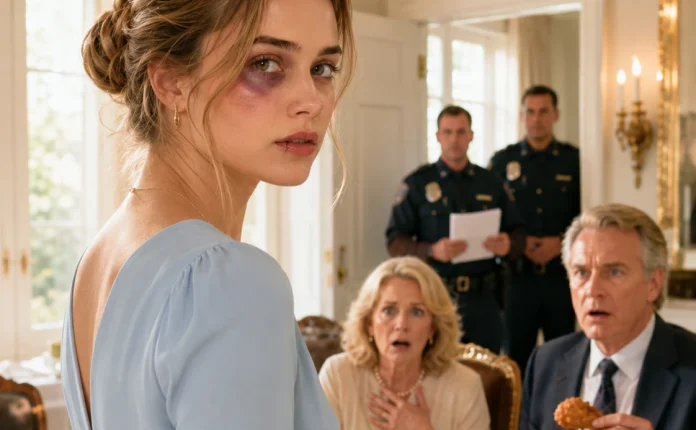
Richard swung his hand across Noah’s face so hard the sound cracked through the porch like a branch snapping. My son stumbled sideways into the railing. Lily screamed and clutched the side of my coat with both hands.
Something inside me went perfectly still.
Not numb.
Sharp.
I moved toward Noah, but Elaine was faster. She grabbed my left hand and yanked my wedding ring from my finger so violently the metal scraped skin.
“This was my mother’s diamond,” she said. “It was never yours.”
For eleven years I had worn that ring while loving their son through long hospital waits, chemo scans, mortgage stress, nights when the pain came back and we both pretended it hadn’t, and the quiet terror that cancer would take him before our children were grown.
They had smiled at church and called me family.
Now they looked at me like I was a bill they refused to pay.
I did not beg.
That may have disappointed them most.
I checked Noah’s cheek, took Lily’s hand, and walked back to the car with my spine straight and my heart hitting my ribs so hard I thought I might be sick. Noah got in beside his sister without a word. His face was already reddening where Richard had hit him, but he said nothing. That silence frightened me more than crying would have.
Inside the glove compartment was the sealed brown folder Mark had handed me two months before he died.
He had been sitting in the recliner by the window with a blanket over his knees, thinner than he wanted me to notice, calmer than I was. He made me promise not to open it unless I truly needed to.
At the time, I hated the way he said it.
Like he already knew.
My hands shook as I broke the seal.
The first page was a letter in Mark’s handwriting.
Julie, if they turn against you, do not argue. Call Attorney Rebecca Hale. The house is yours. The lake property is yours. The business shares are in a trust for you and the kids. Mom and Dad know nothing.
I stopped breathing for a second.
Noah looked over from the passenger seat. “Mom?”
I kept reading.
There were account numbers. Trust documents. Deed copies. Corporate filings. A notarized letter appointing Rebecca Hale as immediate executor of private instructions separate from the estate process his parents thought they understood. And clipped behind all of it was a second handwritten note, shorter this time.
I knew they would show themselves the moment I was gone. Let them. Then let Rebecca handle the rest.
I closed my eyes.
Even dying, Mark had still been protecting us.
The tears came then, sudden and hot and useless. I bent over the folder with one hand pressed to my mouth, trying not to fall apart in front of the children, and failed anyway. Noah reached across the seat and gripped my wrist the way Mark used to when he wanted to steady me without interrupting.
“What is it?” he asked quietly.
I looked at both of them.
Then I said the first true thing that had entered my body all day.
“Your father knew.”
That changed everything.
I called Rebecca Hale from the driver’s seat while Richard and Elaine still stood on the porch behind us, probably congratulating themselves on how efficiently they had removed the burden from their son’s life. Rebecca answered on the second ring in the clipped, controlled voice of a woman who had long ago learned how to organize disaster faster than most people can describe it.
“I was wondering when you’d call,” she said.
That sentence alone nearly undid me.
I told her where I was. What had happened. The slap. The ring. The lockout. The children in the car. She listened without interrupting, then said, “Good. Stay exactly where you are for ten more minutes.”
“Good?” I repeated.
“Yes,” she said. “Because if they removed you physically and denied you entry before formal probate disclosure, they just made this much easier.”
That was the first moment the day tilted.
Not into safety.
Not yet.
But into movement.
By the time Rebecca arrived, Richard and Elaine were still on the porch. She stepped out of a black sedan carrying a slim leather briefcase and the kind of expression that makes men like my father-in-law realize too late they have mistaken noise for power. She walked straight up the path without glancing at me first, as if she already knew I needed one person in the scene who was not emotionally shattered.
Richard tried bluster.
“This is a family matter.”
Rebecca handed him a business card without slowing down. “No. It was. Now it’s legal.”
Elaine’s eyes narrowed. “Who are you?”
“The woman your son hired because he knew exactly who you were.”
That landed.
Rebecca requested immediate access to the home. Richard laughed. Then she showed him the deed copy from my folder, the trust attachment, and the executor instructions with Mark’s signature and the notary seal. Richard took the pages with a confidence that lasted maybe three seconds. Then the color drained from his face so quickly even Elaine noticed.
“This says—”
“Yes,” Rebecca said. “It says the property transferred outside of your son’s general estate eight months ago. Sole beneficial use to Julia Whitman, with trust protections for the minor children. Your son did not leave this house to his parents. He removed it from your reach entirely.”
Elaine actually took a step back.
“That’s not possible.”
Rebecca turned one page and tapped the line with a red nail.
“It’s already done.”
For a long second, nobody spoke.
Behind me, Noah exhaled for what felt like the first time in ten minutes. Lily leaned her head against my shoulder through the open car window and whispered, “Can we go inside now?”
I could have kissed her for the simplicity of that question.
Rebecca asked again for the key.
Richard held it tighter. “Mark would never shut out his own parents.”
Rebecca looked at him with something colder than contempt.
“Apparently he would.”
What followed was ugly in the particular way powerful people get ugly when paperwork strips them faster than shouting ever could. Richard accused me of manipulation. Elaine said I had poisoned Mark during his illness. They claimed he had been confused, vulnerable, emotional, unfairly influenced. Rebecca answered each lie with a page. Dates. Witnesses. Notaries. Transfer records. Trust language. Then she asked if they wanted to continue resisting in front of the responding officer she had already called after hearing they had struck a minor and forcibly removed a widow from trust-held property.
That did it.
Richard handed over the key like it had burned him.
But before he let go, he looked at me and said, “You think this makes you one of us?”
I took the key from Rebecca’s hand and looked him straight in the eye.
“No,” I said. “It proves I never needed to be.”
Elaine’s face went tight with something close to panic.
“My ring,” I said.
She blinked. “Excuse me?”
“The ring you tore off my hand.”
For a second she still looked tempted to deny it. Then the officer pulled into the drive, and apparently even she understood that lies work better when they do not come wrapped in witnesses. She opened her purse, pulled out the ring, and dropped it into my palm.
The diamond caught the late afternoon light.
My father-in-law had slapped my son.
My mother-in-law had stolen from my hand.
And somehow the thing that made me shake most was feeling the circle of metal settle back where it belonged.
I slipped it on and walked into my own house.
The silence inside felt violated.
Not because furniture had moved or drawers were open — though some were. Not because their perfume and cologne lingered in the front hall. But because I could feel their intent in every room. The way Elaine had probably already imagined new curtains. The way Richard had likely pictured himself in Mark’s study chair, drinking Mark’s bourbon, calling it family legacy.
Noah stood in the entryway and looked around like he was entering a place he might no longer recognize. Lily ran straight to the living room sofa, grabbed the afghan Mark used when chemo made him cold, and held it against her chest.
Rebecca stepped inside last.
“There’s more,” she said.
Of course there was.
Mark had not only secured the house and lake property. He had placed his private business shares into a managed trust that paid out for me and the children, with educational protections, medical provisions, and one very specific clause: Richard and Elaine Whitman were to receive no access, no advisory role, no discretionary authority, and no visitation leverage based on financial dependency.
He had thought of everything.
Or almost everything.
He had not predicted Richard would hit Noah.
That part Mark would never forgive, and I knew it.
I asked Noah if he wanted ice for his cheek. He nodded once. Rebecca made another call from the kitchen about documenting the assault. I sat Lily down with juice and crackers because children still get hungry in the middle of catastrophe, which feels offensive until you remember that is what keeps them children.
Then I went into Mark’s study alone.
His reading glasses were still on the desk.
A legal pad with half a grocery list sat beside them.
And pinned under the brass letter opener was one final note in his handwriting that had not been in the folder.
If they touch Noah, don’t negotiate. If they threaten Lily, end it. If they try to shame you, remember they only do that when they’ve run out of power.
I sat down in his chair and cried so hard I had to press the heel of my hand against my chest just to keep breathing.
Not because I was helpless.
Because he had seen this coming while he was still alive and still dying, and he had spent some of his last strength making sure his parents would never be able to finish breaking us after he was gone.
By evening, Richard and Elaine were gone. An emergency protective order was in motion. Noah had given a statement. Lily fell asleep curled on the sofa with Mark’s afghan under her chin. Rebecca sat across from me in the dining room and outlined the next week in neat, practical terms: lock changes, account freezes, formal notice, probate appearance, assault complaint, trust activation.
I listened.
Then I looked down at my wedding ring and said, almost to myself, “He knew they’d do this.”
Rebecca nodded.
“He knew exactly who they were.”
Outside, the porch light came on automatically as dusk settled over the lawn. For the first time since the funeral, the house felt like it belonged to us again. Not because grief had lifted. It hadn’t. Mark was still dead. The children were still fatherless. My body still felt hollowed out by the effort of breathing through a day that should have been impossible.
But the worst people in his family had finally shown their hands.
And Mark, in death, had beaten them before they even realized the game had started.
That night, after I carried Lily to bed and checked on Noah one more time, I stood alone in the hallway outside Mark’s study and touched the ring on my hand.
They thought I was a penniless widow.
They thought I was tired enough to surrender.
Lonely enough to beg.
Broken enough to disappear.
Instead, by the end of the day, they had lost the house, exposed themselves to police, and discovered that the son they thought would always choose blood had already made his choice.
Not them.
Us.