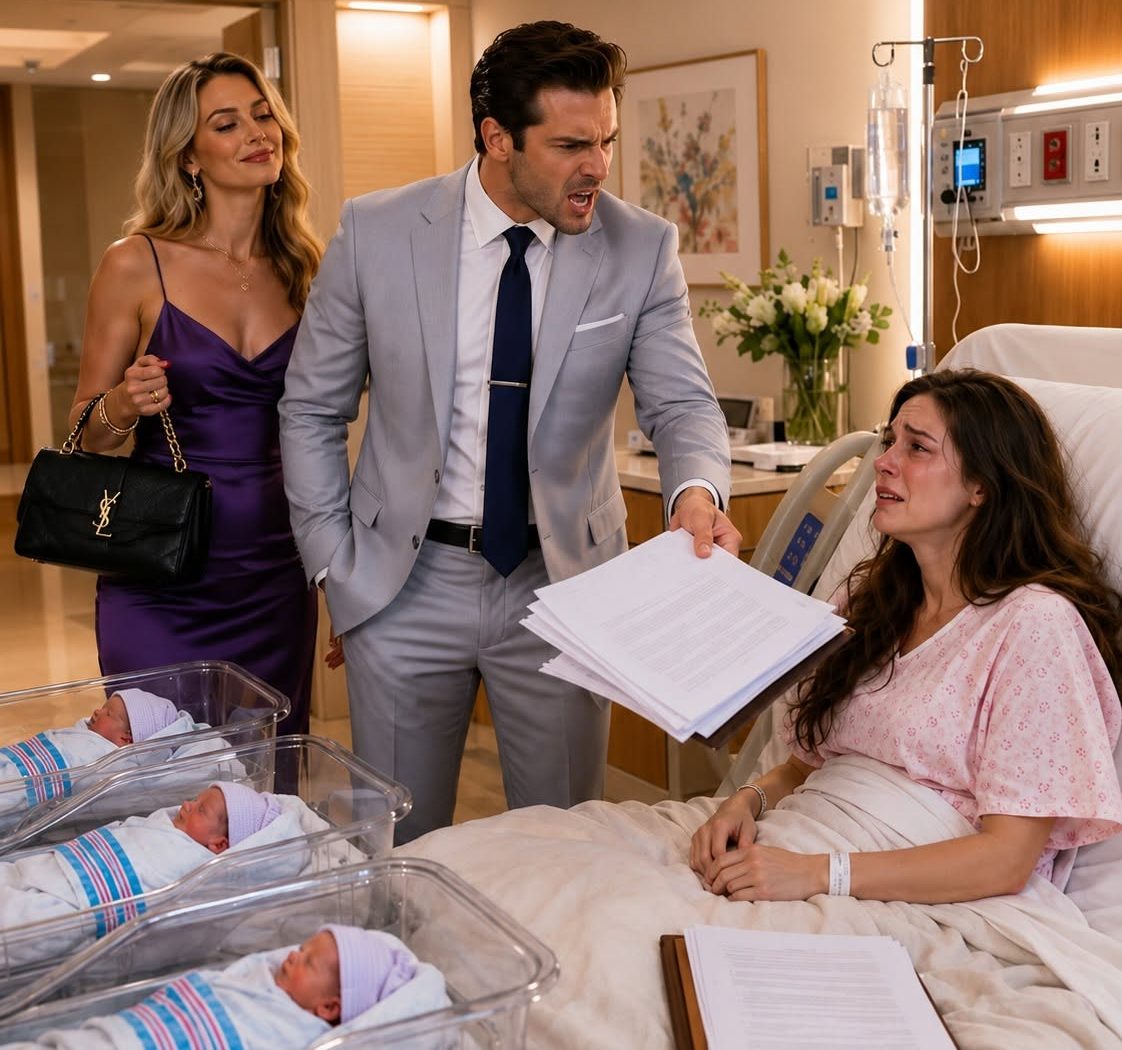
I was still bleeding when my husband walked into my hospital room with another woman on his arm.
She carried a black Birkin bag like a trophy. Her red nails rested against the leather as if my pain were just background scenery, something unfortunate but irrelevant to the life she believed she was already stepping into. Our three newborn sons slept in clear bassinets beside me, wrapped like tiny miracles. I had not slept in thirty-six hours. My body felt split open. My face was swollen. My hair clung damply to my temples.
And there was Adrian Vale, my husband of five years, smiling like he had finally won something.
Beside him, Celeste Monroe tilted her head and looked at me the way rich women look at damage they assume will never touch them.
“Oh,” she said softly. “She looks worse than you said.”
Adrian laughed.
That sound hurt more than the stitches.
I stared at him, waiting for guilt to cross his face. Something. Anything. But he wore only a navy suit, expensive cologne, and the flat confidence of a man who had rehearsed his cruelty until it felt justified.
He dropped a folder onto my hospital blanket.
“Sign the divorce,” he said.
My fingers tightened around the sheet.
“Here?”
“Where else?” His eyes moved over me with open disgust. “You’re too ugly now, Evelyn. You should be thankful I’m making this simple.”
Celeste moved closer, her perfume cutting through the sterile hospital air.
“Adrian wants a fresh start,” she said. “A public one.”
One of my babies whimpered.
“You planned this,” I whispered.
“No,” Adrian said. “I upgraded.”
Celeste smiled and lifted the Birkin slightly. “He has excellent taste.”
A nurse standing at the door froze, clearly shocked by what she was hearing. Adrian noticed and turned on that polished charm he used whenever he wanted strangers to doubt their own instincts.
“Family matter,” he said smoothly.
The nurse hesitated, then stepped back.
I looked down at the folder.
Divorce petition.
Custody proposal.
Property waiver.
A neat little execution in twelve-point font.
“You want me to sign away the house?” I asked.
“Our house,” Adrian corrected. “But not for long.”
That was his first mistake.
He thought pain made me foolish.
I picked up the pen. His smile widened. Celeste’s too.
Then I set it back down.
“No.”
The room changed instantly.
His face hardened. “Don’t be dramatic. You have no job. No money. Three babies. My lawyers will crush you.”
I looked at Celeste, then at the bag, then back at him.
“Is that what your lawyers told you?”
His jaw tightened.
He said nothing after that. Neither did I. I let them leave believing they had frightened me enough to become useful.
The second the door shut, I reached for my phone and called my parents.
My mother answered on the first ring.
I heard my own voice crack as soon as she said hello.
“I chose wrong. You were right about him.”
There was a long silence.
Then my father’s voice came through, steady as stone.
“Are the babies safe?”
“Yes.”
“Good,” he said. “Then cry tonight. Tomorrow, we work.”
Adrian thought I had surrendered.
The hospital discharged me two days later, and I carried my three sons out with more determination than strength. Every step hurt. My incision burned. My arms ached from balancing car seats and paperwork and the weight of not letting myself fall apart yet. Adrian never came back. Not one call. Not even a message asking whether his sons were healthy. Not even curiosity.
When the taxi pulled up to our lakefront home, my heart sank before I even got out.
The locks had been changed.
My fingerprint no longer worked.
A smiling woman opened the door instead.
Celeste stood there in my silk robe, holding the same black Birkin, as if she had always lived in my house and I was the one arriving without permission.
“You’re early,” she said. “Adrian thought you’d cry first.”
I looked past her.
My framed photographs were gone.
Fresh flowers sat in the hallway vase I had bought for our anniversary.
The nursery decorations I had picked out one by one were missing.
Adrian appeared behind her holding a glass of champagne.
“The paperwork has already been filed,” he said. “The house belongs to Celeste now. You should leave before you embarrass yourself.”
My sons started crying all at once.
Neither of them reacted.
That told me everything.
“You stole my home,” I said.
“No,” Adrian replied. “I planned ahead.”
I looked at the deed copy displayed proudly on the entry table. Something about it felt wrong. Too polished. Too fast. Too eager. Like a lie dressed quickly and badly in expensive paper.
But I said nothing.
I turned away, buckled my babies back into the car, and left.
Twenty minutes later, I was on the phone with my parents again.
My mother answered immediately.
“I chose wrong,” I said, the words shaking now. “You were right about him.”
This time my father spoke first.
“Did you sign anything?”
“No.”
“Good.”
His voice stayed perfectly calm.
“Then nothing important has changed.”
I closed my eyes.
“What do you mean?”
There was the sound of papers moving on his end. My father always sounded like that when he was preparing to ruin somebody very politely.
“You forgot one detail,” he said quietly. “That house was never the most valuable thing we put in your name.”
For the first time since giving birth, I smiled.
Not because I felt safe yet.
Because I finally remembered who I came from.
People like Adrian always mistake softness for weakness. My parents had warned me about him from the beginning. Not because they thought he was loud or cruel — men like him rarely begin that way. They thought he was hungry. For image. For access. For shortcuts disguised as charm. But I had insisted he loved me. I had insisted I knew the difference between affection and appetite.
I was wrong.
My father had seen it anyway, and prepared for the day my denial would run out before his caution did.
By sunset, things were already moving.
My mother had arranged a private recovery suite for me and the babies at a medical residence owned through one of her family’s healthcare holdings. My father had called the family office. By nightfall, three lawyers were involved, a forensic property team was reviewing the deed transfer Adrian claimed was valid, and an emergency injunction was being drafted.
At midnight, my mother came to sit beside my bed while the triplets slept in a row of bassinets near the window.
She touched my hair back from my face the way she used to when I was small and feverish.
“I should have pushed harder,” she said quietly.
“No,” I whispered. “I should have listened.”
She shook her head.
“That too.”
There was no judgment in it.
That almost undid me more than if she had shouted.
The next morning, my father arrived in person.
Adrian always hated my father.
Not openly, of course. He was too strategic for that. But he hated the way my father never performed wealth and still somehow filled every room with it. No flashy watches. No loud opinions. Just a man who spoke softly and owned enough of the city to make men like Adrian feel small without understanding why.
He stood at the foot of my bed, looked at his grandsons, then at me, and said only, “He forged confidence into ownership. That was sloppy.”
That was my father’s version of outrage.
Then he handed me a folder.
Inside was everything Adrian had not known.
The lake house had been placed under a layered asset structure two years before the marriage, with beneficial occupancy rights tied to me and any children born of the union, but no transfer rights valid without dual trust verification and biometric witness authentication. In plain English, Adrian’s “new deed” was decorative fiction. Pretty paper. No legal spine.
There was more.
The investment account in my name he had quietly been trying to leverage? Frozen already.
The shell company Celeste had used to receive “gift transfers”? Flagged.
The private lender Adrian used for his side deals? Under review.
And the boutique firm that handled the rushed paperwork on the house? Connected to two prior fraud complaints my father’s legal office had now pulled into one beautiful, devastating bundle.
Adrian thought he had stolen one house.
He had actually walked into a web.
By the second day, the court order was signed.
By the third, my father told me, “You may want to see this.”
He turned his phone toward me.
A video feed.
Front gate camera.
Lake house.
11:07 a.m.
Adrian’s car pulled into the drive first. Celeste’s followed. They both got out looking irritated, probably because whatever cocktail of forged confidence and champagne they had been drinking had finally curdled into panic once they realized the bank transfers were failing and calls were no longer being returned.
Then they saw the driveway.
Two black sedans.
A sheriff’s SUV.
A locksmith van.
And three men carrying their luggage out through the front doors.
Celeste stopped walking.
Adrian kept going until a deputy stepped forward and handed him a folder.
Even through the camera, I could see the exact moment his face changed.
He flipped through pages too fast at first.
Then slower.
Then not at all.
Celeste grabbed at his arm, demanding something. He shook her off. The deputy pointed toward the curb, where their suitcases, garment bags, and boxed belongings had been lined up in precise rows beneath the hedges.
Then the front doors opened wider.
My father stepped out.
Not angry.
Not loud.
Not theatrical.
Just present.
That was enough.
Adrian stared at him the way men stare at earthquakes — with sudden awareness that nothing they built was ever anchored properly to begin with.
Celeste started shouting first. Of course she did. Her gestures got bigger, sharper. She pointed at the house, the sheriff, the movers. She seemed to think volume still counted as leverage.
My father let her finish.
Then he said something the camera did not fully catch.
But I knew his voice.
And I knew the expression on Adrian’s face afterward.
It was the expression of a man discovering too late that he had not outsmarted a wounded woman.
He had insulted an empire.
Later, my father told me exactly what he said.
“You mistook access for ownership. My daughter inherited far more than this house, and you were never one of the assets.”
That line alone was worth the marriage.
By evening, Adrian’s accounts were frozen pending review. Celeste’s family company was under formal investigation after the shell transfers surfaced. The forged deed had been invalidated. And the judge overseeing the emergency family petition had granted temporary sole custody to me until Adrian could explain, under oath, why he tried to remove a postpartum mother and three newborns from a protected residence while presenting fabricated property documents.
He couldn’t.
That was the fun part.
He tried bluster first.
Then indignation.
Then soft language about misunderstandings and stress and emotional timing.
But facts are not easily intimidated.
And neither, it turns out, was I.
A week later, when I was finally strong enough to stand for longer than a few minutes without feeling my body protest, I walked slowly out onto the terrace of the recovery residence with one baby sleeping on my chest and two more in a stroller beside me.
The sunset turned the lake bronze.
My mother stood beside me in silence for a while before asking, “Do you regret calling?”
I looked down at my sons.
“No,” I said. “I regret waiting until he had already shown me everything.”
That was the truth.
Adrian did not destroy me.
He revealed me.
Or maybe he revealed the version of me that would finally stop mistaking endurance for love and cruelty for temporary confusion.
He thought triplets, stitches, exhaustion, and humiliation would make me easy to erase.
Instead, they made me impossible to frighten.
People love to talk about karma like it arrives with thunder.
It doesn’t always.
Sometimes it comes in quiet steps.
A mother answering on the first ring.
A father asking whether you signed anything.
A forged deed meeting real lawyers.
A mistress in your robe learning too late that she never moved into your house at all.
Two days after I came home from the hospital, Adrian thought he had already taken everything.
By the end of that week, he had lost the house, the money, the protection of his lies, and the illusion that I had married him without coming from something far older and far more dangerous than his ambition.
He looked at me in that hospital bed and said no one would want me now.
He was wrong.
My sons already did.
And unlike him, they came into this world with my name, my blood, and no illusions about who was going to protect them.