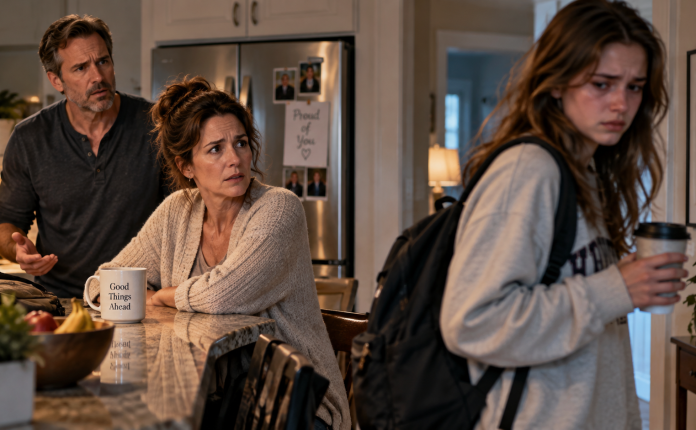
“A cabin suits you perfectly, you stinking woman.”
Skylar tossed the insult across our father’s dining room table with a grin, like humiliation was just one more dish being served after the funeral. The attorney had barely finished reading the will. My younger sister inherited the luxury apartment in Nashville. I got the old family cabin and two hundred acres tucked away in the Ozarks.
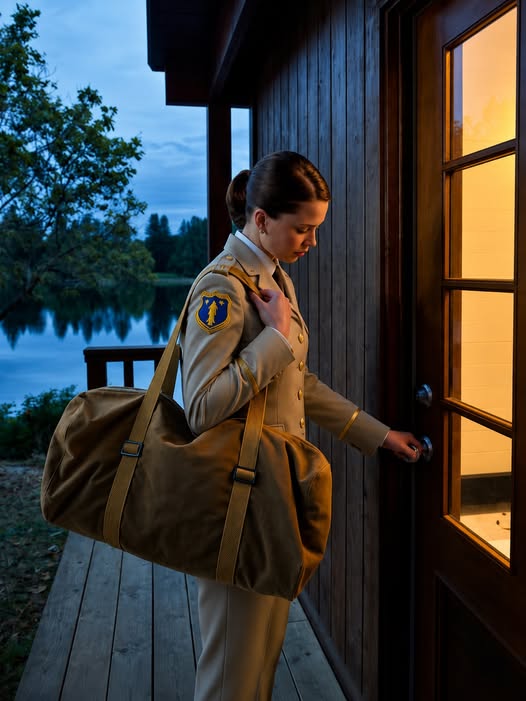
I was still in uniform, having flown straight from Fort Benning without time to change. My boots were dusty. My eyes were dry only because grief had already burned through the tears on the plane.
Skylar folded her arms and raised her voice just enough for the room to hear.
“A rundown cabin for the girl who practically lives out of a duffel bag anyway. Dad really did know what fit each daughter.”
A few relatives suddenly became fascinated by their casseroles. Marcus Finch, my father’s lawyer, kept his eyes on the will as though words on paper could shield him from the ugliness in the room. My mother, Jeanette, only clasped her hands tighter in her lap and said nothing.
That silence hurt more than Skylar’s voice.
When I stood to leave, Skylar followed me into the hallway.
“Oh, don’t act dramatic,” she said. “You were never here anyway. Too busy pretending to be some hero while I stayed behind and handled real life.”
I turned slowly.
“You handled yourself,” I said. “Dad built this family. You just learned how to stand closest to the money.”
Her smile sharpened.
“Well, now I’m standing closest to a multimillion-dollar penthouse, and you’re stuck with a leaking cabin in the woods.”
I walked away before giving her the fight she wanted.
Out on the porch, my mother delivered the excuse I already knew was coming.
“Skylar didn’t mean it. She’s been under stress.”
I looked at her.
“She just inherited a condo worth millions. What exactly is stressing her?”
Mom flinched, but she still didn’t defend me. She just stepped back inside and closed the door.
That was the moment I understood it wasn’t just Skylar.
The whole family had spent years arranging themselves around her comfort.
The next few days proved it. Mom suggested Skylar should probably “manage” the cabin too, since she had better real estate connections. Skylar sent smug little texts asking how life was going in my woodland palace. Even Marcus Finch called once to “clarify” whether I had any immediate plans for the property, which told me Skylar had not wasted a single day trying to turn my inheritance into one more thing she could absorb.
Then Mom called and urged me to spend one night there.
“At least go see what your father left you,” she said quietly.
I almost refused. But something about it pulled at me. Dad had given me that property for a reason.
So I packed a bag and drove north.
The highway narrowed. The towns thinned out. Then even the towns disappeared, replaced by winding roads, trees, and the deep silence that only exists far from traffic, neon, and people capable of hurting you with one sentence and calling it honesty. By the time I reached the Ozarks, my anger had settled into something steadier.
Colder.
The dirt road to the property was narrower than I remembered. My headlights swept over a sagging porch, dark windows, and a roof that looked one bad storm away from collapse. I sat there with the engine off, listening to the dark breathe.
This was the inheritance Skylar laughed at.
I grabbed my bag, climbed the porch, and opened the front door expecting mildew, dust, and abandonment.
Instead, I smelled pine, leather, coffee, and warmth.
A lamp beside the sofa clicked on. The floors were spotless. Firewood was stacked by the stone hearth. The furniture wasn’t fancy, but it was solid and cared for. Fresh blankets were folded on the armchair. The coffee pot was still warm.
I stood there staring.
Someone had been tending this place like a promise.
Then my eyes caught the photograph on the mantel.
My father, barely older than I was now, stood in front of that same cabin beside an elderly woman I had never seen. On the back, in his handwriting, were six words that made my stomach tighten.
With Grandma Adelaide, where everything began.
Adelaide.
My father had always told us there was no one left. No grandparents. No old family history. Just him, then us. But there she was in black and white, staring straight into the camera with the kind of face that suggested nothing got past her.
A knock at the door made me jump.
An older man stood outside holding a casserole dish. His back was straight in that way men keep after the military, even when time has started rounding everything else.
“Hank McCoy,” he said. “Retired Marine Corps. Your father asked me to check on you when the time came.”
He lifted the dish slightly.
“Brought beef stew.”
Hank stepped inside like he had done it a hundred times before. He set the casserole on the counter and looked around the cabin with quiet familiarity.
“Your father hated eating alone,” he said. “After your grandmother passed, this place became the only one where he could still hear himself think.”
I looked around again, noticing what I had missed the first time. The fresh blankets. The dustless shelves. The stocked pantry. Someone had not just kept this place functional. Someone had loved it.
“Your father arranged all this months ago,” Hank said. “He knew one day you’d unlock that door.”
I swallowed.
“He expected me?”
Hank gave me a faint smile.
“He trusted you.”
After dinner, he led me to the fireplace. He reached beneath the lowest shelf and pressed a loose wooden panel. With a soft click, a hidden compartment slid open.
Inside sat an iron key, a leather-bound journal, and an envelope with my name written across it in my father’s unmistakable hand.
My fingers shook as I opened it.
If you are reading this, it means you chose the cabin instead of walking away. That tells me I was right about you.
I had to stop for a second.
Everything your sister believes she inherited is temporary. Everything I truly wanted to preserve begins here.
By then the words had gone blurry.
The letter ended with one instruction.
Trust Hank. Open nothing else until sunrise.
I looked up. Hank’s face was unreadable.
Before I could ask anything, headlights swept across the front windows.
A luxury SUV rolled onto the property.
Skylar got out first, wrapped in an expensive coat, smiling like a woman who had already decided the ending. My mother stepped out behind her. So did Marcus Finch, briefcase in hand.
For the first time all evening, Hank’s calm expression disappeared.
“They came too early,” he muttered.
Marcus pulled a folded document from his briefcase and cleared his throat.
“By court petition filed this afternoon, ownership of this property is temporarily frozen pending review of newly discovered evidence.”
I stared at the paper.
Then at the signature near the bottom.
Adelaide Harper.
The name from the photograph.
My father’s grandmother.
The woman I had supposedly never been told existed.
I looked at Marcus slowly.
“That’s impossible.”
He did not answer immediately, which told me more than a denial would have.
Skylar stepped forward, smiling that bright poisonous smile of hers.
“Looks like your little shack has complications,” she said. “I told Mom there had to be more to the story.”
Hank took one step toward Marcus, his voice low.
“Who told you to file this?”
Marcus straightened. “I’m acting on material discovered in the family archive.”
“Whose archive?” I asked.
My mother’s face changed.
Not guilt.
Panic.
That was the first real crack I had seen in her all week.
Skylar answered for her.
“Dad kept documents from all of us. Naturally, now that he’s gone, things need to be reviewed fairly.”
Fairly.
That word almost made me laugh.
Marcus handed me the order. It wasn’t a full transfer. Just a temporary freeze request based on alleged questions about inheritance legitimacy and prior title chain. Enough to stall. Enough to let Skylar wedge herself into the process. Enough to buy time.
I looked at the signature again.
Adelaide Harper.
Then at the photograph on the mantel.
Then back at Marcus.
“Who found this?”
No one answered.
Hank did.
“Jeanette found it,” he said quietly, looking straight at my mother. “Didn’t you?”
The room went still.
My mother’s lips parted.
“Mom?” I said.
She looked at me, and I saw it then — the fear, yes, but underneath it something older. Shame. The kind people carry for so long it starts wearing other clothes.
“She told your father never to tell the girls,” Mom whispered.
Skylar turned toward her sharply. “What are you talking about?”
But Mom was no longer looking at Skylar. She was looking at the fire, at the photograph, at something decades behind all of us.
“Adelaide Harper wasn’t just his grandmother,” she said. “She owned the mountain. Most of this land. The timber leases. The mineral rights. The cabin was the smallest part.”
My pulse kicked hard.
Hank folded his arms.
“Tell them all of it, Jeanette.”
She closed her eyes.
“Your father wasn’t supposed to inherit through the Nashville line,” she said. “His older brother was. But the older brother gambled everything away, forged documents, and nearly lost the acreage. Adelaide rewrote everything after that. Quietly. She moved the core land, the water rights, and the trust protections under your father’s care because he was the only one she trusted not to sell it for shine.”
Skylar laughed once, too quickly.
“That’s ridiculous.”
“No,” Hank said. “What’s ridiculous is thinking your father would hand the real inheritance to the child most likely to auction it for furniture and followers.”
That hit.
Hard.
Skylar’s face went white.
Marcus looked suddenly less sure of himself, as if the paperwork in his hand had just transformed from strategy into evidence.
I turned toward the mantel, toward the photograph, toward the woman called Adelaide Harper who had apparently been sitting in our family story all along like a sealed room no one wanted opened.
“What is this place?” I asked.
Hank looked at me.
“Not a cabin,” he said. “A key.”
Then he nodded toward the hidden compartment.
“The journal.”
I opened it.
The first pages were my father’s handwriting. Then older entries, tighter, sharper, from Adelaide herself. Land purchases. Lease maps. Timber percentages. Notes on trust boundaries. And beneath all of that, one truth emerging line by line:
The cabin sat at the center of a protected holding structure controlling not just two hundred acres, but access points to a much larger network of family land, conservation easements, underground water rights, and revenue interests nobody in Nashville or Columbus or our own dining room had ever understood.
The “apartment” Skylar inherited?
A gift.
A trinket.
A shiny bone.
This place was the spine.
Skylar must have seen it happen on my face.
Her smile died.
“No,” she said. “No, that can’t be right.”
Hank’s voice was almost gentle.
“Your father gave you the apartment because he knew you’d value what could be shown off. He gave her the cabin because she’d ask why it mattered.”
I think that was the moment my sister understood she had been measured all along and found smaller than she imagined.
She turned on Marcus first.
“You said it was just a temporary hold!”
“It is,” he snapped back, suddenly sweating. “If the title chain is clean—”
“It is clean,” Hank cut in. “And if you filed this off a partial document without disclosing the linked trust structure, you may have just committed something much more expensive than inconvenience.”
Marcus went silent.
My mother sat down heavily in the armchair by the hearth like her knees had stopped belonging to her.
“I told your father not to split it like this,” she whispered. “I told him Skylar would never forgive it.”
I looked at her.
“He wasn’t trying to protect Skylar’s feelings.”
“No,” she said softly. “He was trying to protect what would survive her.”
That landed deepest of all.
Because suddenly I understood my father’s letter.
Everything your sister believes she inherited is temporary. Everything I truly wanted to preserve begins here.
He hadn’t given me less.
He had given me stewardship.
The kind that asks more of a person than taste, noise, or entitlement ever can.
Skylar started shouting after that. About fairness. Manipulation. Old women and dead secrets and how none of this was what she had been promised. But the words had lost their force. They sounded thin in that room, up against timber ledgers, legal maps, trust language, and the steady presence of a man like Hank who had clearly been waiting years for exactly this night.
By then I wasn’t angry anymore.
Just clear.
I folded the freeze order neatly and handed it back to Marcus.
“You should withdraw this before sunrise,” I said. “Because if Hank is right, you didn’t freeze my inheritance.”
I looked around the cabin.
At the hidden compartment.
The journal.
The photograph.
The woman in black-and-white whose name had arrived like a ghost and turned into a foundation.
Then I finished.
“You trespassed into it.”
No one spoke after that.
Outside, the Ozark dark pressed up against the windows, patient and deep. My father had known exactly what he was doing. He left Skylar something loud and visible. He left me something old, layered, and alive — something that had to be entered, understood, protected.
The cabin had never been a consolation prize.
It was the door.
And when I spent that first night beneath its roof listening to the fire settle and the mountains breathe around me, I realized the thing that made me freeze when I first walked in was not fear.
It was recognition.
Some part of me had always belonged there.